K–5 Lesson
Teacher’s Guide
Your Name in Hebrew Letters
An alphabet lesson, right to left · Grades K–5, in two tracks
K–5 Lesson
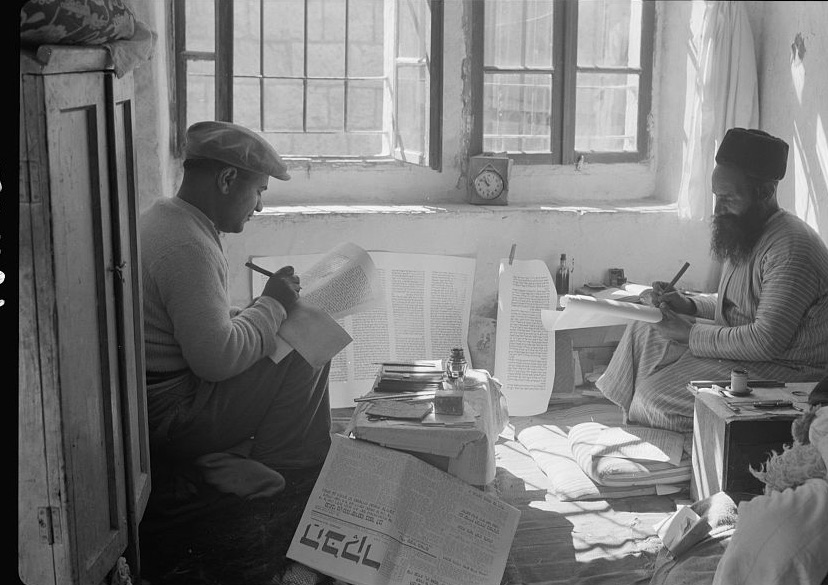
An alphabet is one of the most concrete ways into a culture. A class that has traced a few Chinese characters, or written its names in Arabic script, remembers it. Hebrew has twenty-two letters, runs from right to left, and has been written with the same alphabet for about three thousand years. The scribe in the photograph is writing a scroll by hand with them, the way scribes still do. The same letters are on a street sign in Tel Aviv and on the cover of a picture book. A child who can write her own name in those letters has touched all of that at once. For the students, the lesson is simply: here is an alphabet that goes the other way, and here is your name in it.
The idea a child should leave with: a language a whole people kept for thousands of years, and I can write my name in it.
Students learn that Hebrew is written with twenty-two letters from right to left, that its letters are very old and still in daily use, and that they can write their own name in it. By the end, a K–2 student can trace five letters and find the letters of their name. A 3–5 student can write their full first name, sound out a partner’s, and explain why the vowels are mostly missing.
Project the photograph at the top of this guide, or hold it up.
Take guesses, then the reveal: “Hebrew goes from right to left. Each line starts on the side where our lines end.” Hold up any picture book and open it from the back: “A Hebrew book opens this way too.” Then: “This alphabet is about three thousand years old, and these letter shapes have been used for more than two thousand. Today you are going to write your name with them.”
Hand out The Alef-Bet. Say the first five names together, pointing from the right: alef, bet, gimel, dalet, hey. Children trace each one with a finger first, then with a pencil, starting at the right edge of the row. Kindergarten traces the five. Grades 1 and 2 keep going down the sheet as time allows.
Hand out Your Name in Hebrew Letters. K: before class, or at the table, an adult writes each child’s name in Hebrew letters lightly in pencil in the big box, using the chart, and the child traces it and colors the card. Grades 1–2: children say their name slowly, count the sounds, find each sound in the chart, and write the letters themselves, starting at the arrow on the right. A helper checks the final-form letters. The vowels mostly stay out, “the way a scroll leaves them out.”
Each child cuts or tears off the name card at the bottom of the sheet (K: pre-cut). Tape the cards onto the long strip of paper in a line, the first card at the right end. Then the class reads its own scroll the Hebrew way, right to left, each child saying their name as the teacher’s finger reaches it.
On the board: A language a whole people kept for thousands of years, and I can write my name in it.
The photograph and the right-to-left reveal, as above, then the surprise: “Hebrew letters are also numbers. Alef is 1, bet is 2, gimel is 3, all the way up. Your sheet shows the number under each letter. Find the letter for your age.” (Ten is yud. Eleven is yud followed by alef, written right to left.) Thirty seconds, then hands up.
Hand out The Alef-Bet. Read the twenty-two names across the rows, right to left, the class repeating each. Point out the five letters with a second shape for the end of a word, and the fact that there are no capitals. Children trace the full sheet.
Hand out Your Name in Hebrew Letters. Children say their name slowly, count the sounds, find each sound in the chart, and write the letters in the box starting at the arrow on the right. They use the end form for a final M, N, F, K, or TS sound. Read the honesty line on the sheet aloud: some English sounds have no Hebrew letter, so the chart gives the closest one, and a Hebrew reader could still sound the name out. Then swap papers: each child reads a partner’s name from the Hebrew letters alone, right to left, and the partner says whether it was close.
Children cut off their name cards. Build the scroll on the long strip, first card at the right end, and read it together right to left. Grades 4 and 5: one child reads the whole scroll aloud from the Hebrew letters, then a second child checks.
On the board: A language a whole people kept for thousands of years, and I can write my name in it. If there is a minute left: “What other alphabets do you know that go a different way, or look different from ours?” (Arabic, Chinese characters, Korean, Greek, Cyrillic: any answer is a good one.)