Additionally, each chapter page is available as a PDF.
Every synagogue on earth is built facing the same spot in Jerusalem. At every Jewish wedding, the groom breaks a glass to mourn what once stood there. The building has been gone for nearly two thousand years, and it still organizes Jewish life on every continent.
The First and Second Temples · Unit 1
The Temple is the absent center that organizes Jewish memory. Every synagogue ark in the world faces it. Every Jewish wedding mourns it. The destruction is the famous fact; what was destroyed, where, by whom, and what survives is the story this page tells.
The Makor Project · The First and Second Temples
The Temple of Jerusalem was a specific building, on a specific site, with a recorded history. Two successive Temples stood on the same elevated platform in the heart of what is today the walled Old City of Jerusalem. Both were destroyed by foreign empires: the First by Babylonian forces in 586 BCE, the Second by Roman forces in 70 CE. The site has not held a Jewish Temple for nearly two thousand years. It has held other buildings, which themselves have a history that follows from the Temple's absence.
How we know. The First Temple comes down to us in words: the Hebrew Bible describes the cedar beams, the gold overlay, the exact measurements, and then the burning by Babylon. No stone of the building has ever been identified, because the Temple Mount has never been excavated. The ground nearby still speaks: a layer of burned houses and arrowheads from 586 BCE just downhill, and a soldier’s letters from Lachish, ink on broken pottery, reporting a neighboring town’s fire-signals going dark as the Babylonians advanced. The Second Temple you can touch: its retaining wall still stands, silver coins struck in the revolt against Rome read “Shekel of Israel,” and a carved warning stone from its courtyard sits today in a museum in Istanbul. Which claims rest on text and which on stone is itself part of the record.
Common misconceptions this Chapter addresses
The First and Second Temples in Jerusalem are the documented architectural and ritual center of biblical and Second Temple Judaism. The dedicated Misconceptions entries sort what rests on the written record from what archaeology can and cannot show, and document the broader continuous-presence record that begins (in the dominant misconception) with the 70 CE destruction.
- "There is no archaeological evidence for the First Temple." see the dedicated entry →
- "The Jewish people left the Land of Israel in 70 CE and returned in 1948." see the dedicated entry →
A specific building, on a specific site
The Temple.
The written record places the First Temple’s construction under King Solomon around 957 BCE, on the elevated platform now called the Temple Mount, a roughly 36-acre site in the southeast quadrant of what is today the walled Old City of Jerusalem. It stood for approximately 370 years. In 586 BCE, Nebuchadnezzar II of Babylon besieged Jerusalem, destroyed the Temple, burned the city, and deported much of the population to Babylonia. The exile left a cultural mark that outlived it: Psalm 137, written in its memory, opens "By the rivers of Babylon, there we sat down and wept when we remembered Zion," a line still sung and quoted today.
The Second Temple was constructed on the same site under Cyrus the Great's edict permitting the exiles to return: an altar first, then, after a long stall, the building itself, raised in earnest from 520 BCE and completed around 516 BCE. It stood, modestly at first and then magnificently, for nearly six centuries. In 63 BCE Rome conquered the region and ruled it through client kings. Beginning around 20 BCE, Herod the Great, the king Rome installed over Judea, expanded the platform, a project his heirs carried on until about 64 CE, decades after his death, bringing it itself to roughly its current dimensions, reconstructed the Temple in white limestone, and surrounded the complex with massive retaining walls cut from Jerusalem stone. The result was one of the largest religious complexes in the ancient world.
In 70 CE, after a four-year revolt against Roman rule, Titus's legions besieged Jerusalem, broke through the walls, and destroyed the Second Temple. The plundered Temple treasures, the menorah, the showbread table, the silver trumpets, were carried back to Rome in triumph and are depicted on the Arch of Titus, which still stands today on the Via Sacra. The Object Spotlight that follows examines that relief in detail. The treasures' fate after they reached Rome is unknown.
Object Spotlight
The menorah on the Arch of Titus.
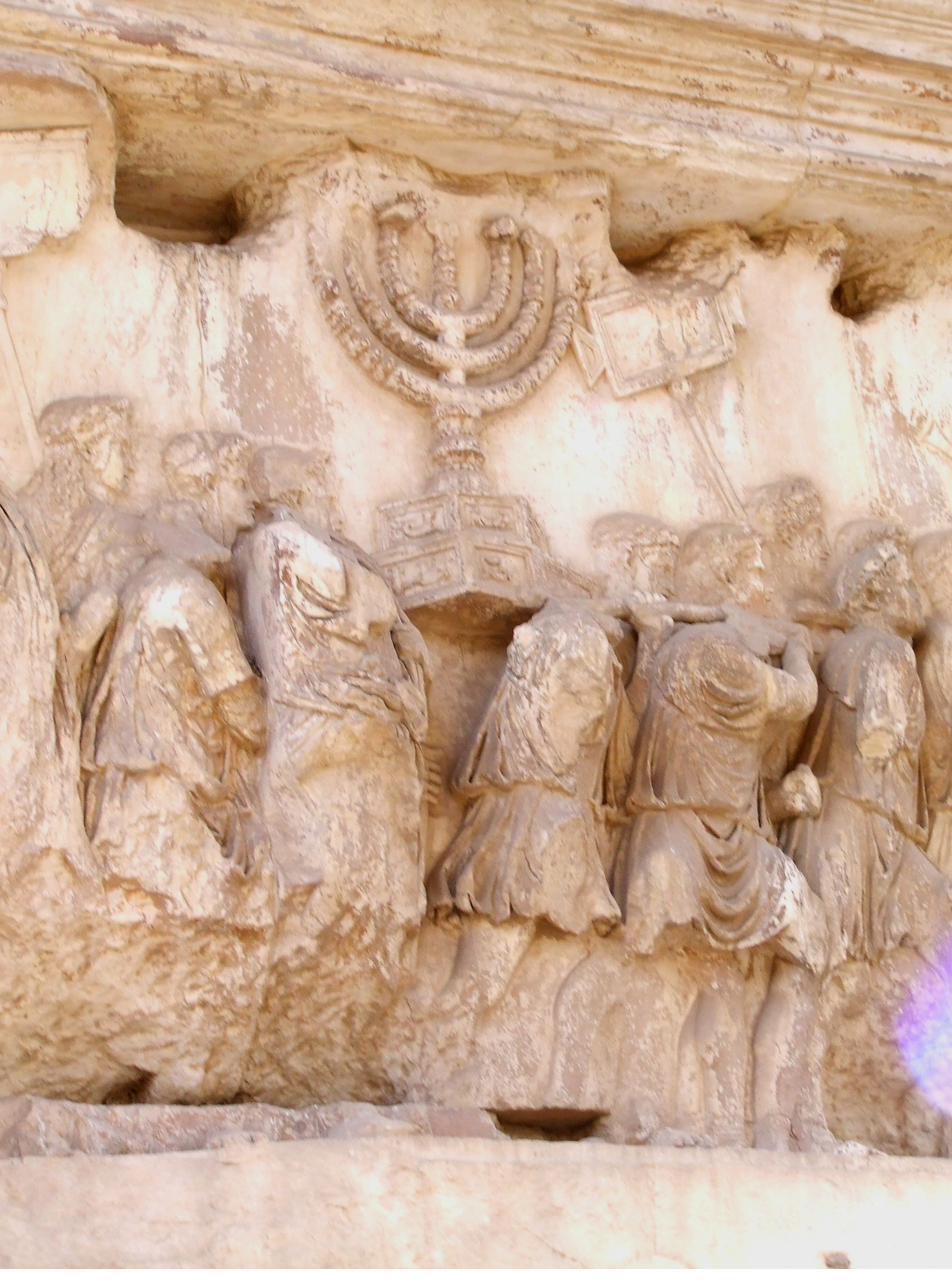
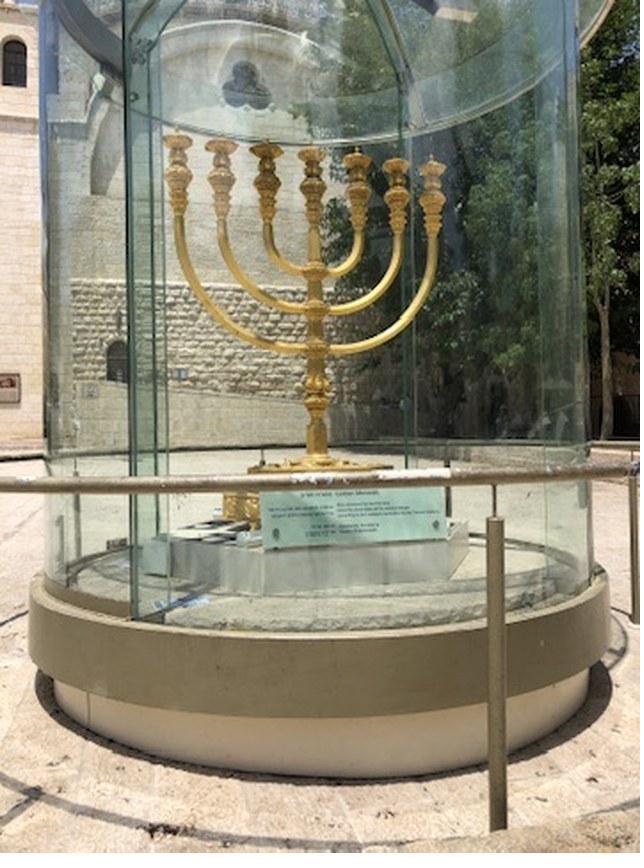
Look at the carving before you place it. A crowd of men strain forward under a heavy load, caught mid-march. Above their shoulders rises a giant lampstand with seven branches, and beside it a table and a pair of long trumpets. The stone is worn smooth and lit gold by the sun. It reads as a parade: people carrying treasure through a street, showing it off.
That is exactly what it is, and here is the gut-punch: it is the enemy's victory photo, in marble. This is a relief (a scene carved into stone so the figures stand out from the background), cut into the inside wall of the Arch of Titus, a giant stone gateway the Romans built in their own capital soon after 70 CE. They built it to celebrate destroying Jerusalem and burning down the Temple. The objects the carved soldiers are hauling are the real treasures looted from inside that Temple: the golden menorah (the seven-branched lamp that stood in the holy place), the table for the sacred bread, and the silver trumpets. Rome was so proud of the conquest it carved the stolen holy objects onto a monument for everyone to walk under.
People argue about whether the Temple really stood where Jews say it did. This relief is a witness from the other side: the people who destroyed it carved a detailed picture of its contents, within living memory of the event, to brag about taking them. You do not have to trust the victims' account. The conquerors left their own. It is the closest we have to a photograph of the objects from the Second Temple, made by the very army that carried them off.
Look closer at the menorah itself. The carving is so detailed that for centuries it has been studied as evidence of what the real Temple menorah looked like. A monument built to say "this people is finished" preserved the single most famous image of that people's sacred lamp.
And the afterlife is the twist the whole Chapter turns on. The Temple was gone, its treasures hauled to Rome and lost to history. But the image on the arch did not die. It became one of the most enduring symbols in Jewish memory, the picture every later menorah is measured against. When the modern State of Israel chose its official emblem in 1949, it chose the menorah from the Arch of Titus, lifting the lamp straight off the Roman victory monument and making it the seal of a Jewish state. An object carved to mark an ending became, nineteen centuries later, the emblem of a beginning. For two thousand years Jews avoided walking under the arch; on November 29, 1947, when the United Nations voted for a Jewish state, Rome’s Jews gathered at the arch and walked through it the other way.
The Western Wall
Not the Temple, but the retaining wall of its platform.
Of the Temple complex itself, nothing remained. Of Herod's massive retaining walls around the platform, sections survive, most prominently a 187-foot exposed segment of the western retaining wall, which has been known for centuries as the Western Wall (Hebrew: HaKotel HaMa'aravi, "the Western Wall"). In English it has also been called the Wailing Wall.
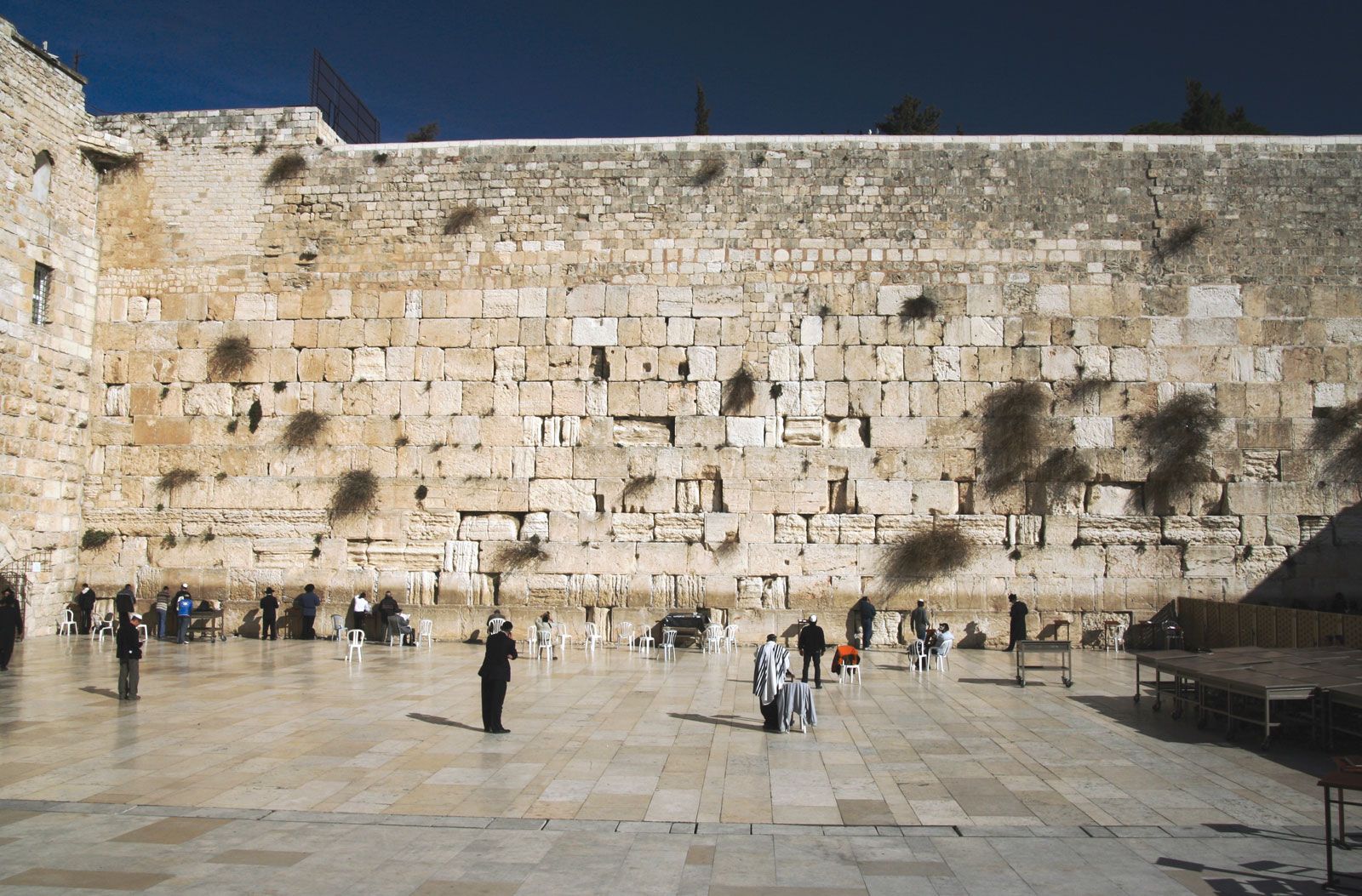
An important distinction, often confused: the Western Wall is not a remnant of the Temple itself. The Temple, the actual sanctuary, was destroyed completely. The Western Wall is a section of the retaining wall that Herod built to hold up the expanded Temple Mount platform. It is the closest surface a Jew can stand against and still be physically adjacent to the location of the destroyed Temple. For nearly two thousand years, that adjacency has made it the most important Jewish prayer site in the world after the Temple Mount itself.
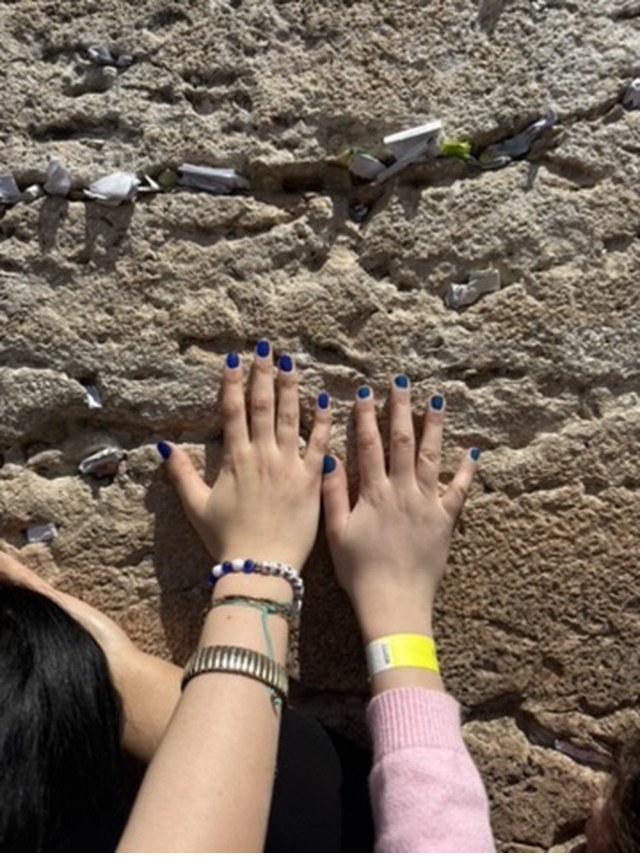
From 1948 to 1967, after Israel’s founding war ended with the Old City in the hands of neighboring Jordan, the Western Wall stood in Jordanian-controlled East Jerusalem, and Jewish access was prohibited, despite the access provision of the 1949 armistice. On June 7, 1967, during the Six-Day War, Israeli forces reached the wall for the first time in nineteen years. Photographs from that morning, paratroopers leaning their helmets against the stone, became some of the most reproduced images in modern Israeli history. The Western Wall plaza was rebuilt and the site became a national pilgrimage destination.
The significance of the site to Jews today
Three concrete continuities.
First, the direction of prayer. From antiquity, and by tradition since the Babylonian exile, Jewish prayer has been oriented toward Jerusalem and specifically toward the Temple Mount. A Jew praying in New York faces east and a Jew praying in Tehran faces west, by conventions that all point the same way: toward Jerusalem. The orientation of every synagogue ark (the cabinet holding the Torah scrolls) in the world is determined by it.
Second, the liturgical calendar. The Jewish year contains numerous fasts and festivals that explicitly commemorate the Temple's destruction. The most central is Tisha B'Av, the ninth day of the Hebrew month of Av, traditionally the date of both Temples' destruction. It is observed by a full 25-hour fast and the reading of the Book of Lamentations. The three weeks leading up to Tisha B'Av are themselves a period of restricted mourning. The destruction is referenced in the standard daily liturgy, in the Grace After Meals, and at every Jewish wedding, where the glass broken underfoot came to be read as mourning for it, even at the moment of greatest joy.
Third, visiting the site. The Temple Mount itself today is administered as an Islamic religious site by the Jordanian Waqf, an Islamic religious trust, and access for non-Muslims is restricted by both Israeli police and traditional Jewish religious authorities. The latter prohibit Jewish entry to most of the platform out of concern for inadvertent passage over the former location of the Holy of Holies, the Temple’s innermost and holiest chamber. The Western Wall plaza below remains continuously accessible. On Jewish holidays the plaza can hold tens of thousands; the Wall itself is open twenty-four hours a day, every day of the year, with no entry fee. It is the most-visited Jewish religious site in the world.
Notes in the Wall. Visitors place folded paper notes containing prayers, personal requests, and the names of people who are ill or in need into the gaps between the ancient stones. The practice is documented at the site as early as the 18th century. People who cannot travel to Jerusalem send their notes by mail, fax, email, and online forms; the rabbi of the Western Wall arranges for the notes to be placed in the Wall on their behalf, free of charge, from anywhere in the world. The notes are periodically removed when the gaps fill up and are buried with religious respect on the Mount of Olives.
The Temple Mount today
What stood where.
An aerial view of the Temple Mount makes the relationship between the destroyed Temple, the still-standing retaining walls, and the present-day architecture concrete. The platform is the same platform Herod built. The perimeter walls are mostly the same walls. The buildings on top changed.
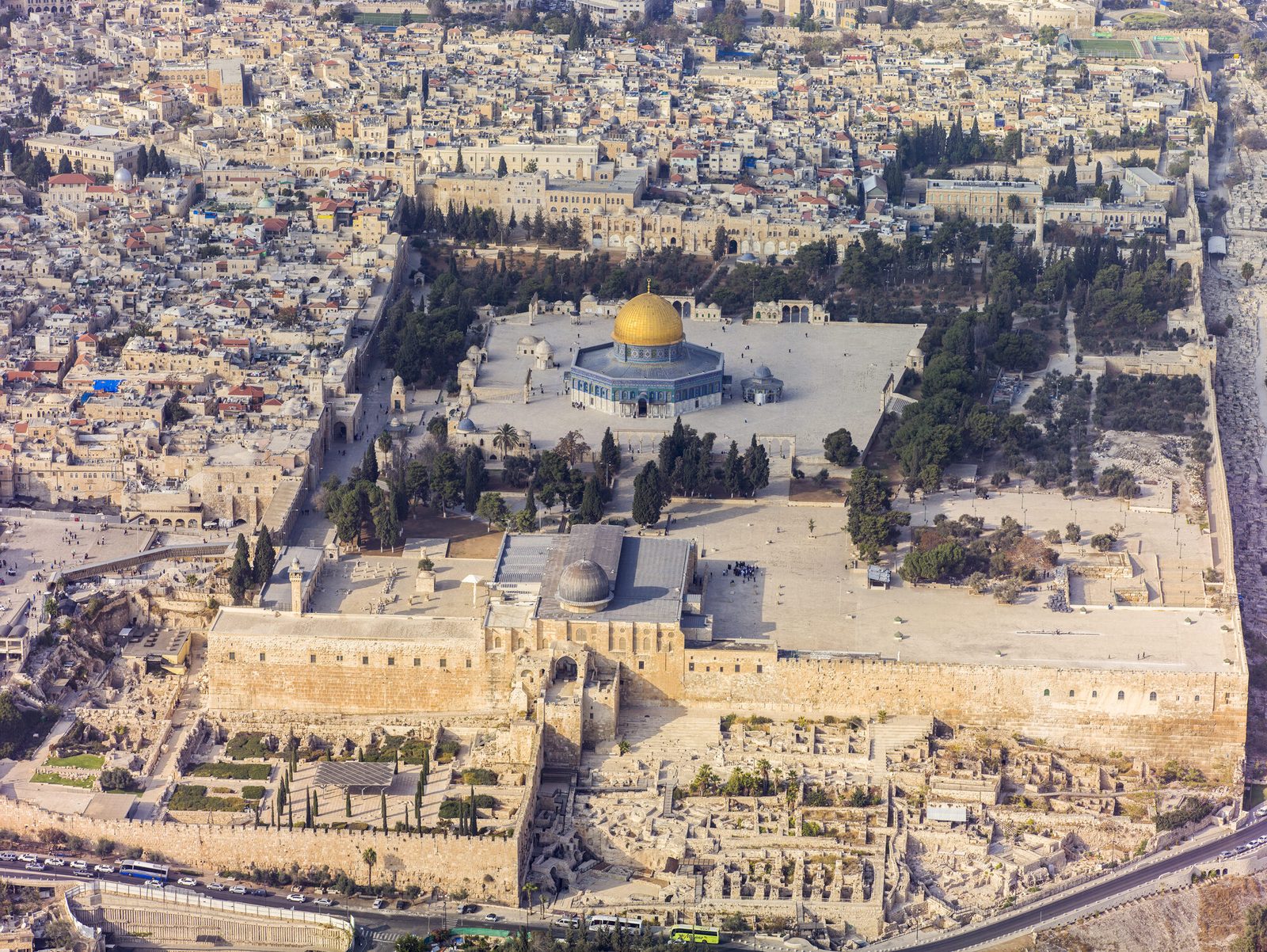
The single most important location on this map
The Holy of Holies (the innermost chamber of the destroyed Jewish Temple, the holiest site in Judaism, the point toward which Jewish prayer is oriented from every continent) stood at the spot now occupied by the Dome of the Rock. The center of the gold dome marks the place, or very nearly; the precise point is debated.
Five landmarks on the platform:
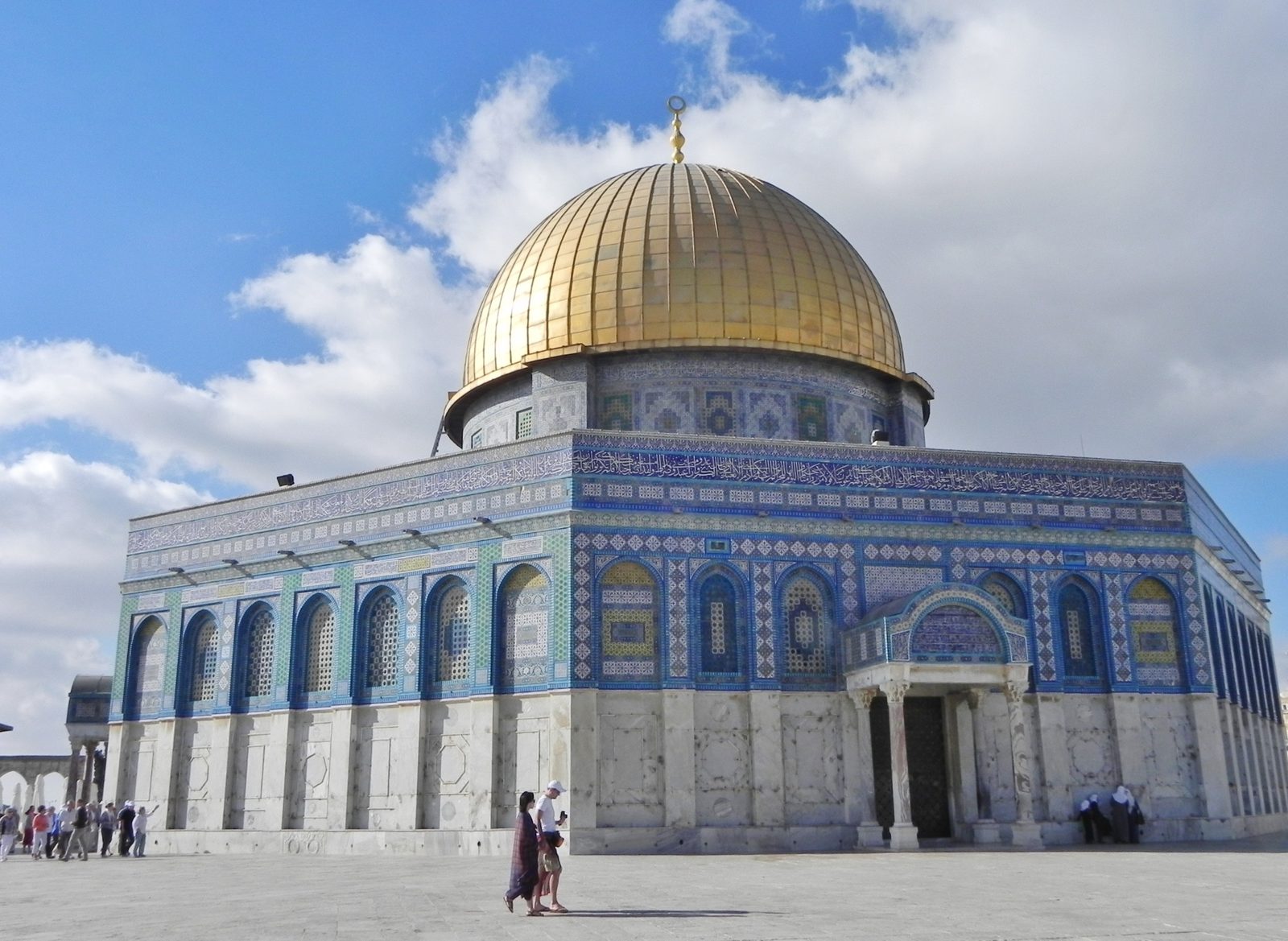
- ★ The Holy of Holies of the Second Temple stood approximately where the Dome of the Rock (the gold-domed octagonal shrine at the platform's center) now stands. The Dome was completed in 691–692 CE under the Umayyad Caliph Abd al-Malik; it is the oldest extant work of Islamic architecture in the world. The exact correspondence between the Dome and the location of the Holy of Holies is debated by archaeologists; the general location is firm.
- Al-Aqsa Mosque: the lead-domed building at the southern end of the platform, near where the Second Temple's Royal Stoa, the great columned hall at the platform's southern end, stood.
- The Western Wall: visible along the lower-left edge of the platform. The 187-foot exposed segment is part of Herod's original retaining wall, c. 20 BCE. Not part of the Temple itself.
- Robinson's Arch: the surviving springer of an arch on the western wall that carried a monumental stairway up from the street below to the Royal Stoa. Excavated and visible in the Jerusalem Archaeological Park today.
- The Mount of Olives: the ridge east of the platform, facing it across the Kidron Valley, holding the great Jewish cemetery and centuries of pilgrimage.
What stood there before
The Second Temple of Herod.
The platform that holds the Dome of the Rock today is the same platform the Second Temple stood on. The clearest way to picture what occupied that space before 70 CE is through reconstructions built from the archaeological record and from the detailed account of the first-century historian Flavius Josephus, who saw the building before it was destroyed.
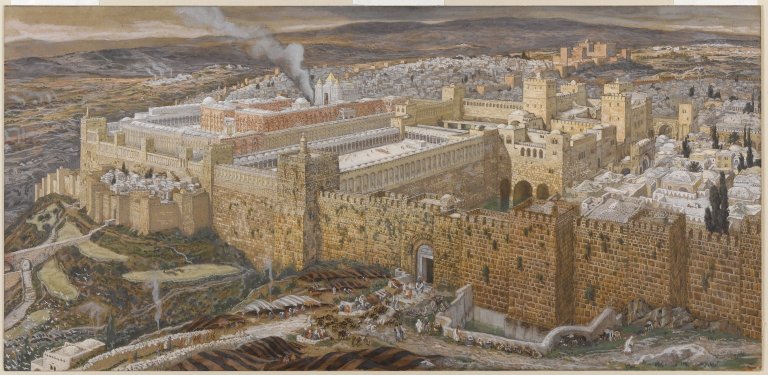
The reconstructed Temple in the banner of this page comes from the Holyland Model of Jerusalem, a 1:50 scale model of the city at the end of the Second Temple period, built in the 1960s and now at the Israel Museum, Jerusalem. The white limestone sanctuary stands at the center of the platform Herod the Great expanded between approximately 20 BCE and 64 CE.
What is there now, and why
The buildings on top changed.
From the Roman destruction of the Temple in 70 CE to the Arab conquest of Jerusalem in 638 CE (five and a half centuries), the Temple Mount platform was left mostly as ruin. Under Hadrian, the Romans, by the account of the historian Cassius Dio, planned a temple to Jupiter on the site around 130 CE, a step Dio counts among the causes of the revolt that followed; where that temple actually stood is debated, since the platform has never been excavated. After their fourth-century Christianization, Christian tradition holds that the Byzantines, the Christian empire that continued Roman rule in the east, left the site desolate as a visible fulfillment of Jesus's prophecy that "not one stone shall be left upon another." Accounts from the Islamic conquest describe the platform as a refuse heap when Caliph Umar arrived in 638 CE.
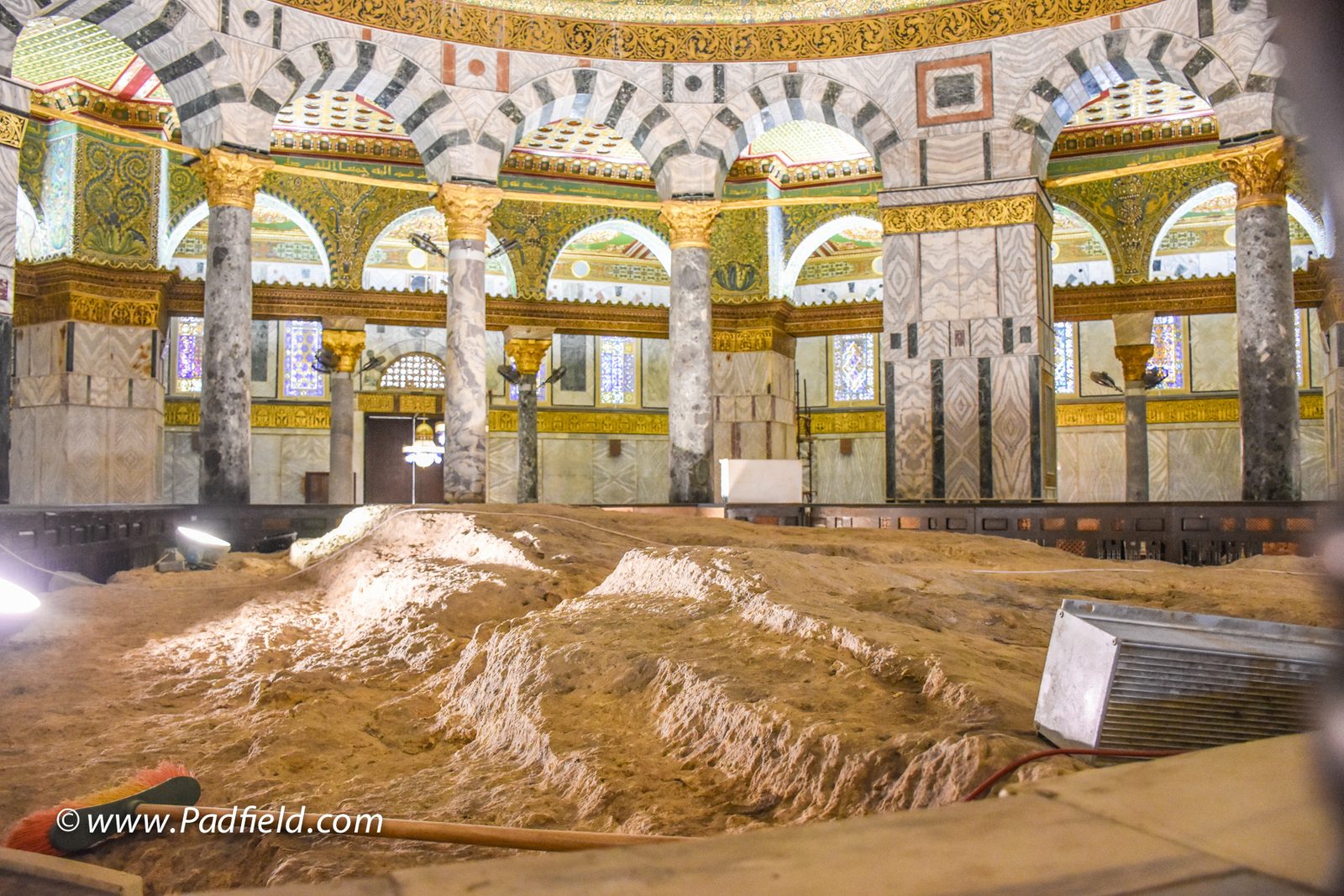
The Dome of the Rock (691 CE). Built under Abd al-Malik, caliph (ruler of the Islamic empire) of the Umayyad dynasty approximately sixty years after the Arab conquest, the Dome is the oldest extant work of Islamic architecture in the world and one of the most architecturally accomplished. Its position is significant. Islamic tradition holds that the rock beneath the dome, the same rock at the platform's center, is the site of Muhammad's Night Journey (Isra and Mi'raj) in 621 CE, when he is said to have ascended through the heavens from this place. Jewish tradition holds the same rock to be the Even ha-Shetiyah, the Foundation Stone, the spiritual center of the universe in rabbinic literature, and the location of the Holy of Holies of the Temple. Both traditions converge on the same stone. The architectural form of the Dome (octagonal plan, gilded dome over a central rotunda) was modeled on the Christian memorial shrine-churches (martyriums) of the era. It is not a mosque; it is a shrine over the rock.
Al-Aqsa Mosque (c. 705 CE). Built under Abd al-Malik's son al-Walid I about fifteen years after the Dome, Al-Aqsa is the working congregational mosque of the Temple Mount complex. The name Al-Aqsa ("the farthest") derives from the Qur'an's reference to the "farthest mosque" Muhammad reached during the Night Journey. Together with Mecca (Masjid al-Haram) and Medina (Masjid al-Nabawi), the Al-Aqsa precinct is one of the three holiest sites in Islam.
The Crusader century (1099–1187). When the First Crusade took Jerusalem in 1099, the Dome of the Rock was converted into a Catholic church (the Templum Domini, "Temple of the Lord"), and Al-Aqsa became the headquarters of the Knights Templar, whose name derives from the building they occupied. The Crusaders added a cross to the Dome and a Christian altar inside. When Saladin retook Jerusalem in 1187, he removed the Christian alterations and restored both buildings to Islamic use. The Mamluk Sultans, the Muslim dynasty ruling from Egypt (1250–1517, masters of this land from 1260) renovated the complex extensively, including most of the surviving fountains and madrasas, religious schools around the platform's edges.
The 1948–1967 prohibition. Between Israel's founding war in 1948 and the Six-Day War in 1967, the entire Old City, including the Temple Mount and the Western Wall, was under Jordanian control. The 1949 armistice agreement provided for Jewish access to the Western Wall; access was never granted. For nineteen years, no Jew prayed at the Western Wall. The Hurva Synagogue in the Jewish Quarter was destroyed. Jewish cemeteries on the Mount of Olives were partially desecrated; their tombstones were used in road construction. Nineteen years passed this way.
1967 to the present. After Israel took the Old City on June 7, 1967, the Israeli government made a controversial decision: it left administration of the Temple Mount platform to the Jordanian-administered Waqf (Islamic religious endowment), rather than placing it under Israeli or Jewish religious authority. The Western Wall plaza was rebuilt as a national gathering place; it is administered by the Israeli government and the Western Wall Heritage Foundation. The Temple Mount platform itself today follows a status-quo arrangement: non-Muslims may visit during restricted hours through the Mughrabi Bridge; non-Muslim prayer on the platform is prohibited; the Waqf manages religious matters. Traditional Jewish religious authorities, across most Orthodox movements, likewise prohibit Jewish visitors from ascending the platform, on different grounds: the concern that an inadvertent visitor might walk over the former site of the Holy of Holies, which only the High Priest was permitted to enter, and only once a year. The two prohibitions, religious and political, produce the same result. The Wall below remains continuously accessible to anyone, every day of the year.
The evidence: why this place, why this rock
Four independent lines of evidence converge.
The construction of the Dome of the Rock in 691–692 CE is one of the best-documented architectural decisions in early Islamic history, because the building itself documents it. Four independent lines of evidence (the inscriptions on the Dome, the geographer al-Muqaddasi's testimony, the architectural plan, and the choice of the rock at the platform's center) converge on the same set of conclusions about why the Umayyad caliph Abd al-Malik built where and what he built.
1. The Dome's own inscriptions. A 240-meter band of Kufic script runs along the top of both sides of the octagonal arcade inside the Dome. The dedicatory text is dated to AH 72, the year 691–692 CE, and named Abd al-Malik as patron, until the Abbasid caliph al-Ma'mun overwrote that name with his own in the early ninth century, leaving the original date in place. The inscriptions on the inner arcade contain some of the earliest dated Quranic verses surviving anywhere in the world. Their content is overwhelmingly Christological. They cite verses asserting that Jesus is a messenger of God and not God's son, that the Trinity is rejected, and that Muhammad is the seal of the prophets. The Israeli historian S.D. Goitein, working at the Hebrew University, established that the inscriptional program is a structured theological polemic against Christianity, built into the building itself, in 691 CE, on the Temple Mount.
The text of the inscriptions is preserved in scholarly publications and partially visible in high-resolution photographs of the interior. Representative passages from the inner-arcade band, drawn from the established scholarly editions (van Berchem, Matériaux pour un Corpus Inscriptionum Arabicarum, 1927; Grabar, The Shape of the Holy, 1996), include the following Qur'anic verses, addressed in part to Christians:
"There is no god but God alone. He has no associate. Muhammad is the Messenger of God."
"O People of the Book, do not exaggerate in your religion, and do not say of God anything but the truth. The Messiah, Jesus, son of Mary, was only a messenger of God, and His word that He cast unto Mary, and a spirit from Him. So believe in God and His messengers, and do not say 'Three.' Cease, it is better for you. God is only one God. Glory be to Him above having a son. To Him belongs whatever is in the heavens and whatever is on earth." (Qur'an 4:171)
"So peace upon him the day he was born, and the day he dies, and the day he is raised alive. That is Jesus, son of Mary, a statement of truth about which they doubt." (Qur'an 19:33–34)
"It is not for God to take a son. Glory be to Him. When He decrees a matter, He only says to it, 'Be,' and it is." (Qur'an 19:35)
These verses, addressed across the upper register of a building on the Temple Mount in the late seventh century, sit within reach of any visitor's eye. They are not incidental decoration. They are the building's primary text, a doctrinal declaration in the most prominent religious-architectural setting the early Islamic state had yet produced, on ground sacred to all three Abrahamic faiths.
2. Al-Muqaddasi's testimony, c. 985 CE. The Jerusalem-born Muslim geographer Shams al-Din al-Muqaddasi, writing about three centuries after construction in his geographical treatise The Best Divisions for Knowledge of the Regions, records a conversation with his uncle on why Abd al-Malik spent so lavishly on the Jerusalem buildings: "He beheld Syria to be a country that had long been occupied by the Christians, and he noted there were beautiful churches still belonging to them, so enchantingly fair, and so renowned for their splendor, as are the Church of the Holy Sepulchre, and the churches of Lydda and Edessa. So he sought to build for the Muslims a mosque that should prevent their regarding these, and that should be unique and a wonder to the world." This is a Muslim primary source, written by a Jerusalem native, explicitly attributing the motivation for the Dome's construction to competition with the Church of the Holy Sepulchre. Al-Muqaddasi reports that seven times the annual tax revenue of Egypt was spent on the Dome and the Aqsa complex.
3. The architectural plan. K.A.C. Creswell, the foundational scholar of early Islamic architecture, demonstrated in his study Origin of the Plan of the Dome of the Rock (1924) that the Dome's interior measurements were taken from the Church of the Holy Sepulchre. The octagonal plan with a central rotunda is a Byzantine Christian martyrium form, foreign to all prior Islamic architecture; the Dome was, in 691, the first major Islamic monument anywhere, and it adopted the architectural vocabulary of the buildings it was designed to surpass. Marble columns inside the Dome were spolia, recycled from earlier Christian and Byzantine structures, with crosses still visible on some.
4. The choice of this rock. The exposed bedrock at the platform's center (visible inside the Dome today, the same rock the building was constructed to enshrine) was not a neutral location. In Jewish tradition it is the Even ha-Shetiyah, the Foundation Stone: the spiritual center of the universe in rabbinic literature, the location of the Holy of Holies in the destroyed Temple, the rock from which Jewish tradition holds the world was created. In Islamic tradition recorded by the time of the Dome's construction, the same rock became identified as the site of Muhammad's Night Journey (Isra and Mi'raj), the place from which he ascended through the heavens. The decision to build the most expensive and architecturally significant Islamic monument of its century directly over this rock was a deliberate religious-political statement, inheriting two older layers of sanctity (Jewish, and the residual Christian sanctity of Jerusalem) and superimposing Islamic significance upon them.
The political context. Abd al-Malik built the Dome in the immediate aftermath of the Second Fitna, the civil war that had divided the early Islamic community for roughly twelve years (680–692 CE). His rival Ibn al-Zubayr had controlled Mecca and Medina during much of that period. The Dome's construction in Jerusalem was completed in 692 CE, the same year Abd al-Malik's forces finally took Mecca. Abbasid historiography, two centuries later, claimed Abd al-Malik intended to substitute Jerusalem for Mecca as the destination of the pilgrimage (hajj); modern scholarship has mostly rejected this claim as later anti-Umayyad polemic, while accepting the inscriptional, architectural, and al-Muqaddasi-attested evidence for the anti-Christian-and-pro-Umayyad reading. Both readings agree on what the Dome is not: it is not an ordinary mosque, and it is not an arbitrary location. It is a theological-political monument, on the most sacred contested ground in the Levant, built to make a permanent visible statement that the Levant had a new ruler with a new religion.
That statement was addressed to the absence this page documents. Thirteen centuries later, the platform holds both records at once, the retaining wall of the Second Temple below and the Dome above, and a student who can read both has understood why this one small hill carries so much of the world’s history.
Key takeaways
- There were two Temples on the same site in Jerusalem: the First (built under Solomon, destroyed by Babylon in 586 BCE) and the Second (rebuilt from 516 BCE, expanded by Herod, destroyed by Rome in 70 CE).
- The Western Wall is not the Temple itself. It is a surviving section of the retaining wall that held up the platform the Second Temple stood on, the closest accessible point to where the Temple sanctuary was.
- The site's location is supported by several independent lines of evidence, including the Arch of Titus relief carved by the Romans who destroyed the Temple, a witness from the conquering side.
- The same place is sacred to more than one faith. The Dome of the Rock and al-Aqsa Mosque stand on the platform today; the site's layered history is stated factually, without adjudicating present-day claims.
- Though the building has been gone for nearly two thousand years, it still orients Jewish life worldwide: synagogues face the site, and its memory recurs in daily practice.
Discussion questions
Working from the evidence.
These questions ask students to work from the evidence on this page and reach their own conclusions. Each is anchored in a specific fact the Chapter documents.
- The page draws a careful distinction between the Western Wall and the Temple itself: the Temple was destroyed completely, and the Wall is a surviving section of the retaining wall Herod built to hold up the platform. Why does that distinction matter, and what does it change about how you understand what people are standing at when they pray there?
- From the Babylonian exile onward, Jewish prayer everywhere has been oriented toward one point in Jerusalem: a synagogue ark in New York faces east, one in Tehran faces west, and both face the same spot. What does it tell you about a community that it keeps a shared physical direction for more than two thousand years after the building at its center is gone?
- The menorah on the Arch of Titus was carved by Rome to mark a victory over Judaea. The same seven-branched form is now the official emblem of the State of Israel. How does one object travel from a conqueror's monument to a national seal, and what does that journey show about memory?
- The Temple Mount is sacred to Jews, Christians, and Muslims, and the buildings on the platform have changed with each regime that controlled Jerusalem. How can the same site hold continuous meaning for one tradition while its structures are repeatedly rebuilt by others?
- Open a standard world-history textbook to its section on the ancient Israelites or the kingdom of Judah, and set it beside this page. Each works from the same kinds of evidence historians use for any ancient structure: a dated building, a named site, surviving stone, a documented practice. What does each source include that the other leaves out, and what would a historian want to add to either one?
Classroom Connections
Where this Chapter fits.
Teaching Connections
The disciplines and courses this Chapter naturally supports, for any educator, anywhere.
- World History & Belief Systems: Solomon’s Temple, the Babylonian destruction, the Persian return, and the Temple Mount as ground sacred to all three Abrahamic faiths.
- Ancient & Classical History: the Herodian Temple and the Roman destruction in 70 CE.
- World Religions: the Temple’s relationship to Christianity and Islam; the Dome of the Rock.
- Art History & Archaeology: the Arch of Titus relief, the Western Wall, and the material record of the site.
- Geography: Jerusalem and the Temple Mount across the regimes that have held it.
- Historical Thinking: weighing a monument made by the enemy, and continuity of meaning at a contested site.
Standards Alignment
- NYS Global History & Geography: 9.2 (Belief Systems) and 9.3 (the classical world).
- Common Core ELA-Literacy: RH.6–8.2 and RH.9–10.2 (central ideas of a primary source): the Dome of the Rock inscription and al-Muqaddasi’s treatise.
- C3 Framework: Dimension 2 (D2.His.2, D2.His.5, D2.His.10, D2.His.14: evaluating sources, continuity and change, and perspectives).
External sources
Sources for further reading.
Primary sources
A primary source is a record from the time. It was made by people who were there. Examples: letters, diaries, photos, decrees, trial records, and newspapers.
- Library of Congress: The G. Eric and Edith Matson Photograph Collection of Palestine 1898–1946, with hundreds of high-resolution photographs of the Temple Mount, the Western Wall, and the Old City of Jerusalem.
- National Library of Israel: Hebrew manuscript collections, biblical commentaries, and the largest collection of Jewish historical documents in the world. Free English-language lesson plans for K–12 educators.
- The Hebrew University Institute of Archaeology: Ongoing excavation reports for sites in the Old City of Jerusalem, including the Jerusalem Archaeological Park (the southern wall excavations at the Temple Mount).
- Israel Antiquities Authority: Official authority over archaeological excavation in Israel. Manages the Magdala Stone, the Soreg inscription (Temple warning stone), and other primary material relating to the Second Temple.
- Flavius Josephus. The Jewish War and Jewish Antiquities, 1st century CE. The principal literary witness to the Second Temple and its destruction.
- The Temple Warning Inscription (the Soreg inscription), Second Temple period. Istanbul Archaeology Museums.
- The Hebrew Bible. 1 Kings 6–8 (Solomon's Temple); 2 Kings 25 (Babylonian destruction); 2 Chronicles 36; Ezra 1–6 (return and rebuilding); Psalm 137. Primary source.
- The Dome of the Rock dedicatory inscriptions, AH 72 (691–692 CE). Primary source.
- al-Muqaddasi, Shams al-Din. Aḥsan al-Taqāsīm fī Maʿrifat al-Aqālīm (The Best Divisions for Knowledge of the Regions), c. 985 CE. Translated edition by Basil Anthony Collins, Garnet Publishing, 1994. Primary source.
- Creswell, K.A.C. Origin of the Plan of the Dome of the Rock. London: British School of Archaeology in Jerusalem, 1924.
- Kessler, Christel. "'Abd al-Malik's Inscription in the Dome of the Rock: A Reconsideration." Journal of the Royal Asiatic Society, 1970.
- Goitein, S.D. "The Sanctity of Jerusalem and Palestine in Early Islam." In Studies in Islamic History and Institutions. Leiden: Brill, 1968.
- Grabar, Oleg. The Shape of the Holy: Early Islamic Jerusalem. Princeton: Princeton University Press, 1996.
Secondary sources
A secondary source was written later. It is a book or article by a historian who studied those records and explains what they mean.
- The Israel Museum, Jerusalem: The Holyland Model of Jerusalem (the 1:50 scale reconstruction of the city at the end of the Second Temple period) and the Bird's Head Haggadah. The largest collection of Judaica and Holy Land archaeology in the world.
- Brooklyn Museum: James Tissot's The Life of Our Lord Jesus Christ series, including the watercolor reconstruction of Jerusalem and the Temple of Herod (accession 00.159.6), accessible online with open-access digital images.
- Levine, Lee I. Jerusalem: Portrait of the City in the Second Temple Period (538 BCE to 70 CE). Philadelphia: Jewish Publication Society, 2002.
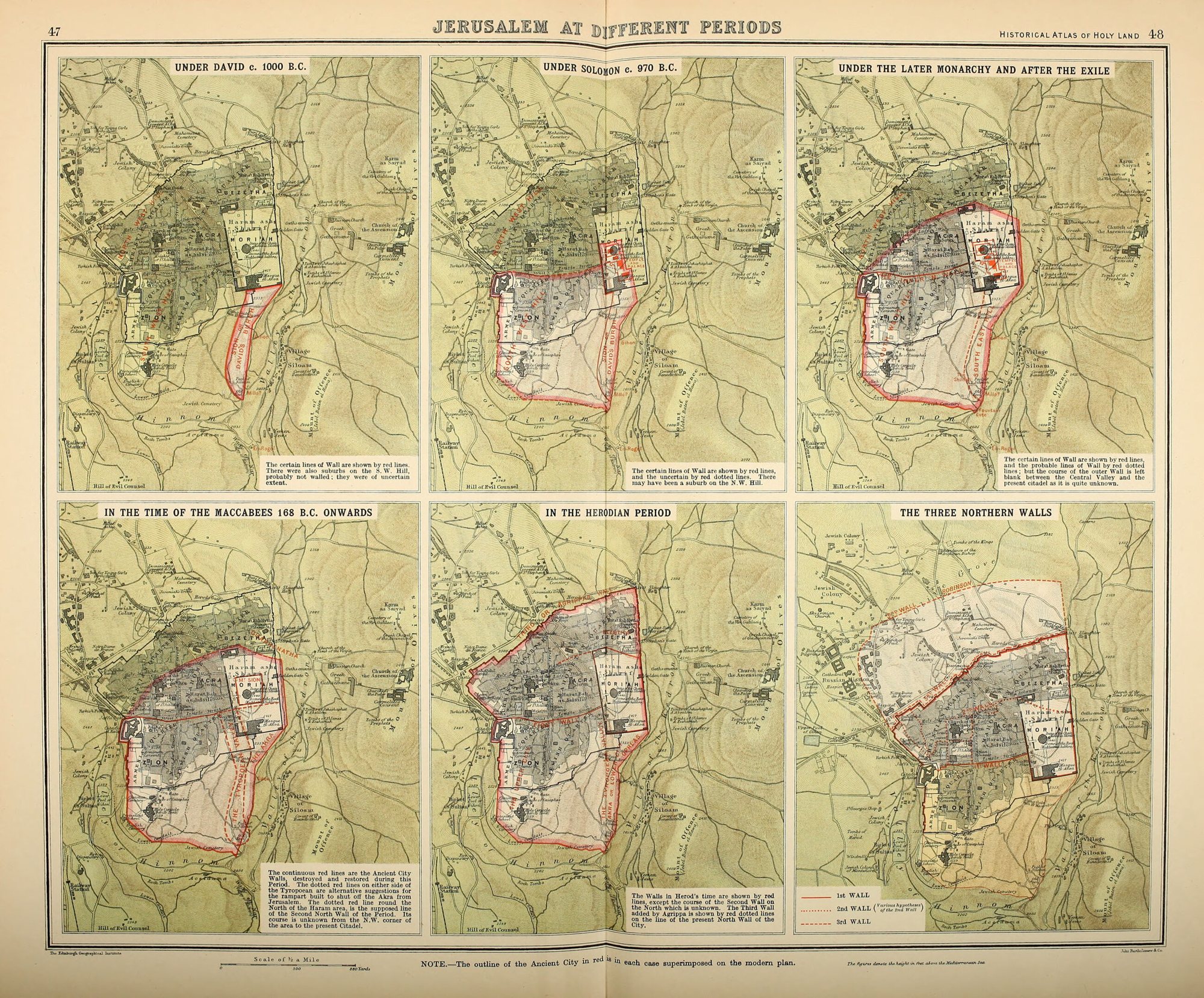
- George Adam Smith, Atlas of the Historical Geography of the Holy Land (London: Hodder & Stoughton, 1915), cartography by J. G. Bartholomew. Public domain. The two Jerusalem plans in this Chapter are from plates 47–48; the whole atlas is on the Internet Archive.
Finding these documents: many primary sources are free online. Good places to start are the Fordham Internet Jewish History Sourcebook, Yale’s Avalon Project (law and diplomacy), German History in Documents, the collections of the US Holocaust Memorial Museum and Yad Vashem, the National Library of Israel, and Sefaria (for Jewish texts). Search the document’s name and date.
This Chapter establishes the historical and geographic foundation that the rest of Unit 1 builds on. The Synagogue begins where this one ends, with how Jewish religious life continued after the Temple's destruction, and the Chapters that follow, on the sacred texts, the calendar, ritual objects, and the life cycle, trace the practices that organized Jewish life across the diaspora in the two thousand years since. Without the Temple, none of these later developments has its anchor.
The synagogue, the portable institution that carried Jewish communal life after the Temple's destruction: its origins, its art from Dura-Europos to the Galilean mosaics, its interior elements, and its architecture across two thousand years of dispersion.
Comments?
Write to editor@makorproject.org.
Last updated: August 2026.