The Makor Project
The Museum

The objects behind the history.

Manuscripts, coins, and material evidence across the centuries, and a separate gallery on how words and images have been used to make prejudice look normal.
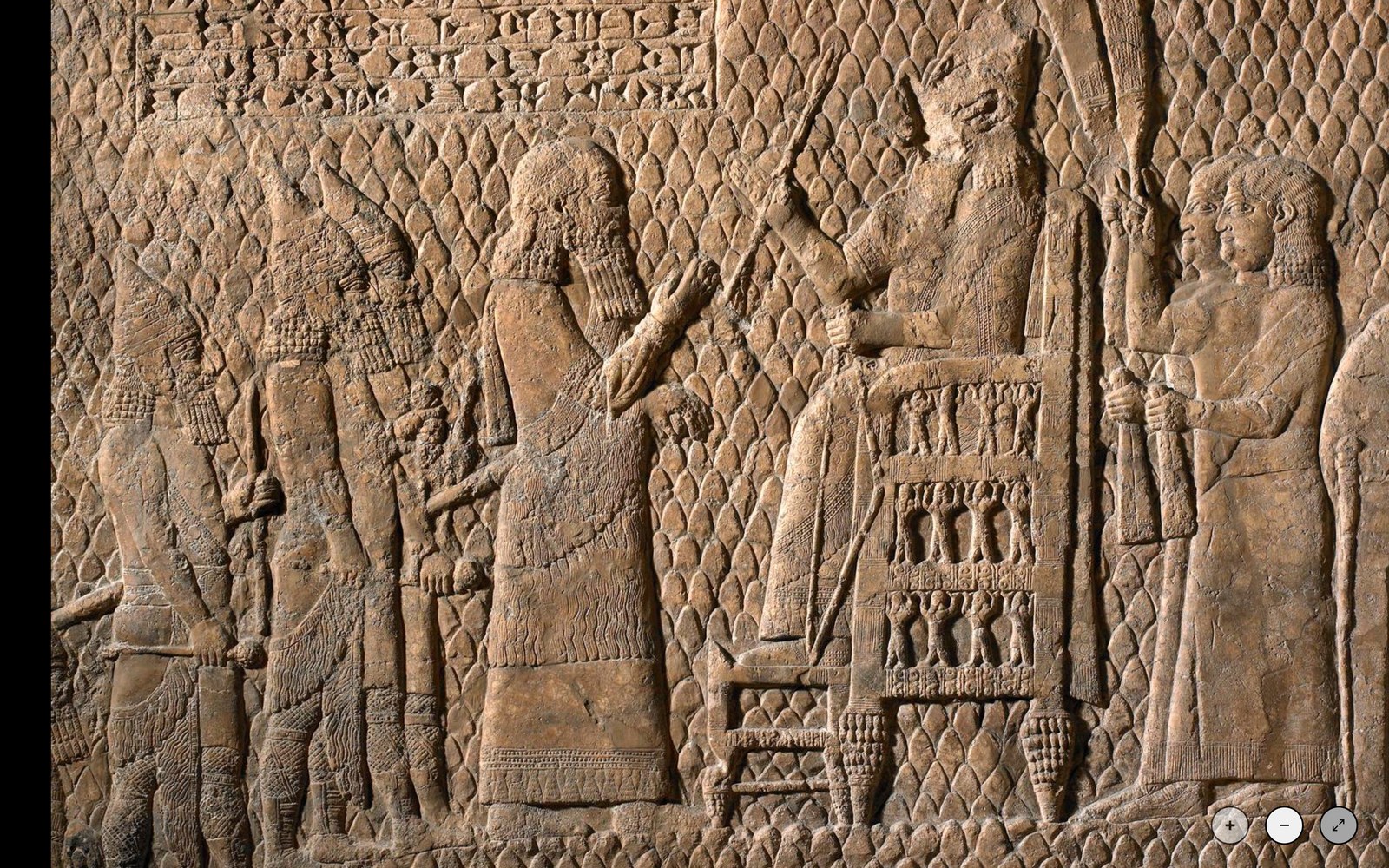
Banner: The Siege of Lachish, gypsum wall panel from Nineveh, c. 700–681 BCE · The British Museum, London · public domain

Objects preserve history differently than texts. A coin, a manuscript, an inscription, a synagogue wall, a household vessel, a fragment lifted from the ground, each holds something a written account can miss: who made it, what it was for, how ordinary people actually lived, what was kept and what was destroyed. A text records what someone chose to set down; an object often preserves what no one thought to write. So the question to carry through this gallery is a simple one: what does each piece let us know that a textbook alone could not? Read the objects below as evidence to look at, not illustrations to look past.

The Holocaust itself is taught, and taught well, by the institutions built for it, the United States Holocaust Memorial Museum and Yad Vashem chief among them. This collection points to their archives throughout. What it gathers here is the rest of the story: the long Jewish civilization that came before, and the world that continued after. The objects run from the ancient Near East to the present, with one gallery on how words and images were used to make prejudice look normal, the mechanism, not only its worst hour.

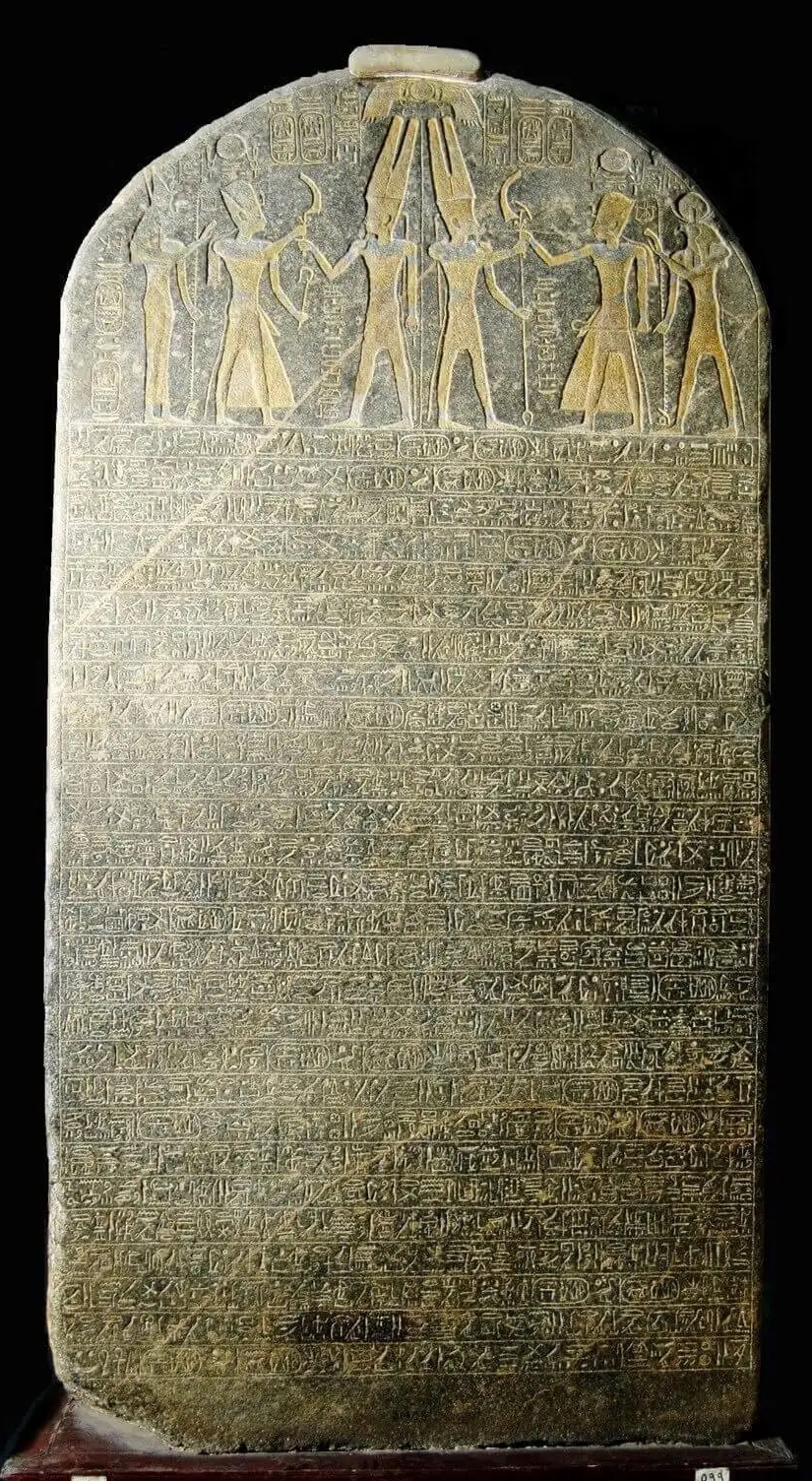
A tall dark-granite Egyptian victory stele, its rounded top carved with a pharaoh facing a god, and dense rows of hieroglyphs below.
Antiquity

Granite stele · c. 1207 BCE · Egypt

The Merneptah Stele

Three meters of granite carved for the pharaoh Merneptah around 1208 BCE to boast of his victories. In line 27, among the peoples he claims to have crushed, one name appears: Israel. It is the earliest mention of Israel found anywhere outside the Bible, and it survives because an enemy carved it, in stone, to brag.

Egyptian Museum, Cairo (JE 31408) · sculpture public domain by age · Full story in The Land of Israel ↗

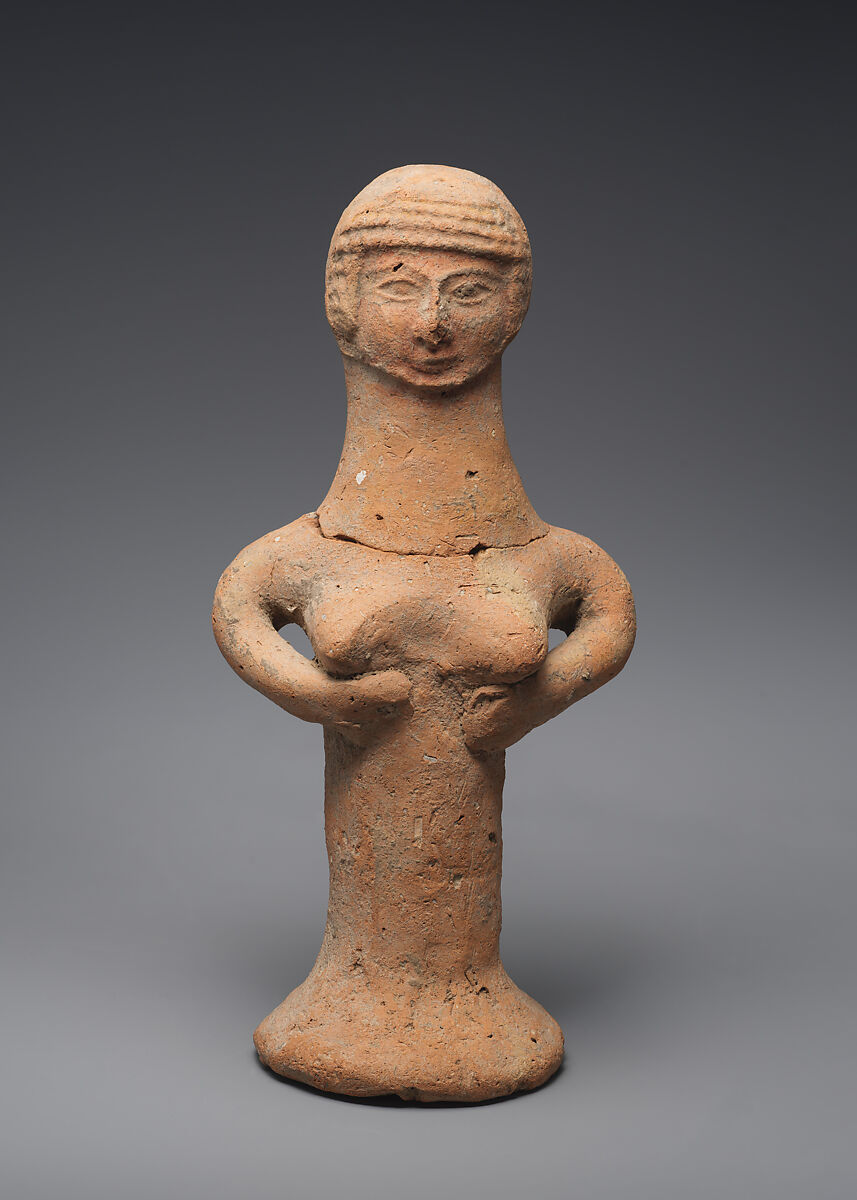
A small terracotta figurine of a woman: a mold-made head with banded curls, arms curving beneath full breasts, and a solid pillar body widening to a flat base.
Antiquity

Terracotta · 8th–7th century BCE · Judah

A Judahite Pillar Figurine

Made in the Kingdom of Judah during the First Temple period, found by the hundreds in ordinary homes. It is exactly the kind of object the Hebrew Bible condemns. The prophets thundered against household images and fertility cults, and ordinary people made and kept them anyway. The monotheism we now take for granted was not a settled fact in ancient Judah but an argument still being fought, house by house.

The Metropolitan Museum of Art, New York · Gift of Harris D. and H. Dunscombe Colt, 1934 · public domain (CC0). Met collection ↗

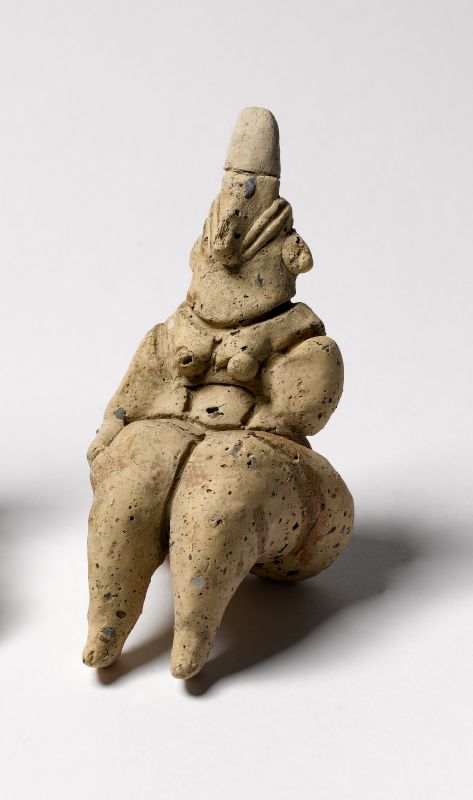
A small clay figurine of a seated figure with a pointed head, slit 'coffee-bean' eyes, and broad hips, modeled in pale fired clay.
Antiquity

Fired clay · c. 6400–5800 BCE · Sha'ar HaGolan, Israel

A Yarmukian Figurine

The oldest object in the museum, made some 8,000 years ago, five millennia before the next-oldest object here. It belongs to the Yarmukian culture, the Neolithic farmers of Sha'ar HaGolan in the Jordan Valley, among the first anywhere in the land to make pottery. People were shaping clay into figures by this riverbank thousands of years before the first city, the first king, or the first scroll.

The figure is read as a goddess. Among these early farming communities, some of the first images that may show gods took the form of clay figures of a female body. Her eyes, shaped like grains of cereal or date pits, are read as signs of fertility; the faint traces of red pigment that still survive, as earth and life. Her tall headgear is the kind of status marker that later Near Eastern art would give to rulers and gods.

Goddess figurine, Sha'ar HaGolan, Israel · Pottery Neolithic period, Yarmukian culture, c. 8,000 years BP · clay · Israel Antiquities Authority (IAA 2002-1187) · object public domain by age. Israel Museum record ↗

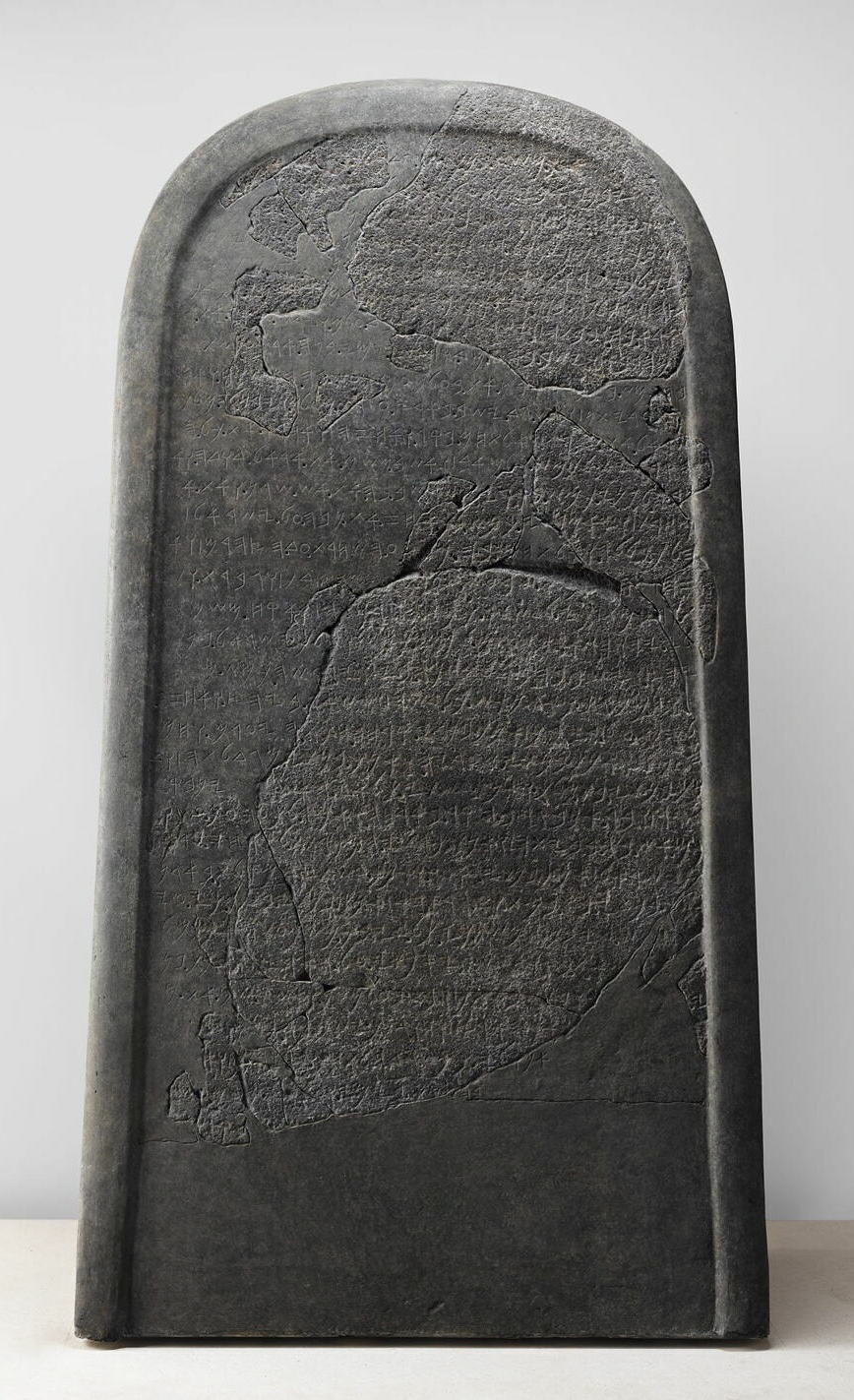
A tall dark basalt stele with a rounded top, its surface heavily cracked and patched, covered with rows of an early Semitic alphabet.
Antiquity

Basalt stele · c. 840 BCE · Moab

The Mesha Stele

Carved for Mesha, king of Moab (a kingdom east of the Dead Sea, in what is now Jordan), to boast that his god had helped him throw off the rule of Israel. It names the kingdom of Israel and its king Omri; a damaged line has been read by some scholars as "House of David," a reconstruction still debated. It is one of the longest inscriptions of its kind ever found, and like the Merneptah Stele, it records Israel because a rival wanted to brag about beating it.

Musée du Louvre, Paris (AO 5066) · basalt, c. 840 BCE · stele public domain by age. Louvre collection ↗

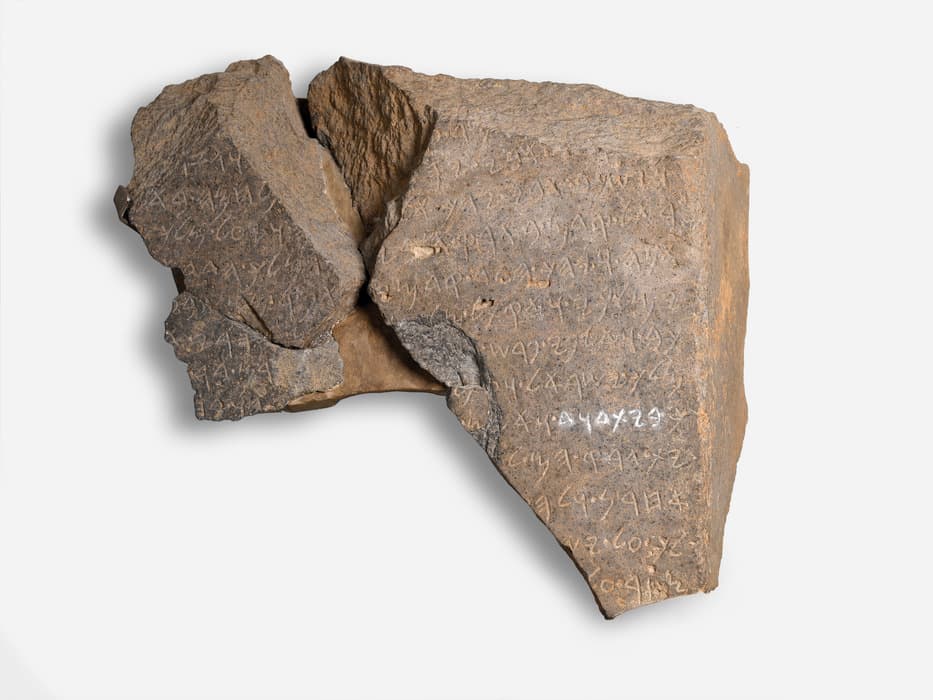
Several joined fragments of a dark basalt slab, the broken surface incised with rows of an early alphabetic script, one line highlighted in white.
Antiquity

Basalt stele · 9th century BCE · Tel Dan, Israel

The Tel Dan Stele

Found smashed and reused in a wall at Tel Dan in northern Israel. Carved not by an Israelite but by an enemy: an Aramean king from what is now Syria, boasting that he had killed kings of Israel and Judah. In the broken lines is one phrase: "House of David." It is among the earliest mentions of David's dynasty found outside the Bible, written by someone with no reason to invent it.

The Israel Museum, Jerusalem · basalt victory stele, made in Aram (Syria), 9th century BCE · public domain by age. Israel Museum record ↗

A carved stone palace relief: a bearded king seated on a high ornate throne receives bowing figures and prisoners, with dense cuneiform above.
Antiquity

Gypsum wall relief · c. 700–681 BCE · Nineveh

The Lachish Relief

This stone panel once lined an entire room in the palace of the Assyrian king Sennacherib at Nineveh, in what is now Iraq. It shows his siege of Lachish, a fortified city of Judah, in 701 BCE, the same campaign the Bible describes from Judah's side (2 Kings 18). Here the king sits enthroned as the spoils and captives of a Judahite city are paraded before him. It is the enemy's own picture of a moment in Judah's history.

The British Museum, London · gypsum wall panel from Nineveh, c. 700–681 BCE · public domain by age. British Museum record ↗

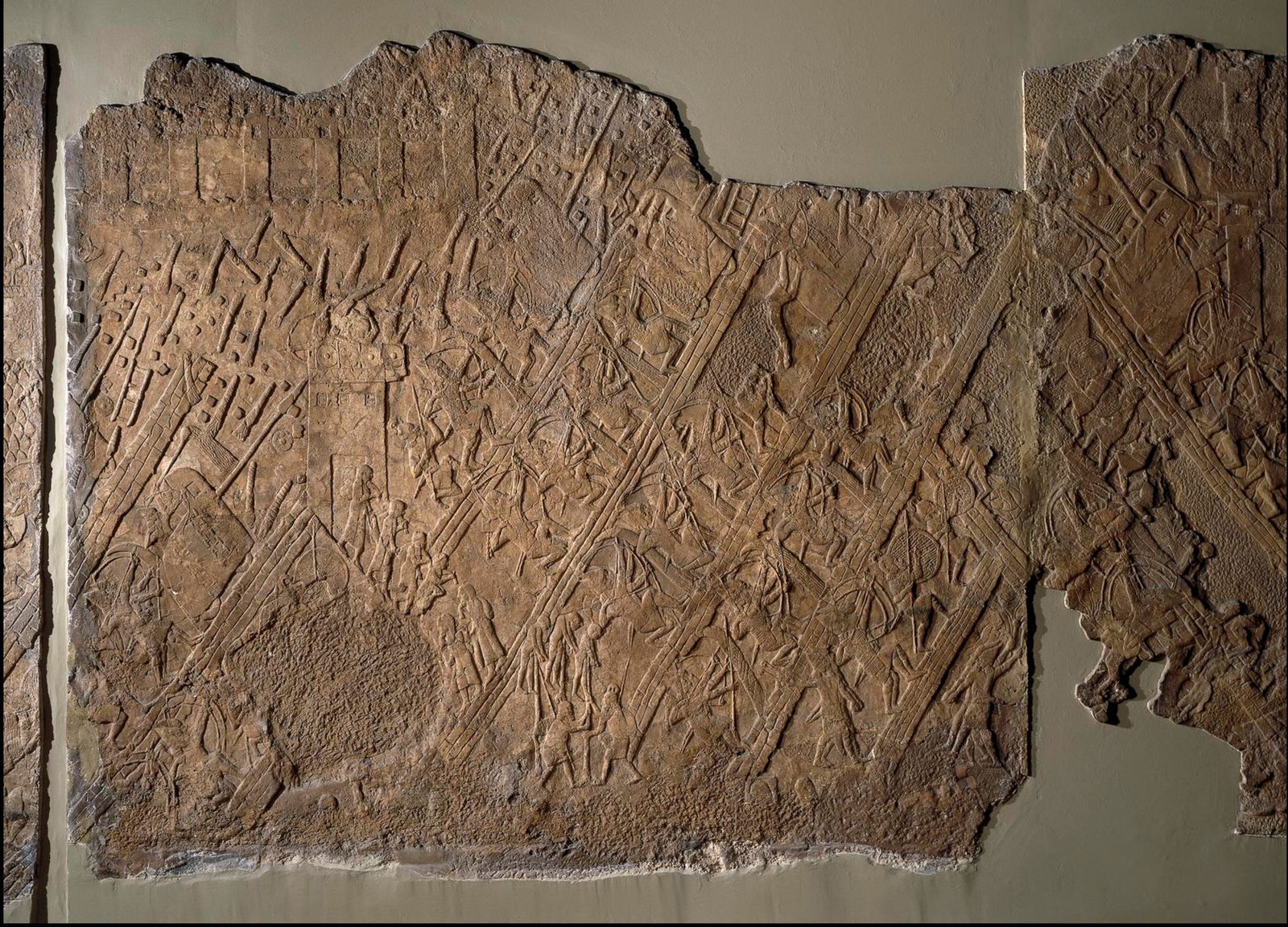
A long carved stone relief showing an Assyrian assault on a walled city: soldiers climb siege ramps, archers fire, and battering rams roll against the towers.
Antiquity

Gypsum wall relief · c. 700–681 BCE · Nineveh

The Siege of Lachish

The assault itself, from the same palace series: Assyrian soldiers drive battering rams up earthen ramps while archers cover them and the defenders of the Judahite city fight from the walls. It is the most detailed surviving picture of ancient siege warfare, and the army it shows is the one Sennacherib turned next toward Jerusalem in 701 BCE. Its full story is told in The Land of Israel.

The British Museum, London · gypsum wall panel from Nineveh, c. 700–681 BCE · public domain by age. British Museum record ↗

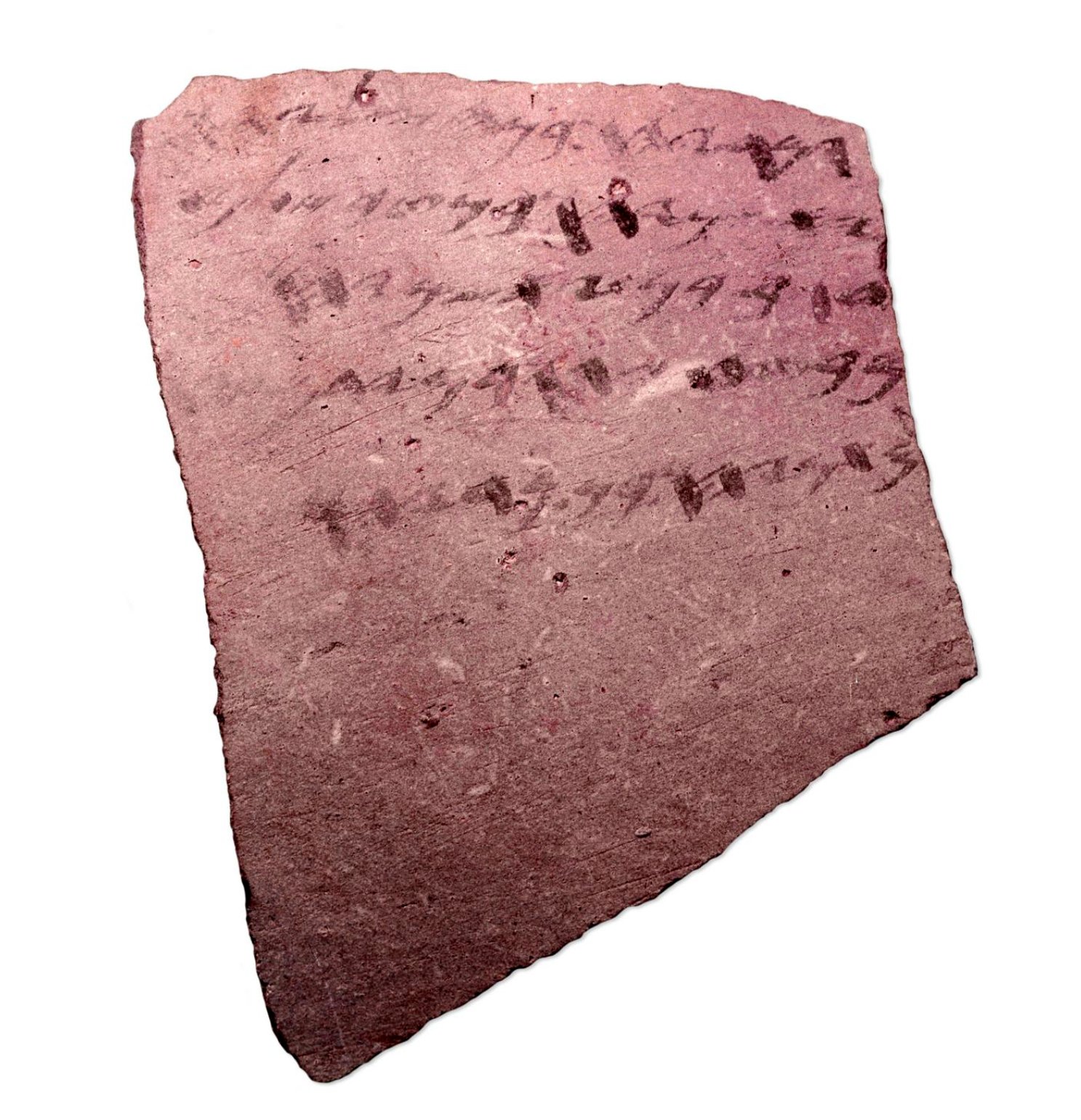
A reddish broken potsherd with several lines of faded dark-ink writing in an early Hebrew alphabet across its upper half.
Antiquity

Inked potsherd · c. 590 BCE · Lachish, Judah

A Lachish Letter

A potsherd used as scrap paper, the cheap writing surface of the ancient world, carrying a letter written in ink in the Hebrew of the Kingdom of Judah. The Lachish letters were written in the last days before the Babylonian army destroyed Judah around 586 BCE. This is not an enemy's record but Judah's own voice, ordinary military correspondence in the actual hand and language of First Temple Judah, at the edge of catastrophe.

The British Museum, London · inked clay ostracon, Lachish, c. 590 BCE · public domain by age. British Museum record ↗

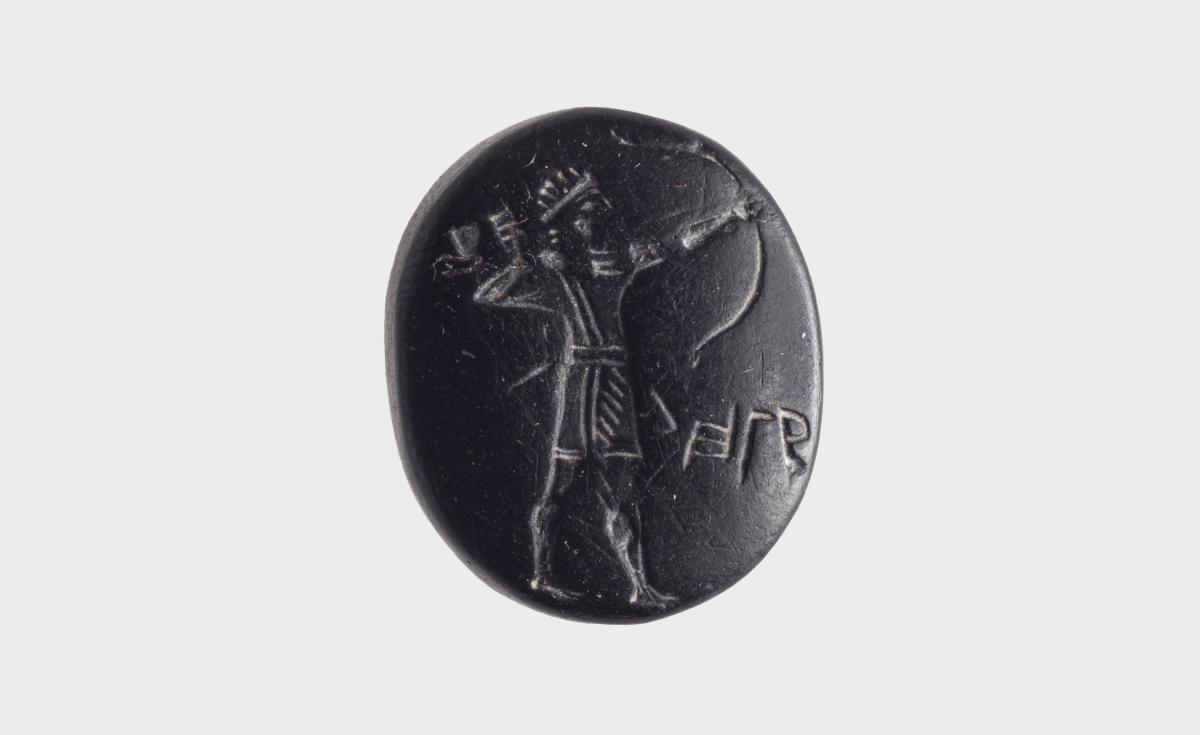
A small oval black stone seal engraved with a standing archer drawing a bow, with a short line of early Hebrew letters beside him.
Antiquity

Engraved stone seal · First Temple period · Judah

The Seal of Hagab

A personal seal, the size of a fingertip, cut from black stone with the figure of an archer drawing his bow and a name in old Hebrew letters: Hagab. The archer suggests a military man; the seal states only his name. Seals like this were pressed into wet clay to mark ownership and authority. It is a single named person reaching out of the First Temple period, not a king or a prophet but an officer, signing his name.

The Israel Museum, Jerusalem · engraved stone seal, Judah · public domain by age. Israel Museum record ↗

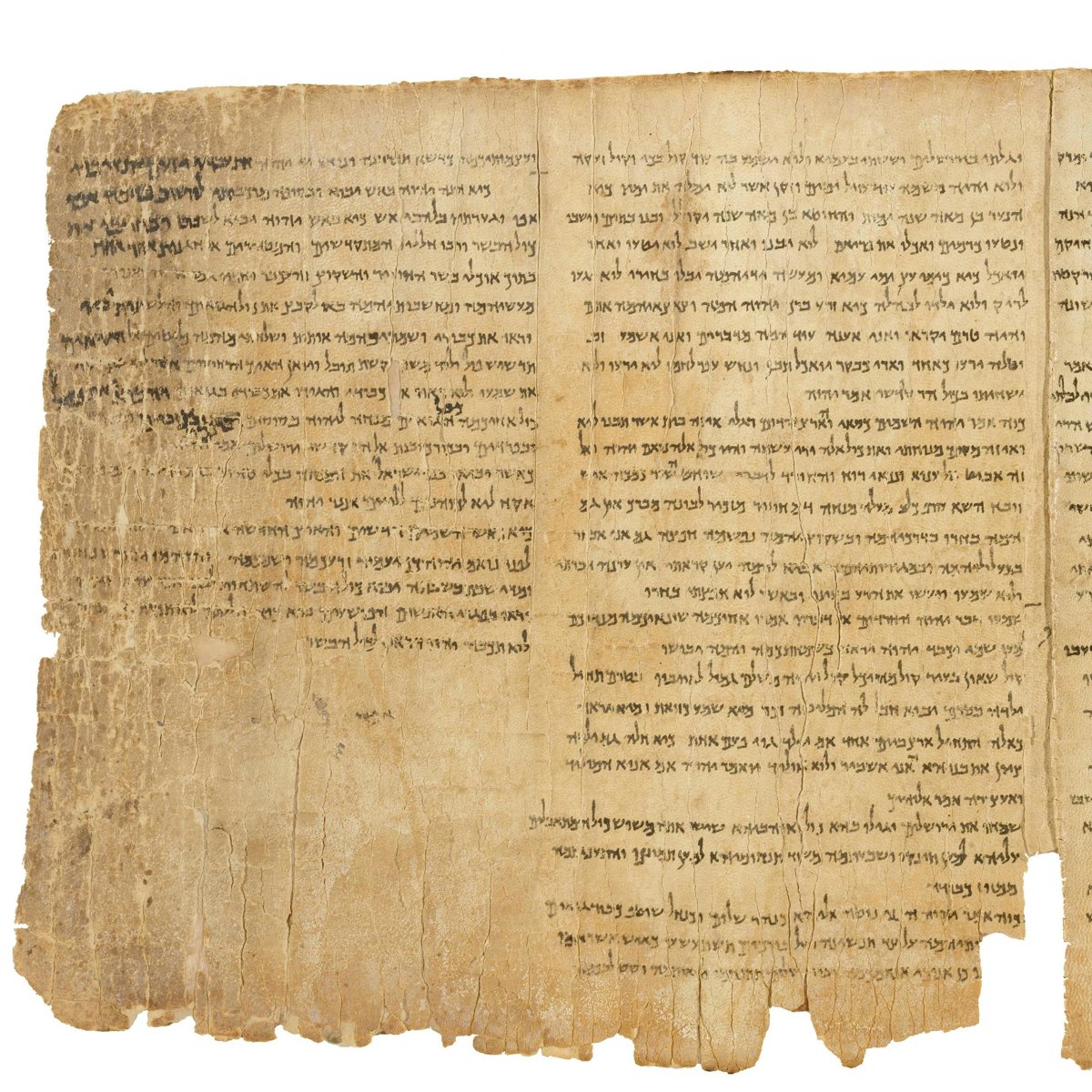
A long section of the Great Isaiah Scroll, columns of ancient Hebrew text on aged parchment
Antiquity

Manuscript · c. 250 BCE – 70 CE

Dead Sea Scrolls

Roughly 25,000 fragments preserved in eleven Qumran caves above the Dead Sea, discovered between 1947 and 1956. The Hebrew Bible texts among them, including a complete Isaiah scroll, predate the next-oldest Hebrew Bible manuscripts by about a thousand years. They show how closely the text was preserved across the gap from the Second Temple period to the medieval codices.

Image: Great Isaiah Scroll, The Israel Museum, Jerusalem (public domain) · Museum record ↗ · Digital Dead Sea Scrolls ↗

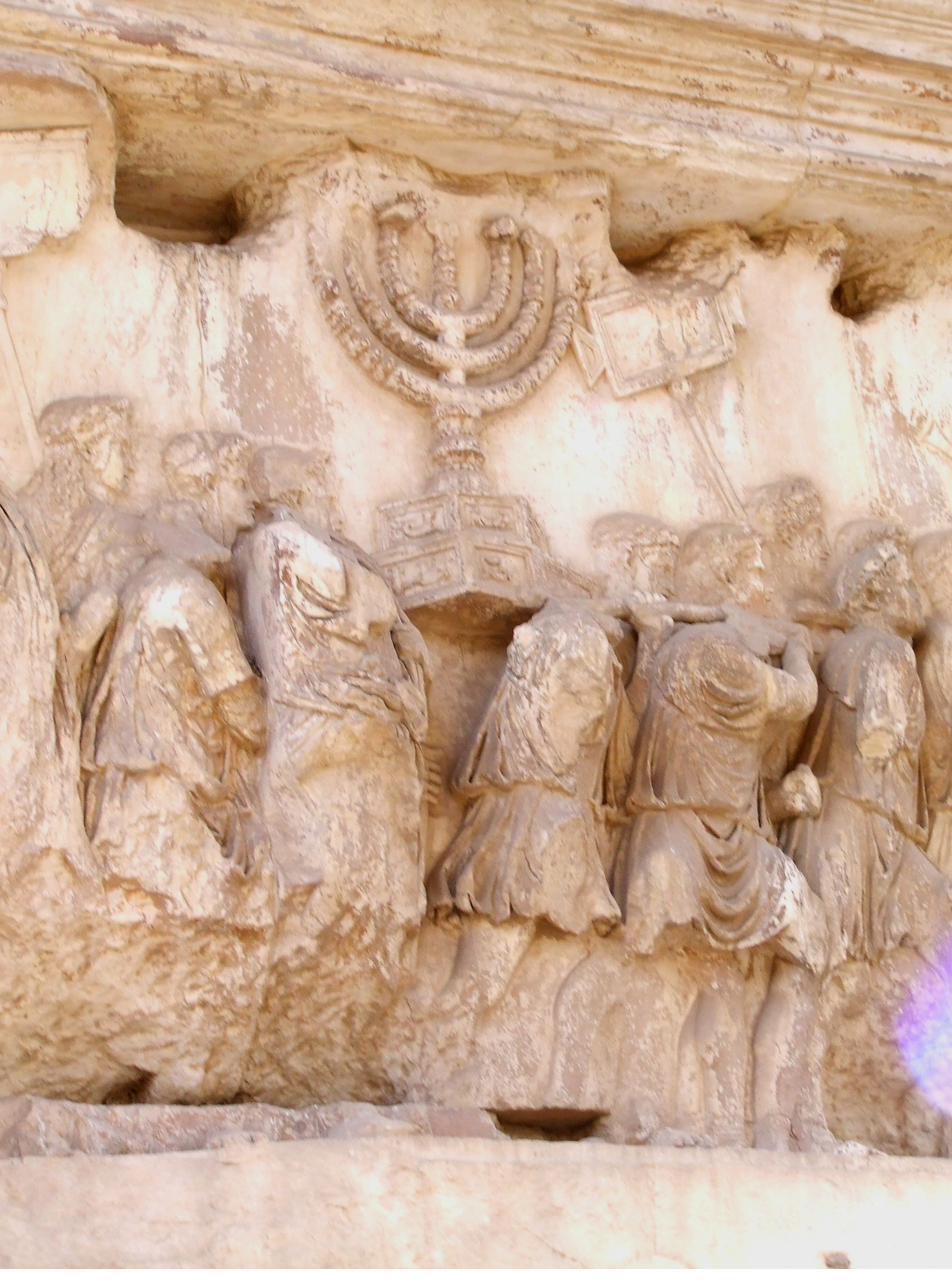
A Roman relief on the Arch of Titus showing soldiers carrying the seven-branched Temple Menorah and other spoils from Jerusalem
Antiquity

Stone relief · 81 CE

The Arch of Titus

Carved in Rome around 81 CE, this relief on the Arch of Titus shows Roman soldiers carrying the spoils of the Second Temple in the triumphal procession after the destruction of Jerusalem in 70 CE. The seven-branched Menorah is at the center, with the Table of the Shewbread and silver trumpets. It is among the earliest surviving depictions of the Temple Menorah, and the monument by which Rome recorded its conquest of Judea. The arch still stands at the entrance to the Roman Forum.

Arch of Titus, Roman Forum · photograph: Media Center for Art History, Columbia University · documented by the Arch of Titus Project, Yeshiva University ↗

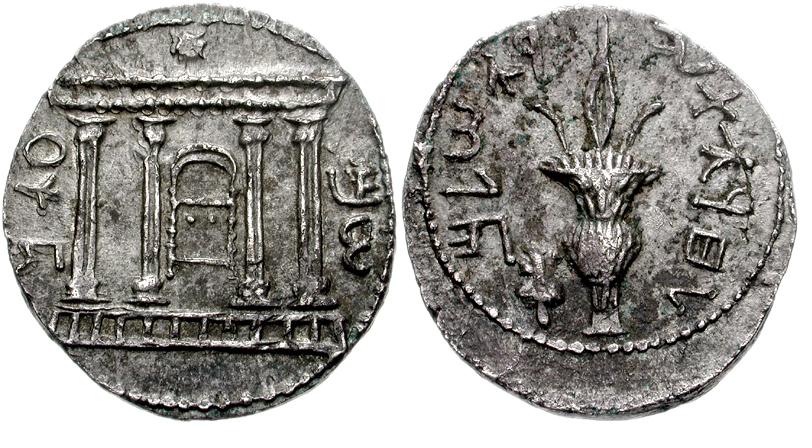
Bar Kokhba silver tetradrachm showing the Jerusalem Temple facade
Antiquity

Coin · 132–135 CE

Bar Kokhba Silver Tetradrachm

Struck during the Second Jewish Revolt against Rome, this silver coin shows the Temple of Jerusalem on one face, and the four species used at the festival of Sukkot on the reverse. The Temple had been destroyed by the Romans sixty years earlier, in 70 CE. The inscription reads "Year Two of the Freedom of Israel." Most surviving examples were minted on Roman coins, the imperial portraits hammered away beneath.

Harvard Art Museums · View the coin ↗ · More coins of the revolt ↗ · Ashmolean Museum, Oxford ↗ · Lecture: David Hendin, American Numismatic Society ↗

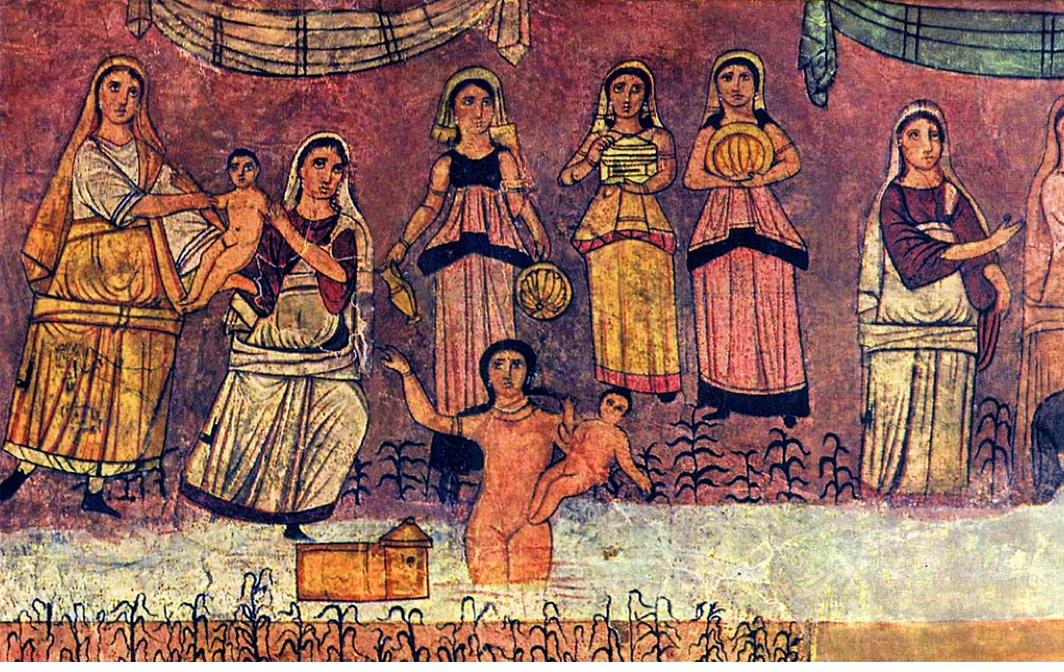
A painted panel from the Dura-Europos synagogue showing robed biblical figures, in muted ochre and red tones
Antiquity

Mural · c. 244 CE

Dura-Europos Synagogue

Excavated in eastern Syria in 1932, this third-century synagogue contained extensive figural wall paintings depicting biblical scenes, Moses, Exodus, the binding of Isaac, the prophet Ezekiel. The paintings overturned the assumption that ancient Jewish communities universally prohibited figurative art. The murals are preserved at the National Museum of Damascus.

Image: Dura-Europos synagogue paintings (public domain) · National Museum of Damascus · Yale University Art Gallery ↗

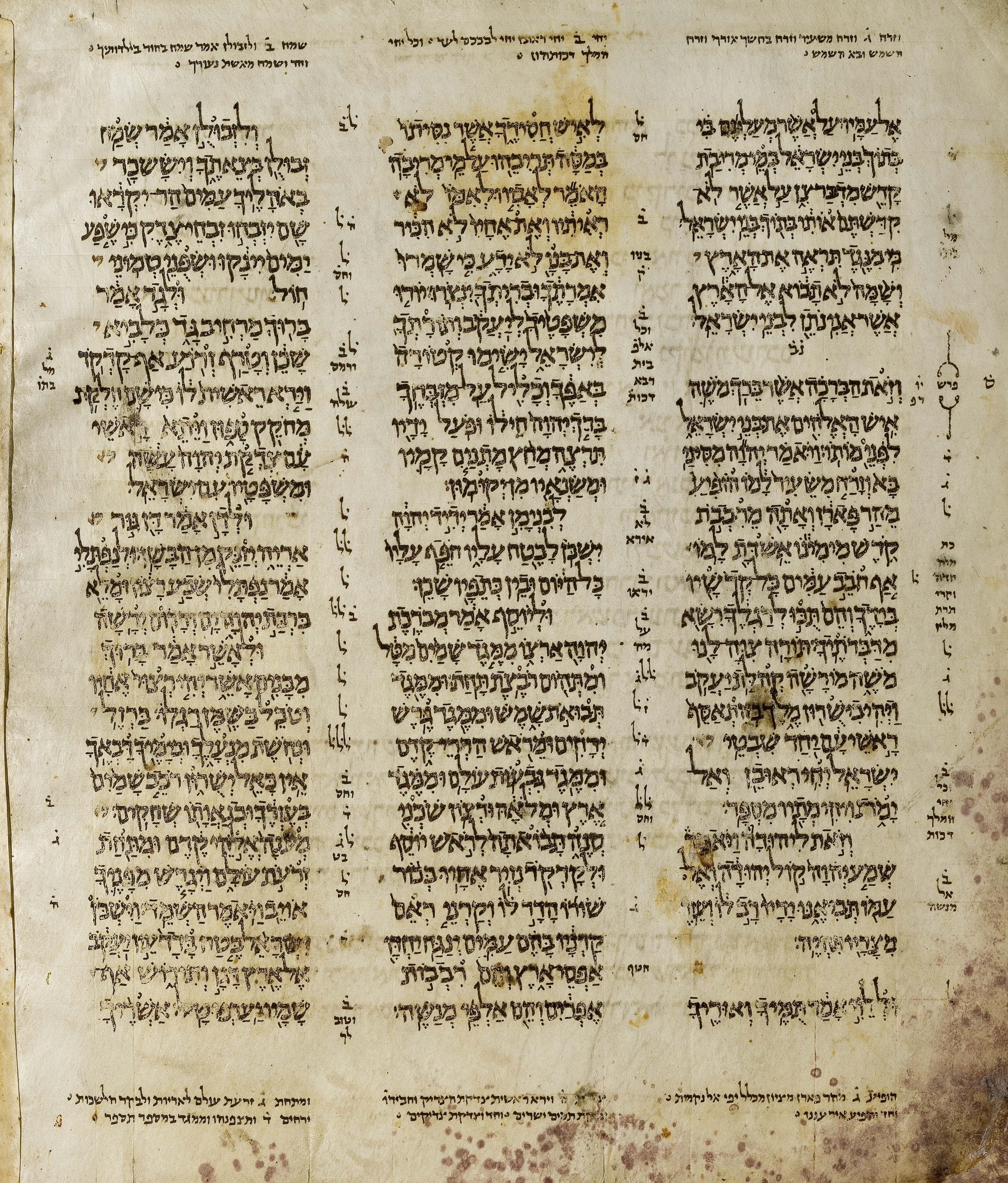
A page from the Aleppo Codex, columns of Hebrew biblical text with vocalization marks on aged parchment
Medieval

Manuscript · c. 930 CE

Aleppo Codex

Written in Tiberias around 930 CE, the Aleppo Codex is one of the oldest and most important known Hebrew Bible manuscripts, written by the scribe Shlomo ben Buya’a and pointed by Aaron ben Asher. Maimonides used it as the authoritative reference for his rulings on Torah scroll preparation. Kept in Aleppo from the 14th century until 1947, when communal violence damaged it and parts went missing, the surviving portions are housed at the Israel Museum.

Israel Museum, Jerusalem · Memory of the World Register · Digital edition ↗

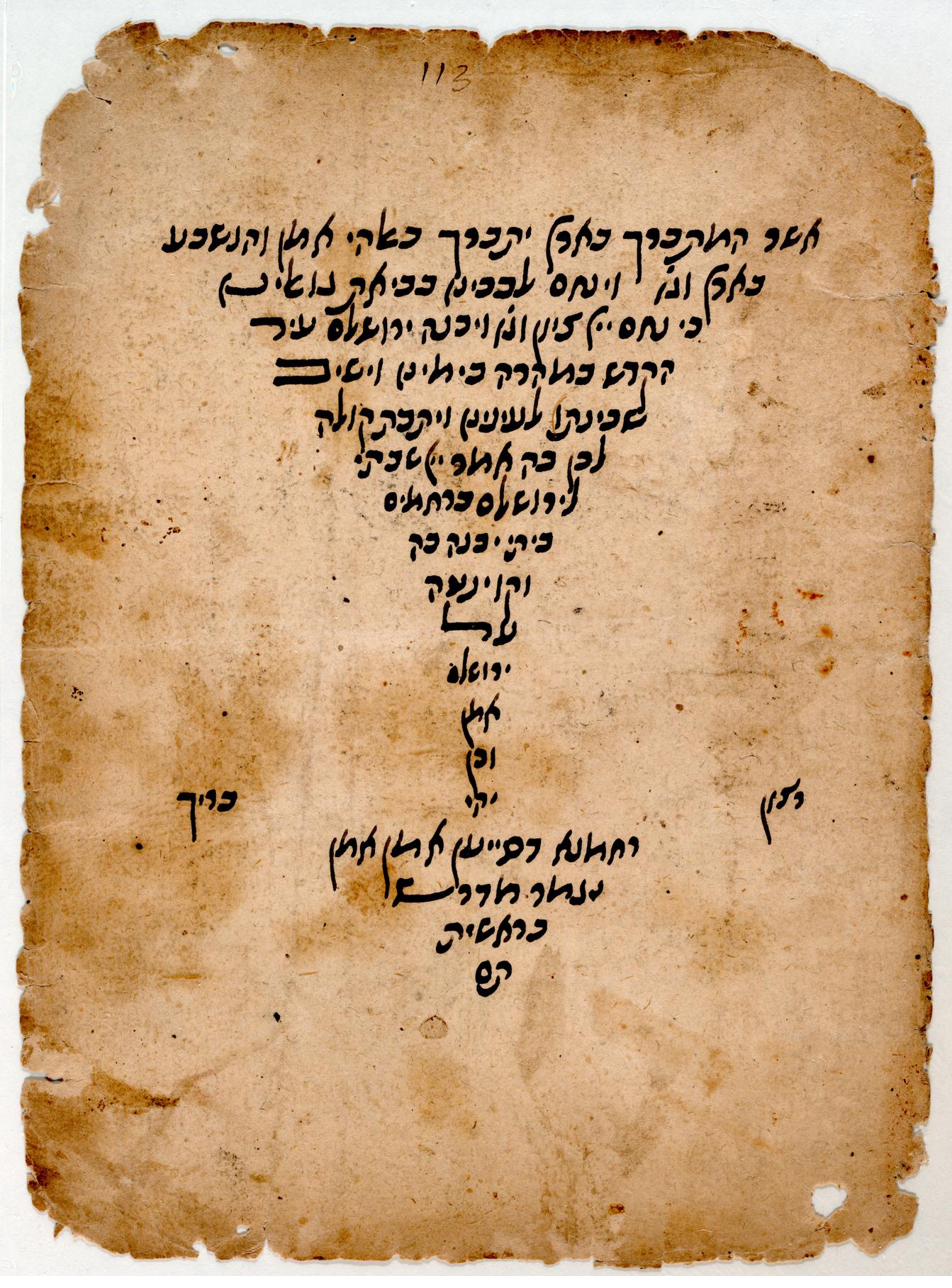
A fragment of a handwritten medieval Hebrew manuscript from the Cairo Geniza, showing columns of script with a scribal colophon at the foot of the page.
Medieval

Manuscript · c. 12th century

Cairo Geniza · Halper 113

A colophon fragment from a medieval commentary on Genesis, one of approximately 400,000 fragments preserved in the storeroom of the Ben Ezra Synagogue in Old Cairo and removed to Cambridge in 1896. The Geniza contains everything from biblical manuscripts to grocery lists, letters, marriage contracts, and trade ledgers, a complete window into medieval Mediterranean Jewish life.

University of Pennsylvania Libraries · Halper Collection · Penn Libraries ↗ · OPenn high-res images ↗

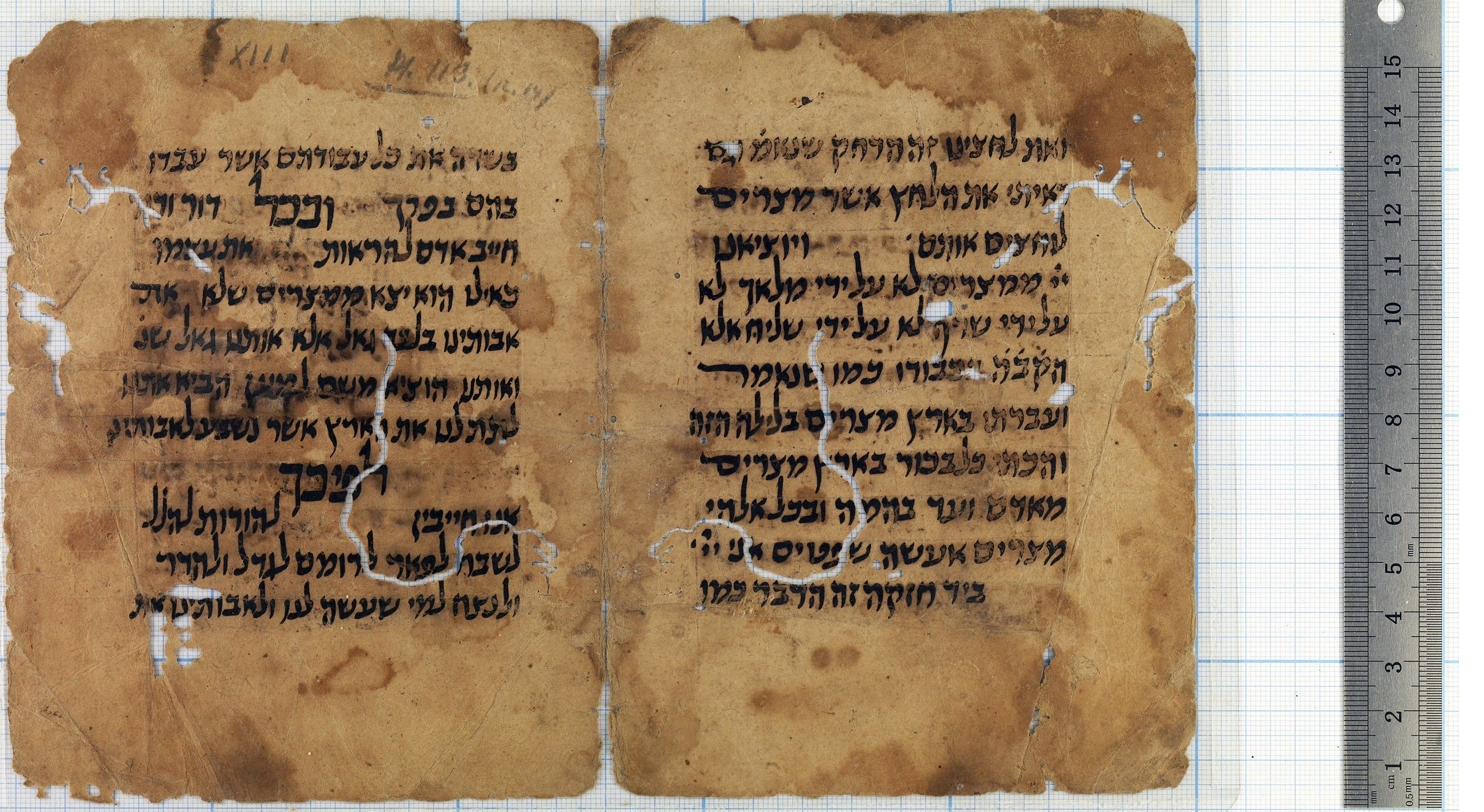
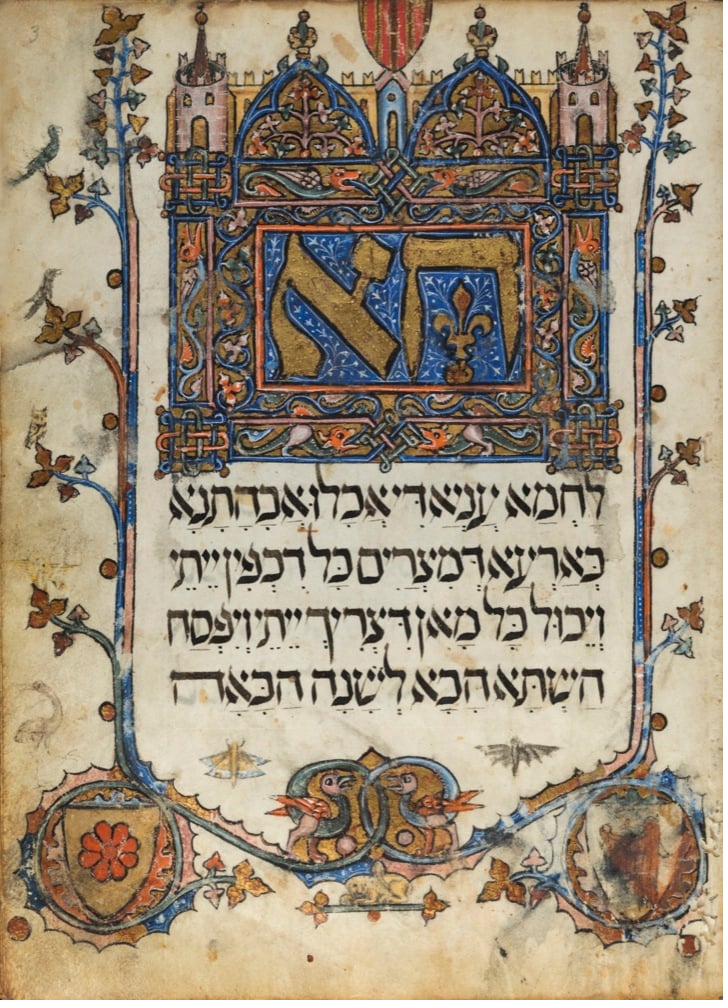
Passover Haggadah fragment from the Cairo Geniza
Medieval

Liturgy · medieval

Passover Haggadah Fragment

A fragment of the Passover Haggadah from the Cairo Geniza. The Haggadah is the liturgical text read on the first night of Passover, recounting the Exodus from Egypt. Versions from the medieval Mediterranean differ in detail from later European editions, revealing local liturgical traditions and the continuity of a ritual practiced annually for two thousand years.

Cairo Geniza · Cambridge University Library · Cambridge Digital Library ↗

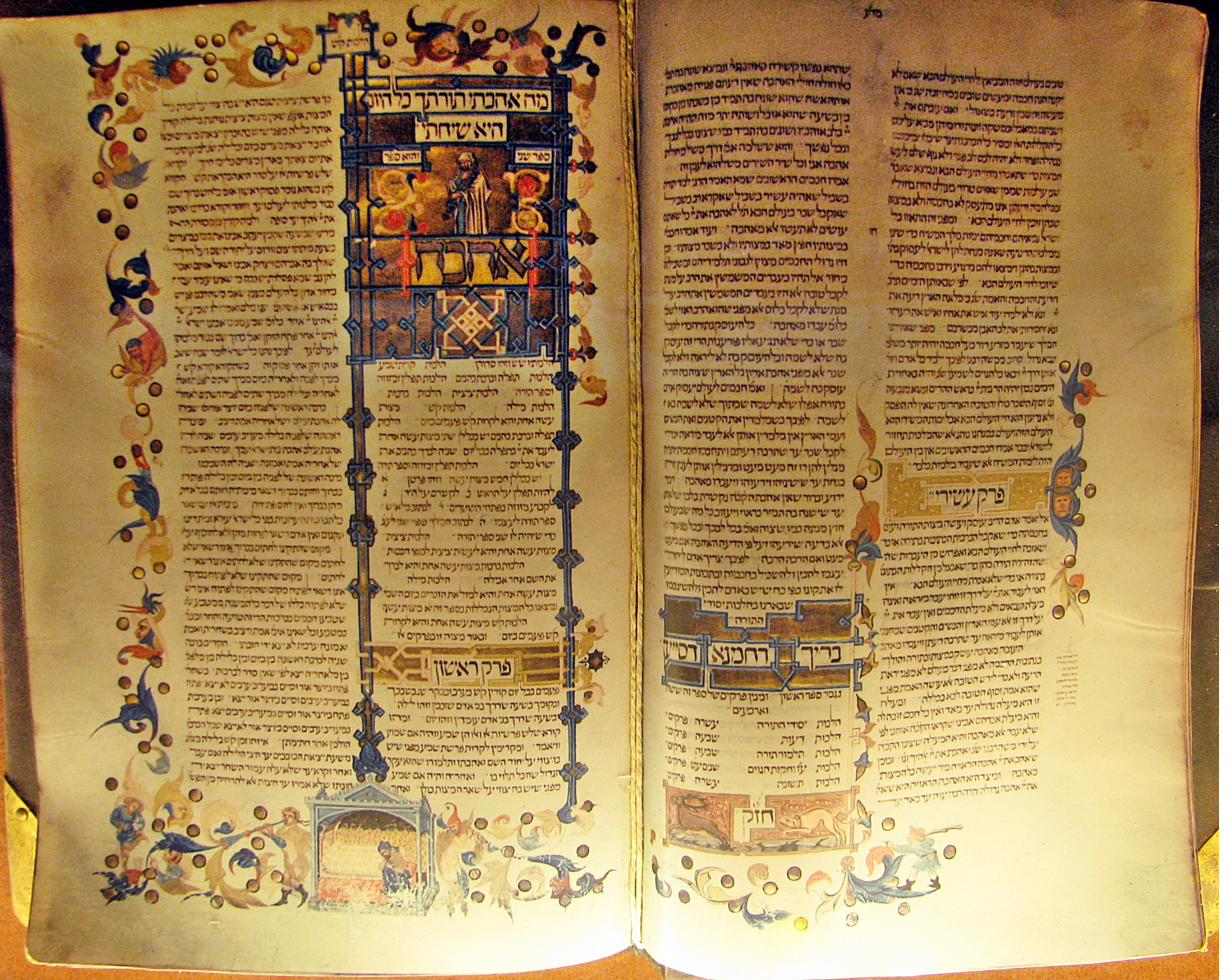
Illuminated Hebrew manuscript page from Maimonides' Mishneh Torah
Medieval

Manuscript · 12th–13th c.

Maimonides · Mishneh Torah

Moses Maimonides (Rambam, 1138–1204), born in Córdoba, physician at the court in Cairo, produced the Mishneh Torah, an attempt to organize the entire body of Talmudic law into a single, systematically arranged Hebrew code. He wrote at the meeting point of Jewish, Islamic, and Greek learning, and his works were read across all three worlds. Surviving manuscripts, including pages in his own hand from the Cairo Geniza, are held in major research libraries.

Image: Mishneh Torah manuscript, Perugia, c. 1400 · View related manuscript: Digital Bodleian, University of Oxford ↗ · see also the Law and Ethics Chapter

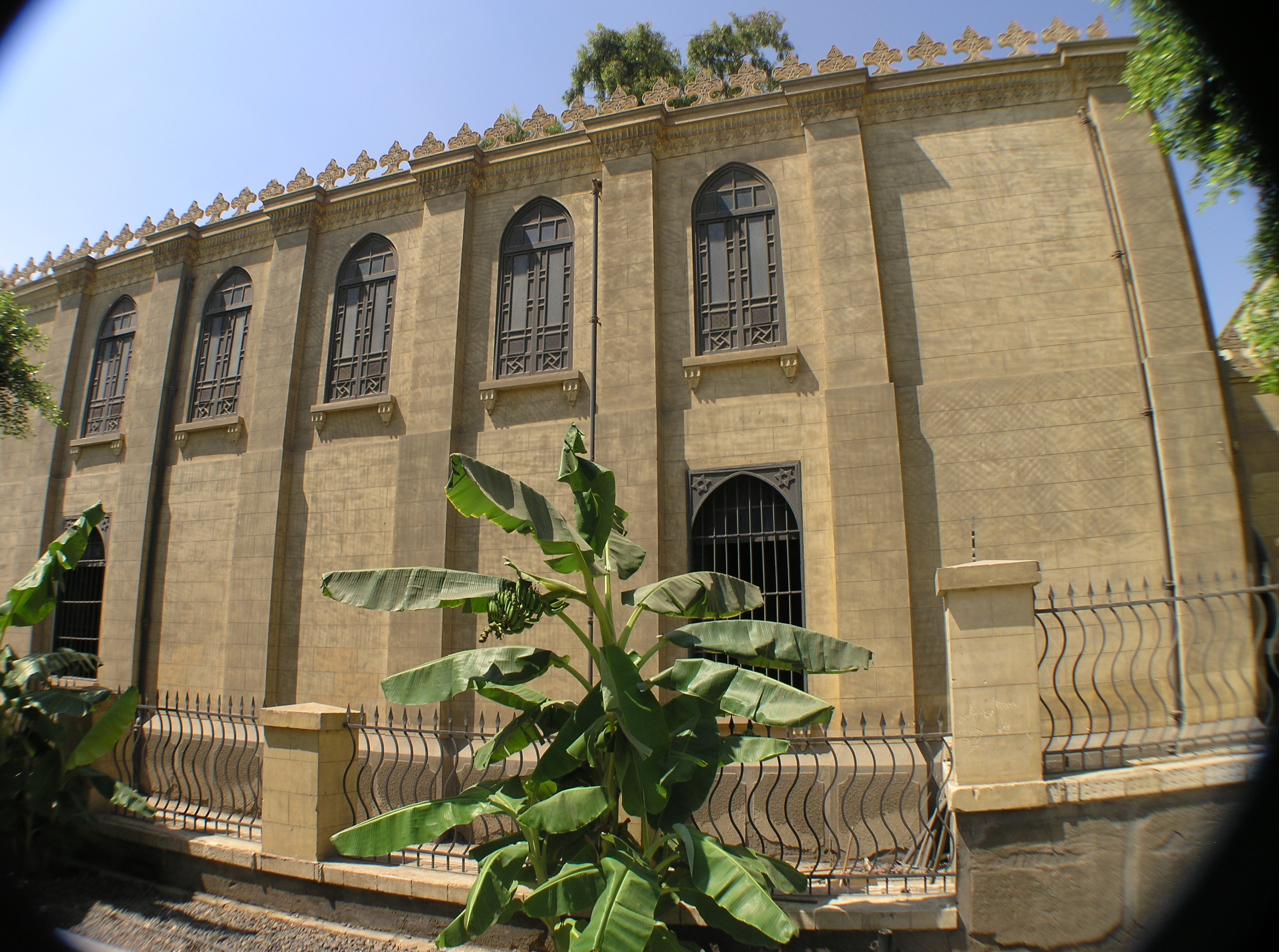
The exterior of the Ben Ezra Synagogue in Old Cairo, with tall arched windows and a decorative cornice
Medieval

Synagogue · Fustat (Old Cairo)

The Ben Ezra Synagogue

The oldest synagogue in Egypt, in Fustat (Old Cairo). Its hekhal is decorated in Arabesque style and inlaid with mother of pearl, a merging of artistic traditions, with the Ten Commandments inscribed in Hebrew. Its storeroom, or geniza, accumulated documents over roughly 850 years. Discovered in the 1890s, those fragments became the Cairo Geniza now studied in libraries worldwide, including the fragments shown elsewhere in this gallery.

Explore (with virtual tour): Egyptian Ministry of Tourism and Antiquities ↗

Pages of the illuminated Sarajevo Haggadah, a medieval Hebrew manuscript with painted decoration and gold leaf
Medieval

Illuminated manuscript · c. 1350

The Sarajevo Haggadah

An illuminated Passover Haggadah made in Spain around 1350, one of the most celebrated surviving Sephardic manuscripts, with painted miniatures and gold leaf. It left Spain with the expulsion of 1492, surfaced in Sarajevo in the nineteenth century, and survived both the Second World War and the 1990s siege of Sarajevo, twice hidden by Muslim librarians to protect it. A single object that carries the whole arc of Sephardic history: flourishing, expulsion, diaspora, and survival.

National Museum of Bosnia and Herzegovina, Sarajevo · widely reproduced; the manuscript is medieval and in the public domain National Museum of Bosnia and Herzegovina ↗ More on this · ANU ↗

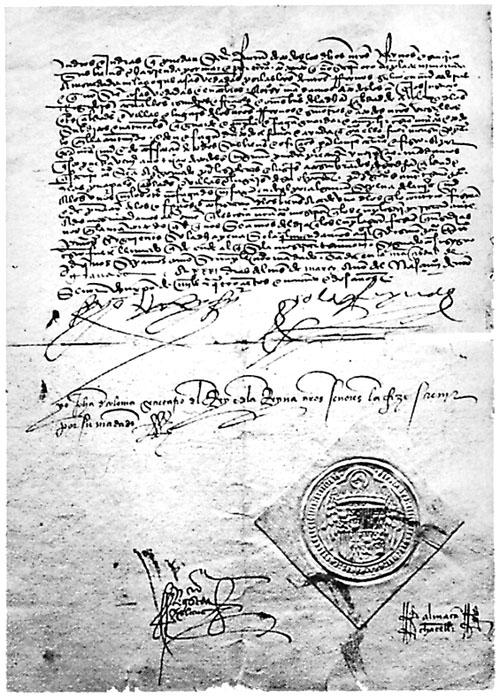
A page of the 1492 Alhambra Decree in early modern Spanish script
Early Modern

Decree · March 31, 1492

The Alhambra Decree

Signed by Ferdinand and Isabella four months before Columbus sailed, the Edict of Expulsion gave the Jews of Spain until the end of July to convert to Catholicism or leave. Estimates are contested, but tens of thousands, by some estimates well over 100,000, chose exile, scattering across the Ottoman Empire, North Africa, the Low Countries, and the New World. The Sephardi diaspora, and the Ladino language, date from this moment.

Archivo General de Simancas · Original held in Spain. Archivo General de Simancas ↗ Background · History.com ↗

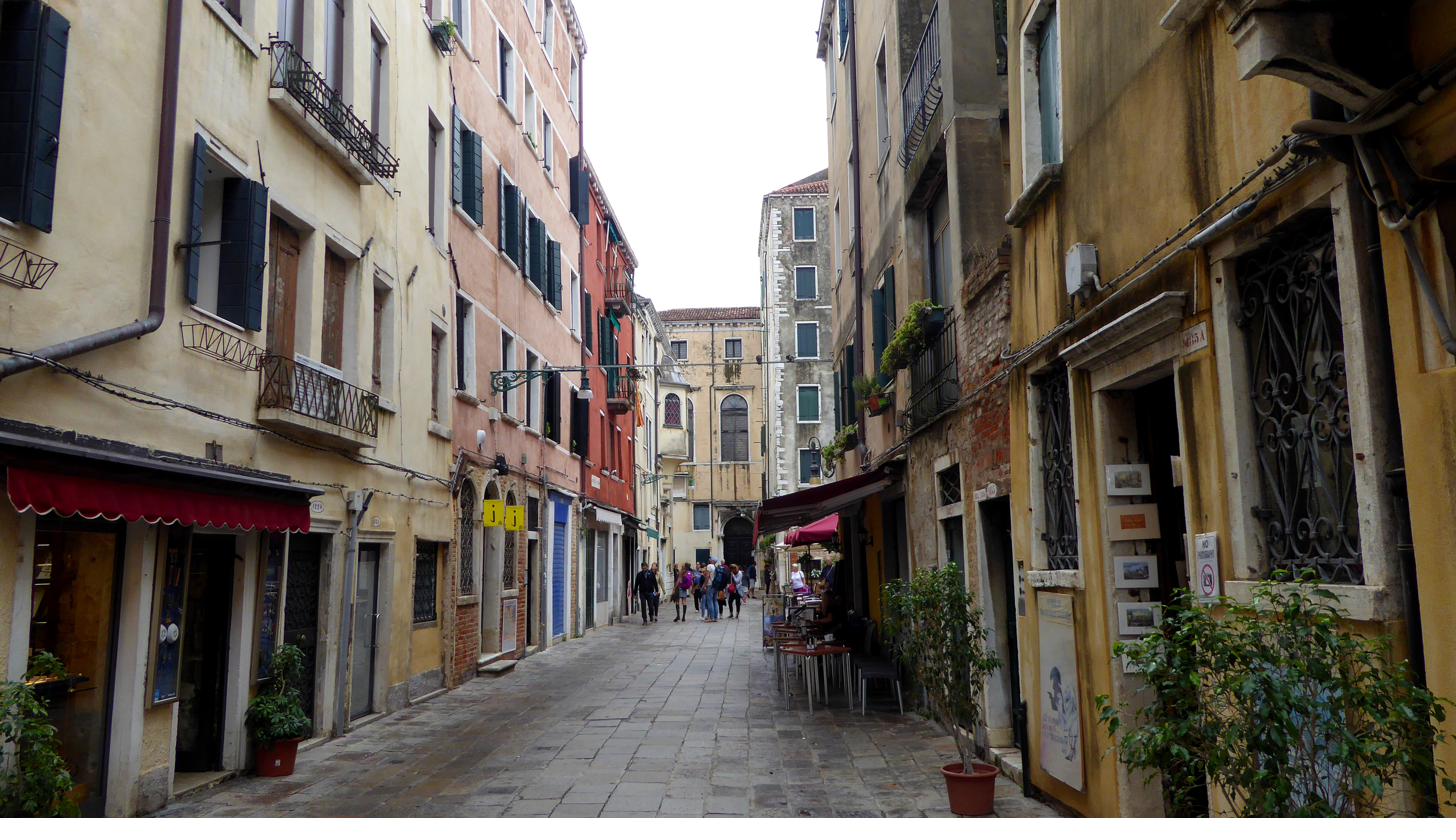
A narrow street in the Venetian Ghetto with tall multi-storey buildings
Early Modern

Architecture · 1516

The Venetian Ghetto

Established by Venetian Senate decree on March 29, 1516, the Geto Nuovo island was the first compulsory Jewish quarter to be called a ghetto, and the place from which the word takes its name; mandated Jewish streets, Frankfurt's among them, had existed for decades. The buildings rise unusually tall because the Jewish population could not expand the island's seven-acre footprint outward; floors were halved and added vertically across three centuries to accommodate growth.

Jewish Museum of Venice, at the ghetto site · Museo Ebraico di Venezia ↗

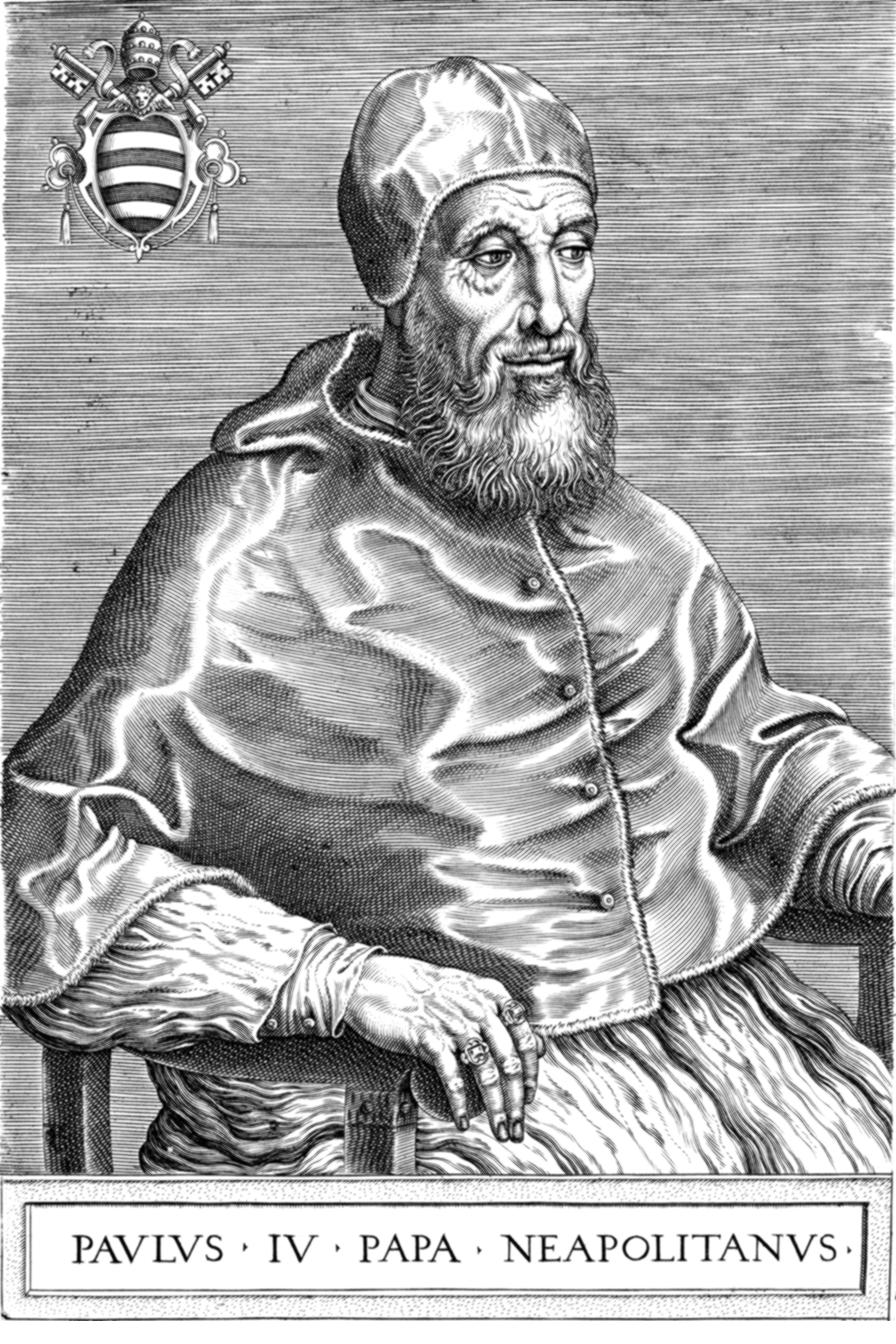
An engraved portrait of Pope Paul IV, elderly and bearded, in a papal cape and skullcap
Early Modern

Engraving · 1555

Pope Paul IV

Gian Pietro Carafa (1476–1559). On July 14, 1555, two months after his election, he issued Cum nimis absurdum, the papal bull codifying the ghetto system across the Papal States. The Roman Ghetto it created persisted until 1870.

Public-domain engraving · The bull he issued, Cum nimis absurdum, appears in the Antisemitism · Primary-Source Evidence gallery.

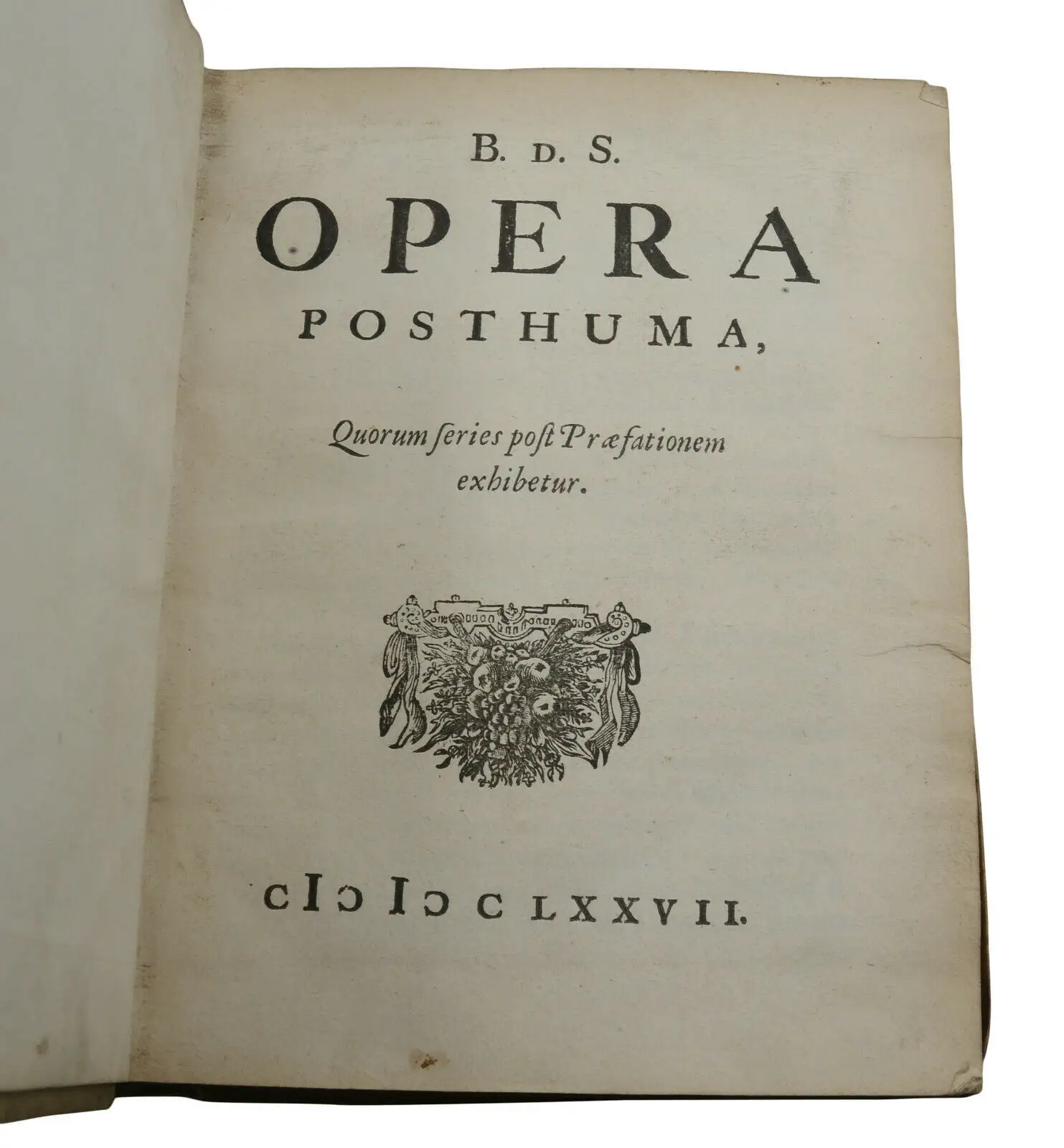
The 1677 title page of Spinoza's Opera Posthuma, printed in Latin
Early Modern

Printed book · 1677

Spinoza · Opera Posthuma

The title page of the Opera Posthuma (1677), the posthumous collected works of Baruch Spinoza (1632–1677), which first published his Ethics. Born into the Sephardic Jewish community of Amsterdam, descendants of Jews expelled from Iberia, Spinoza became a foundational figure of modern European philosophy and a forerunner of the Enlightenment. The volume was printed anonymously (the author given only as “B.d.S.”) because of the controversy his ideas provoked.

First edition, 1677 · public domain · see also the Philosophy and Science Chapter

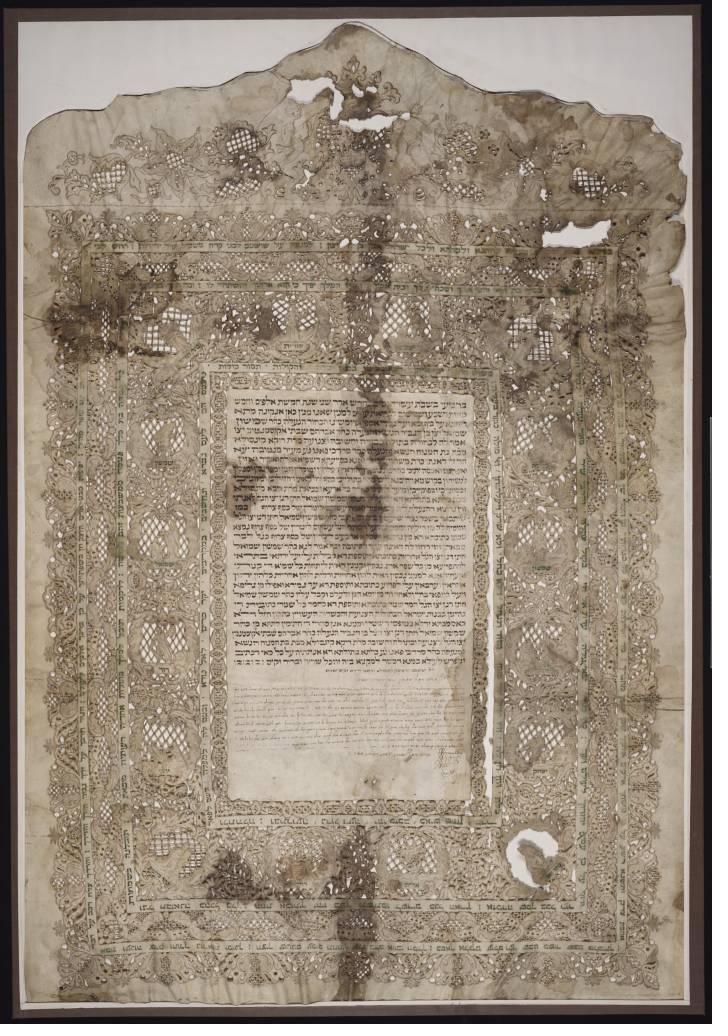
Illuminated ketubah from Ancona, Italy, 1777
Early Modern

Illuminated manuscript · 1777

Illuminated Ketubah

A ketubah, a Jewish marriage contract from Ancona, Italy, 1777, ink on vellum. Psalm 45 frames the text in green, surrounded by painted biblical scenes: the binding of Isaac, Esther before the king, Judith with the head of Holofernes. The earliest decorated ketubot survive from the Cairo Geniza, and the illuminated ketubah flowered above all in seventeenth- and eighteenth-century Italy and the post-expulsion Sephardic diaspora; in the Ottoman Empire, Jewish artists blended Hebrew text with Islamic decorative styles, sometimes adding a star and crescent at the apex. An ordinary document of a life, made beautiful.

Image: Ancona ketubah, 1777, historical manuscript reproduction · View & learn: Beinecke Library, Yale (1777 ketubah) ↗ · UW Stroum Center, Sephardic ketubot ↗

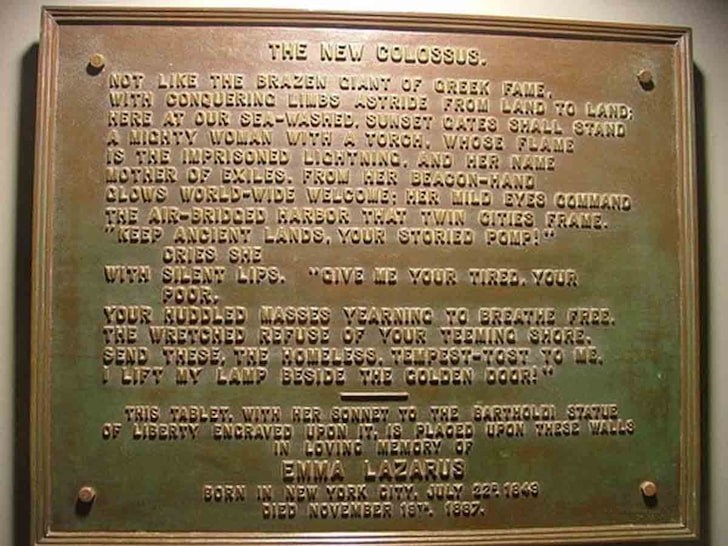
The bronze plaque inside the Statue of Liberty's pedestal bearing the full text of Emma Lazarus's sonnet The New Colossus.
Modern

Bronze plaque · 1903 · New York Harbor

The New Colossus Plaque

Fourteen lines by the American Jewish poet Emma Lazarus, written in 1883 for the auction that funded the statue's pedestal. They were mounted in bronze inside that pedestal in 1903, sixteen years after her death. The plaque is why the Statue of Liberty means what it means: "Give me your tired, your poor." She wrote the welcome with the refugees of the Russian pogroms in mind; she had taught them herself.

Statue of Liberty National Monument, National Park Service · photograph public domain · Full story in Emma Lazarus ↗

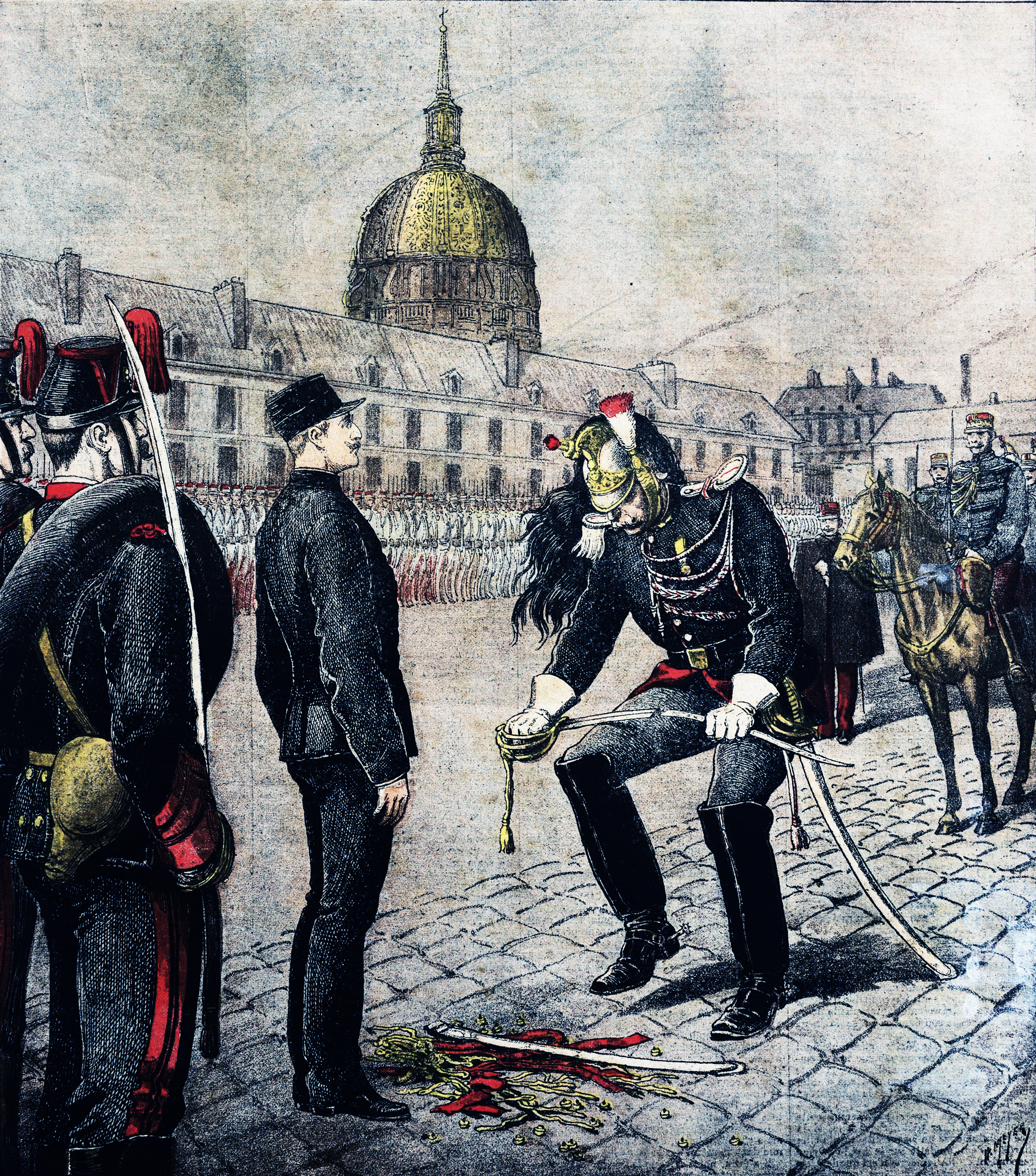
Period engraving of the public degradation of Alfred Dreyfus, 1895
Modern

Affair · 1894–1906

The Dreyfus Affair

Captain Alfred Dreyfus, a French Jewish artillery officer, was convicted of treason in 1894 on forged evidence and exiled to Devil's Island. Émile Zola's open letter J'Accuse…! (1898) split France for a decade. Dreyfus was eventually exonerated in 1906. The affair is widely cited as the moment when racialized antisemitism became publicly legible as a political force in modern European life.

Bibliothèque nationale de France · Archives nationales · BnF Gallica ↗

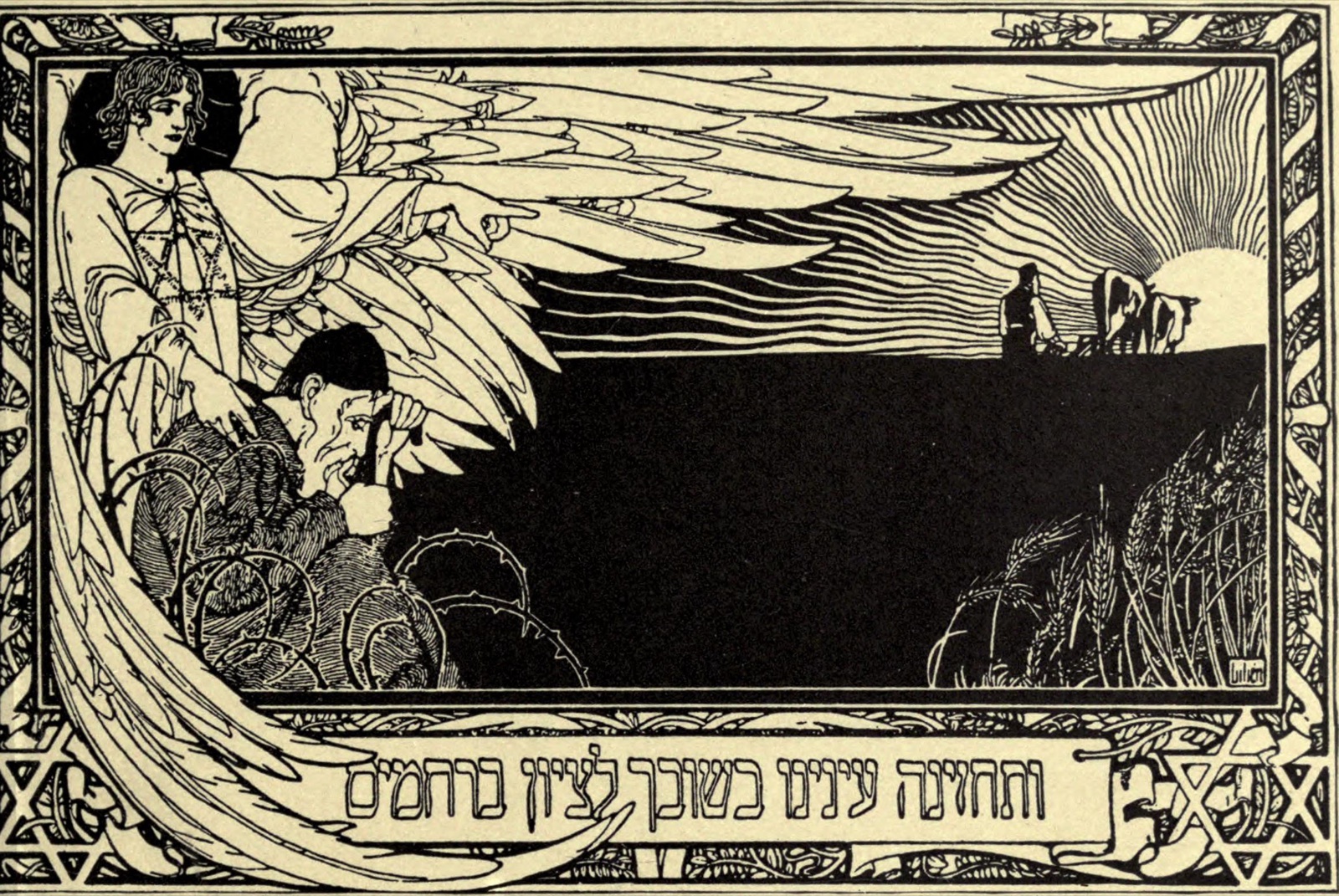
An art nouveau print: an angel with vast wings points an elderly Jew, tangled in thorns, toward a rising sun where a farmer plows a field. A Hebrew verse runs in a banner below.
Modern

Printed card · E. M. Lilien · 1901

The Fifth Zionist Congress Card

Ephraim Moses Lilien, an art nouveau illustrator, is remembered as the first Zionist artist. He made this image for the Fifth Zionist Congress in Basel in December 1901, the congress that founded the Jewish National Fund. An angel points an old Jew, tangled in thorns, toward a rising sun where a farmer plows a field. Beneath runs a line Jews had prayed daily for centuries, from the Amidah: may our eyes behold Your return to Zion in mercy. Lilien was born in Drohobycz, the same Galician town as the painter Maurycy Gottlieb a generation before.

Public domain by age

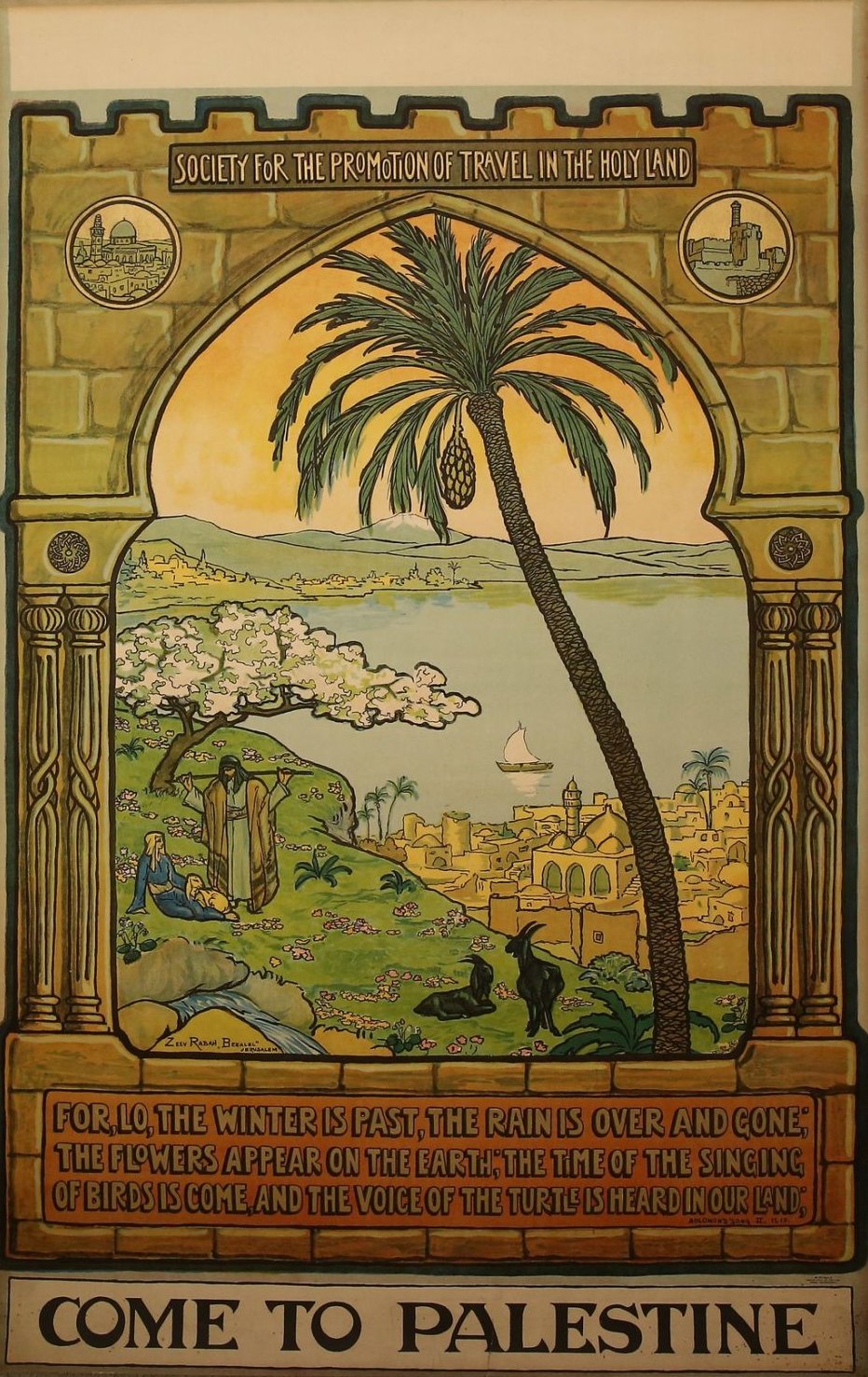
A richly colored lithograph: through a horseshoe arch in a golden stone wall, a shepherd rests under a blossoming almond tree above the Sea of Galilee, a date palm rising past a sailboat, snow-capped Mount Hermon beyond, over the words Come to Palestine
Modern

Lithograph · Ze'ev Raban · 1929

Come to Palestine

A tourism poster by Ze'ev Raban of the Bezalel school in Jerusalem, made for the Society for the Promotion of Travel in the Holy Land. The Sea of Galilee sits in a frame of blooming almond and date palm, with Mount Hermon behind. The corner medallions hold two Jerusalem landmarks: the Tower of David, and the Temple Mount, crowned since the seventh century by the Dome of the Rock. The border carries a verse from the Song of Songs: for, lo, the winter is past, the flowers appear on the earth. The verse is set in the King James English that Christian travelers knew. The invitation was to everyone. In 1929, Palestine was the name of the British Mandate territory, and the name the Zionist movement itself used. The poster inviting the world to the Jewish homeland says so in its title.

The Israel Museum, Jerusalem · Spencer Museum of Art · public domain in the United States

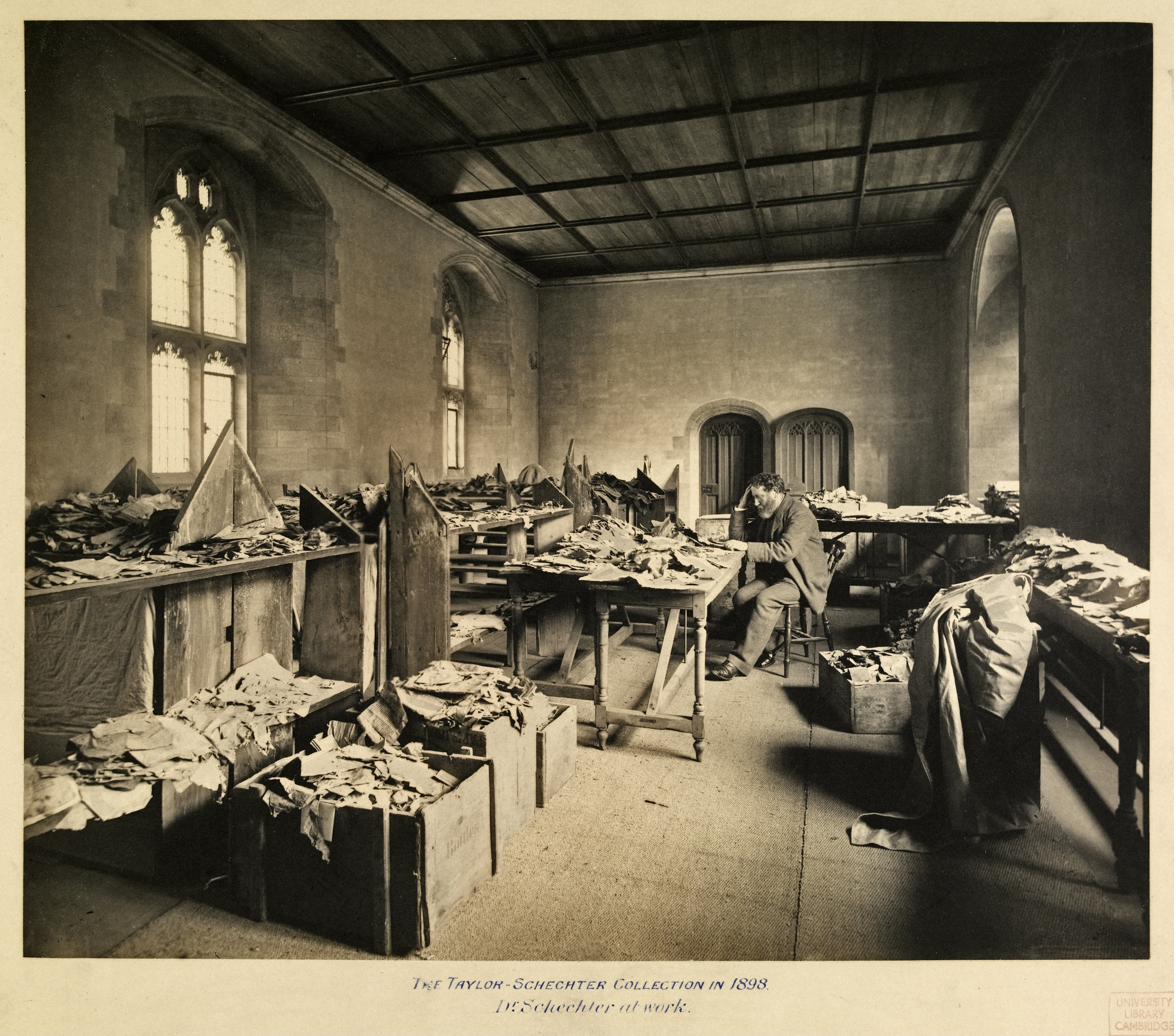
Solomon Schechter at his desk studying Cairo Geniza fragments
Modern

Photograph · c. 1898

Solomon Schechter at the Cairo Geniza

Schechter, then a Cambridge scholar, was permitted in 1896 to remove the bulk of the Ben Ezra Synagogue's storeroom, roughly 190,000 fragments of a hoard whose dispersed total runs to some 400,000, and ship them to Cambridge for study. The Geniza collection has been parsed for more than a century, and continues to yield new historical material. The photograph shows him at work amid the fragments.

Cambridge University Library · Genizah Research Unit · Cambridge Genizah Unit ↗

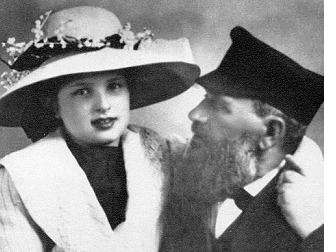
A studio portrait of a young woman in a wide-brimmed hat trimmed with flowers beside an older bearded man in a dark hat, from the People of a Thousand Towns collection documenting Jewish life in Eastern Europe
Modern

Photography · 1880–1939

Eastern European Jewish Life

The institutional photographic record of the Jewish civilization of Eastern Europe: the YIVO archives in Vilna, the Kacyzne photographic collection, the Roman Vishniac photographs of Polish Jewry on the eve of war. Roughly five million Jews lived in Eastern Europe in 1939. By 1945, the world they had built across a thousand years was all but gone.

Image: archival photograph from YIVO-related Eastern European Jewish life collections · Explore the archives: Roman Vishniac Archive (ICP) ↗ · YIVO Institute ↗ · YIVO Encyclopedia ↗ · USHMM

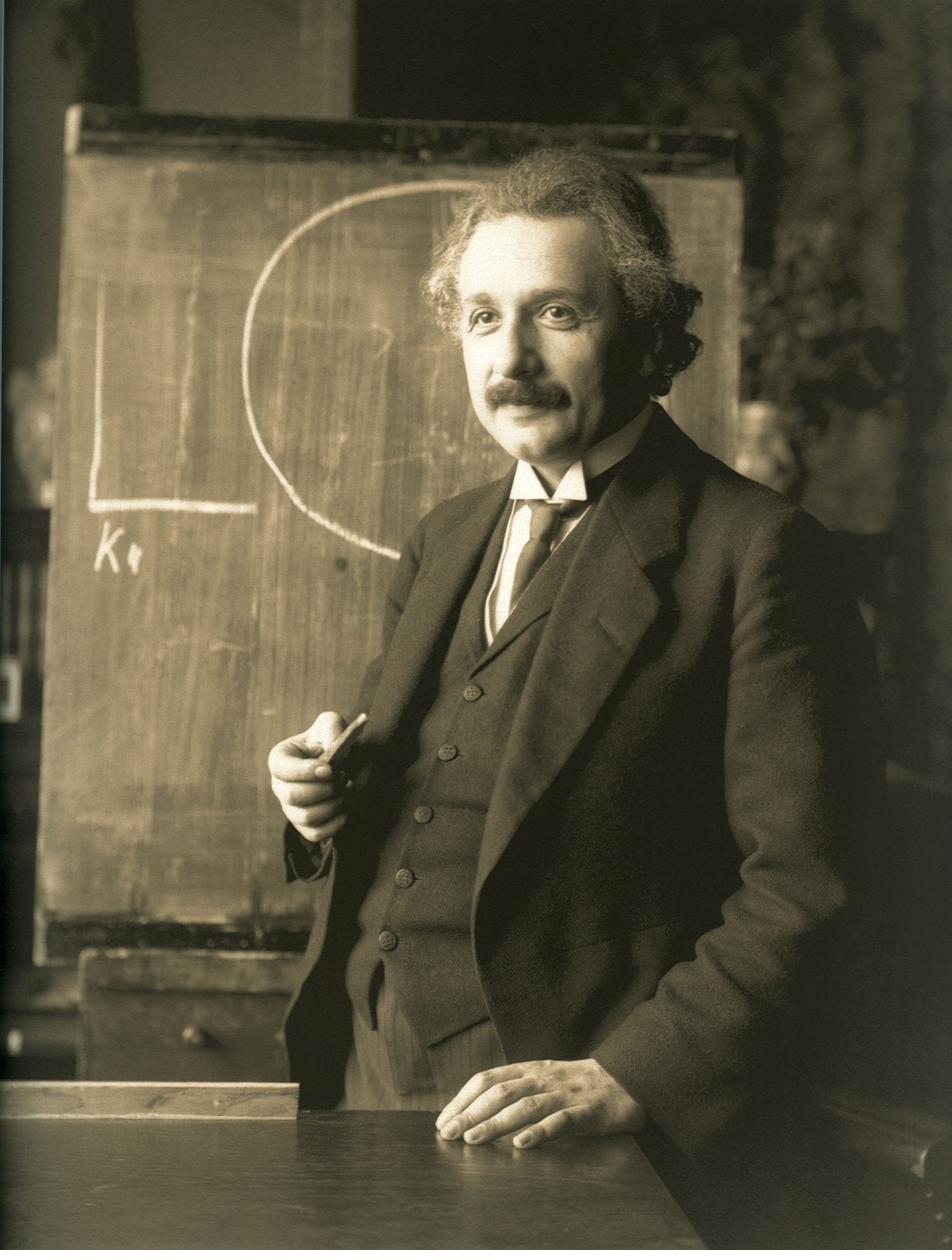
A 1921 photographic portrait of Albert Einstein standing beside a blackboard
Modern

Photograph · 1921

Albert Einstein, 1921

Photographed in 1921, the year for which he was awarded the Nobel Prize in Physics. Einstein (1879–1955) reshaped modern physics with the theories of relativity. He was one of many European Jewish scientists whose lives were upended by the Nazi rise to power: he left Germany in 1933 and never returned, settling at the Institute for Advanced Study in Princeton.

Portrait by Ferdinand Schmutzer, 1921 · public domain · see also the Philosophy and Science Chapter

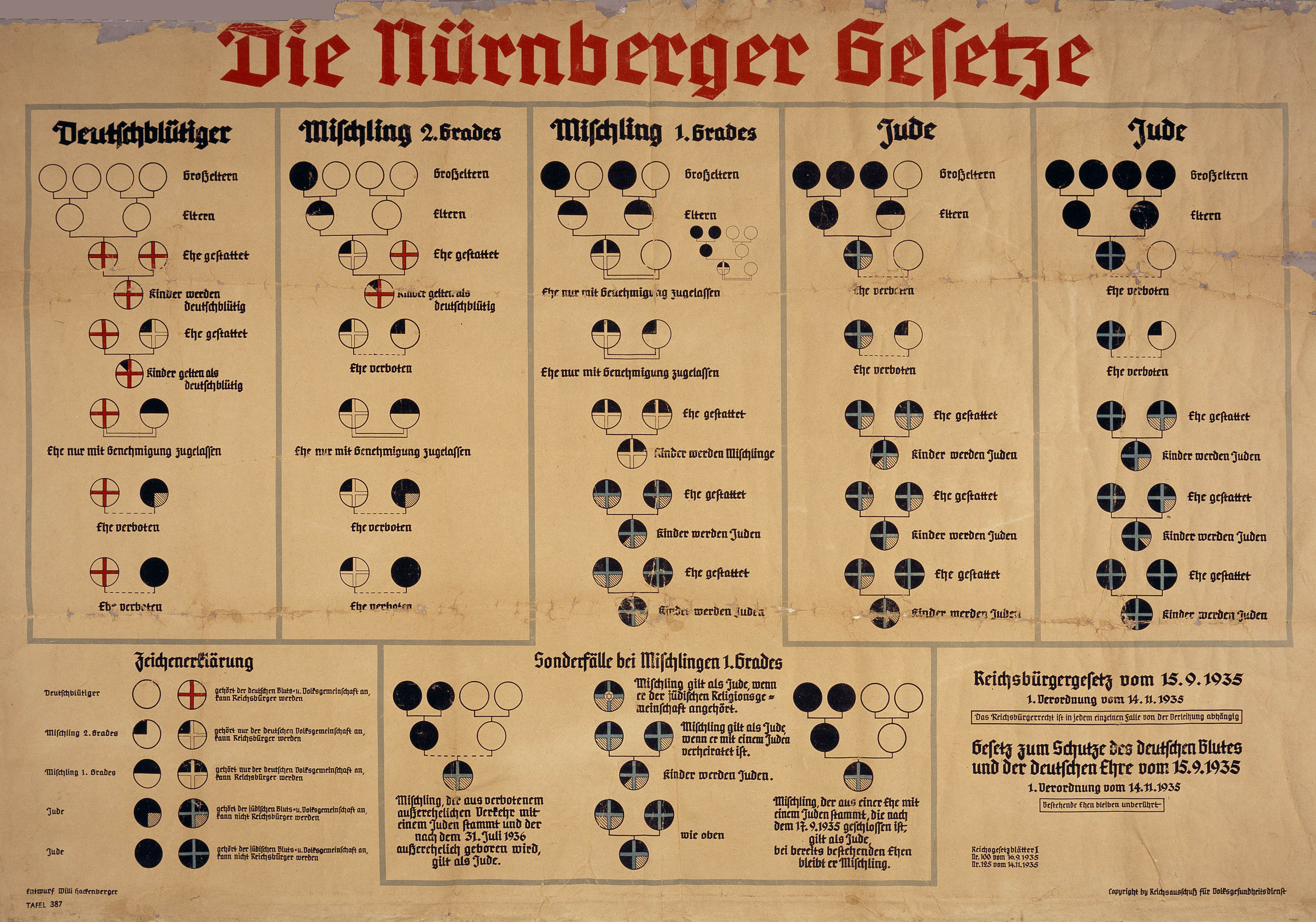
The 1935 Nuremberg Laws chart, using circles to classify people as German, Mischling, or Jewish
Holocaust Era

Legal Document · 1935 / 1945

From Nuremberg Laws to Nuremberg Trials

The Nuremberg Race Laws of September 1935 stripped German Jews of citizenship and prohibited their marriage to non-Jews, the legal architecture that made the Final Solution administratively possible. Ten years later, in the same city, the International Military Tribunal at Nuremberg tried the surviving Nazi leadership for crimes against humanity. The signed originals are at the U.S. National Archives; USHMM documents both.

United States Holocaust Memorial Museum · Holocaust Encyclopedia ↗

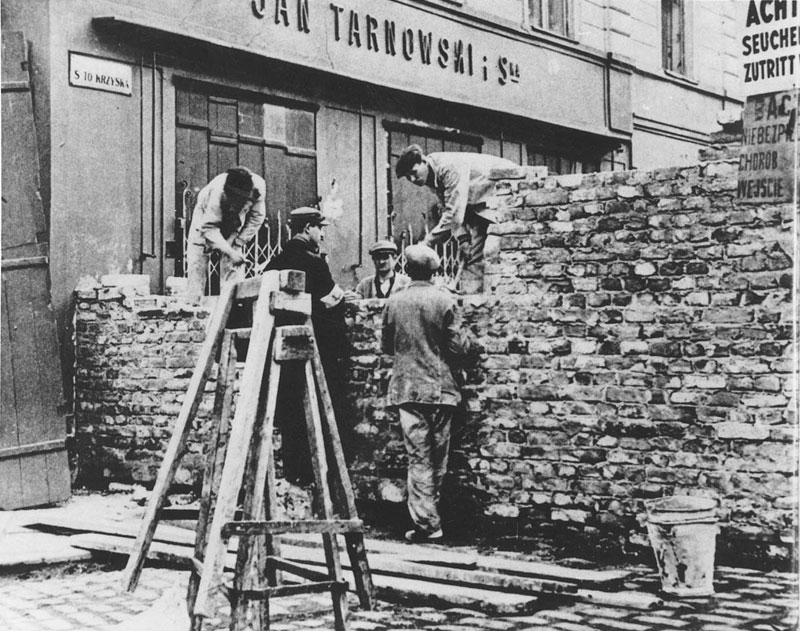
Construction of the Warsaw Ghetto wall, August 1940
Holocaust Era

Photograph · August 1940

The Warsaw Ghetto Wall

Construction of the Warsaw Ghetto wall under Nazi-German occupation, August 1940, 385 years after Pope Paul IV codified the Italian ghetto system, seventy years after Italian unification ended it. The institutional vocabulary was inherited directly. The function had shifted decisively from confinement to extermination. By the end of the war, more than 90 percent of Warsaw's Jewish population had been killed.

United States Holocaust Memorial Museum · Holocaust Encyclopedia ↗

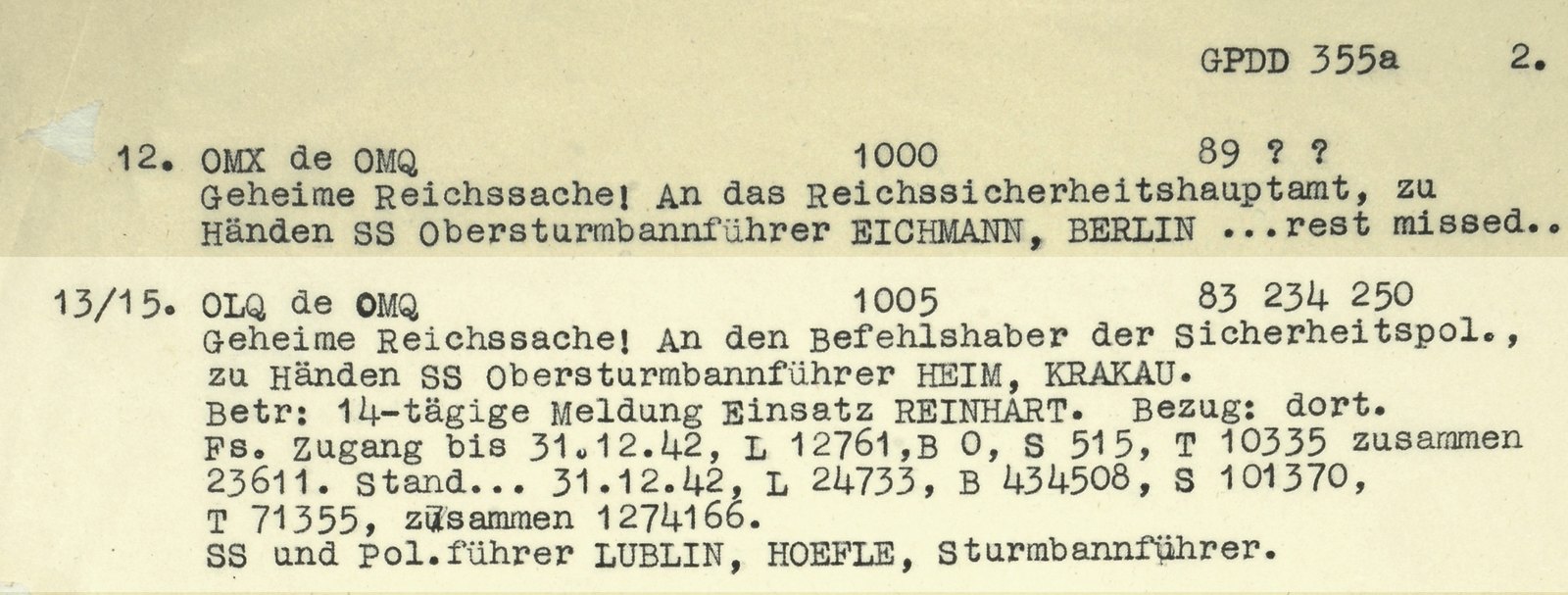
A typed British intelligence decrypt sheet from January 1943 carrying the Höfle message with the figures for Lublin, Bełżec, Sobibór, and Treblinka
Holocaust Era

Intercepted radio message · January 11, 1943

The Höfle Telegram

A fortnightly report radioed by SS officer Hermann Höfle to Berlin and Kraków, caught and decoded by British listeners at Bletchley Park, and filed away unread until 2000. It gives the perpetrators' own running totals for the four killing sites the message lists, to the end of 1942: 1,274,166 people. A system built to leave no witnesses was counted by its own signals.

The National Archives (UK), HW 16/23 · Full story in The Camp System ↗

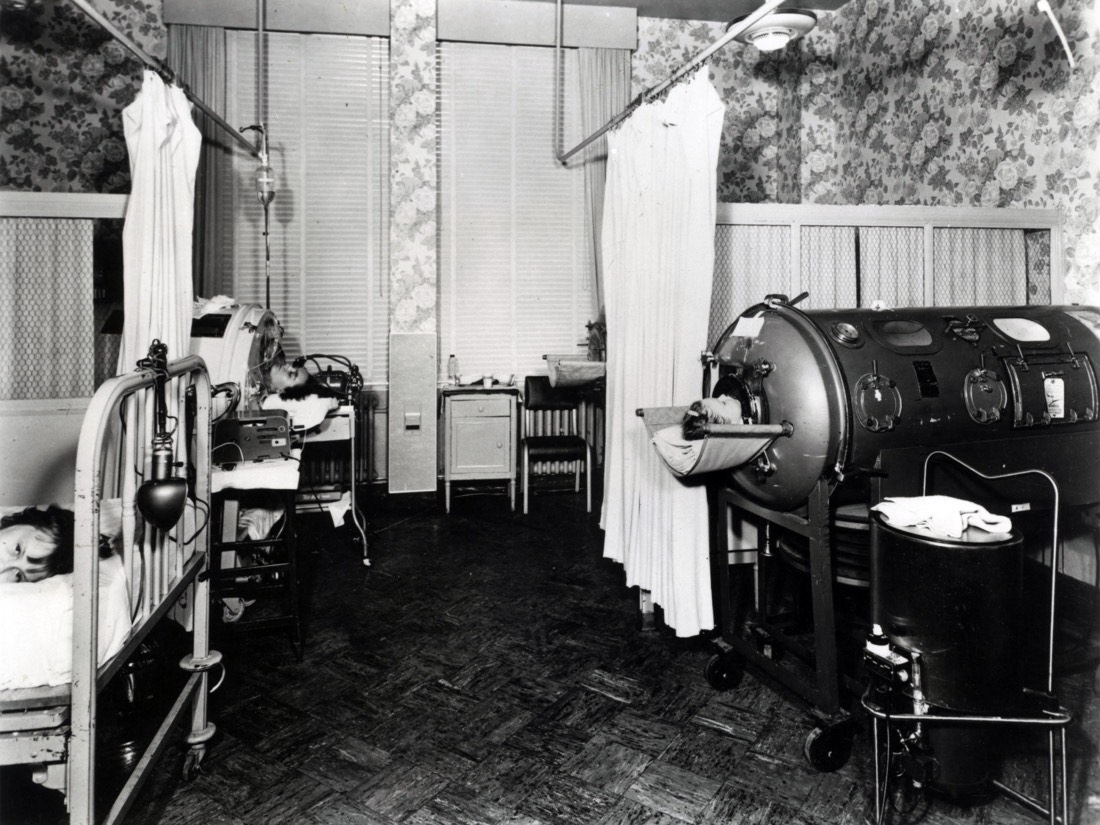
A yellow-green iron lung, a long metal cylinder on wheels with portholes and gauges, the machine that breathed for polio patients.
Post-1945

Respirator · 1930s–1950s · United States

An Iron Lung

The machine that breathed for children whose chest muscles polio had paralyzed. Rows of them filled hospital wards every American summer until April 12, 1955, when the vaccine developed by Jonas Salk, the son of Russian-Jewish immigrants, was declared safe, effective, and potent. Museums preserve iron lungs now as artifacts: an empty one is what a cure looks like.

U.S. Food and Drug Administration photograph · public domain · Full story in Jonas Salk ↗

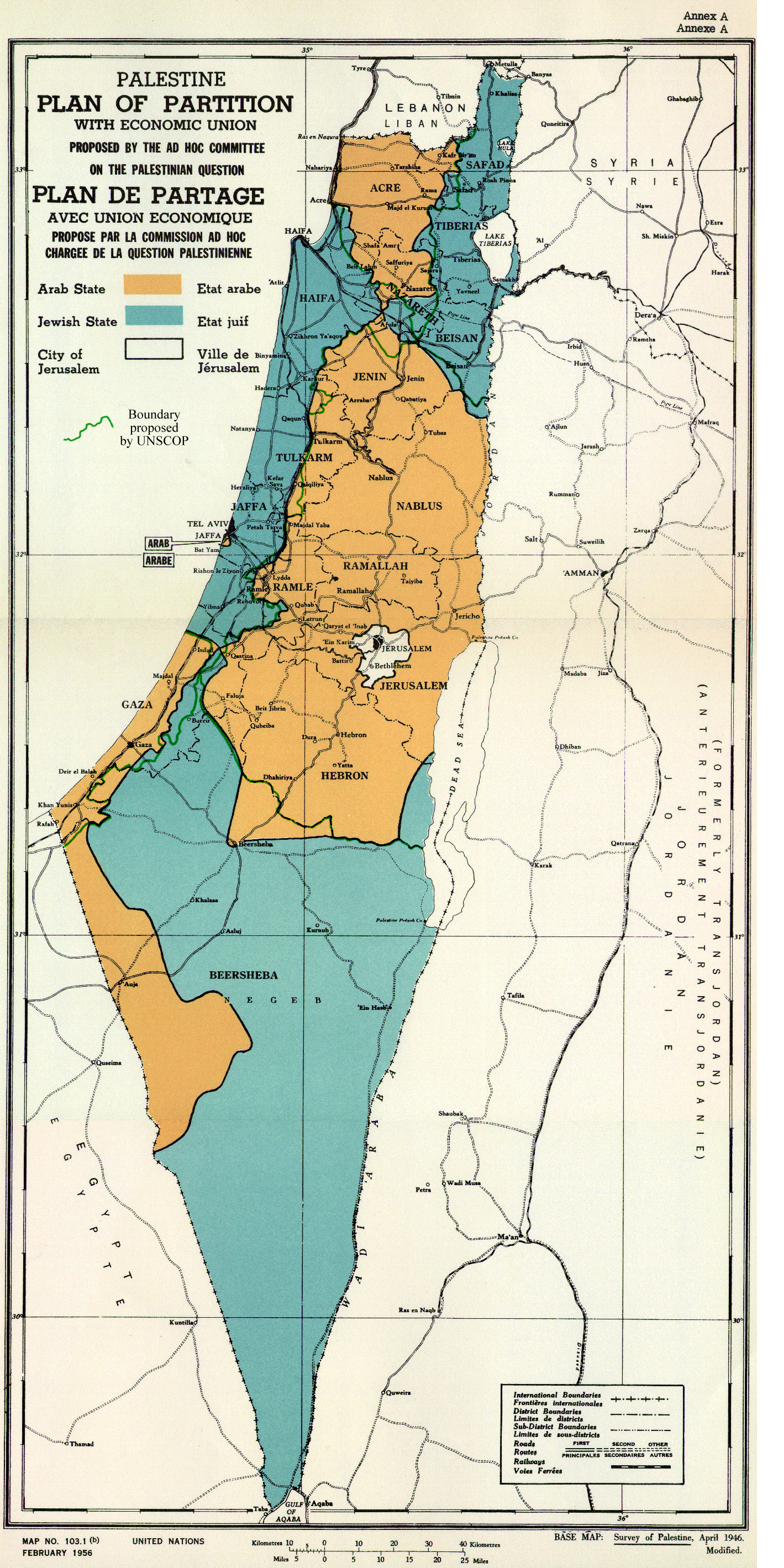
United Nations 1947 Partition Plan map for Palestine
Post-1945

UN Resolution · November 29, 1947

UN Resolution 181

The United Nations General Assembly Resolution partitioning the British Mandate of Palestine into an Arab state and a Jewish state, with Jerusalem under international administration. Passed 33 to 13 with 10 abstentions. The State of Israel was declared on May 14, 1948, the first sovereign Jewish state since the Roman destruction of the Second Temple in 70 CE.

United Nations Archives · UN Audiovisual Library · UN Resolution 181 (II) ↗

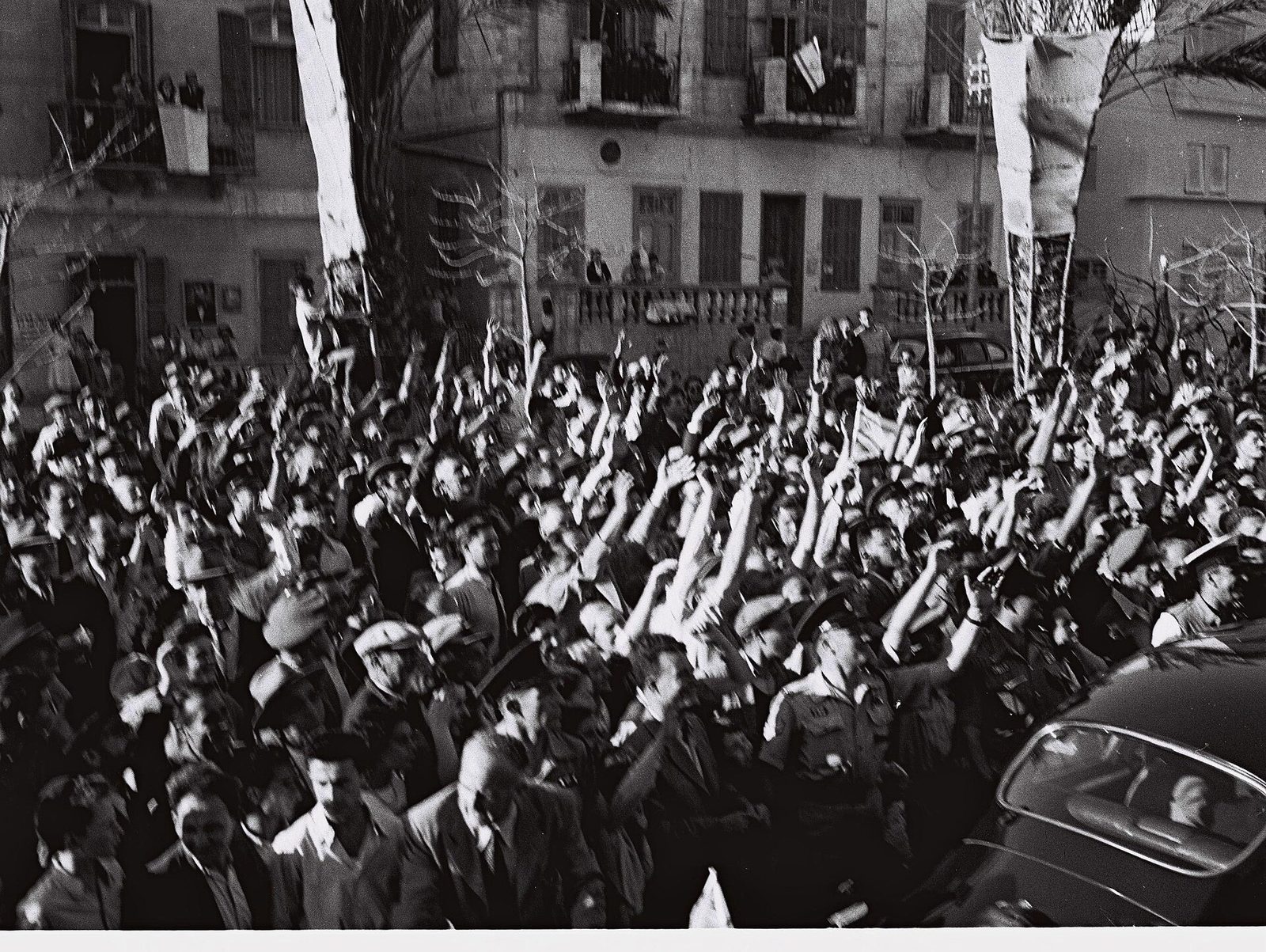
Crowds filling a Tel Aviv street celebrating the declaration of the State of Israel, 14 May 1948
Post-1945

Photograph · 1948

The Declaration of the State of Israel

On 14 May 1948, in a Tel Aviv museum hall, David Ben-Gurion read out the declaration that established the modern State of Israel; outside, crowds filled the streets. The photograph catches the public moment of a founding that reshaped where the world's Jews live. Today roughly half of them live in the state declared that afternoon.

Hans Pinn / Government Press Office of Israel · CC BY-SA 3.0 · see also The Modern State of Israel

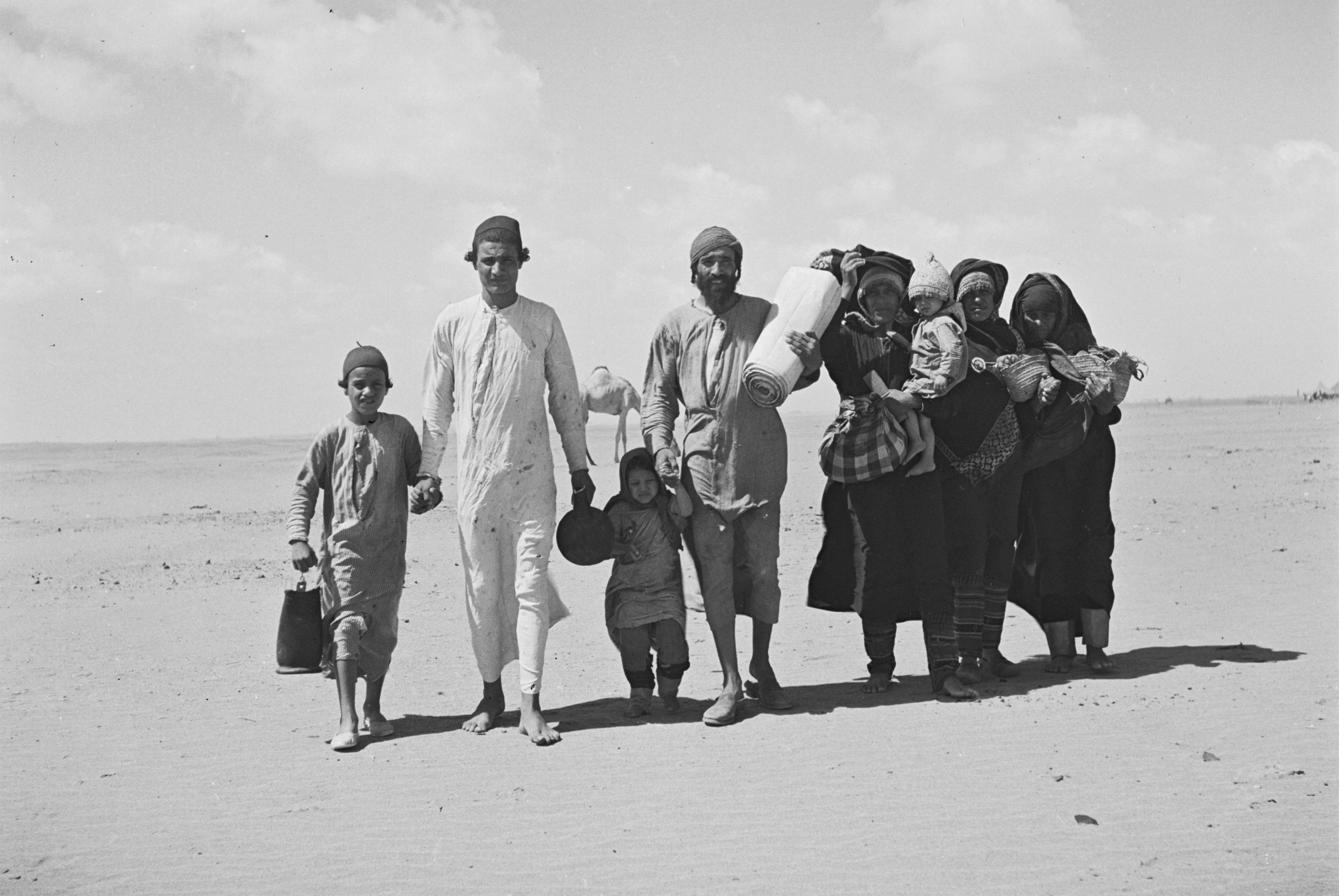
Yemenite Jewish family walking through the desert to a Joint Distribution Committee reception camp near Aden, 1949
Post-1945

Demographic record · 1945–1972

The MENA Jewish Displacement

Between 1945 and the early 1970s, roughly 850,000 Jews were displaced from Arab and Muslim-majority countries, Iraq, Egypt, Libya, Yemen, Morocco, Tunisia, Syria, Algeria. Communities present for more than two thousand years effectively ended within a generation.

Image: Yemenite Jewish family walking toward a Joint Distribution Committee reception camp near Aden, 1949 · Zoltan Kluger / Government Press Office · JIMENA ↗

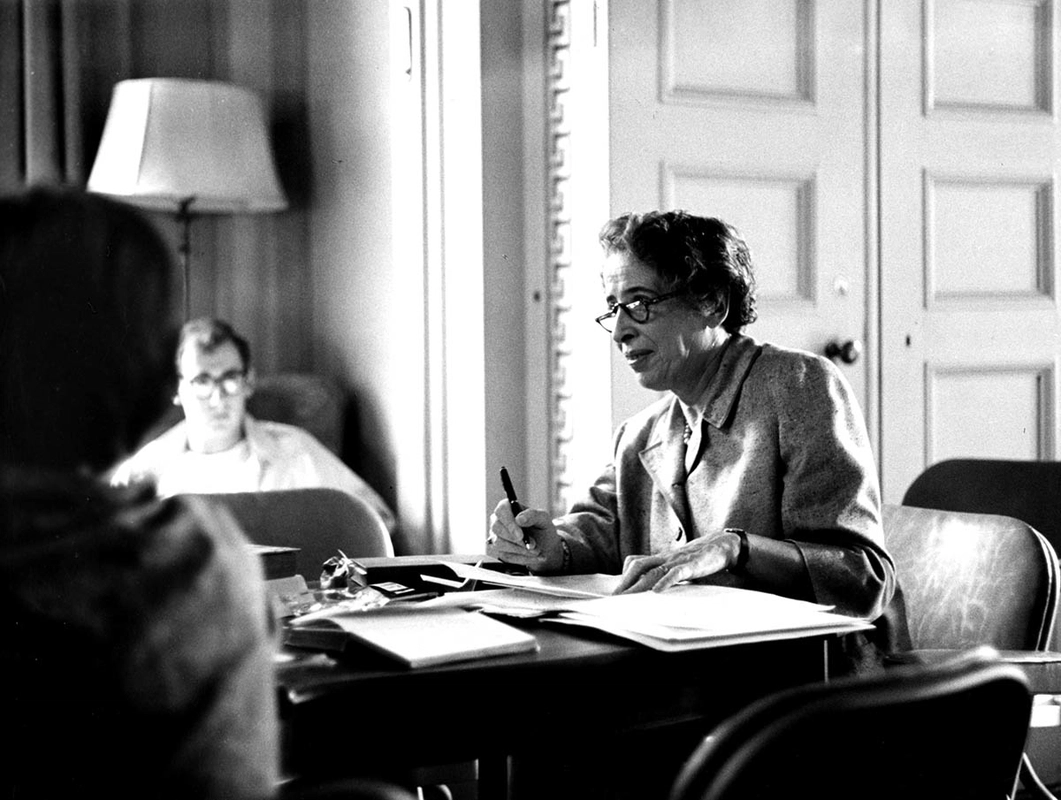
Hannah Arendt teaching in a classroom at Wesleyan University, c. 1961
Post-1945

Photograph · 1961

Hannah Arendt at Wesleyan

Hannah Arendt (1906–1975) teaching at Wesleyan University, where she held a fellowship in the early 1960s. A German Jewish political theorist who escaped Nazi Europe, she gave the postwar world much of its working vocabulary for mass violence, "totalitarianism," "the banality of evil," "the right to have rights." The Chapter treats her life, her major books, and the arguments that still surround them.

Arendt teaching at Wesleyan, c. 1961 · via Wesleyan's official blog · Wesleyan ↗ · see also Hannah Arendt

An Ethiopian Jewish family arriving in Israel during Operation Solomon, May 1991
Post-1945

Photograph · 1991

Operation Solomon

On 24–25 May 1991, Israel airlifted roughly 14,000 Ethiopian Jews, the Beta Israel, to Israel in about 36 hours, aboard a fleet of stripped-down aircraft. The photograph shows a family on arrival. It is one chapter in the in-gathering of a community whose Jewish life in the Horn of Africa runs back many centuries.

Tsvika Israeli / Government Press Office of Israel · CC BY-SA 3.0 · JDC · Operation Solomon ↗ · see also Ethiopian Jewry, Beta Israel

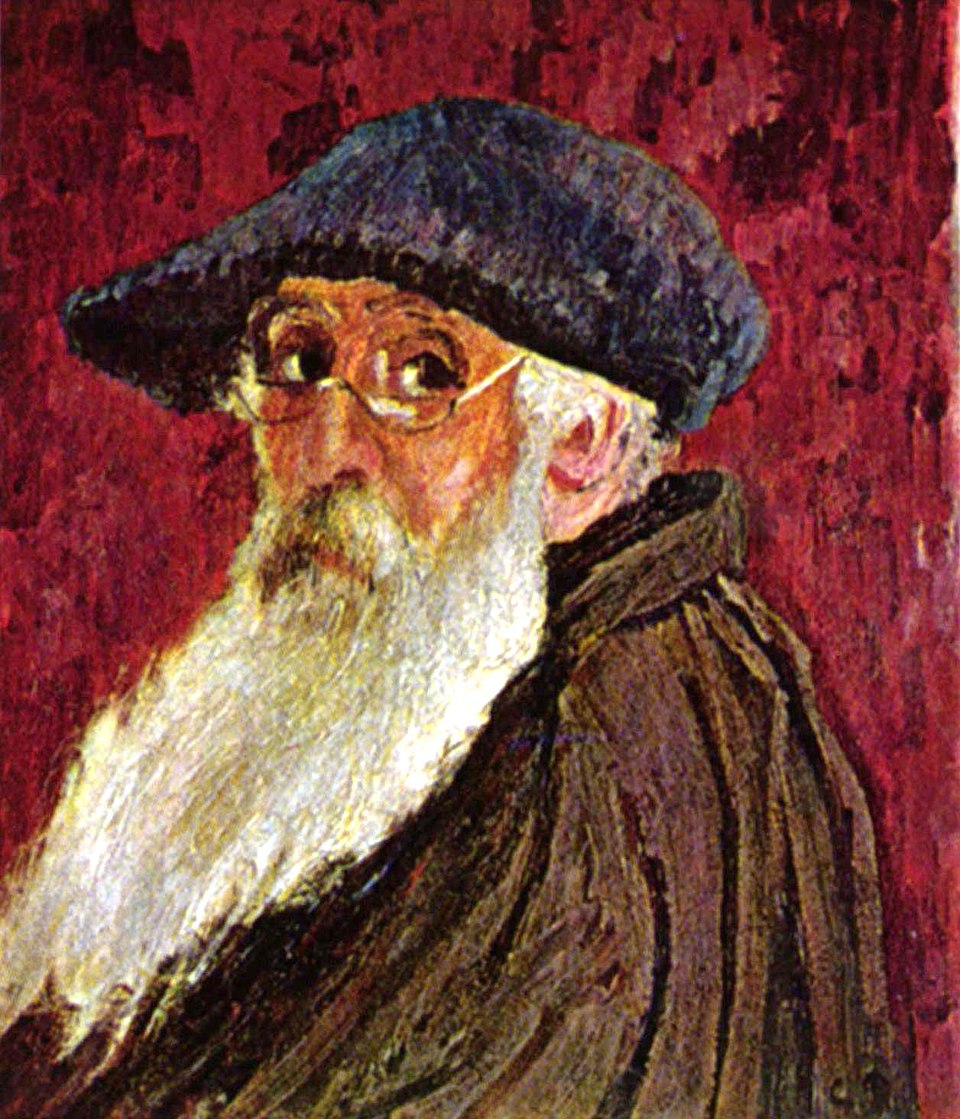
A self-portrait by Camille Pissarro, bearded artist in a dark coat
Jewish Artists

Painter · 1830–1903

Camille Pissarro

Born on St. Thomas to a Sephardi Jewish family, Pissarro became one of the founders of French Impressionism and the only artist to exhibit in all eight Impressionist exhibitions between 1874 and 1886. Mentor to Cézanne and Gauguin, early champion of Van Gogh, and, rare for a founder of the movement, a late convert to the pointillism of the younger Seurat. His private letters express the difficulty of being a Jewish radical in France during the Dreyfus Affair, when he sided publicly with Dreyfus.

Works in the Met, the Musée d'Orsay, the National Gallery, the Art Institute of Chicago · View at the Musée d'Orsay ↗

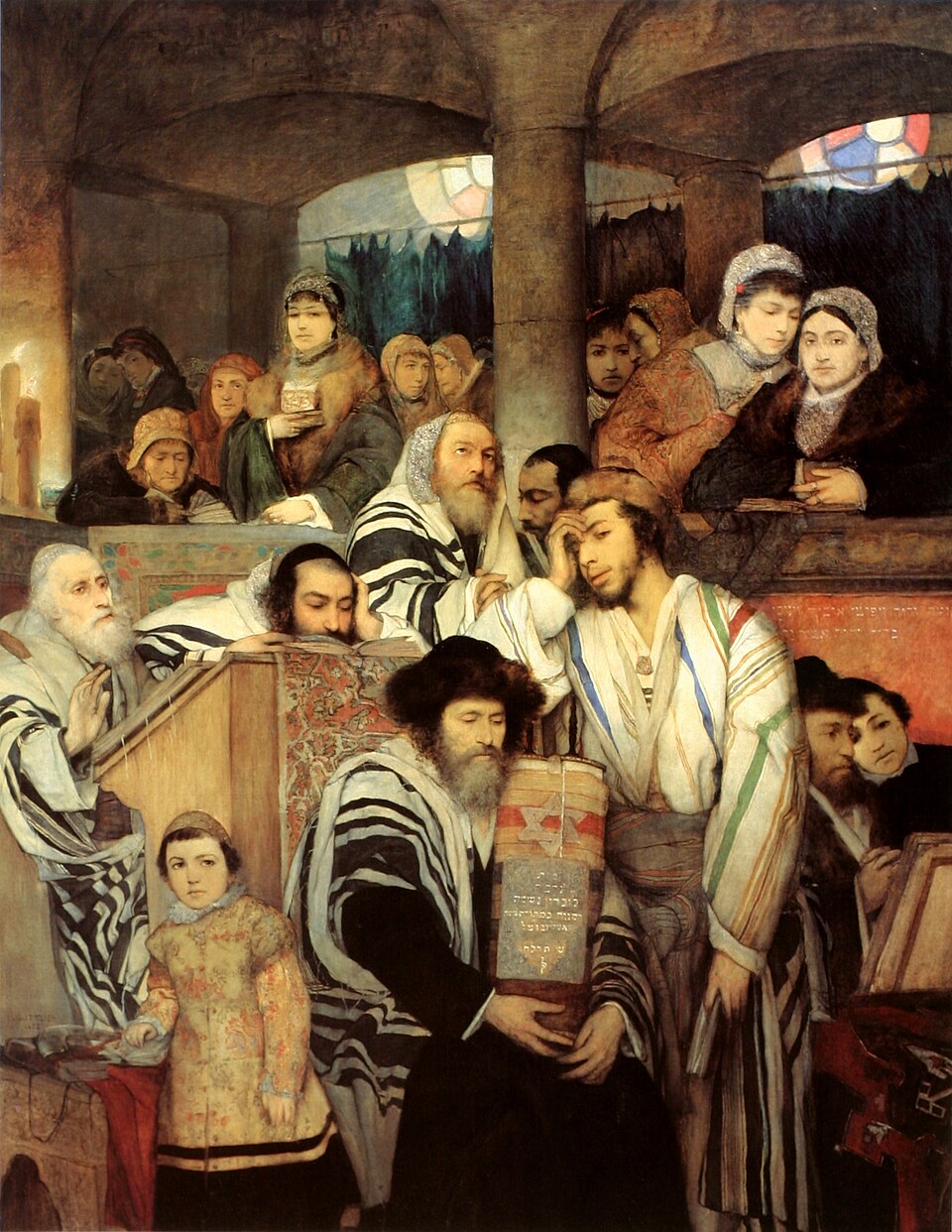
An oil painting of a crowded synagogue interior on Yom Kippur: men in prayer shawls fill the foreground around a seated elder holding a Torah scroll, while women look on from a balcony behind. The artist painted himself into the scene.
Jewish Artists

Painter · 1856–1879

Maurycy Gottlieb

Galician-Polish Jewish painter, a student of Jan Matejko in Kraków. Gottlieb painted Jewish subjects with the high seriousness Polish historical painters reserved for national mythology. “How deeply I wish to eradicate all the prejudices against my people!” he wrote to a friend from Rome in 1878. His 1878 Jews Praying in the Synagogue on Yom Kippur is one of the masterworks of 19th-century Jewish self-representation: Gottlieb stands among the worshippers, twenty-two years old, wearing the white kittel that Jews wear on Yom Kippur and are buried in, and the mantle of the Torah scroll carries a memorial inscription with his own Hebrew name and the date 1878. He died the following year. His work hangs at the Tel Aviv Museum of Art and the National Museum, Warsaw.

Tel Aviv Museum of Art · National Museum, Warsaw · Tel Aviv Museum of Art ↗ · Larry Silver on Gottlieb’s Christ Teaching at Capernaum, Smarthistory ↗

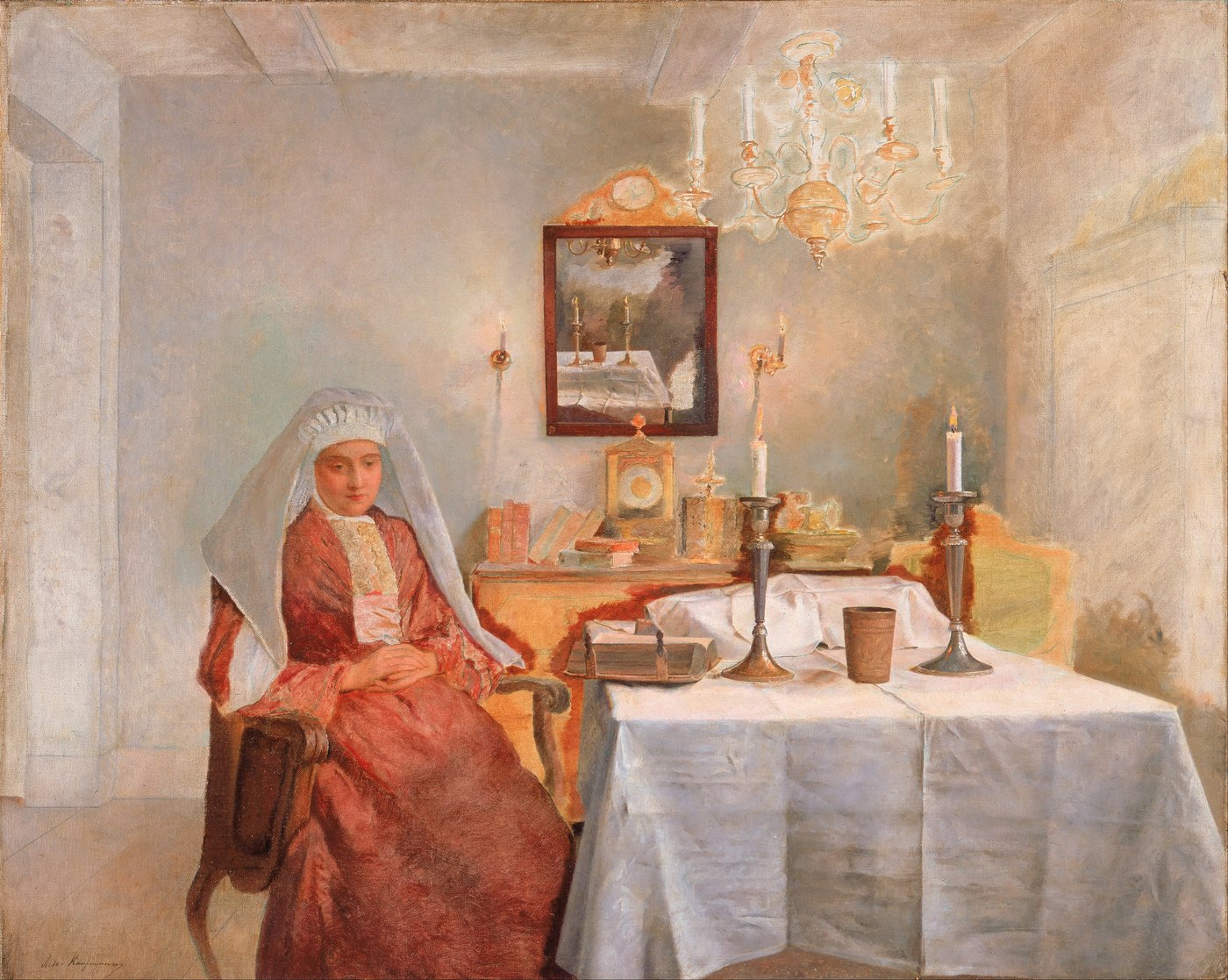
Isidor Kaufmann's painting Friday Evening: a woman stands beside a table set with Sabbath candles in a quiet room
Jewish Artists

Painter · 1853–1921

Isidor Kaufmann

Austro-Hungarian painter who specialized in scenes of Eastern European Jewish ritual life, Shabbat tables, rabbis at study, women lighting candles. His paintings are some of the most detailed surviving visual records of a civilization that was almost entirely destroyed within twenty years of his death. The Jewish Museum (Vienna) and the Israel Museum hold his work.

Image: Isidor Kaufmann, Friday Evening, c. 1920. The Jewish Museum, New York. Public domain by age. · Jewish Museum Vienna ↗

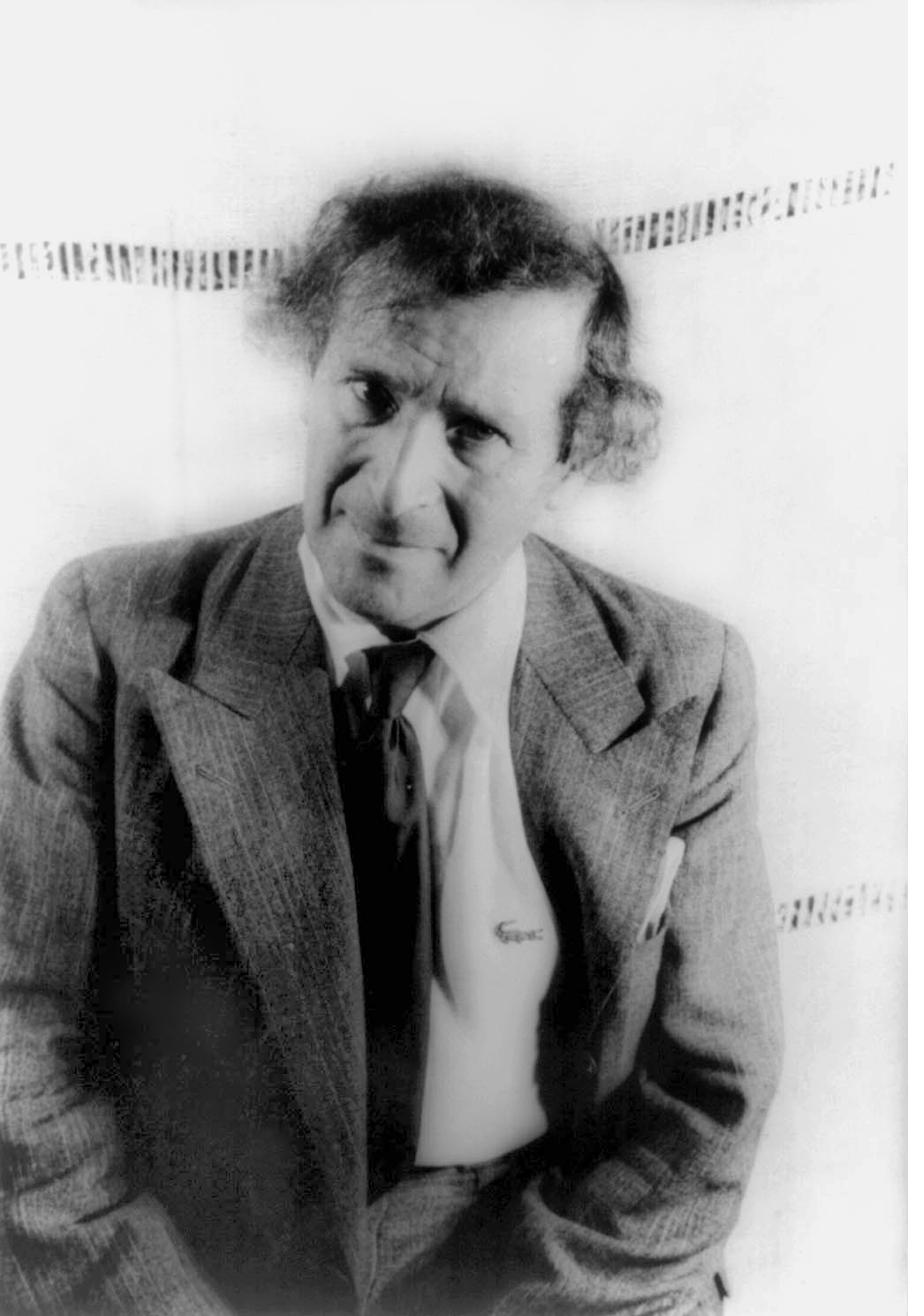
A 1941 portrait photograph of Marc Chagall standing in a tweed suit and tie, hands in his pockets, against a light backdrop
Jewish Artists

Painter · 1887–1985

Marc Chagall

Born in Vitebsk in the Pale of Settlement, Chagall carried the visual world of Russian Jewish village life (the violinist on the roof, the floating bride, the rabbi with the Torah) into 20th-century European modernism. Survived both World Wars and the Holocaust in exile. His stained-glass commissions include the windows at Hadassah Hospital, the Metz Cathedral, and the UN headquarters.

Image: Marc Chagall photographed by Carl Van Vechten, 1941, Library of Congress. Musée national Marc Chagall → USHMM Holocaust Encyclopedia → Artsy: his Jewish identity → His Jewish identity in his paintings →

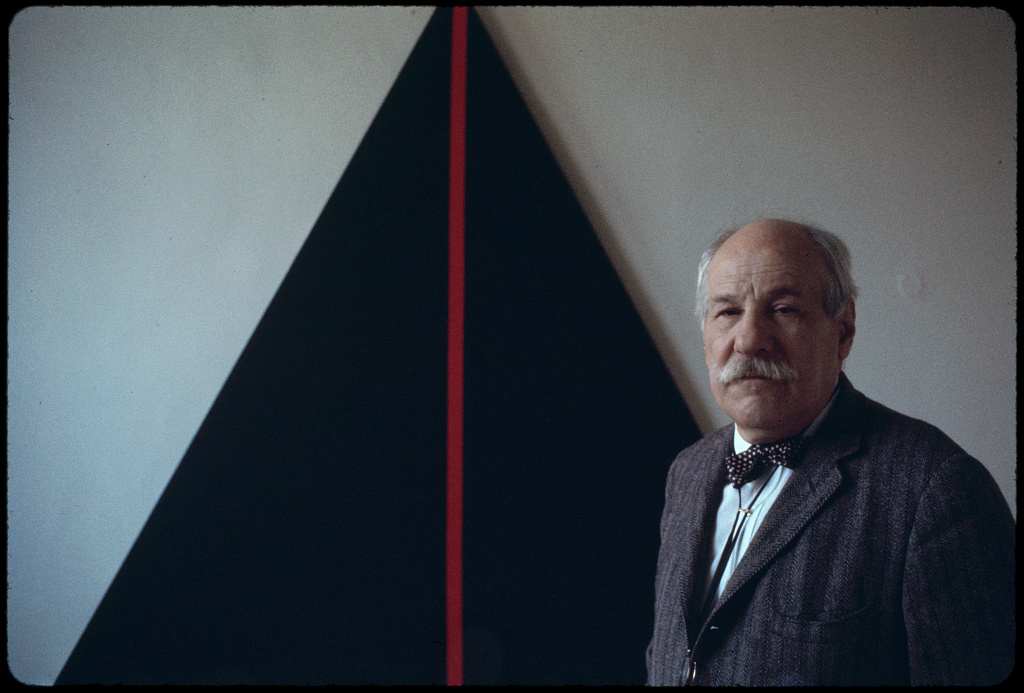
A 1969 color photograph of Barnett Newman in a tweed jacket and bow tie, standing beside a triangular black canvas split by a vertical red stripe
Jewish Artists

Painter · 1905–1970

Barnett Newman

Painter and theorist of the New York School, born in New York to Polish Jewish immigrants. He studied philosophy at City College and came to painting at nearly thirty years old. His breakthrough, Onement I (1948), runs a single band of light through a field of deep red. He called such bands zips, and they became his signature; one crosses the canvas beside him here. His titles kept reaching into scripture: Abraham, Covenant, Cathedra, the fourteen Stations of the Cross. The Museum of Modern Art holds some sixty of his works, Onement I among them.

Image: Barnett Newman photographed by Bernard Gotfryd, 1969, Library of Congress. MoMA: his life and works → Onement I →

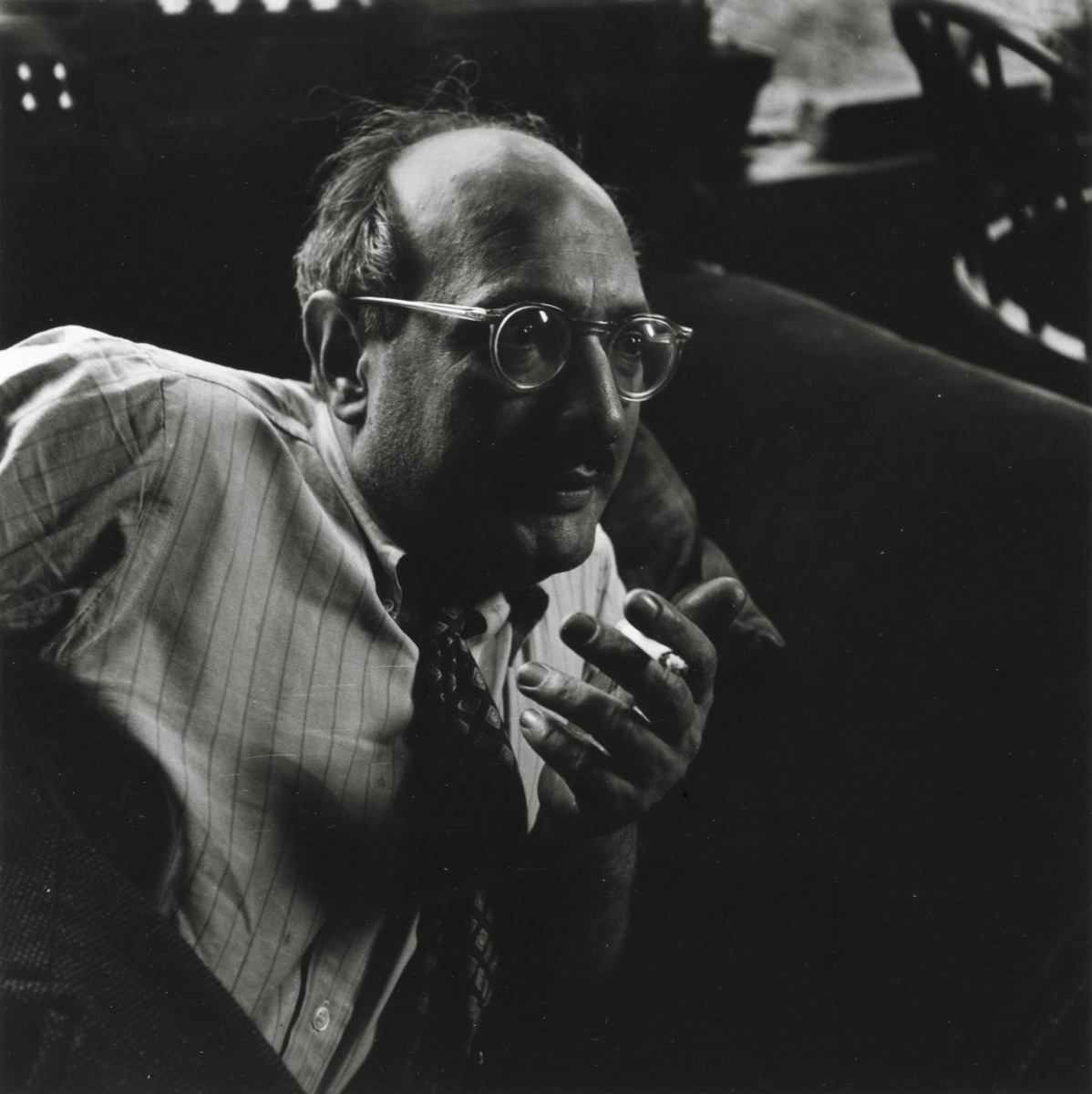
A black and white photograph of Mark Rothko in round glasses and a striped shirt, seated in shadow with a cigarette
Jewish Artists

Painter · 1903–1970

Mark Rothko

Born Markus Rothkowitz in Dvinsk, in the Russian Empire (today Daugavpils, Latvia). He arrived in New York as a boy in 1913, and the family settled in Portland, Oregon. His mature paintings float rectangles of color against fields of color. He meant them, he said, to carry basic human emotions: tragedy, ecstasy, doom. The chapel that bears his name in Houston is filled with fourteen of his darkest paintings. The Museum of Modern Art and the National Gallery of Art hold major collections of his work.

Image: Mark Rothko photographed by Consuelo Kanaga, c. 1949, Brooklyn Museum, no known copyright restrictions. MoMA: his life and works → National Gallery of Art →

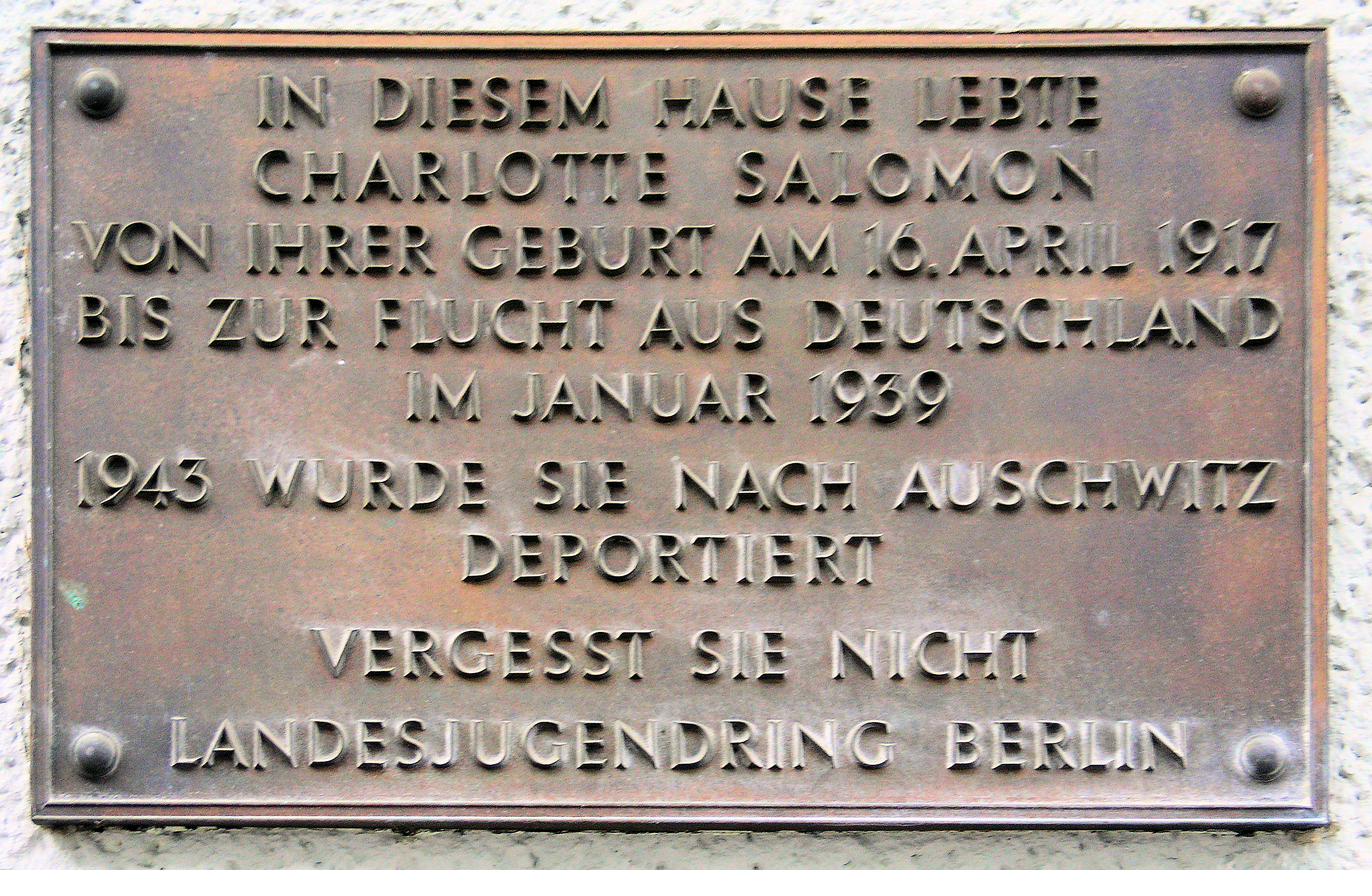
Memorial plaque for Charlotte Salomon in Berlin
Jewish Artists

Painter · 1917–1943

Charlotte Salomon

German Jewish artist who created Life? or Theatre?, a large autobiographical cycle of gouaches, while living in exile in the south of France during the Holocaust, after internment at Gurs. She was deported to Auschwitz in 1943 and murdered at age twenty-six. The work belongs to the Charlotte Salomon Foundation and is held at the Jewish Museum Amsterdam.

Image: Charlotte Salomon memorial plaque, Berlin-Charlottenburg, photograph by OTFW, CC BY-SA.

A studio portrait of a young woman in a wide-brimmed hat trimmed with flowers beside an older bearded man in a dark hat, from the People of a Thousand Towns collection documenting Jewish life in Eastern Europe
Jewish Artists

Photographer · 1897–1990

Roman Vishniac

Both an artist and a primary source. Commissioned by the Jewish Joint Distribution Committee from roughly 1935 to 1938, Vishniac photographed the impoverished Jewish communities of central and Eastern Europe in the years before their destruction: Polish shtetls, Carpathian villages, the streets of a Berlin filling with Nazi signage. After 1947 he documented Displaced Persons camps and survivors rebuilding. His photographs are at once formal works of art and one of the most extensive surviving visual records, with the YIVO commissions of Alter Kacyzne and Menachem Kipnis, of a world about to be destroyed.

Explore the archive: Roman Vishniac Archive, International Center of Photography ↗ · YIVO-related photographic collections

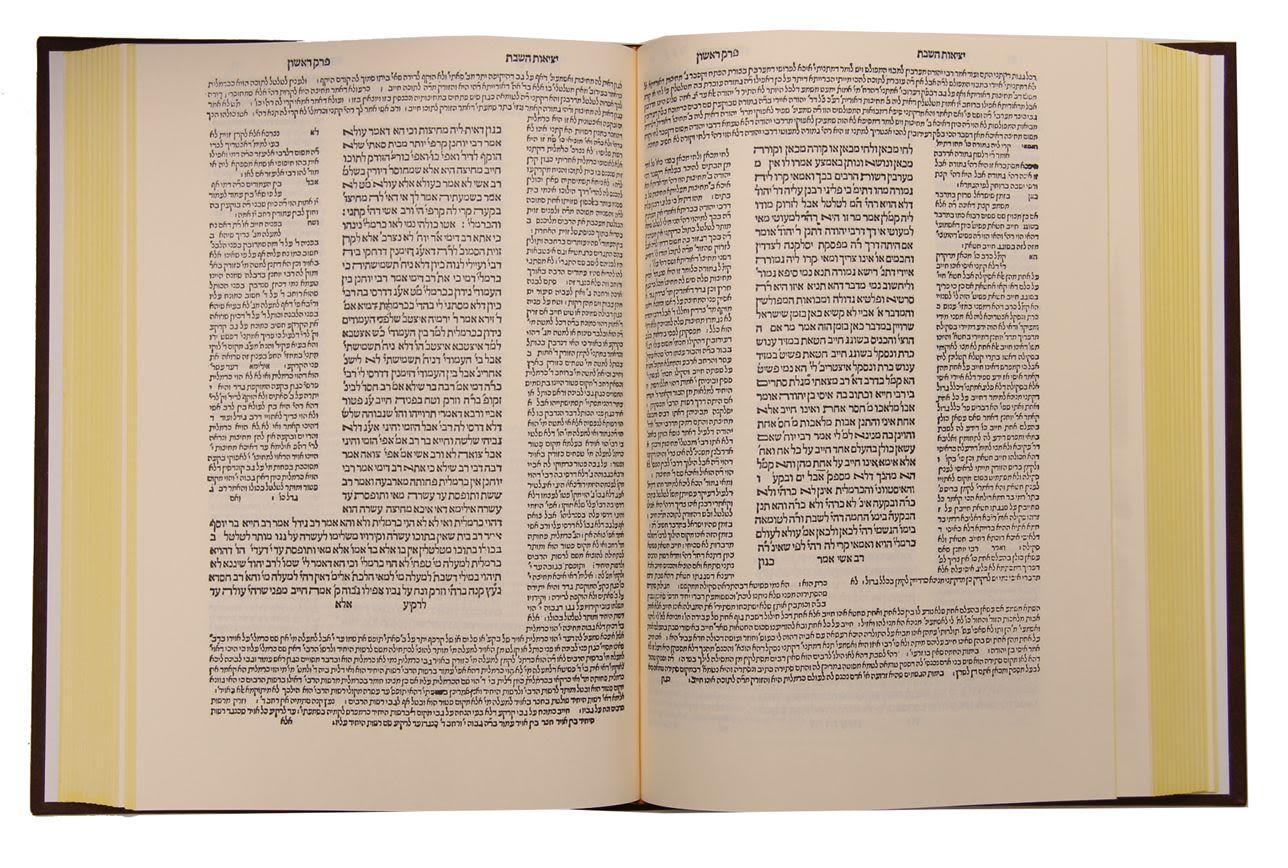
An open page of the Bomberg Venice Talmud, the central text framed on every side by columns of commentary in different typefaces.
Early Modern

Printed book · 1520–1523 · Venice

The Bomberg Talmud

The first complete printed Talmud, made in Venice by the printer Daniel Bomberg in the same years the city was building its ghetto. Its page layout (the core text in the center, ringed by layers of commentary) became the standard every later edition copied. Confinement on one island; a design that reached every Jewish library in the world.

Bomberg edition, Venice · public domain by age · Full story in The Ghetto System ↗

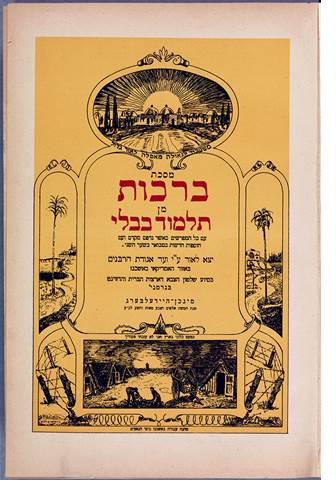
The printed title page of the Survivors' Talmud, with an inscription set above an image of barbed wire and a rising landscape.
Post-1945

Printed book · 1948 · Heidelberg, Germany

The Survivors' Talmud

Printed by Holocaust survivors with the U.S. Army on German presses in 1948, the first Talmud printed in Germany after the Holocaust, and the only edition ever published under a government's sponsorship. Its title page sets a line of hope above an image of barbed wire: a community that had just been targeted for destruction, immediately printing the book at the center of its learning, in the country that had tried to end it.

United States Holocaust Memorial Museum · USHMM ↗ · Full story in Liberation & the DPs ↗

Words & images that normalize prejudice

How prejudice was made to look normal.

This gallery is different from the others. Its objects are not here to be admired, they are evidence, studied so the technique can be recognized. Each card explains how the words or images did their work: what they showed, what they hid, and how they made hatred feel like ordinary truth. The deeper analysis lives on The Evolution of Antisemitism.

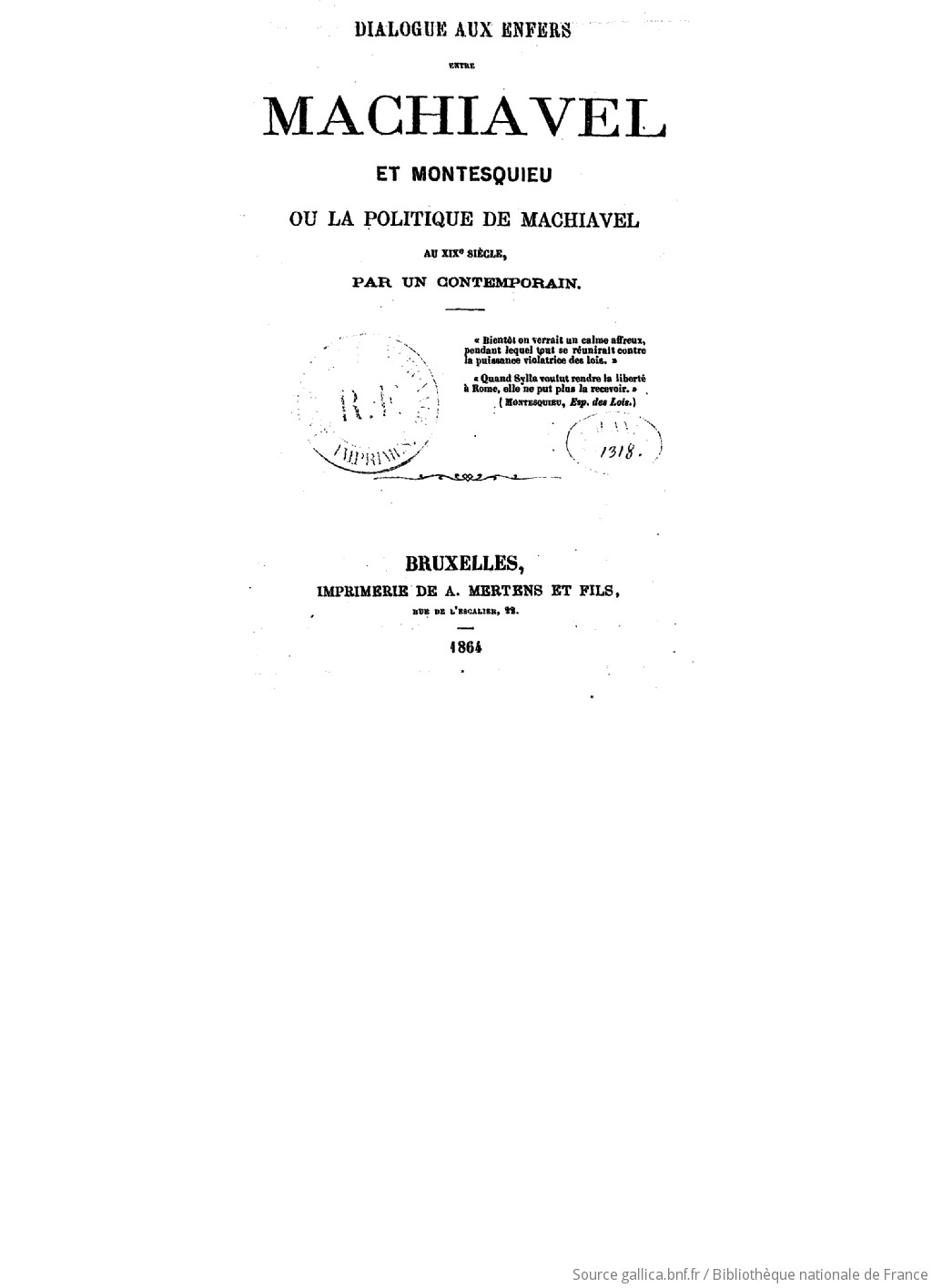
The title page of Maurice Joly's 1864 Dialogue in Hell, an unrelated French political satire later plagiarized to forge an antisemitic hoax.
Forgery · 1864 / 1903

Book · the source of a hoax

The Book Behind the Forgery

Maurice Joly's Dialogue in Hell (1864) was a French satire attacking Napoleon III, nothing to do with Jews. Decades later, forgers lifted whole passages from it, swapped in Jewish villains, and published the result as the Protocols of the Elders of Zion, a fake plan for world domination. A London Times reporter exposed the plagiarism in 1921 by laying the two texts side by side.

How it normalizes prejudice The forgery works by theft and disguise: real, persuasive writing is stolen, its target swapped, and the result presented as a secret document. Dressed as evidence "leaked" from the enemy, a pure invention reads as proof.

Bibliothèque nationale de France · public domain · Full story in The Protocols ↗

Text · primary source
Imperial History

Imperial History · c. 110 CE

Tacitus · Histories, Book V

The fullest surviving hostile Roman account of the Jews, written about forty years after the destruction of the Second Temple; Cicero's courtroom sneer came earlier, but nothing this complete. Tacitus describes Jewish practices as "base and abominable" and Jews as regarding "the rest of mankind with all the hatred of enemies." A foundational text in the long history of European antisemitism, and one of the primary sources Unit 3's Adversus Judaeos Chapter reads in full.

Image based on the public-domain Oxford 1912 translation title text · LacusCurtius (University of Chicago) ↗

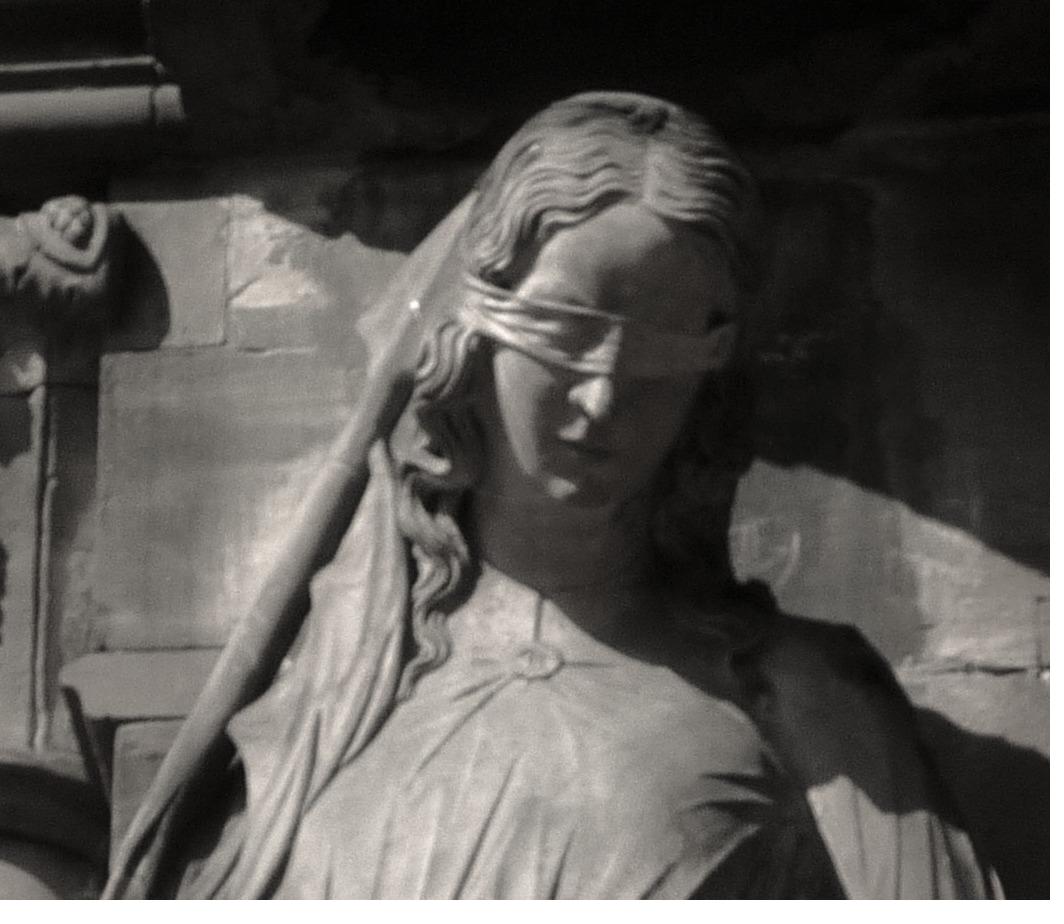
The Synagoga statue from Strasbourg Cathedral: a blindfolded female figure with a broken staff
Cathedral sculpture

Cathedral sculpture · c. 1230

Ecclesia and Synagoga

The paired figures of the triumphant Church (Ecclesia, crowned and upright) and the defeated Synagogue (Synagoga, blindfolded, her staff broken, the tablets of the Law slipping from her hand) appear on the portals of major medieval cathedrals. The example here is from Strasbourg, c. 1230. The theology made visible, with Judaism depicted as superseded and blind to truth. One of the most widespread vehicles by which Christian anti-Judaism was taught to a public that mostly could not read.

Originals of c. 1230 in the Musée de l'Œuvre Notre-Dame, Strasbourg; copies stand on the cathedral · photograph, CC BY-SA · see also Adversus Judaeos

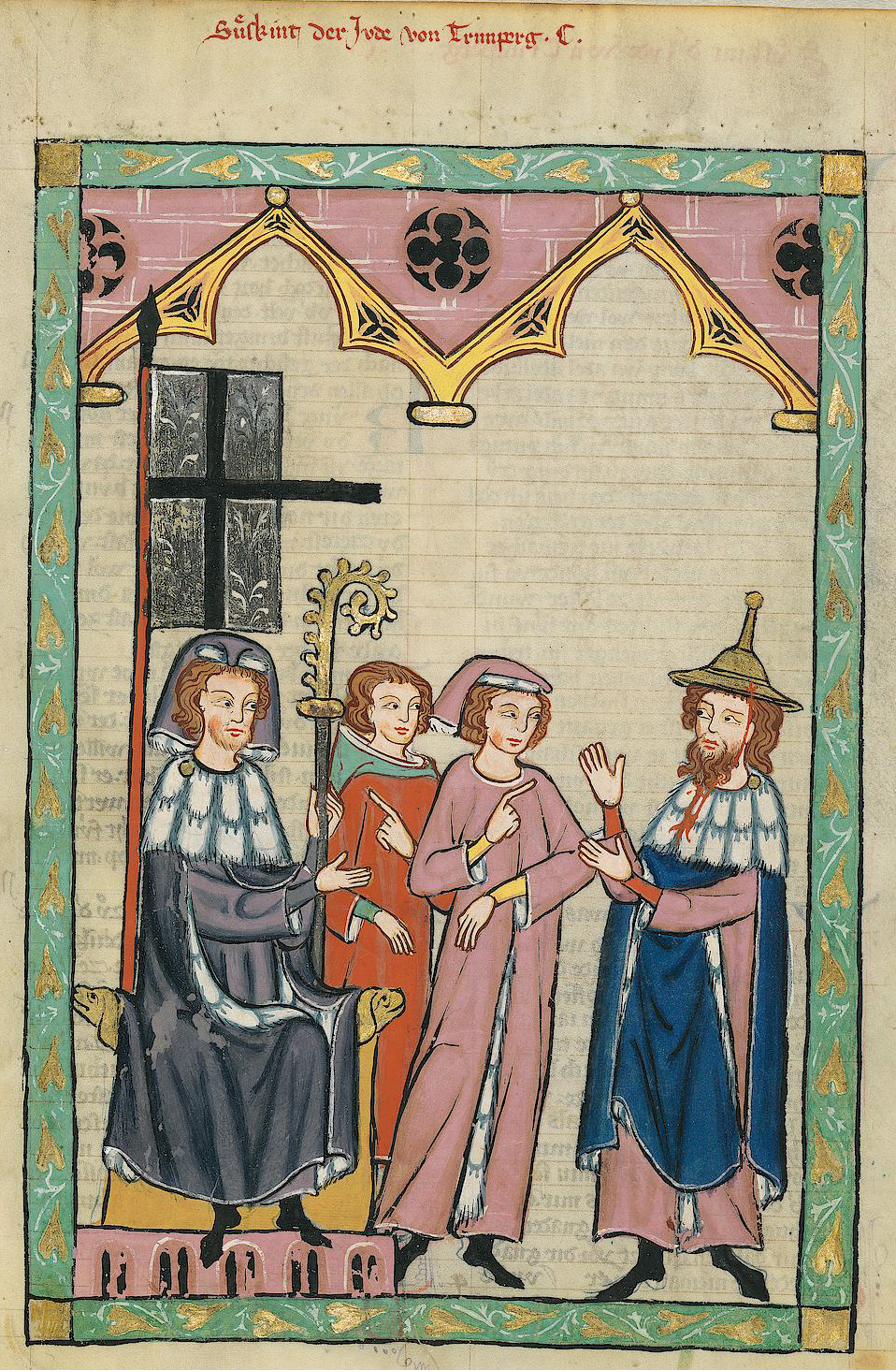
A medieval manuscript illustration showing the Jewish poet Süsskind von Trimberg in the pointed Judenhut
Illuminated manuscript

Illuminated manuscript · c. 1300–1340

The Marking of Jews · the Judenhut

This illumination from the Codex Manesse depicts the Jewish poet Süsskind von Trimberg wearing the pointed Judenhut (Jewish hat). The Fourth Lateran Council of 1215 required Jews and Muslims to wear distinguishing dress so they could be told apart from Christians. It is the institutional ancestor of every later marking decree, including the yellow badge the Nazis revived seven centuries later. Here it appears almost matter-of-factly, marking the figure as Jewish.

Codex Manesse, Heidelberg University Library (Cod. Pal. germ. 848) · public domain Heidelberg University Library ↗

Historical engraving documenting the medieval Judensau relief
Architectural relief

Architectural relief · 13th–15th c.

The Judensau Reliefs

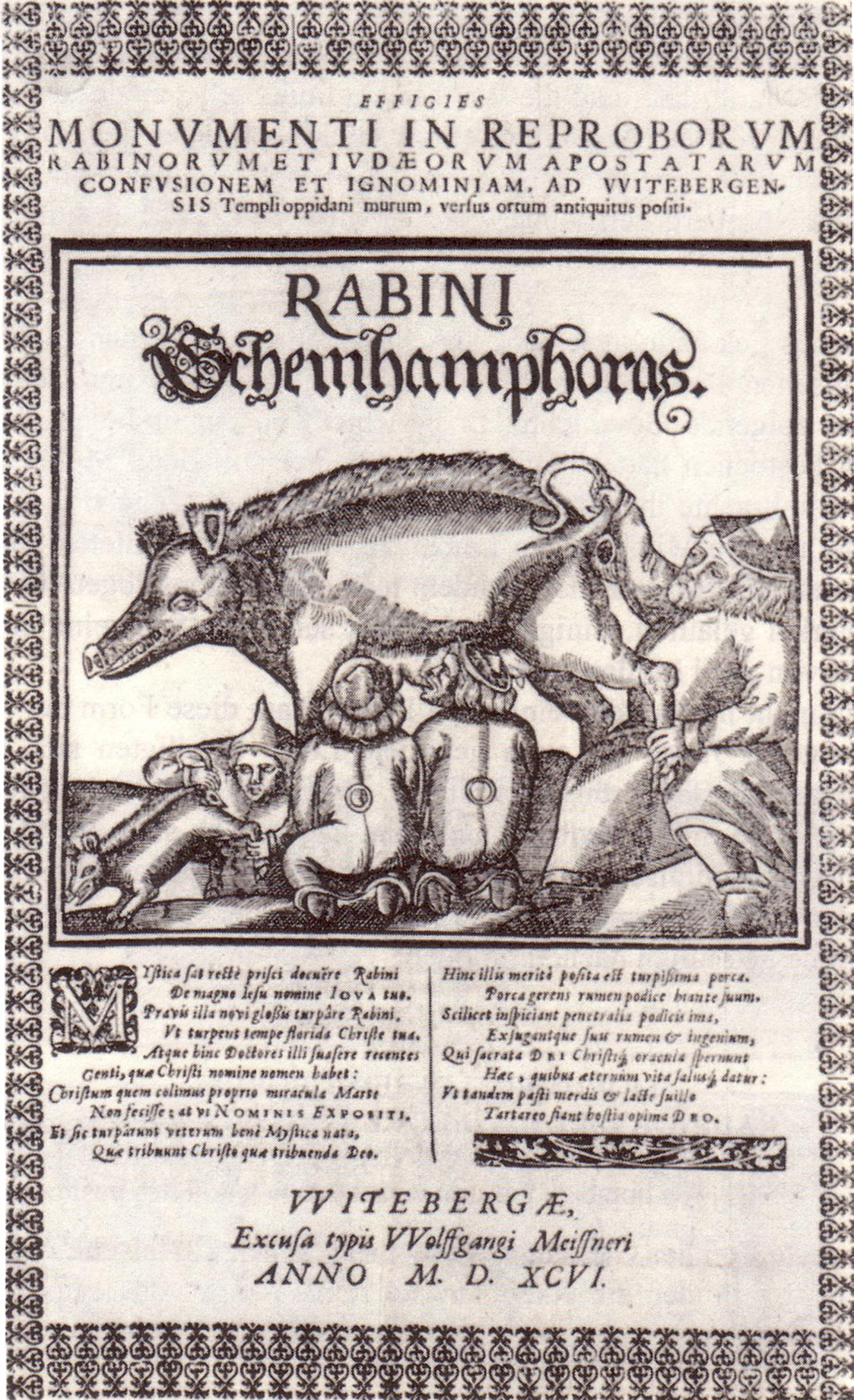
Carved on the exterior of medieval German churches, most notably at the Wittenberg Stadtkirche where Luther preached, these reliefs depict Jews suckling and feeding from a sow. Roughly thirty examples survive on churches across Germany, Austria, and Poland. The Wittenberg relief remains in place; in 2022 the German Federal Court of Justice declined to order its removal. Primary evidence of medieval and early-modern Christian antisemitism, still physically present.

Wittenberg Stadtkirche · Documented by the Stiftung Luthergedenkstätten · USHMM on antisemitism ↗

A 1493 woodcut depicting the blood-libel accusation surrounding Simon of Trent
Printed woodcut

Printed woodcut · 1493

Simon of Trent · Blood Libel

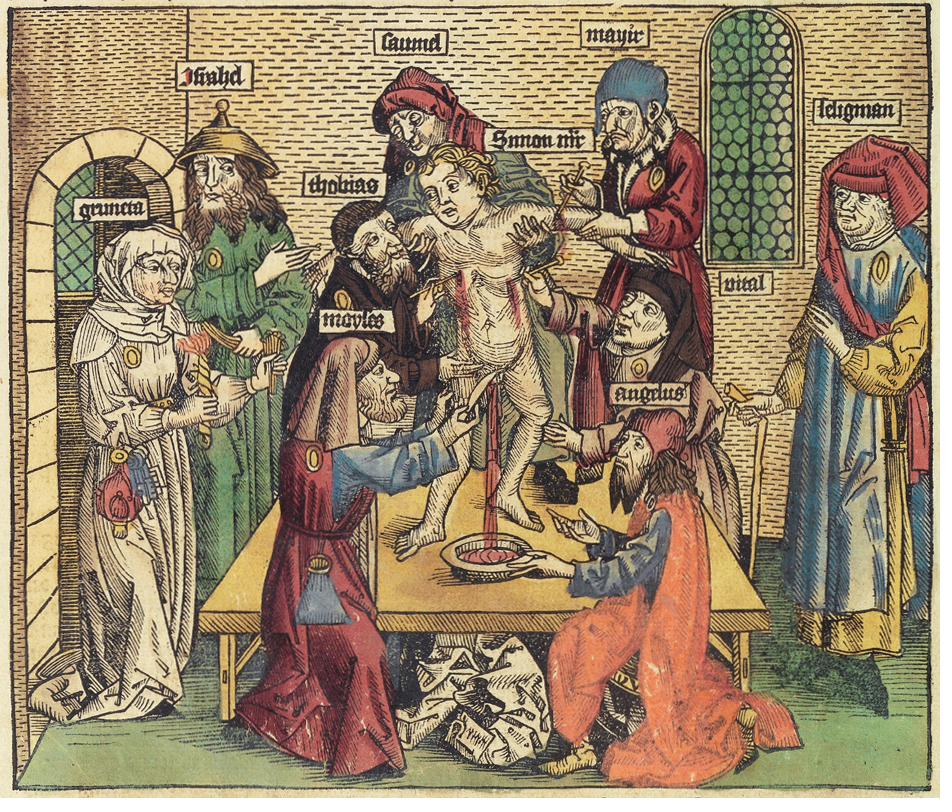
A woodcut from the Nuremberg Chronicle (1493) depicting the alleged ritual murder of a Christian child, Simon of Trent, by named members of the local Jewish community in 1475. The charge led to the torture and execution of the town's Jews. The "blood libel" was a recurring medieval and early-modern accusation with no basis in fact. Printed in one of the first mass-produced illustrated books, it shows how the printing press accelerated the spread of antisemitic myth.

Hartmann Schedel, Nuremberg Chronicle, 1493 · public domain · Library of Congress ↗

An engraved portrait of Pope Paul IV, elderly and bearded, in a papal cape and skullcap
Papal Bull

Papal Bull · July 14, 1555

Cum nimis absurdum

Pope Paul IV's bull codifying the ghetto system across the Papal States. The Latin opens: "Cum nimis absurdum et inconveniens existat", "Since it is exceedingly absurd and improper" that Jews live among Christians as their equals. Confined Roman Jews to a walled quarter, required identifying yellow hats, restricted them to limited trades; compulsory conversionary sermons followed under Gregory XIII in 1584. The full bull is preserved in the Vatican Apostolic Archive.

Vatican Apostolic Archive · Full text (Jewish Virtual Library) ↗

A period antisemitic caricature from the Dreyfus-era Musee des horreurs series, shown as historical evidence
Political Caricature

Political Caricature · 1894–1906

Anti-Dreyfus Caricature

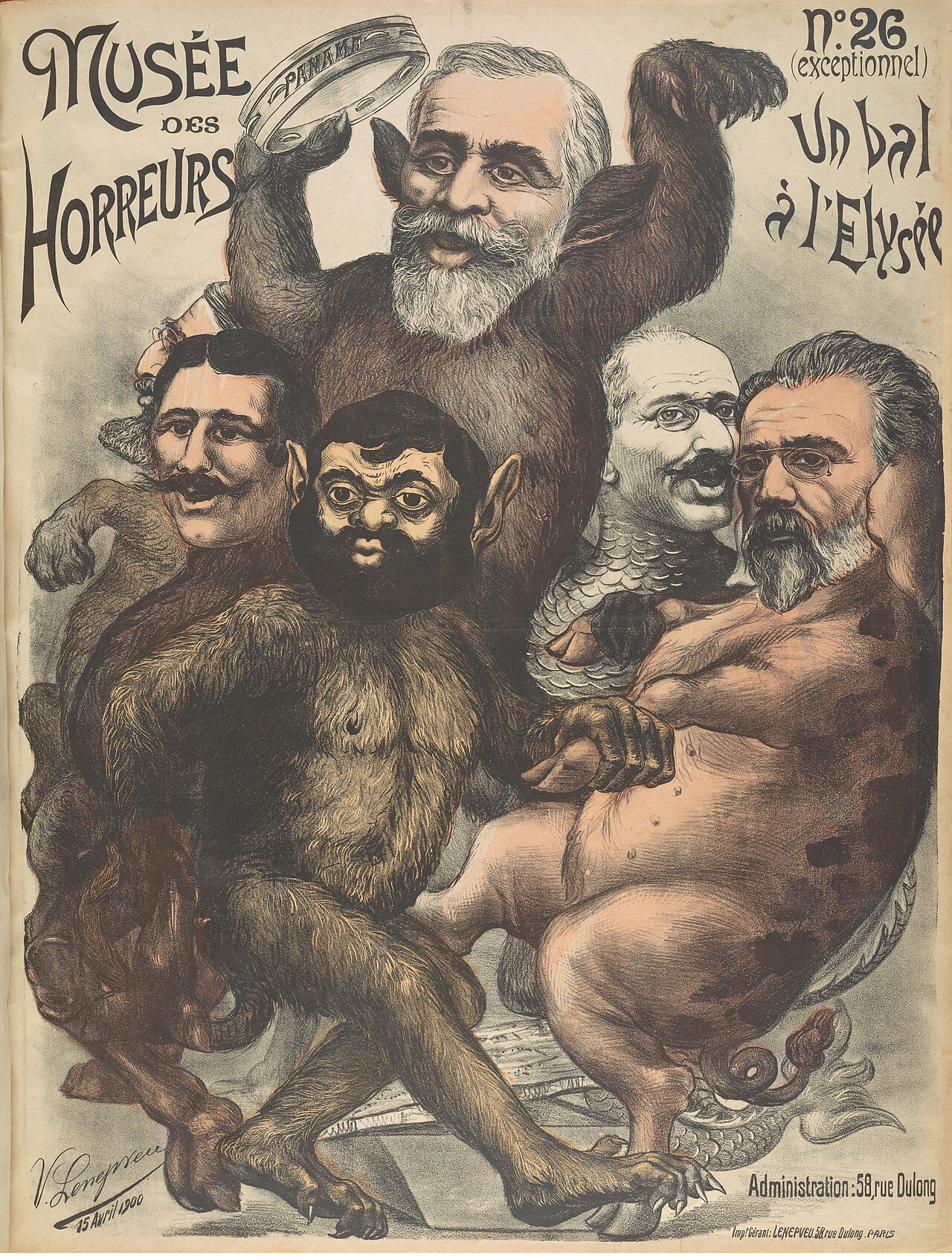
The French caricature press, La Libre Parole illustrée, Psst…!, and the poster series Musée des Horreurs (the source of this image), published thousands of antisemitic caricatures during the twelve-year Dreyfus Affair. These visual records document how 19th-century racialized antisemitism circulated through mass-market print culture before reaching its administrative apotheosis in the 1930s. Held in the Bibliothèque nationale de France.

Bibliothèque nationale de France · BnF Gallica digital collection ↗

Der ewige Jude exhibition poster, Munich 1937: Nazi propaganda shown as documented historical evidence
Propaganda

Propaganda · 1937

Der ewige Jude · Exhibition Poster

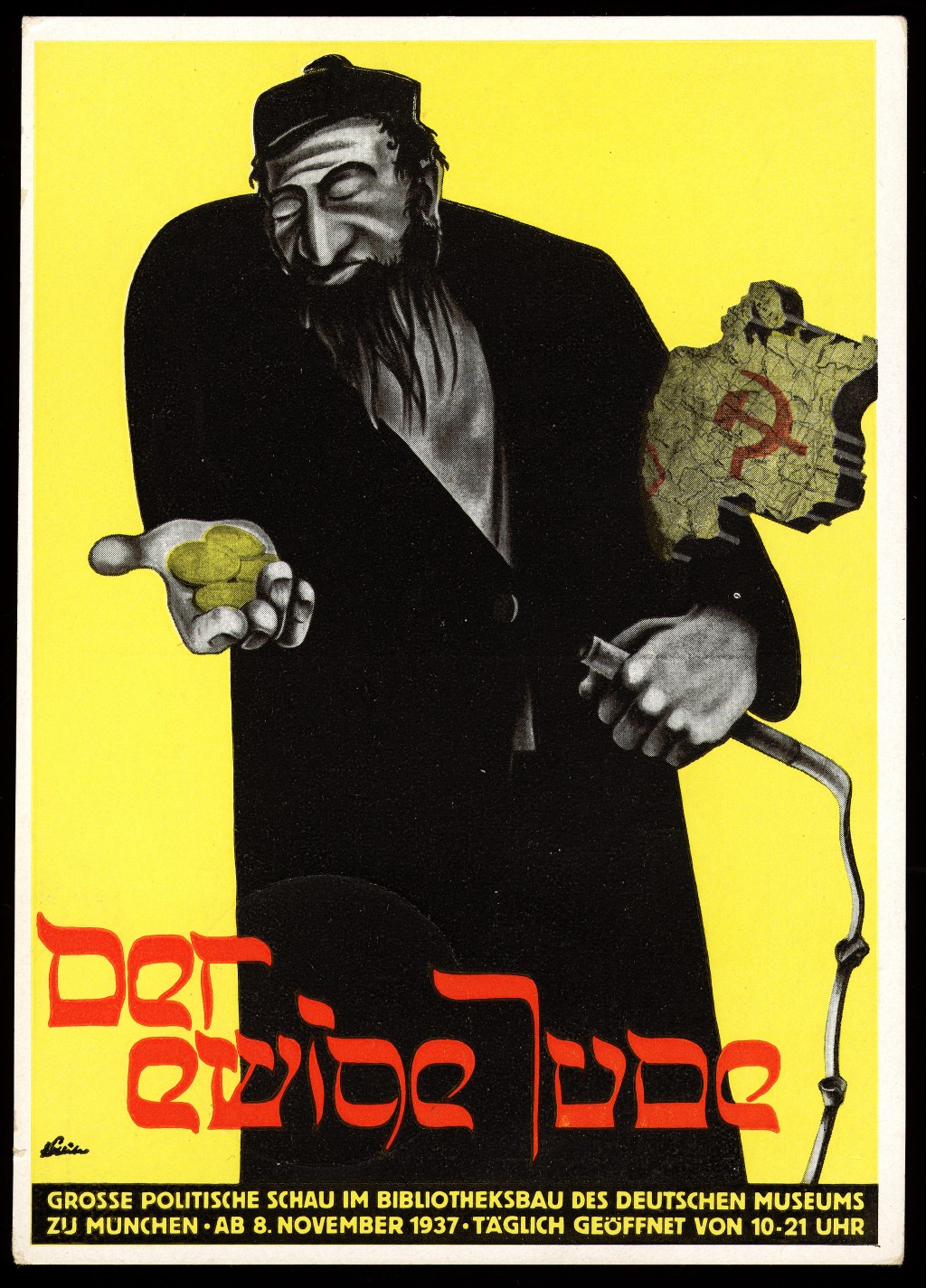
Poster for the 1937 Munich Nazi propaganda exhibition The Eternal Jew. Depicts a stereotyped Jewish figure carrying coins, a whip, and a map of the Soviet Union, combining the medieval coin-and-usury trope with 20th-century racial-conspiracy iconography. The exhibition drew approximately 412,000 visitors in under three months in Munich before touring. The 1940 film of the same name extended the propaganda into the Holocaust years. Held at USHMM.

United States Holocaust Memorial Museum · Holocaust Encyclopedia ↗

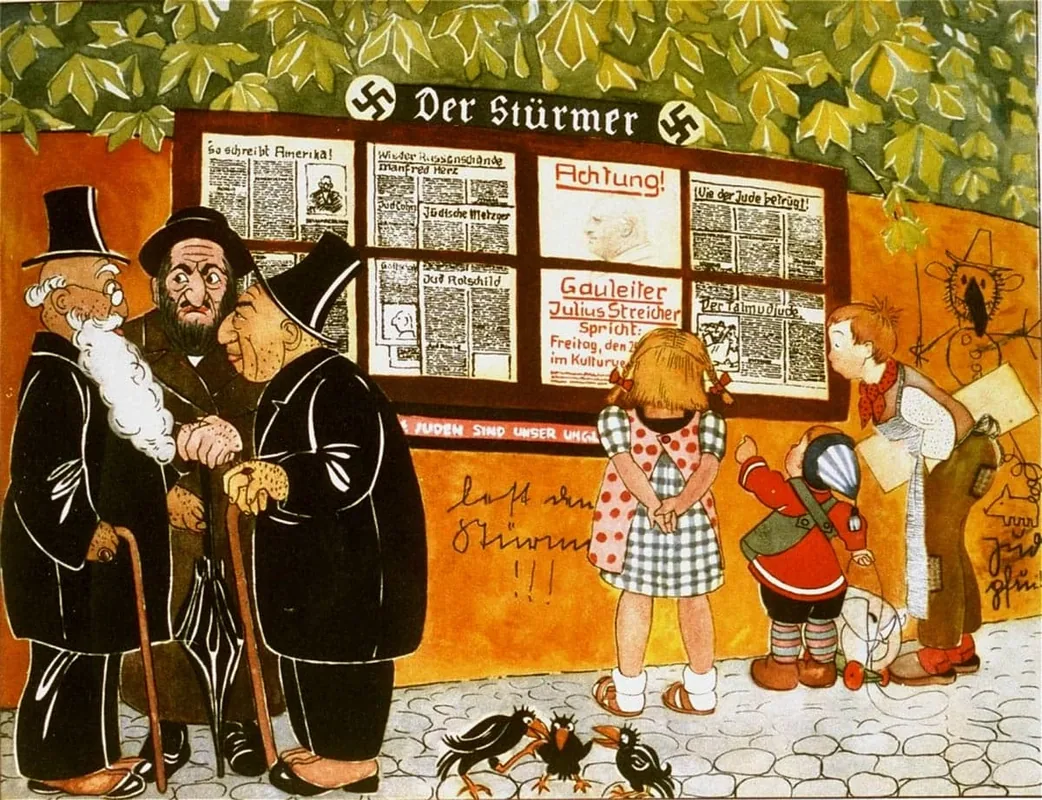
Illustration from the 1936 Nazi children's book Trust No Fox in the Green Meadow and No Jew on his Oath: antisemitic propaganda shown as documented historical evidence
Propaganda

Children's book · 1936

Trust No Fox

A page from Trau keinem Fuchs auf grüner Heid und keinem Jud bei seinem Eid ("Trust No Fox in the Green Meadow and No Jew on His Oath"), an antisemitic picture book published in 1936 by Julius Streicher's Stürmer-Verlag for German children. Children crowd a Der Stürmer display board to read the headlines, "The Jews are our misfortune" and "How the Jew cheats", while caricatured Jewish figures are driven off. The regime taught the hatred to the young on purpose: the inverse of what an education is for.

United States Holocaust Memorial Museum · USHMM Holocaust Encyclopedia ↗

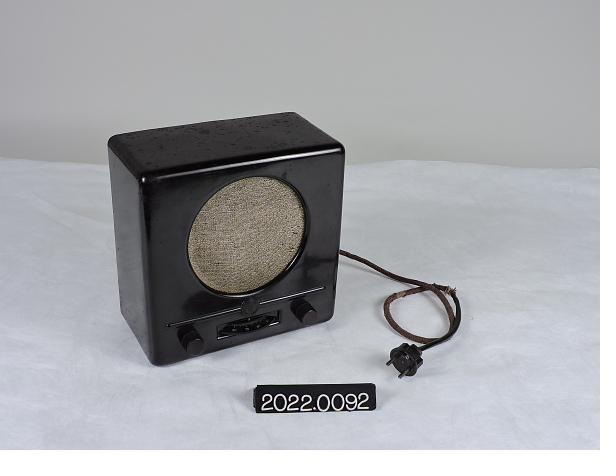
A Volksempfänger, the Nazi-era German people's radio receiver, against a museum backdrop
Broadcast Propaganda

Broadcast Propaganda · 1939–1945

Nazi Arabic-Language Radio

Between 1939 and 1945 Nazi Germany broadcast more than seventy antisemitic Arabic-language radio programs per week into the Middle East, from the Zeesen transmitter near Berlin and from regional outposts. Voice scripts, broadcast logs, and German foreign-ministry correspondence are preserved at USHMM and at the National Archives. The propaganda's regional reach and lasting effects are documented by the historian Jeffrey Herf.

Image: Volksempfänger ("people's receiver"), the mass-produced German radio of the period, shown to illustrate how broadcasts reached households · Smithsonian Institution · USHMM Holocaust Encyclopedia ↗

The 1935 Nuremberg Laws racial chart, using circles to classify people as German, Mischling, or Jewish
Racial Law

Legal Codification · 1935

The Nuremberg Laws Racial Chart

This 1935 chart, titled Die Nürnberger Gesetze ("The Nuremberg Laws"), turned the new race laws into a diagram. Using white and black circles to mark "German" and "Jewish" grandparents, it sorted people into legal categories: Deutschblütiger (German-blooded), Mischling (mixed), and Jude (Jew). Then it spelled out which marriages were permitted or forbidden. It shows how a regime translated prejudice into bureaucratic rule, reducing human identity to a grid of dots.

Image: "Die Nürnberger Gesetze" racial chart, 1935 · shown as documented legal/propaganda evidence · USHMM Holocaust Encyclopedia ↗

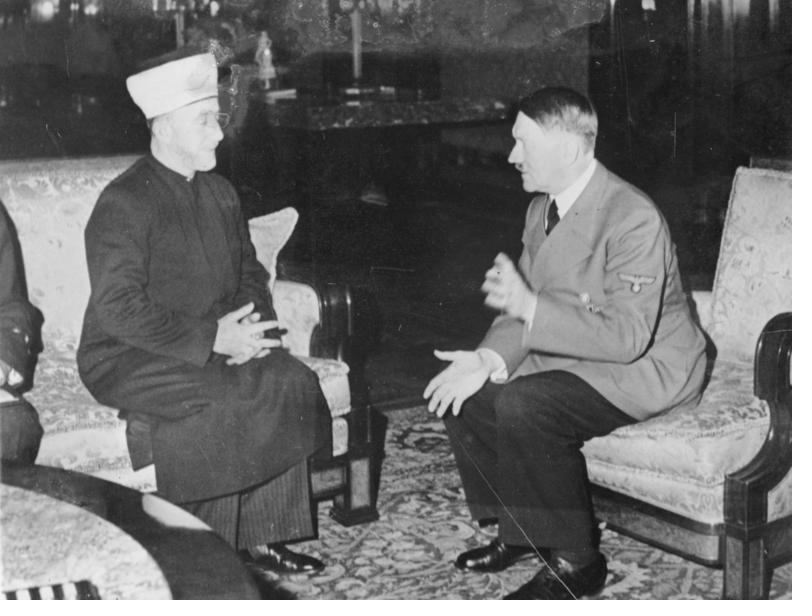
Amin al-Husseini, the Grand Mufti of Jerusalem, meeting Adolf Hitler in Berlin, December 1941
Photograph

Photograph · December 1941

The Mufti and Hitler, Berlin

Amin al-Husseini, the Grand Mufti of Jerusalem, received by Hitler in Berlin on November 28, 1941. From Berlin, al-Husseini broadcast antisemitic propaganda in Arabic across the Middle East and helped recruit Muslim units for the SS. The photograph documents a link between European Nazism and the wartime Arab world.

German Federal Archives (Bundesarchiv Bild 146-1987-004-09A) · CC-BY-SA · documented by USHMM ↗

Where to see more

Museums & online collections.

The home institutions of every object above, alongside other major museums and libraries whose Jewish collections are online, most of them free and fully digitized. For curated shows rather than catalogs, the Special exhibitions below gather virtual tours and interactive features you can walk through. Many are also global spots worth the trip in person; the Field Trips travel guide maps them, and dozens more, country by country.

7dorim · Iranian Jewish Culture. An archive of the culture, history, and daily life of the Jews of Iran: "seven generations," gathering photographs, documents, and community memory. 7dorim.com →
ANU · Museum of the Jewish People. Tel Aviv's museum of the whole Jewish story across geography and time, with online exhibitions and a deep genealogical database. anumuseum.org.il →
The Braginsky Collection. Illuminated Hebrew manuscripts, decorated marriage contracts, and Esther scrolls from across the diaspora, in a high-resolution zoom viewer. braginskycollection.com →
The British Museum. Object records for pieces that frame the ancient Near East (among them the Babylonian Chronicle and the Taylor Prism), searchable online. britishmuseum.org →
Cambridge Digital Library · Genizah. The Cairo Geniza online: biblical manuscripts, letters, contracts, and the everyday paper of a thousand years of Mediterranean Jewish life. cudl.lib.cam.ac.uk →
Center for Jewish History. The shared home of five major partner collections in New York, with a deep set of online exhibitions drawing on their combined archives. cjh.org →
Diarna · Geo-Museum of MENA Jewish Life. A geo-museum mapping the endangered Jewish heritage of the Middle East and North Africa: synagogues, schools, and shrines preserved through satellite imagery, 3D models, photographs, and place-based oral histories, with online exhibits by region. diarna.org →
Digital Bodleian · Oxford. Among its treasures, a copy of Maimonides' Mishneh Torah corrected in the author's own hand, fully digitized, free, high-resolution. digital.bodleian.ox.ac.uk →
German Propaganda Archive · Calvin University. A scholarly archive of translated Nazi and East German propaganda: posters, caricatures, school wall charts, and the propagandists’ own instructions, compiled by Prof. Randall Bytwerk. Studied as evidence of how the material was built. research.calvin.edu →
The Iraqi Jewish Archive. "Discovery & Recovery": the documentary record of one of the oldest Jewish communities on earth, recovered from a flooded Baghdad basement in 2003. ijarchive.org →
Israel Antiquities Authority · Dead Sea Scrolls. The Leon Levy Digital Library: nearly 1,750 scroll fragments in high-resolution spectral images, searchable by site, language, or text. deadseascrolls.org.il →
The Israel Museum · Archaeology Wing. The archaeology of the land of Israel, including inscriptions of the kings of Judah, seals, and the material record of the First and Second Temple periods. imj.org.il →
The Israel Museum · Collection Galleries. The collection galleries of Israel's national museum: archaeology, Jewish art and life, and the Shrine of the Book, where the Dead Sea Scrolls are held. imj.org.il →
The Israel Museum · Dead Sea Scrolls. The Digital Dead Sea Scrolls project: the Great Isaiah Scroll and others, photographed at a resolution you can read word by word. imj.org.il →
Jewish Museum Berlin. Selected objects and archival holdings online: Judaica, art, and personal documents tracing German-Jewish life from the eighteenth century through the postwar period. jmberlin.de →
Jewish Museum London. An online catalogue of more than 10,000 items: ceremonial art, photographs, and the material record of Jewish life in Britain. jewishmuseum.org.uk →
The Jewish Museum · New York. Thousands of years of art and Jewish culture, with more than 1,600 collection images free to download and explore online. collections.thejewishmuseum.org →
JIMENA · Sephardic & Mizrahi Oral History. First-person testimony and country-by-country narratives of Jews from the Middle East and North Africa: an online record of communities that lived in the region for over 2,500 years, told in their own words. jimena.org →
The Leiden Yerushalmi. Leiden Or. 4720: the most important manuscript of the Palestinian Talmud, copied in 1289, the basis for every printed edition. Digitized page by page. View the manuscript →
Leo Baeck Institute. The record of German-speaking Jewry: art, manuscripts, and family papers salvaged after the Holocaust, spanning centuries of Central European Jewish life. lbi.org →
Library of Congress. Digitized historical print and documents, including period material studied in the evidence gallery, from the U.S. national library. loc.gov →
The Magnes · Maven, UC Berkeley. A searchable catalogue of one of the largest collections of Jewish art and material culture, with curated highlight sets. maven.magnes.berkeley.edu →
The Met · Open Access. The Metropolitan Museum's open-access collection: Jewish ritual objects, manuscripts, and art, with images free to use. metmuseum.org →
MoMA · Rothko and Newman. The Museum of Modern Art's online collection holds the American abstract painters Mark Rothko and Barnett Newman, with biographies and their works in high resolution. Rothko arrived from Dvinsk as a boy; Newman was born in New York to Polish Jewish immigrants. Newman's Onement I →
Museum of Jewish Heritage · New York. MJH Collections Online: more than 10,000 digitized artifacts, photographs, and ephemera of Jewish life before, during, and after the Holocaust. mjhnyc.emuseum.com →
National Library of Israel. Manuscripts, maps, photographs, music, and the Ketubbot collection: a national archive of Jewish and Israeli cultural heritage, digitized. nli.org.il →
POLIN · Museum of the History of Polish Jews. A collections portal of more than 7,000 artifacts: Judaica, artworks, photographs, and oral histories of a thousand years of Jewish life in Poland and Eastern Europe. kolekcje.polin.pl →
U.S. Holocaust Memorial Museum. The Holocaust Encyclopedia, a deep digitized collection, and the "Artifacts Unpacked" series: single objects explained by the museum for classrooms. collections.ushmm.org →
UW Stroum · Sephardic Studies Digital Collection. The world’s first major digital repository of Sephardic sources in Ladino: books, family documents, marriage contracts, and recorded songs of the Mediterranean Jewish world, from the seventeenth century to the twentieth. lib.washington.edu →
The Vatican Library · DigiVatLib. The Vatican’s digitized manuscripts, including major Hebrew codices, fully zoomable. digi.vatlib.it →
The Weitzman · Online Collection. More than thirty thousand artifacts of American Jewish life, searchable by theme, from the national museum in Philadelphia. theweitzman.catalogaccess.com →
Yad Vashem. Israel's Holocaust remembrance center: testimony, the art museum, the main museum, and rotating exhibitions, with an extensive education portal for teachers. Art Museum → · Museum → · Exhibitions →
Yale University Art Gallery · Dura-Europos. Yale excavated the Dura-Europos synagogue and holds the record: a dedicated digital project on its third-century wall paintings. duraeuropos.artgallery.yale.edu →
YIVO · Vilna Online Collections. The digitized prewar library and archives of Jewish Vilna, reunited online from New York and Vilnius. vilnacollections.yivo.org →
Where to explore more

Special exhibitions.

Not the collections above, but specific shows you can walk through, read, and play with: virtual tours, day-by-day exhibitions, and interactive features built for the web.

Virtual tour Synagogues360, ANU Museum of the Jewish People. 360° tours inside synagogues around the world, from village prayer rooms to grand city buildings, searchable by place. synagogues-360.anumuseum.org.il →
Interactive The YIVO Online Museum. The life of one Vilna girl, Beba Epstein, across ten interactive chapters with 3D models of 1930s Vilna and hundreds of artifacts. Built for grades 3 to 12. museum.yivo.org →
Virtual tour The Weitzman · Core Exhibition. A 360° walkthrough of the national museum of American Jewish history, gallery by gallery, from 1654 to today. nmajhtour.org →
Interactive archive Virtual Shtetl, POLIN Museum. A town-by-town record of nearly 1,500 Jewish communities of the old Polish-Lithuanian lands, with local histories, maps, photographs, and oral histories. sztetl.org.pl →
Online exhibition Exploring Sephardic Life Cycle Customs, UW Stroum Center. Birth, coming of age, marriage, and death among Ladino-speaking Sephardic Jews, told through artifacts of the Sephardic Studies Digital Collection, from the Ottoman Empire to the Pacific Northwest. jewishstudies.washington.edu →
Interactive Jewish Books, Jewish Worlds, Jewish Theological Seminary. A digital museum of Jewish book culture you navigate by time, place, or theme, each manuscript and printed book opening into the ones it connects to. jheritage.jtsa.edu →
3D walkthrough Hebrew Manuscripts · Journeys of the Written Word, The British Library. A navigable 3D walk through the gallery of a landmark show, zooming into some forty manuscripts from tenth-century Europe to China, a Maimonides responsum among them. v21artspace.com →
Virtual tour The Golden Path · Maimonides, Center for Jewish History. The medieval philosopher, with manuscripts in his own hand and a carved Torah ark door from the Ben Ezra Synagogue in Cairo. cjh.org →
Virtual tour How Jews Became Citizens, Center for Jewish History. The Sid Lapidus collection on Jewish emancipation in Europe, 17th to 19th century, with a zoomable timeline and a 360° gallery. cjh.org →
3D museum Shared History · 1,700 Years of Jewish Life, Leo Baeck Institute. Fifty-eight objects with scholarly essays, plus a 3D museum you move through, including a recreation of Berlin’s New Synagogue. sharedhistoryproject.org →
Online exhibition Fighting Antisemitism from Dreyfus to Today, Wiener Holocaust Library. A hundred and fifty years of antisemitism and the people who fought it, from the Dreyfus Affair through the present. wienerholocaustlibrary.org →
Interactive State of Deception · The Power of Nazi Propaganda, USHMM. How propaganda worked, from the Weimar years through the war, with posters, film, and a media-literacy frame useful in any classroom. exhibitions.ushmm.org →
Day-by-day 1933 · The Beginning of the End of German Jewry, Jewish Museum Berlin. One primary-source document for each day of 1933, so a class watches persecution tighten week by week. jmberlin.de →
Day-by-day 1938Projekt · Posts from the Past, Leo Baeck Institute. A letter, diary page, or photograph for each day of 1938, with eleven ready-to-use lesson plans. lbi.org →
Interactive My Verses Are Like Dynamite · Curt Bloch’s Underwater Cabaret, Jewish Museum Berlin. A hidden Jewish refugee’s wartime satirical magazines, ninety-six issues you can page through, with a timeline and survivor testimony. onderwatercabaret.com →
Online exhibition Americans and the Holocaust, USHMM. What Americans knew and did, built on five years of research into the press, public opinion, and American antisemitism. exhibitions.ushmm.org →
Interactive In Real Times · Arthur Szyk, The Magnes Collection. The anti-fascist artist’s political art, with a tool that lets you take a cartoon apart and rebuild it to see how it works. magnes.berkeley.edu →
Interactive story The Danish Rescue · Compassion in Action, Museum of Jewish Heritage. The 1943 rescue of Denmark’s Jews, told as a scrolling interactive map with photographs, testimony, and documents. storymaps.arcgis.com →
Online exhibition The Auschwitz Album, Yad Vashem. The 193 surviving photographs of arrival and selection at Auschwitz-Birkenau, the only visual record of the process, page by page. yadvashem.org →
Online exhibition The Anguish of Liberation, Yad Vashem. The aftermath, told through survivors’ art, documents, and stories of liberation, the displaced-persons camps, and rebuilding. yadvashem.org →

Why objects matter

Civilizations survive in what they leave behind.

Not only in their books, but in their coins, their walls, their manuscripts, and the worn objects of ordinary days. Each one is another way of asking a historical question, and often an answer no text thought to record. Every object here is held by a real institution, named and traceable; the same ones return throughout the Chapters, where the questions they raise are followed further.

Last updated: September 2026.