This Saturday, Jews in Morocco, Poland, and Argentina will read the same Torah portion, in the same ancient language. They have never met. They may share no country, no spoken language, and no belief about God.
Why this Chapter exists
The first question, usually answered too fast.
It is easy to open the Jewish story with one sentence, “Judaism is one of the world’s oldest religions,” and move on. That sentence is true, but it is incomplete. If Jews are only a religion, two parts of the later history are hard to explain: the persecution of Jews for their ancestry, whatever they believed, and the rise of a Jewish national movement.
What Jews have in common is a set of bonds, some more than 3,000 years old and some much newer, kept across many lands and through repeated attempts to destroy them.
Common misconceptions this Chapter addresses
Three common answers about who the Jews are, and how many there are, do not match the record. The dedicated Misconceptions entries lay out the evidence.
- “The Jewish people are a religious group like other religious groups, defined primarily by religious belief.” see the dedicated entry →
- “There are hundreds of millions of Jews worldwide.” see the dedicated entry →
- “Jews have always been Eastern European and Ashkenazi.” see the dedicated entry →
What Jews have in common · 1
One God, and an agreement.
At the center is the idea that there is one God, not many. For most of the ancient world, every city and nation had its own gods. The Israelites, the ancient ancestors of today’s Jews, came, across many centuries, to hold a belief their neighbors did not share: one God alone, invisible. Their own prophets describe a long struggle over it.
The idea had a political edge, too. In a world where kings and emperors could be worshiped as gods, Jews prayed for rulers but never to them. The prophet Jeremiah told the exiles in Babylon to “seek the welfare of the city to which I have exiled you and pray to GOD in its behalf.” Adversus Judaeos (Latin for “Against the Jews”) tells what that refusal to worship rulers cost.
The Israelites also understood themselves as bound to that God by a covenant, a two-sided agreement. In the words of Exodus, if the people kept God’s covenant, they would be God’s “treasured possession among all the peoples.”
The Torah, the first five books of the Hebrew Bible, tells how the covenant came about. In its account, Abraham, whom the Bible presents as the first ancestor of the Jewish people, leaves his native land at God’s command and journeys to the land of Canaan. His descendants later go down to Egypt and are enslaved there. The Torah then tells of the Exodus, the departure from Egypt led by Moses, and of the covenant at Mount Sinai, where God gives the people the Ten Commandments. Each spring at the Passover meal, Jewish families retell the Exodus to their children, as the Torah instructs. The Land of Israel Chapter sets the Bible’s account of Israel’s beginnings beside the archaeological record.
Christianity and Islam both trace their belief in one God back to Abraham. Christianity itself began among Jews. Jesus was a Jew who lived in Galilee and Judea, under Roman rule, in the first century, and his first followers were Jews too. His title, Christ, comes from the Greek Christos, “anointed one,” a translation of the Hebrew mashiach, which gives English the word Messiah. In Jewish tradition, the Messiah is a future king descended from David. Christians came to believe Jesus was that king. Judaism does not, and traditional Jewish belief still awaits the Messiah’s coming.
A Jew today may believe every word of this or none of it. Many secular Jews still use the calendar and the vocabulary that grew from the covenant.
What Jews have in common · 2
One book, read on nearly the same schedule everywhere.
Walk into a synagogue almost anywhere on a Saturday morning and you will hear the Torah read aloud. Jewish communities around the world carry the same core text: the Torah, written by hand on a scroll in a form fixed since late antiquity. They read it in weekly portions, moving through the whole scroll in a year and starting again the moment they finish.
Around that core sits a larger library: the Talmud, the vast record of the rabbis’ debates on Jewish law, compiled around 500 CE, and centuries of commentary. The rabbis were the teachers of Jewish law. The Sacred Texts Chapter explores that library.
What Jews have in common · 3
A language kept, then revived.
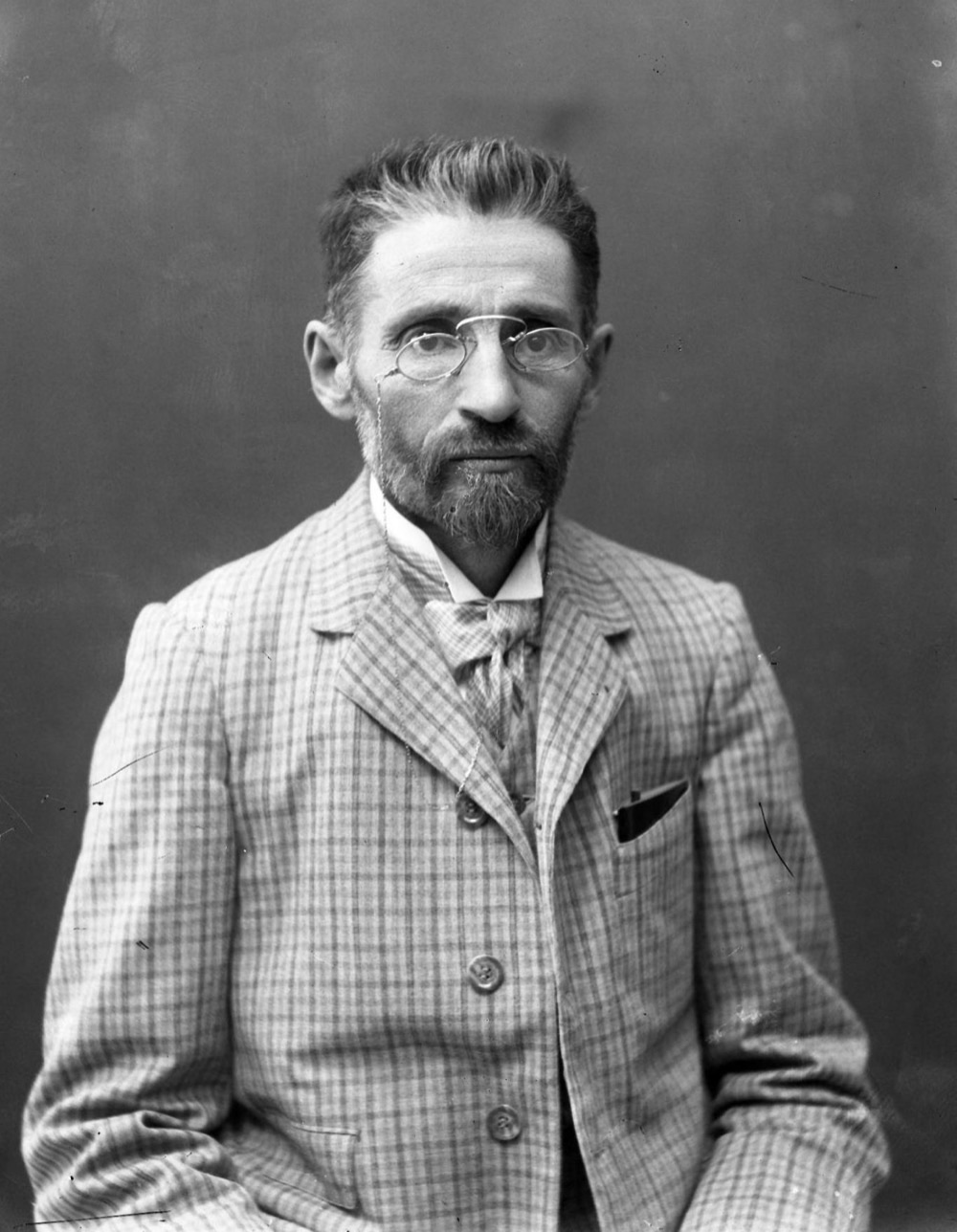
That shared reading depends on a shared language. Hebrew is the language of the Torah and of Jewish prayer. For many centuries it was kept alive mainly in study and worship, while Jews spoke the local languages of wherever they lived. A Jewish trader in medieval Cairo and a Jewish scholar in medieval Germany could not have chatted easily, but both could read the same Hebrew. In the nineteenth and twentieth centuries, Hebrew was revived as an everyday spoken language. It is now the daily speech of millions in Israel.
What Jews have in common · 4
A shared way of life: the commandments.
Judaism is at least as much about what you do as what you believe. The tradition centers on the mitzvot, the commandments, understood as the practical terms of that ancient covenant: a way of ordering daily life. They include resting on the Sabbath, from Friday evening to Saturday night. They include rules about which foods may be eaten, called kashrut, from the same Hebrew root as “kosher.” And they mark every major holiday and turning point of life, from birth and coming of age to marriage and death, with specific acts and blessings.
The food rules show how this works. The Torah forbids pork and shellfish. Three times it says, “You shall not boil a kid in its mother’s milk,” a kid being a young goat. The rabbis of the Mishnah, the first written collection of rabbinic law (compiled around 200 CE), read that verse broadly. They banned cooking any meat in milk, and serving the two together. That is why a cheeseburger is not kosher.
Many commandments are about how to treat other people. The rabbis sorted them into two kinds: duties bein adam la-Makom, between a person and God (Makom, literally “the Place,” is a rabbinic name for God), and duties bein adam la-havero, between one person and another. The Mishnah shows how the two differ. On Yom Kippur, the Day of Atonement, Jews fast and pray for forgiveness. But the Mishnah teaches that for wrongs done to another person, “Yom Kippur does not atone until he appeases the other person.” You have to make it right with them first.
The Torah spells out what that looks like in everyday terms. Leave the edges of your field unharvested, “for the poor and the stranger.” Keep “an honest balance, honest weights” in the market. Do not take revenge or hold a grudge. “Love your fellow as yourself,” the line most English readers know as “love your neighbor.” And love the stranger who lives among you: “you shall love each one as yourself, for you were strangers in the land of Egypt.”
The prophet Micah put it in one line: “to do justice and to love goodness, and to walk modestly with your God.” A famous story in the Talmud tells of a non-Jew who wanted to convert and asked the sage Hillel to teach him the whole Torah while standing on one foot. Hillel answered, “That which is hateful to you do not do to another; that is the entire Torah, and the rest is its interpretation. Go study.” In Pew’s 2020 survey, 72 percent of American Jews said leading an ethical and moral life was essential to what being Jewish means to them.
What Jews have in common · 5
One religion, many ways to keep it.
These commandments belong to one religion, Judaism. But Jews keep it in many different ways.
At one end are Orthodox Jews, who hold that the whole system of Jewish law, called halakha, is binding, and live by it: the Sabbath, the food laws, daily prayer. At the other end are secular Jews, who may keep little or no ritual and still feel fully Jewish. In between are many other ways of keeping it. Conservative Judaism also treats Jewish law as binding but holds that it has always developed. Its statement of principles says the law’s authority belongs to “the body of the law, not to each law separately, for throughout Jewish history Halakhah has been subject to change.” Reform Judaism’s 1937 platform offered its principles “not as a fixed creed but as a guide,” leaving more of the choices to each Jew. In the United States, most Jews identify with a movement. In a 2020 survey by the Pew Research Center, 37 percent of American Jews identified with Reform Judaism, 17 percent with Conservative Judaism, and 9 percent with Orthodox Judaism. Another 4 percent named smaller movements, such as Reconstructionist Judaism, and 32 percent named no movement at all.
Israel sorts itself differently. In Pew’s survey there, nearly all Jews placed themselves in one of four groups: Haredi (often translated “ultra-Orthodox”), Dati (“religious”), Masorti (“traditional”), and Hiloni (“secular”). Almost half called themselves secular. Even so, Pew found, many secular Israelis “observe some religious traditions, such as keeping kosher and fasting on Yom Kippur.” Communities also carry the customs of the places their families came from. Ashkenazi Jews trace back to Europe, Sephardi Jews to Spain and Portugal, and Mizrahi Jews to the Middle East and North Africa. The lines overlap, and many North African Jews call themselves Sephardi, as the Synagogue Chapter shows.
So not every Jew keeps every commandment, and many keep few. A mostly non-observant family may still gather for a Passover meal or light candles on Friday night.
What Jews have in common · 6
A tradition of argument.
Argument appears in the Bible itself. In Genesis, when God tells Abraham that the city of Sodom will be destroyed, Abraham argues back: “Shall not the Judge of all the earth deal justly?” Centuries later, the Mishnah and the Talmud were written down as debates. Open a page of the Talmud and you see rabbis quoted by name, disagreeing, with the losing side kept on the page.
That was deliberate. The Mishnah asks why it records “the opinion of a single person among the many, when the halakhah must be according to the opinion of the many.” The answer it gives is that a later court may one day rely on it. The most famous rivals, the schools of the sage Hillel and of his contemporary Shammai, argued for three years. Then, the Talmud says, a heavenly voice declared, “Both these and those are the words of the living God. However, the halakha is in accordance with the opinion of Beit Hillel” (the school of Hillel).
The Talmud explains why Hillel’s side won: its students “were agreeable and forbearing,” and taught their rivals’ views before their own. The Mishnah also distinguishes kinds of argument. “Every dispute that is for the sake of Heaven, will in the end endure,” it teaches, Heaven meaning God. One that is not for the sake of Heaven will not.
What Jews have in common · 7
A shared calendar and a shared memory.
Jews keep their own calendar. It counts years from a traditional date of creation, a reckoning that became standard in the Middle Ages. That is why the Jewish year is in the mid-5780s while the common year is in the 2020s. On that calendar fall the same festivals, kept by Jews around the world. Passover each spring retells the escape from slavery in Egypt. The High Holy Days, Rosh Hashana (the New Year) and Yom Kippur, come in the autumn. Simchat Torah celebrates the day the yearly Torah reading begins again. The festivals retell the same handful of stories on the same days, in Jewish homes across the world and across the centuries.
What Jews have in common · 8
Responsibility for one another, and for the world.
The Talmud teaches that “all Jews are considered guarantors, i.e., responsible, for one another.” Jewish communities ransomed captives, funded schools, supported the poor, and took in refugees. They treated this giving, called tzedakah (from the Hebrew word for “justice”), as an obligation.
That responsibility points outward too. An old phrase, tikkun olam, “repairing the world,” appears in the Mishnah, where rabbis changed laws “for the betterment of the world.” In modern times it has come to mean leaving the world better than you found it, by working for justice and the relief of suffering beyond your own community. In Pew’s 2020 survey, 59 percent of American Jews said working for justice and equality in society was essential to being Jewish.
What Jews have in common · 9
One place they all point to.
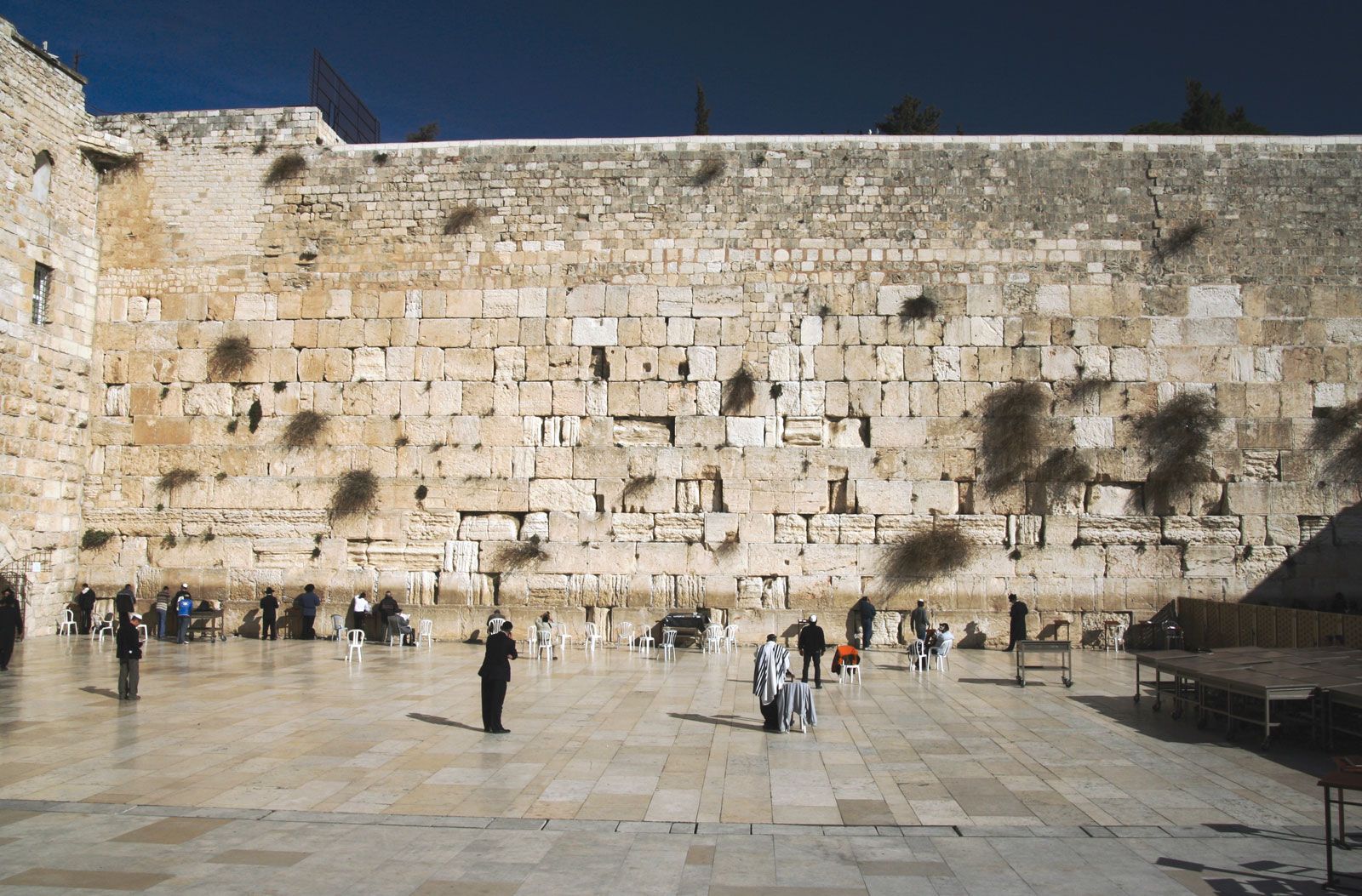
Finally, the shared orientation toward a single place: the Land of Israel. The Mishnah tells Jews to face “toward the direction of the Holy Temple” when they pray. A Jew in medieval Spain prayed toward Jerusalem and marked harvest festivals tied to the seasons of a country thousands of miles away. The seder, the ritual Passover meal, still ends with the words “Next year in Jerusalem.” The next Chapter takes up that land and its long history. The bond is far older than the modern State of Israel.
What kind of group
So what kind of group is this?
Look back at the list: a covenant, a book, a language, a way of life, a habit of argument, a calendar, a mutual responsibility, a homeland. Some of those sound like a religion. Some sound like an ethnicity. Some sound like a nation. No single English word (“religion,” “race,” “nationality”) holds all of them. The word that comes closest is people. A people can contain a faith, an ancestry, and a homeland together, and can include members who share the ancestry but not the faith, or the faith but not the ancestry.
Two rules show how this works. In Jewish law, a person born to a Jewish mother is Jewish by birth, whatever they believe or practice. (Some movements also count a child of a Jewish father who is raised Jewish.) A person with no Jewish ancestors can also become fully Jewish through conversion. By long tradition, conversion means joining the people as well as accepting a faith. You can be born into the Jewish people or welcomed into it.
The Torah uses the language of nationhood. In Exodus, God calls the people of Israel “a kingdom of priests and a holy nation.” The Bible names them for their ancestor Jacob, who was also called Israel. The Hebrew word in that verse is goy, “nation.” A common phrase today is am Yisrael, “the people of Israel.” The English word Jew comes, through Latin and Greek, from the Hebrew Yehudi. It first meant a member of the tribe of Judah, then anyone living in the kingdom of Judah, and after the Babylonian exile the people as a whole. The Book of Ruth tells of a woman from Moab, a neighboring land, who joins the people of Israel. She tells her Israelite mother-in-law, “your people shall be my people, and your God my God.” Later Jewish tradition took her words as the model for joining the Jewish people.
Not every Jew has always accepted the word “nation.” In 1885, American Reform rabbis meeting in Pittsburgh declared, “We consider ourselves no longer a nation, but a religious community.” In 1937, the Central Conference of American Rabbis, the main body of American Reform rabbis, changed course. “Judaism is the soul of which Israel is the body,” it wrote, Israel here meaning the Jewish people. It called on all Jews to help build Palestine, then ruled by Britain, “as a Jewish homeland.”
Jewish communities have lived for centuries in places as different as Ethiopia, Iraq, Iran, Morocco, and Poland, and Jews today come from many backgrounds. The Chapters on Ethiopian Jewry, Iraq, Iran, North Africa, and Poland and Lithuania follow some of them.
How many, and how few
How many Jews are there?
Roughly 15 to 16 million Jews live in the world today, about 0.2 percent of humanity. In 1939 there were about 16.5 million Jews. The Holocaust murdered six million, and by 1945 the population had fallen to roughly 11 million. The demographer Sergio DellaPergola has estimated that without those losses, world Jewry today would number between 26 and 32 million. More than eighty years later, the population has still not returned to its 1939 size.
Explore
The World Jewish Congress maintains an interactive map of Jewish communities around the world today, by country, with the size and history of each. Open the interactive map →
Where the confusion comes from
Why the question keeps getting answered wrong.
English sorts groups into boxes (“religion,” “race,” “ethnicity,” “nationality”) that were shaped mostly by Christian and modern European experience, where those categories often are separate. A Christian can be of any nationality. An American can be of any faith. Jewish tradition held those categories together for most of its history, so the boxes do not fit well.
Two later events show the difference it makes. Nazi Germany’s Nuremberg Laws of 1935 defined a Jew by the religion of his grandparents, not by his own beliefs, as The Years Before the Killing Chapter shows. From the 1890s, the Zionist movement described the Jews as a nation, as the Theodor Herzl Chapter shows.
Who is a Jew
One people, many doors in.
An atheist in Tel Aviv who keeps no commandment, a rabbi in Brooklyn, a convert in São Paulo, and a family in Morocco who have kept the Sabbath for generations are all Jews.
Object Spotlight
A synagogue, painted by a living hand.
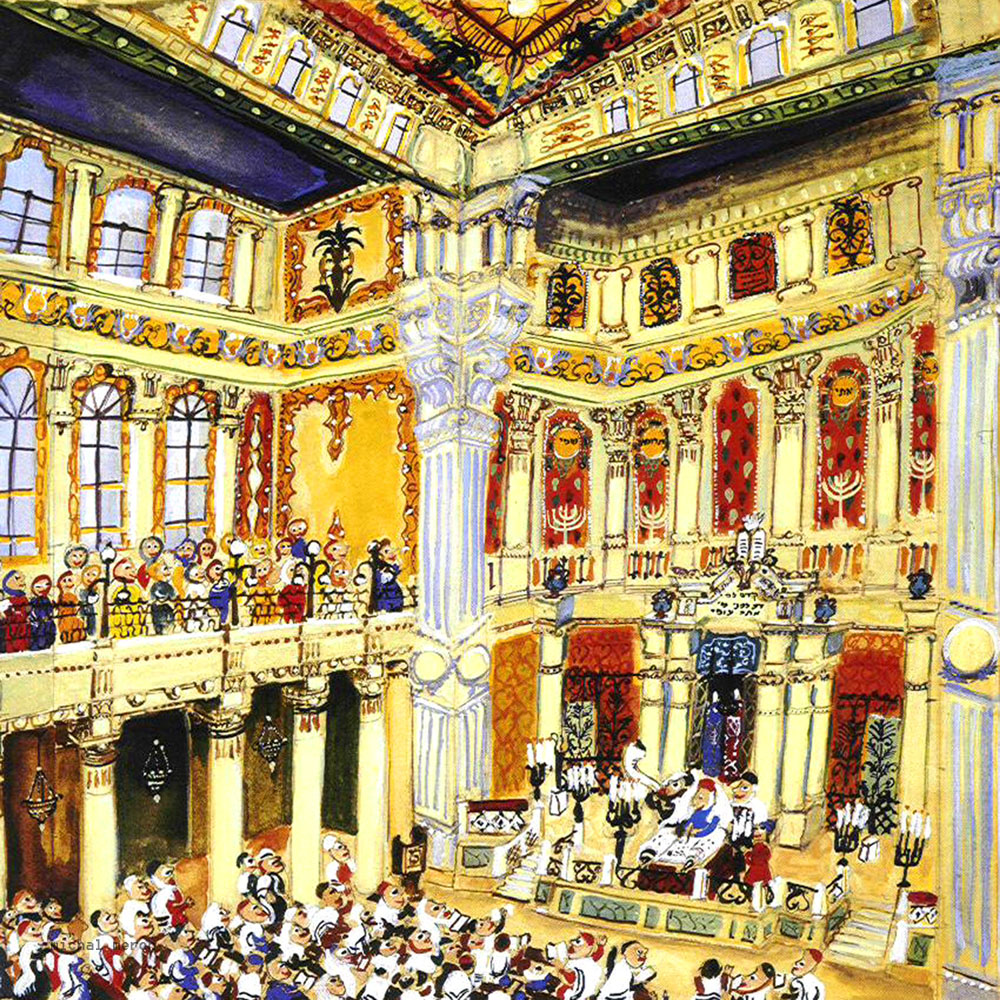
Look at the picture. A synagogue in Rome is packed for Rosh Hashana, the Jewish New Year. Worshippers crowd the floor in white and red, more lean over a balcony above, and the whole space glows in gold and warm light. Tall draped curtains mark the holiest spot, the ark where the Torah scrolls are kept. Hanging lamps and a coffered ceiling rise overhead.
The painting is recent, the work of Michal Meron, an Israeli artist born in Haifa. She works today from The Studio in Venice, inside the historic Venice Ghetto, the walled quarter where the city forced its Jews to live beginning in 1516, the place that gave the word “ghetto” to the world. From that studio she paints Jewish life across Europe, here a synagogue in Rome on the New Year.
Meron also painted The Illustrated Torah, a painting for each of the 54 weekly Torah portions.
Key takeaways
- What Jews hold in common includes belief in one God and a covenant, the Torah, the Hebrew language, and a shared way of life, the commandments. It also includes a habit of argument, a shared calendar and memory, responsibility for one another and for the world, and an orientation toward the Land of Israel.
- The commandments cover how to treat other people as well as how to worship: honesty, care for the poor and the stranger, and “love your fellow as yourself.”
- Jews keep one religion in many ways, from Orthodox to Conservative and Reform to secular, and in Israel from Haredi to Hiloni.
- Argument is built into the tradition. The Talmud keeps the losing side of its debates, and in Genesis Abraham argues with God.
- The word that fits best is people. A person can be Jewish by birth to a Jewish mother, whatever they believe, or by conversion, which means joining the people.
- Jewish sources call the Jews a people and a nation, am Yisrael, with one religion, Judaism. Some Jews, like the Reform rabbis of 1885, defined themselves instead as a religious community. In 1937 the main body of American Reform rabbis called on all Jews to help build a Jewish homeland.
- English categories (religion, race, nationality) fit poorly. They were shaped where those distinctions hold, and for most of Jewish history they did not.
Discussion questions
Working from the evidence.
Each question is anchored in a fact this Chapter documents. Answer from the evidence on the page.
- This Chapter says a person can be a Jewish atheist and a person can convert into Judaism with no Jewish ancestors. In your own words, why do those two facts together show that “religion” alone is not a complete definition? (C3 D2.His.1)
- English sorts groups into “religion,” “race,” and “nationality.” Where do those categories come from, and why might they fit some groups better than others? (C3 D2.His.5)
- Jews have been defined by belief, by ancestry, and as a nation. Choose one later event from the page (the Nuremberg Laws, or the Zionist movement). Which definition did the people involved use, and what difference did it make? (C3 D2.His.1)
- In 1885 American Reform rabbis wrote that Jews were “no longer a nation, but a religious community.” In 1937 the Central Conference of American Rabbis called on Jews to help build a Jewish homeland. How does each answer this Chapter’s question, religion or people, and what events of the 1930s, told in The Years Before the Killing (Unit 4 · Ch. 01), might have shaped the change? (C3 D2.His.5)
- The Talmud keeps the losing side of its arguments on the page, and it says Hillel’s school won because its students were “agreeable and forbearing.” Why might a legal tradition record opinions it rejects? What does the Hillel story suggest about how an argument should be conducted? (C3 D2.His.4)
- Look again at Michal Meron’s Rosh Hashana in Rome. How does a crowded, present-day scene picture the Jewish people differently than a quiet historical portrait would? What does the artist’s choice of bright, warm color add to the scene? (C3 D2.His.11)
- The Talmud makes all Jews responsible for one another, and the Mishnah changed laws “for the betterment of the world.” Where do you see both kinds of responsibility, to your own group and to everyone, in the place where you live? (C3 D2.His.2)
Classroom Connections
Where this Chapter fits.
Teaching Connections
- World Religions & Belief Systems. Judaism as one of the world’s belief systems, and what kind of group the Jews are: a people, a faith, and a nation at once.
- World History. Peoplehood and group identity sustained across time and place.
- Civic Education. Identity, peoplehood, and belonging.
- Historical Thinking. How to define a group that does not fit a single familiar category.
Standards Alignment
- NYS Global History & Geography: 9.2 (Belief Systems).
Further Teaching Resources
- Weitzman National Museum of American Jewish History, “Who Are Your People?: Defining Jewish Peoplehood”. Grades 6–12, with handouts and slides, directly on the peoplehood idea at the center of this Chapter.
- American Jewish Committee, Translate Hate glossary. A glossary of antisemitic terms, tropes, and code words, with explanations.
Sources and citations
Primary sources
A primary source is a record from the time. It was made by people who were there. Examples: letters, diaries, photos, decrees, trial records, and newspapers.
- Jeremiah 29:7 (“seek the welfare of the city”). The JPS Tanakh: Gender-Sensitive Edition. Free at Sefaria. sefaria.org.
- Genesis 32:29 (Jacob renamed Israel). The JPS Tanakh: Gender-Sensitive Edition. Free at Sefaria. sefaria.org.
- Mishnah Berakhot 4:5 (facing the Temple in prayer). c. 200 CE. William Davidson Edition. Free at Sefaria. sefaria.org.
- Mishnah Kiddushin 3:12 (a child’s status follows the mother when the father’s cannot apply). c. 200 CE. William Davidson Edition. Free at Sefaria. sefaria.org.
- Genesis 18:23–25 (Abraham: “Shall not the Judge of all the earth deal justly?”). The JPS Tanakh: Gender-Sensitive Edition. Free at Sefaria. sefaria.org.
- Mishnah Eduyot 1:5 (why minority opinions are recorded). c. 200 CE. Trans. Joshua Kulp. Free at Sefaria. sefaria.org.
- Pirkei Avot 5:17 (“Every dispute that is for the sake of Heaven”). c. 200 CE. Trans. Joshua Kulp. Free at Sefaria. sefaria.org.
- Mishnah Gittin 4:2 (laws changed “for the betterment of the world,” tikkun ha-olam). William Davidson Edition. Free at Sefaria. sefaria.org.
- Babylonian Talmud, Eruvin 13b (“Both these and those are the words of the living God”). William Davidson Edition. Free at Sefaria. sefaria.org.
- Babylonian Talmud, Shevuot 39a (all Jews “guarantors” for one another). William Davidson Edition. Free at Sefaria. sefaria.org.
- Pittsburgh Conference of Reform rabbis. “Declaration of Principles” (the Pittsburgh Platform), 1885. Text at the Central Conference of American Rabbis. ccarnet.org.
- Central Conference of American Rabbis. “The Guiding Principles of Reform Judaism” (the Columbus Platform), 1937. ccarnet.org.
- Emet Ve-Emunah: Statement of Principles of Conservative Judaism. Jewish Theological Seminary, Rabbinical Assembly, and United Synagogue of America, 1988. Berman Jewish Policy Archive. bjpa.org.
- Exodus 19:5–6 (“treasured possession among all the peoples”; “a kingdom of priests and a holy nation”). The JPS Tanakh: Gender-Sensitive Edition. Free at Sefaria. sefaria.org.
- Genesis 12:1–5 and 46:3–4; Exodus 1:13, 13:8, 19:1–6, 20:1–14, and 34:28 (the Torah’s founding account: Abraham’s journey to Canaan, the descent into Egypt, the Exodus, the instruction to tell it to one’s child, and the covenant and Ten Commandments at Sinai). The JPS Tanakh: Gender-Sensitive Edition. Free at Sefaria. sefaria.org.
- Leviticus 19:9–10, 19:18, 19:33–36 (gleanings for the poor and the stranger; love your fellow; love the stranger; honest weights). The JPS Tanakh: Gender-Sensitive Edition. Free at Sefaria. sefaria.org.
- Micah 6:8 (“to do justice and to love goodness”). The JPS Tanakh: Gender-Sensitive Edition. Free at Sefaria. sefaria.org.
- Mishnah Yoma 8:9 (Yom Kippur and wrongs between people). c. 200 CE. William Davidson Edition. Free at Sefaria. sefaria.org.
- Babylonian Talmud, Shabbat 31a (Hillel: “That which is hateful to you do not do to another”). William Davidson Edition. Free at Sefaria. sefaria.org.
- Pew Research Center. “Jewish Identity and Belief.” In Jewish Americans in 2020. May 11, 2021. pewresearch.org.
- Pew Research Center. Israel’s Religiously Divided Society. March 8, 2016. pewresearch.org.
- Paintings by Michal Meron (b. Haifa), The Studio in Venice: The Campo Ghetto Nuovo (banner) and Rosh Hashana in Rome (Object Spotlight). Images © Michal Meron, used with the artist's permission; thestudioinvenice.com.
- The Book of Ruth, 1:16 (“your people shall be my people, and your God my God”). The narrative later tradition took as the model of joining the Jewish people. The JPS Tanakh: Gender-Sensitive Edition. Free at Sefaria.
- The Torah’s food laws: Leviticus 11 (forbidden animals, including the pig and water creatures without fins and scales) and the verse “You shall not boil a kid in its mother’s milk” (Exodus 23:19, Exodus 34:26, Deuteronomy 14:21), in the JPS translation. Free at Sefaria.
- Mishnah Chullin 8:1 (c. 200 CE). The rule against cooking any meat in milk, or setting the two on one table. Free at Sefaria.
Secondary sources
A secondary source was written later. It is a book or article by a historian who studied those records and explains what they mean.
- Biographical detail on Michal Meron from her studio profile: born in Haifa, she trained in Vienna and at Tel Hai Art College in Israel.
- World Jewish population figures from Sergio DellaPergola, World Jewish Population (American Jewish Year Book; Berman Jewish DataBank). The estimate that world Jewry would today number roughly 26–32 million but for the Holocaust is DellaPergola’s demographic modeling, against a 1939 population of about 16.5 million and roughly 11 million in 1945.
- Louis Jacobs, “Torah, Reading of,” Encyclopaedia Judaica, 2nd ed. (Detroit: Macmillan Reference USA, 2007): the 54 weekly portions of the annual cycle, the older three-year cycle of the Land of Israel, and the weeks when Israel and the Diaspora read different portions. encyclopedia.com.
- David Flusser, “Jesus,” Encyclopaedia Judaica, 2nd ed. (Detroit: Macmillan Reference USA, 2007): Jesus “was a Jew who lived toward the end of the Second Commonwealth period”; the early Christian belief that he was the Messiah. encyclopedia.com.
- Harold Ginsberg, David Flusser, et al., “Messiah,” Encyclopaedia Judaica, 2nd ed. (Detroit: Macmillan Reference USA, 2007): the expected king descended from David, and Christos as the Greek for “the anointed one.” encyclopedia.com.
- Ernest Klein, A Comprehensive Etymological Dictionary of the Hebrew Language for Readers of English (1987), entries for the root k-sh-r: kasher (“kosher,” fit) and kashrut (ritual fitness). Free at Sefaria.
- Joseph Gedaliah Klausner, “Ben-Yehuda, Eliezer,” Encyclopaedia Judaica, 2nd ed. (Detroit: Macmillan Reference USA, 2007): Ben-Yehuda (1858–1922), who “made Hebrew speech a national goal.” encyclopedia.com.
- Yehoshua M. Grintz, “Jew,” Encyclopaedia Judaica: the word’s path from the Hebrew Yehudi through the Greek Ioudaios and the Latin Judaeus. encyclopedia.com.
Finding these documents: many primary sources are free online. Good places to start are the Fordham Internet Jewish History Sourcebook, Yale’s Avalon Project (law and diplomacy), German History in Documents, the collections of the US Holocaust Memorial Museum and Yad Vashem, the National Library of Israel, and Sefaria (for Jewish texts). Search the document’s name and date.
The Land of Israel across more than 3,000 years: its geography, its changing names and rulers, and the enduring relationship between the Jewish people and the Land, from the Israelite kingdoms to 1948.
Comments?
Write to editor@teachjewishhistory.org.
Last updated: November 2026.