
Aktion T-4, The Killing of Disabled Germans
Before the Nazis built the killing centers, they had already built a smaller system of organized murder, first directed against their own citizens with disabilities.
Why this Chapter exists
The origins of the Holocaust’s killing methods.
This Chapter is about Aktion T-4, the Nazi program that murdered disabled Germans. Between January 1940 and August 1941, it killed 70,273 people, by its own records, in a network of six killing centers. After it was officially "halted," a looser, decentralized version went on killing in the hospitals themselves, taking another 100,000 to 200,000 lives by the end of the war.
T-4 is essential to understanding the Holocaust because it established methods, personnel, and administrative practices that were later adapted for the mass murder of European Jews. The method, sealed rooms filled with carbon monoxide gas, and the men who ran it were moved directly from T-4 to the killing centers. Christian Wirth, the police official who ran the office side of the first killing center in 1940, became the first commandant of Belzec, one of the killing centers later built in occupied Poland to murder the Jews of Europe, in late 1941. Franz Stangl, who worked at two T-4 centers, became the commandant of Sobibór and then Treblinka. The historian Henry Friedlander laid out this line of descent in his 1995 study, The Origins of Nazi Genocide: From Euthanasia to the Final Solution. To know the killing centers without knowing the program that invented the gas chambers, trained the killers, and worked out the procedures is to miss the record of how the killing machine was built.
Common misconceptions this Chapter addresses
T-4 is often taught, when it is taught at all, as a footnote disconnected from the Holocaust. The record shows otherwise.
- "Aktion T-4 was a separate program with no connection to the Holocaust killing centers." see the dedicated entry →
- "The Holocaust began in 1933 with the Nazi seizure of power." see the dedicated entry →
- "The Holocaust targeted only Jews." see the dedicated entry →
What the Nazis inherited
What the Nazis inherited.
The Nazis did not invent the idea behind T-4. They inherited it from a movement called eugenics, the belief that a society could improve its population by encouraging the "fit" to reproduce and stopping the "unfit" from doing so. That movement was built across Britain, the United States, and Germany in the late 1800s and early 1900s. Its main threads:
- Britain. Francis Galton (1822–1911), a cousin of Charles Darwin, coined the word "eugenics" in 1883 and founded the field. The British movement argued for selective reproduction and worked through academic societies and public-health campaigns.
- The United States. Charles Davenport (1866–1944) ran the Eugenics Record Office on Long Island, New York, from 1910 to 1939. The American movement produced forced-sterilization laws in more than thirty states (Indiana passed the first in 1907) and the Supreme Court's 1927 ruling in Buck v. Bell, which upheld forced sterilization, the case in which Justice Oliver Wendell Holmes wrote the notorious line, "Three generations of imbeciles are enough." Between 1907 and 1979, roughly 60,000 to 70,000 Americans were forcibly sterilized.
- Germany. The German version, called "racial hygiene" (Rassenhygiene), was built by Alfred Ploetz, Wilhelm Schallmayer, and Eugen Fischer. The Kaiser Wilhelm Institute for Anthropology, Human Heredity, and Eugenics opened in Berlin in 1927 under Fischer. This framework was already in place when the Nazis took power in 1933.
So the Nazis came to power with an intellectual and policy apparatus ready to use. What the Nazi regime introduced was the systematic use of state power to transform these ideas into organized persecution, compulsory sterilization, and ultimately mass murder.
The first Nazi step
The first Nazi step.
The Law for the Prevention of Hereditarily Diseased Offspring, passed on July 14, 1933 (and covered in the 1933–1939 Chapter), allowed the forced sterilization of people the state labeled as carrying "hereditary" conditions. The categories included so-called "feeblemindedness" (the largest group), schizophrenia, manic-depressive illness, hereditary epilepsy, Huntington's disease, hereditary blindness and deafness, severe physical deformity, and severe alcoholism.
To carry it out, Germany set up about 200 "Hereditary Health Courts" and about 26 appeals courts to rule on cases, with the procedures done in hospitals under medical supervision. About 400,000 Germans were forcibly sterilized between 1934 and 1945, roughly six times the American total of seven decades, compressed into eleven years.
The 1933 law built the foundation that T-4 would stand on: the courts, the participation of doctors, the official lists of disabled people, and a public taught to accept all of it. The move from sterilizing people in 1933 to killing them in 1939 was the radicalization the regime carried out across those six years.
The children's program
The children's program.
The killing began with children. The Children's "Euthanasia" program (Kinder-Euthanasie) started in the summer of 1939, before the wider T-4 program, and before Germany invaded Poland on September 1, 1939.
The trigger was the "Knauer case" of late 1938 or early 1939. A family in Leipzig had a severely disabled infant, and the father petitioned Hitler directly for permission to have the child killed. Hitler routed the case through his personal physician, Karl Brandt, and that became the precedent for the program that followed.
A new office, the Reich Committee for the Scientific Registration of Serious Hereditary and Congenital Illnesses, was set up in May 1939 to run it. Midwives, pediatricians, and family doctors were required to report newborns and young children with disabilities to the committee, which then marked cases for "treatment", the euphemism for killing. At least 5,000 children were killed under the program between 1939 and 1945, and estimates reach 10,000.
The killing was usually done with repeated overdoses of barbiturate drugs (often Luminal) given over several days, so that families and authorities could be told the death had natural medical causes. The children were killed in about 30 "children's specialist wards" set up at psychiatric hospitals across Germany, including at Eichberg, Brandenburg-Görden, Eglfing-Haar, and Hadamar, which later became an adult killing center as well.
The written order
The written order.
In October 1939, Hitler signed a one-paragraph authorization for the adult killing program. It was typed on his personal stationery, addressed to Philipp Bouhler (head of the Chancellery of the Führer) and Dr. Karl Brandt (his personal physician), and backdated to September 1, 1939, the day Germany invaded Poland, to tie the killing program to wartime. The order gave named physicians the authority to grant what it called a "mercy death" to patients judged "incurable." It was the only written authorization Hitler ever signed for any of the Nazi killing programs.
Tiergartenstrasse 4
Tiergartenstrasse 4.
The program ran from a villa at Tiergartenstrasse 4 in central Berlin, facing the Tiergarten park and inside the government district. The address, shortened to "T-4" in internal correspondence, became the program's code name. The building was destroyed by Allied bombing in 1945; today the spot holds the Berlin Philharmonic concert hall, with a memorial on the site since 2014.

T-4 operated as a branch of the Chancellery of the Führer under Bouhler. The day-to-day running was handled by Viktor Brack (1904–1948). The medical side was directed by Karl Brandt, with Werner Heyde, a psychiatrist, as medical chief through 1941, later replaced by Paul Nitsche.
Patients were selected through a paper process that never involved seeing them:
- The Interior Ministry sent registration forms to psychiatric hospitals, nursing homes, and care facilities across Germany, requiring them to report every patient with a qualifying condition.
- The completed forms, listing the patient's diagnosis, how long they had been institutionalized, their family situation, their capacity to work, and their "racial background", went back to T-4 headquarters.
- About three "experts," psychiatrists serving as the selection authority, reviewed the forms. They never examined a single patient. They decided from the paperwork alone.
- They marked each form: a "+" for killing, a "–" for continued care, a "?" for further review.
- Patients marked for death were taken to the killing centers by a front company called the Charitable Patient Transport Company (Gekrat), which ran the bus transports.
About 200 institutions took part in the selection, around 30 "experts" did the marking, and Gekrat ran roughly 30 gray buses, the "Gray Buses" later used as a symbol in German memorials, carrying patients to the centers.
The six killing centers
The six killing centers.
T-4 ran six killing centers across Germany and annexed Austria. Each was set up at an existing psychiatric hospital or facility, fitted with a gas chamber disguised as a shower room and a crematorium, and staffed by a small team of 60 to 100 people:
- Brandenburg-an-der-Havel (central Germany). January–October 1940. The first center and the model for the rest, in a former prison. 9,772 killed under T-4, by the program’s own count. Partly preserved today as a memorial.
- Grafeneck (southern Germany). January–December 1940. In a former castle turned nursing home. 9,839 killed under T-4. Now partly preserved as a memorial.
- Hartheim (Upper Austria, near Linz). May 1940–December 1944, far longer than the others. In a Renaissance castle converted to a care home. 18,269 killed under T-4, the highest single-center total; the memorial’s fuller count of about 30,000 includes the concentration-camp prisoners murdered there in the later phases. Now the Schloss Hartheim memorial.
- Sonnenstein (Saxony). June 1940–August 1941 as a T-4 gassing center; dismantled in 1942. At a psychiatric hospital founded in 1811, one of Germany's first. 13,720 killed under T-4. Partly preserved.
- Bernburg (Saxony-Anhalt). November 1940–April 1943. At a psychiatric hospital. 8,601 killed under T-4, plus more under "Operation 14f13" (below). Partly preserved.
- Hadamar (central Germany). January 1941–March 1945. At a psychiatric hospital. 10,072 killed under T-4 in 1941; roughly 4,400 more died there in the later "wild euthanasia," bringing the site’s full toll to almost 15,000. Now the Hadamar Memorial, the best-preserved of the sites.
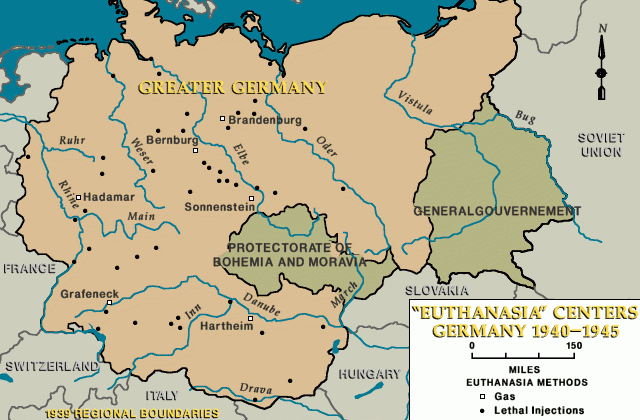
A note on the numbers: the six figures above are the T-4 program’s own recorded totals, the ones that sum to 70,273. The memorial sites often cite higher numbers because their counts include the killing that continued at some centers after August 1941. Historians keep the two kinds of count separate.
As word of the killings spread through the German public in the spring and summer of 1941 (covered in the Galen section below), individual centers were shut and the work moved to the ones that remained. That is why Brandenburg, Grafeneck, and Sonnenstein closed while Hartheim and Hadamar kept operating into 1944 and 1945.
The method
The method that later ran at Belzec, Sobibór, and Treblinka.
The killing method was the same at all six centers: a sealed room disguised as a shower, into which 20 to 30 patients were led at a time, where carbon monoxide gas piped in from steel cylinders killed them in about 15 to 20 minutes. The bodies were burned in the adjoining crematorium. Families were sent forged death certificates citing natural causes (pneumonia, heart failure) and urns of ash that were not their relative's.
The gas-chamber method was worked out at Brandenburg in January 1940, under Christian Wirth (a former criminal-police officer assigned to T-4) and Viktor Brack. The first test, recorded in the postwar trial record, used patients from a Brandenburg hospital. Judged by the program's own measures (speed, efficiency, and how few staff it took) the gas chamber became the chosen method, and all six centers were equipped with it.
This is the central historical connection explored in this Chapter. The method that ran at Brandenburg in January 1940 was the method that ran at Belzec from March 1942, Sobibór from May 1942, and Treblinka from July 1942. The killing centers changed one detail: they used carbon monoxide from engine exhaust rather than bottled gas, because bottled gas was hard to supply at the scale the Holocaust required. But the principle was a direct inheritance from T-4, gas-chamber killing in small disguised rooms with crematoria attached. The transfer of the men who ran it, covered below, completes the line.
The Lion of Münster
The Lion of Münster.
Through 1940 and 1941, the truth about T-4 leaked out, through families of the victims, through medical staff uneasy about what they were doing, and through church networks. The loudest public protest came from Bishop Clemens August Graf von Galen (1878–1946), the Catholic Bishop of Münster.
Galen preached three public sermons in July and August 1941 exposing and condemning the killings. The decisive one, delivered at St. Lambert's Church in Münster on Sunday, August 3, 1941, included this passage: "It is a terrible doctrine which tries to justify the murder of innocent people, which sanctions the violent killing of disabled persons, of invalids, of the incurably ill, of feeble old people."
The sermon named the program outright, described the Gekrat bus transports, identified the killing centers, and called on German Catholics to refuse any part in it. It was printed and passed hand to hand in thousands of copies; the British Royal Air Force dropped translated copies over Germany as propaganda. The German Catholic Church backed Galen, and a few Protestant leaders, including Bishop Theophil Wurm in Württemberg, made similar statements.
The Nazis were boxed in. Galen was a prominent bishop with broad popular support across Catholic Germany. The leadership weighed arresting and executing him but held off, judging that moving against him would stir unrest in Catholic Germany at a dangerous moment in the war against the Soviet Union, which Germany had invaded that June. Galen survived the war, was made a cardinal in February 1946, and died a month later.
What the halt meant
What the halt actually meant.
On August 24, 1941, three weeks after Galen's sermon, Hitler gave a verbal order to halt the T-4 program. It stands out as one of the few times the Nazi regime changed a policy in response to public protest. The halt closed much of the T-4 administrative apparatus and several of the centers, and produced the official story that the program was over.
The reality was different. The halt ended the centralized machinery of T-4; it did not end the killing of disabled Germans. That continued in a decentralized form, described in the next section. The recorded death toll for the formal T-4 program, January 1940 to August 1941, was 70,273, a figure that comes from the Nazis' own internal statistics, the "Hartheim Statistics," recovered after the war, which gave the total with that exact precision.
The halt also raises an important historical question. Galen's sermons were the loudest public protest against the program, whose halt shows that public pressure could move Nazi policy. So why did no comparable protest stop the murder of Jews? That comparison, and why it would have been far harder to mount, is one of the central questions in the scholarship on Nazi decision-making and German public response.
Wild euthanasia
The killing continues, quietly.
The "wild euthanasia" (Wilde Euthanasie) was the decentralized killing of disabled Germans that ran from August 1941 to the end of the war in May 1945. The pattern shifted from the centralized T-4 system, with its dedicated centers and paperwork, to killings carried out in the hospitals and care homes themselves, by starvation, by overdoses of barbiturates, and by lethal injection.
The hospitals ran what were called "hunger houses," wards where patients were fed too few calories to survive and died of starvation over several months. Staff also administered lethal overdoses. The records were simply the hospital's own files, with death certificates noting natural causes.
The toll of the wild euthanasia was roughly 100,000 to 200,000 more deaths. Together, the formal T-4 program and the wild euthanasia killed well over 200,000 German citizens with disabilities between 1939 and 1945.
One more strand, code-named "Operation 14f13," extended the T-4 killing apparatus to concentration camp prisoners between 1941 and 1943. It used the T-4 centers (mainly Bernburg, Sonnenstein, and Hartheim) to kill about 20,000 prisoners selected from the camps as unable to do slave labor, tying T-4 directly into the wider camp system covered in the Camp System Chapter.
The bridge to the death camps
The bridge to the death camps.
The link from T-4 to Operation Reinhard (whose killing centers at Belzec, Sobibór, and Treblinka murdered about 1.5 million Polish and other European Jews in 1942–43) was a direct transfer of people and technology. The key men:
- Christian Wirth (1885–1944). Ran the Brandenburg killing center in 1940 and was the operational chief of T-4. Moved to Operation Reinhard in late 1941; arrived at Belzec in December 1941 as its first commandant (killing operations began March 17, 1942), then became inspector of the whole Reinhard operation. Killed by Yugoslav partisans on May 26, 1944.
- Franz Stangl (1908–1971). An Austrian police official who served at the Hartheim and Bernburg centers. Moved to Operation Reinhard in 1942; commandant of Sobibór, then of Treblinka. Escaped to Brazil after the war, was extradited to West Germany in 1967, and was convicted and sentenced to life in 1970. He died in prison in 1971. Gitta Sereny's biography Into That Darkness (1974) traced his career through interviews shortly before his death.
- Franz Reichleitner (1906–1944). An Austrian who served at Hartheim. Moved to Operation Reinhard; became the second commandant of Sobibór after Stangl. Killed by Italian partisans on January 3, 1944.
- About 90 more T-4 staff (administrators, technicians, guards, support workers) were transferred to Operation Reinhard in late 1941 and 1942, carrying the program's methods with them.
The methods also carried over. Viktor Brack's June 1942 memo to Heinrich Himmler, preserved in the postwar trial record, spelled out the transfer, noting that "Wirth has been put in charge … to carry out the special action."
The postwar trials
The postwar trials.
Legal accountability for T-4 came mainly through the Nuremberg Doctors' Trial (United States v. Karl Brandt et al., the first of the Nuremberg Successor Trials, covered in the Postwar Trials Chapter) and later German prosecutions.
The Doctors' Trial (December 9, 1946 to August 20, 1947) made T-4 one of the major charges against the twenty-three defendants. Among the key figures:
- Karl Brandt: Hitler's personal physician and T-4's medical chief. Convicted; hanged at Landsberg Prison on June 2, 1948.
- Viktor Brack: T-4's administrative chief. Convicted; hanged the same day.
- Philipp Bouhler: head of the Chancellery of the Führer, with oversight of T-4. Killed himself on May 19, 1945, before any trial.
- Werner Heyde: T-4's psychiatric chief through 1941. Evaded capture by living for years under a false identity, "Dr. Sawade," in Schleswig-Holstein. Discovered in 1959, he killed himself in prison in February 1964 before his trial.
- Paul Nitsche: Heyde's successor as psychiatric chief. Tried separately by a German court in Dresden in 1947, convicted, and executed in March 1948.
Later German prosecutions through the 1970s convicted more T-4 staff and participants. An earlier trial at Hadamar, run by the U.S. military government at Wiesbaden in October 1945, was the first Nazi war-crimes trial in the American occupation zone: seven defendants tried, three executed.
The honest accounting
The honest accounting.
Several questions about T-4 are still worked over by historians:
- How many died. The 70,273 figure for the formal T-4 program is firm, drawn from the Nazis' own Hartheim Statistics. The wider toll including the wild euthanasia (100,000 to 200,000 more) is less precise, because that killing was scattered and the records are thinner. The overall consensus is that roughly 250,000 disabled people were killed in Nazi programs between 1939 and 1945.
- The responsibility of the medical profession. How much of the German medical profession took part, and what that meant afterward, has been studied closely. Robert Lifton's The Nazi Doctors (1986) examined the individual physicians; Michael Burleigh's Death and Deliverance (1994) and Robert Proctor's Racial Hygiene (1988) traced the broader patterns. Germany's medical association has issued formal apologies in the 2000s and after, and the reckoning continues.
- The Catholic Church. Galen's 1941 sermons were the most public of the protests that preceded the T-4 stop order; how decisive they were is debated, since the program had nearly reached its planned quota and the killing continued by other means. Why the Church intervened against the killing of disabled Germans but did not mount a comparable intervention against the murder of Jews has been debated from several angles. The Church's broader record on the Holocaust is treated in the Nostra Aetate Chapter.
- Disability rights today. T-4 has become a reference point in modern disability-rights work, cited in defense of the inclusion and protection of disabled people. German memorials increasingly reflect that engagement, and it continues to grow.
Key takeaways
The record in brief.
- Aktion T-4 was the Nazi program that murdered disabled Germans: 70,273 people between January 1940 and August 1941, by its own records.
- The idea came from eugenics, a movement built in Britain, the United States, and Germany before the Nazis took power.
- The killing began with children, before the war began. Hitler’s only written authorization was one paragraph, backdated to September 1, 1939.
- Six killing centers used a sealed gas chamber disguised as a shower, the method later moved to Belzec, Sobibór, and Treblinka.
- Public protest, led by Bishop von Galen of Münster, forced the official halt of August 1941, one of the few times the regime bent to public pressure.
- The halt did not stop the killing. “Wild euthanasia” continued in hospitals to the end of the war, adding an estimated 100,000 to 200,000 more victims.
- T-4’s men and methods transferred directly to the death camps of Operation Reinhard.
Object Spotlight
The Hartheim Statistics.
It is a small stack of typed pages, found at Hartheim castle when the war ended. The program’s own clerks had tallied the killings, center by center and month by month, in the neat columns of an office report.
The pages also calculate what the murders “saved”: food, clothing, and Reichsmarks the state would no longer spend on the people it had killed, projected years into the future. The bookkeeping treats human beings as costs removed from a ledger.
The document was entered in evidence at Nuremberg, and it is why the toll of the six killing centers is known with the precision this Chapter reports. The perpetrators kept the proof themselves.
Discussion questions
Working from the evidence.
Each question is anchored in a fact this Chapter documents. Students should answer from the evidence on the page.
- The idea behind T-4 was built before the Nazis took power, in Britain, the United States, and Germany: Indiana passed the first forced-sterilization law in 1907, and the U.S. Supreme Court upheld the practice in 1927. Using this Chapter’s evidence, what changed when the Nazi state took these ideas over in 1933?
- The path ran from a sterilization law in 1933 to the killing of patients in 1939, a radicalization carried out across six years. Trace the steps this Chapter documents. What made each step easier than the one before it?
- Hitler’s only written authorization for any Nazi killing program was a single backdated paragraph granting a “mercy death” to patients judged “incurable.” Why might the language avoid plain words, and what does backdating it to the day the war began tell you?
- Public protest, led by Bishop von Galen, forced the official halt of August 1941, one of the few times the regime bent to public pressure. No comparable protest met the murder of the Jews. Drawing on the Evolution of Antisemitism unit, what might explain the difference?
- Wirth and Stangl moved from T-4 to Belzec, Sobibór, and Treblinka, and about 90 staff and the gas-chamber method moved with them. What does this transfer show about how the Holocaust’s machinery was built, and why do historians treat T-4 as part of the Holocaust rather than a footnote?
Classroom Connections
Where this Chapter fits.
Teaching Connections
The disciplines and courses this Chapter naturally supports, for any educator, anywhere.
- World History. Examines the origins of state-sponsored murder, Nazi racial ideology, eugenics, medical ethics, and the relationship between Aktion T-4 and the later Holocaust.
- Classroom Applications. Students can:
- analyze medical ethics under state power;
- trace how propaganda prepared the public for the killing;
- examine how an ideology captured hospitals, courts, and a ministry;
- follow the T-4 method and personnel into the killing centers.
- International Classroom Relevance. Supports Holocaust education, disability history, medical ethics, and human rights instruction.
Standards Alignment
- NYS Social Studies Framework: NY Global History 10.5 (World War II and the Holocaust).
- NYS Holocaust Education Mandate, Education Law §801. Supports Holocaust instruction by documenting the first organized Nazi killing program and its influence on later genocide.
- Common Core RH.11–12.6 & RH.11–12.9. Students analyze official documents, sermons, trial evidence, institutional records, and historical scholarship.
- C3 Framework, D2.His.1, D2.His.14. Students examine historical causation, institutional responsibility, and competing historical interpretations.
Learn more · take this further
Verified resources from outside organizations for teachers and students.
Sources
Primary sources
A primary source is a record from the time. It was made by people who were there. Examples: letters, diaries, photos, decrees, trial records, and newspapers.
- Hitler's October 1939 authorization for the euthanasia program. Reproduced in the Nuremberg Doctors' Trial record, Case 1 (NMT). Available through the USHMM document archive.
- Bishop Clemens August Graf von Galen, Sermon at St. Lambert's Church, Münster (August 3, 1941). Full text in subsequent published collections.
- United States v. Karl Brandt et al. (Nuremberg Doctors' Trial). Trial of War Criminals before the Nuremberg Military Tribunals, vols. 1–2. Washington: U.S. Government Printing Office, 1949.
- The Hartheim Statistics, found at Schloss Hartheim, 1945. The T4 program's own tally of the murdered and its projected “savings,” entered in evidence at Nuremberg.
Secondary sources
A secondary source was written later. It is a book or article by a historian who studied those records and explains what they mean.
- Friedlander, Henry. The Origins of Nazi Genocide: From Euthanasia to the Final Solution. Chapel Hill: University of North Carolina Press, 1995.
- Burleigh, Michael. Death and Deliverance: 'Euthanasia' in Germany c. 1900–1945. Cambridge: Cambridge University Press, 1994.
- Proctor, Robert N. Racial Hygiene: Medicine Under the Nazis. Cambridge, MA: Harvard University Press, 1988.
- Bachrach, Susan, ed. Deadly Medicine: Creating the Master Race. Washington, D.C.: United States Holocaust Memorial Museum / University of North Carolina Press, 2004.
- Aly, Götz. Final Solution: Nazi Population Policy and the Murder of the European Jews. London: Arnold, 1999.
- Aly, Götz, Peter Chroust, and Christian Pross. Cleansing the Fatherland: Nazi Medicine and Racial Hygiene. Baltimore: Johns Hopkins University Press, 1994.
- Lifton, Robert Jay. The Nazi Doctors: Medical Killing and the Psychology of Genocide. New York: Basic Books, 1986.
- Sereny, Gitta. Into That Darkness: An Examination of Conscience. New York: McGraw-Hill, 1974.
- Mostert, Mark P. "Useless Eaters: Disability as Genocidal Marker in Nazi Germany." Journal of Special Education 36, no. 3 (2002): 155–168.
- Snyder, Sharon L., and David T. Mitchell. Cultural Locations of Disability. Chicago: University of Chicago Press, 2006.
- Kaiser, Jochen-Christoph, Kurt Nowak, and Michael Schwartz. Eugenik, Sterilisation, "Euthanasie": Politische Biologie in Deutschland 1895–1945. Berlin: Buchverlag Union, 1992.
- Klee, Ernst. "Euthanasie" im NS-Staat: Die "Vernichtung lebensunwerten Lebens". Frankfurt: S. Fischer, 1983.
- Kühl, Stefan. The Nazi Connection: Eugenics, American Racism, and German National Socialism. New York: Oxford University Press, 1994.
- USHMM Holocaust Encyclopedia · Euthanasia Program · encyclopedia.ushmm.org →
- Yad Vashem · Aktion T-4 · yadvashem.org →
- Gedenkstätte Hadamar · gedenkstaette-hadamar.de →
- Lern- und Gedenkort Schloss Hartheim · schloss-hartheim.at →
- United States Holocaust Memorial Museum, “‘Euthanasia’ centers, Germany 1940–1945,” map, Holocaust Encyclopedia. encyclopedia.ushmm.org. The map in this Chapter.
Finding these documents: many primary sources are free online. Good places to start are the Fordham Internet Jewish History Sourcebook, Yale’s Avalon Project (law and diplomacy), German History in Documents, the collections of the US Holocaust Memorial Museum and Yad Vashem, the National Library of Israel, and Sefaria (for Jewish texts). Search the document’s name and date.
The sealed ghettos of Nazi-occupied Poland (Warsaw, Łódź, and hundreds more) where Jews were confined, starved, and worked before deportation to the killing centers.
Comments?
Write to editor@makorproject.org.
Last updated: August 2026.