Jewish Resistance & Rescue
The many ways people resisted genocide.
In October 1944, prisoners who were forced to operate the gas chambers at Auschwitz blew one of the crematoria apart. The gunpowder had been smuggled to them, a pinch at a time, by four young women who worked in a nearby munitions factory. The women were caught and hanged in front of the other prisoners. The crematorium never operated again.
Why this Chapter exists
They did not go without a fight.
Holocaust education gives most of its attention to persecution and mass murder, and it must. Yet the historical record also holds thousands of acts of resistance, rescue, documentation, religious perseverance, and mutual aid. Every one was carried out under conditions built to make it nearly impossible. The Holocaust cannot be fully understood without them.
A caricature took hold after the war: Jewish populations going passively to their deaths. Some early postwar literature repeated it. From the 1960s onward, Yehuda Bauer, Yisrael Gutman, Saul Friedländer, and the broader generation of Holocaust historians challenged it. The documentary record, they showed, does not support it. What the record shows instead is armed resistance under conditions that made it extraordinarily difficult. And it shows unarmed resistance: preserving human dignity in a system designed to make that impossible.
Common misconceptions this Chapter addresses
Most people absorb a single image: Jewish populations walking quietly to their deaths, doing nothing to stop it. The documentary record shows armed revolts in the ghettos and the killing centers, organized partisan units in the forests, archives buried under burning streets, and a network of rescue that ran from single farmhouses to entire nations.
- "The Jews of Europe went passively to their deaths." see the dedicated entry →
- "Resistance only counts if it means picking up a gun." see the dedicated entry →
- "Hiding or rescuing Jews carried little real risk." see the dedicated entry →
- "Resistance could have stopped the killing." see the dedicated entry →
What counts as resistance
Resistance was more than armed revolt.
What counts as "resistance" has broadened since the first postwar years. Raul Hilberg's foundational The Destruction of the European Jews (1961) centered on the German machinery and treated Jewish response as largely compliant; Bauer and Gutman built the broader resistance framework against that reading. It stressed how limited that resistance was against the scale of the catastrophe. Later work, above all Yehuda Bauer's from the 1960s onward, set out a broader category that distinguished:
- Armed resistance: organized military action against the Nazi regime and its collaborators, including the ghetto uprisings, the killing-center revolts, partisan combat, and underground sabotage.
- Unarmed resistance: keeping religious, cultural, educational, and welfare institutions alive in the ghettos under conditions designed to destroy them. It includes the drive to document (most prominently the Oneg Shabbat archive), and the preservation of dignity, family, and community under a regime built to erase them.
- Rescue: the work of those, Jewish and non-Jewish, who hid, moved, or otherwise saved Jewish lives. Some rescue overlapped with armed resistance, like the Bielski partisan unit that sheltered a refugee community. Much of it was civilian.
- Spiritual resistance: the work of holding onto a moral world under conditions designed to destroy it. It includes the underground religious life of the ghettos, prayer kept alive in the camps, and the writing produced by Jews under Nazi rule, most famously Anne Frank's diary, alongside a large body of writing from the time.
Bauer gathered these forms under the Hebrew term amidah, literally ‘standing firm’. In that framing, unarmed and spiritual acts count as resistance alongside armed revolt. The sections that follow treat armed resistance, unarmed and spiritual resistance, and rescue in turn.
The ghetto uprisings
Armed resistance inside the Nazi ghettos.
Armed resistance organizations formed in many of the major Nazi ghettos, and the pattern looked much the same from site to site. Secret youth groups (from across the Jewish political movements: Zionist, Bundist, Communist, and unaffiliated) formed the first cells in 1941–42. Organizing sped up once the deportations began and residents understood that deportation meant death. Coordinated armed action came last, taken up by fighters who mostly knew they would not survive.
The major documented ghetto resistance organizations:
- Warsaw: The Jewish Combat Organization (ŻOB, Żydowska Organizacja Bojowa), founded July 28, 1942, and the Jewish Military Union (ŻZW, Żydowski Związek Wojskowy), founded earlier in 1942 from Revisionist Zionist networks. Treated in its own section below.
- Vilna (Vilnius, Lithuania): The United Partisan Organization (FPO, Fareynikte Partizaner Organizatsye), founded January 21, 1942 under the leadership of Yitzhak Wittenberg, Abba Kovner, and others. The Vilna uprising of September 1, 1943 was far smaller than the Warsaw uprising. Kovner's manifesto, calling Jews not to be "led like sheep to the slaughter", became one of the founding documents of the resistance.
- Białystok (Poland): Armed uprising August 16–20, 1943, led by Mordechai Tenenbaum and Daniel Moszkowicz. About 300 fighters against German forces. The uprising was crushed. Both leaders died: Moszkowicz in action, Tenenbaum likely by suicide.
- Częstochowa (Poland): Armed resistance in connection with the June 1943 deportations.
- Sosnowiec, Bedzin, Tarnów, Kraków: Smaller documented resistance organizations and isolated armed actions.
The barriers to armed resistance in the ghettos were enormous. Most ghetto populations lacked weapons, military training, and outside support. The Nazi regime held absolute military superiority. Civilians beyond the walls, including parts of the Polish underground, were unwilling or unable to arm Jewish fighters. And the German practice of collective reprisal meant any armed action would bring killing down on the very civilians the fighters were trying to protect. The fighters at Warsaw, Vilna, and the other ghettos understood all of this. They knew organized resistance would not save the ghetto population. It would leave a record of a Jewish armed response to the genocide. They acted anyway.
The Warsaw Ghetto Uprising
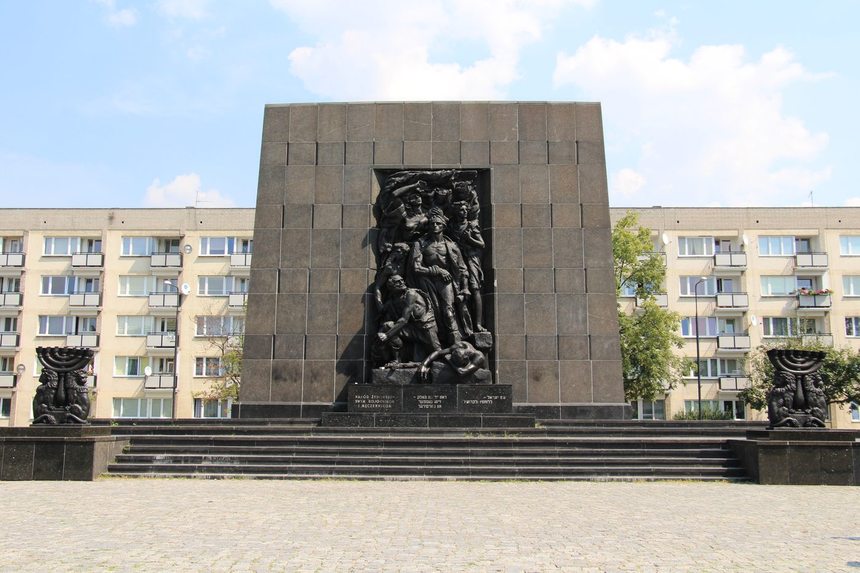
April 19 – May 16, 1943.
The Warsaw Ghetto Uprising is the largest single armed Jewish uprising of the Holocaust. It was also the largest revolt by any group in Nazi-occupied Poland before the Polish Uprising of August 1944. The context: the ghetto's registered population had peaked at about 445,000 in the spring of 1941. The Great Deportation of July 22 to September 21, 1942 had sent roughly 265,000 to the Treblinka killing center. By spring 1943 about 55,000 to 60,000 remained.
The uprising was led by the Jewish Combat Organization (ŻOB) under Mordechai Anielewicz, age 24. The smaller Jewish Military Union (ŻZW) under Paweł Frenkel fought in parallel, under its own command, after unification talks failed. The combined force was some 700 armed fighters. Their weapons were few: pistols, rifles, hand grenades, and improvised explosives. Most were obtained at heavy cost from the Polish Home Army (AK) and the Communist People's Guard (GL) on the “Aryan side” of the wall, the non-Jewish part of the city outside the ghetto. The fighters faced roughly 2,000 German troops under SS-Brigadeführer Jürgen Stroop, eventually reinforced to far larger numbers.
The uprising began on April 19, 1943, the eve of Passover, when German forces entered the ghetto for what was intended as the final deportation. The fighters opened fire from prepared positions. The Germans withdrew. The next day they returned in larger force and were again driven back. Stroop responded with a systematic burning of the ghetto, building by building, to force the fighters and the hidden civilian population out. The uprising continued for about four weeks, with sporadic resistance even after Stroop declared the operation completed on May 16, 1943.
Anielewicz was killed at the ŻOB command bunker at Miła 18 on or around May 8, 1943. The last surviving fighters escaped through the sewers under the city on May 10, an earlier group having gone out on April 29. Among them was Marek Edelman, who became one of the uprising’s principal witnesses. Some 13,000 ghetto residents were killed in the burning of the ghetto itself. The rest were deported to Treblinka or to the labor camps at Majdanek, Trawniki, Poniatowa, and elsewhere. Stroop's final report, Es gibt keinen jüdischen Wohnbezirk in Warschau mehr ("The Jewish Quarter of Warsaw Is No More"), is among the most revealing single Nazi documents on the German conduct of the genocide. The original is held at the U.S. National Archives and the Institute of National Remembrance (IPN) in Warsaw.
Anielewicz's last letter, written from Miła 18 on April 23, 1943, has become one of the foundational documents of postwar Jewish memory. In it he wrote (translation from the Yad Vashem edition): "What happened is beyond our wildest dreams. The Germans ran twice from the ghetto. One of our companies held out for 40 minutes; the other for more than six hours. […] The dream of my life has come true; Jewish self-defense in the Warsaw Ghetto has become a reality. Jewish armed resistance and revenge are facts."
Revolts in the killing centers
Treblinka, Sobibór, Auschwitz.
Three of the six dedicated killing centers saw documented armed prisoner revolts: Treblinka, Sobibór, and Auschwitz-Birkenau. The conditions could hardly have been harder. The Jewish prisoners in the killing centers were mostly the Sonderkommando, the work-units forced to operate the killing process. A smaller group was kept for camp labor: cooks, tailors, mechanics, sorting workers. The work-units were periodically killed and replaced. Any uprising, then, had to be planned and carried out by prisoners who knew they faced near-certain death.
- Treblinka, August 2, 1943. The revolt at Treblinka was organized over several months by an underground committee including Berek Lajcher, Marceli Galewski, and Zelo Bloch. Roughly 200 to 300 prisoners took part. They had managed to get keys to the camp armory and take weapons. More than 300 prisoners escaped during the revolt. Most were hunted down and killed in the surrounding forests by German forces and local collaborators. Some 70 are known to have survived the war and given postwar testimony. Treblinka ran limited operations after the revolt. It was largely dismantled in November 1943, as the killings of Operation Reinhard, the Nazi program to murder the Jews of occupied Poland, ended.
- Sobibór, October 14, 1943. The Sobibór revolt had two leaders. Alexander "Sasha" Pechersky was a Soviet Jewish prisoner of war, transferred to Sobibór that September. Leon Feldhendler was a Polish Jewish prisoner who had organized the camp's underground. The plan: kill individual SS officers in their workshops at the same time, then break out together through the gates and over the perimeter. Roughly 300 of 600 prisoners took part. Eleven SS men were killed. About 300 prisoners escaped; roughly a hundred were hunted down in the days that followed, and 58 are known to have survived the war. Within weeks, the Germans closed Sobibór for good and destroyed the site. Pechersky survived. He returned to the Soviet Union after the war and lived in Rostov-on-Don until his death in 1990. Feldhendler survived the war but was murdered in Lublin in April 1945 in circumstances historians still debate.
- Auschwitz-Birkenau Sonderkommando revolt, October 7, 1944. By fall 1944 the killing operations were slowing, and the Sonderkommando knew they would soon be killed and replaced. Over several months, working with the camp's wider underground, they organized a revolt. On October 7, 1944, they destroyed Crematorium IV at Birkenau. The gunpowder had been smuggled into the camp by four Jewish women working at the Union munitions factory: Roza Robota, Ala Gertner, Estusia Wajcblum, and Regina Safirsztajn. That day, 451 Sonderkommando prisoners died, including about 250 killed in the fighting. Some members of the squad survived the war, and their testimony underlies much of what is known about the crematoria. The four women who had smuggled the gunpowder were arrested, tortured, and publicly hanged at Auschwitz on January 5, 1945, three weeks before the camp was liberated. Crematorium IV never operated again. The Sonderkommando also left a written record: the "Scrolls of Auschwitz," buried near the crematoria. Some of it was recovered between 1945 and 1980, in fragments, much of it damaged. It is among the most important documentary sources on the killing operation.
Partisan units in the forests
Armed Jewish resistance outside the ghettos and camps.
Jewish armed resistance also operated well outside the ghettos and camps. Most of it took the form of partisan units in the forests of Belarus, Lithuania, Ukraine, and eastern Poland. The setting was the German occupation of the Soviet Union, which began on June 22, 1941. The occupied Soviet lands held deep forests that could hide and feed partisan operations. And the Soviet government backed partisan warfare: Stalin's directive of July 3, 1941 ordered the creation of partisan units in occupied territory. Jewish partisans operated within that broader framework.
The major documented Jewish partisan formations:
- The Bielski partisans: Belarus / Naliboki Forest, 1942–44. The Bielski brothers, Tuvia the commander, Asael, Zus, and Aron, escaped the German massacre of their family in the village of Stankiewicze. In mid-1942 they set up a partisan unit in the Naliboki Forest. The Bielski unit was different: it was a fighting force and a refugee community at once. Tuvia Bielski's rule was that the unit would take in every Jew who reached the forest, including the elderly, women, and children whom most partisan units turned away. At its peak in summer 1944, the Bielski otriad (partisan detachment) numbered 1,236 people, about 70 percent civilians, some 30 percent armed fighters. The unit fought German forces and local collaborators. It also ran a working community: workshops, a hospital, a synagogue, a school, the fabric of Jewish life. The Bielski group is the largest documented armed Jewish unit that doubled as a refugee community. Roughly 1,200 of its members survived the war. The story is documented in Nechama Tec's Defiance: The Bielski Partisans (Oxford University Press, 1993) and was adapted as the 2008 film Defiance.
- The Vilna partisans: Lithuania, 1943–44. After the September 1943 destruction of the Vilna Ghetto, the surviving members of the FPO escaped to the Rudniki Forest and established Jewish partisan units. Abba Kovner commanded the principal unit. The group fought the German occupation until the Soviets took the area in July 1944.
- Soviet-allied units in Ukraine and Belarus. Many Jewish refugees joined Soviet-organized partisan units across the occupied territories. The record here is extensive but uneven. Soviet records often did not identify Jewish partisans as Jewish, and much of what is known was reconstructed later by historians. Central to that work was Yitzhak Arad, himself a former Lithuanian Jewish partisan and later the chairman of Yad Vashem from 1972 to 1993.
- The French Maquis and the Jewish Army (Armée Juive). France's Jewish fighters served in the broader French Resistance and in an organization of their own, the Armée Juive, founded in Toulouse in January 1942. It fought the German occupation and the Vichy regime, ran escape routes across the Pyrenees to Spain, and took part in the liberation of southern France in summer 1944.
Unarmed resistance
The resistance that used no weapons.
The great majority of resistance during the Holocaust was unarmed. The Nazi regime set out to systematically destroy Jewish religious institutions, schools, cultural organizations, welfare networks, and economic life. Against that campaign, keeping those institutions alive was itself resistance. It was done in secret, with improvised means. The major documented categories:
- Clandestine religious life. Keeping synagogue services, Torah study, daily prayer, and the religious calendar alive in the ghettos and, where possible, in the camps. The Yom Kippur fast of 1942 was widely observed in the Warsaw Ghetto despite the catastrophic conditions. The daily minyan, the quorum of ten required for Jewish communal prayer, operated in many ghettos and in some camp barracks. The smuggling of religious texts into the ghettos is documented in survivor testimony.
- Clandestine education. Running secular and religious schools, under prohibition, across the ghettos. Janusz Korczak's orphanage in the Warsaw Ghetto was the most documented example. It operated until Korczak and the orphans were deported together to Treblinka on August 5–6, 1942. The pattern was widespread. At the time of the Great Deportation, the Warsaw Ghetto held a secret network of about 40 schools serving thousands of students.
- Cultural life. Theater, music, lectures, literary readings, and the broader cultural life of the ghettos. The Warsaw Ghetto had five working theaters as late as 1942. The Łódź Ghetto had a dense cultural network, including a symphony orchestra. The cultural life of Theresienstadt, the ghetto-camp near Prague, including the children's opera Brundibár performed under Nazi supervision, is well documented. When the Nazis permitted it, they used it as propaganda. For the prisoners, it preserved human dignity.
- Welfare institutions. Keeping soup kitchens, orphanages, and medical clinics running under imposed starvation. The Warsaw Ghetto's soup kitchens, funded by the Joint Distribution Committee, served some 100,000 meals a day at their peak. The welfare network is the main reason the ghetto did not collapse.
- Documentation. The impulse to record the events being lived, which is treated in its own section below.
What unarmed resistance achieved is still debated. Some historians have argued that keeping cultural and religious life alive under Nazi rule was itself resistance, because erasing that life was exactly what the regime set out to do. The postwar Jewish community largely saw it as the resistance that had occurred. Others have argued that a focus on unarmed resistance can risk softening the sheer brutality of the conditions.
The Oneg Shabbat archive
The Warsaw Ghetto's clandestine documentation project.
The Oneg Shabbat archive was the documentation effort organized in the Warsaw Ghetto by the historian Emanuel Ringelblum (1900–1944). The name is Hebrew for "Sabbath delight", the cover name for the project's meetings. Ringelblum was a historian with a University of Warsaw doctorate on medieval Polish Jewish history. He began the project in November 1940, the month the ghetto was sealed.
This was no loose pile of papers. Ringelblum recruited roughly sixty contributors: historians, writers, journalists, teachers, religious figures, and ordinary ghetto residents. Together they collected documentation, systematically, on the life of the ghetto and on the wider German campaign of murder against the Jews of Poland. The collection included:
- Diaries and memoirs by ghetto residents
- Reports on ghetto conditions: food, housing, deaths, forced labor, cultural and religious life
- Testimonies from refugees who reached Warsaw from elsewhere, including accounts of the killing operations at Chełmno, the first dedicated killing center. With these, Ringelblum and his collaborators were among the first to document the Nazi killings as a program of genocide
- Photographs, posters, official Nazi documents, and the ephemera of ghetto life
- Studies of specific communities and aspects of ghetto life by individual contributors
When the deportations to Treblinka began in July 1942, Ringelblum and his collaborators understood what was coming. The archive had to survive even if the ghetto did not. The archive was buried in three caches, packed into metal milk cans and tin boxes, in the cellars of various buildings in the ghetto. The first cache was buried in August 1942, during the Great Deportation. The second followed in February 1943, and the third in April 1943, during the uprising.
Ringelblum himself, his wife Yehudit, and their son Uri escaped the ghetto in March 1943 and went into hiding on the Aryan side under the protection of the Polish gardener Mieczysław Wolski. The hiding place was betrayed in March 1944. Ringelblum, his family, the Wolski family, and the other 35 Jews hidden at the site were arrested by the Gestapo and shot on or shortly after March 7, 1944.
Two of the three caches were recovered after the war. The first, ten metal boxes holding about 8,000 documents, was dug up in September 1946. The second, two milk cans, followed in December 1950. The third, buried at 34 Świętojerska Street, has never been found despite repeated searches. The recovered material (some 25,000 pages of documentation) is held at the Jewish Historical Institute in Warsaw (Żydowski Instytut Historyczny, ŻIH). The archive was inscribed on the UNESCO Memory of the World Register in 1999.
The Oneg Shabbat archive is among the largest single documentary collections produced by victims of the Holocaust during the events themselves. What they recorded, the conditions of the ghetto, the deportations, Nazi rule, and the community's response, became a foundation of postwar Holocaust scholarship. Ringelblum's purpose was that the documentation would survive a destruction the documenters did not expect to survive themselves. That purpose was largely achieved.
Theresienstadt, 1942–1944
The classrooms and drawings of Theresienstadt.
In the Theresienstadt ghetto, children were housed separately, in youth homes overseen by the ghetto’s own welfare department, and adults built lessons and art classes around them. The art classes were organized by Friedl Dicker-Brandeis (1898–1944), a Bauhaus-trained painter and designer, who taught drawing as a way for children to understand, communicate, and steady themselves. Before her deportation to Auschwitz she packed about 4,500 of the children’s drawings into two suitcases and hid them in one of the ghetto’s children’s dormitories. The suitcases were recovered after the war.
The drawings are held today by the Jewish Museum in Prague, the largest collection of children’s drawings from the period of the Shoah in the world, inscribed with other collections of children’s wartime art on UNESCO’s Memory of the World Register. Most of the children who drew them were deported to Auschwitz and murdered. Only a few survived. The ghetto’s young writers left a record too. Pavel Friedmann, a twenty-one-year-old deported from Prague, wrote a poem on a sheet of thin copy paper on June 4, 1942, about the last butterfly he had seen: butterflies, the poem says, do not live in the ghetto. He was murdered at Auschwitz on September 29, 1944. The poem was recovered after the war and gave its name to the best-known anthology of the ghetto children’s writing, I Never Saw Another Butterfly. Like the milk cans of Warsaw, the suitcases of Theresienstadt were resistance by preservation: the regime intended that these children leave no trace, and their teachers made sure they left one.
The Righteous Among the Nations
Yad Vashem's designation for non-Jewish rescuers.
The Righteous Among the Nations (Chasidei Umot HaOlam) is the designation Yad Vashem confers on non-Jews who risked their lives to save Jews from the Nazi genocide. Yad Vashem itself, Israel's national Holocaust memorial, was established under the Yad Vashem Law of 1953. A commission within Yad Vashem grants the designation, and only on solid documentary evidence. The standard requires that the rescuer acted at serious personal risk and without payment.
As of 2026, roughly 28,000 individuals from about 50 countries (28,707 at the start of 2024) have been designated as Righteous Among the Nations. The largest single national groups are Poland (some 7,200), the Netherlands (roughly 5,900), France (about 4,200), Ukraine (some 2,700), and Belgium (roughly 1,800). The smaller country totals reflect two facts. Some countries had smaller Jewish populations under Nazi rule. And in some cases, the documentary work for particular communities has not yet been completed.
The commission requires documentary evidence and survivor testimony, so the count runs conservative. The actual number of non-Jewish rescuers during the Holocaust period was far higher than the formal designation total. What the designation has produced is a documentary record across much of Nazi-occupied Europe, each case documented to the commission's standards.
The honors are concrete. Designated Righteous receive recognition at Yad Vashem: a tree planted on the Avenue of the Righteous Among the Nations at the Yad Vashem complex in Jerusalem, where space permits, and afterward a name on the Wall of Honor. They receive honorary citizenship of the State of Israel (or commemorative citizenship for deceased rescuers). And the record is preserved at Yad Vashem.
Rescue was sometimes organized. In occupied Poland, where sheltering a Jew was punishable by death, the Polish underground founded the Council to Aid Jews, known by its code name Żegota, in December 1942. Backed by the Polish government-in-exile and staffed by both Polish and Jewish members, it forged identity papers, placed Jewish children with families and convents, and moved funds to people in hiding. One of its workers, Irena Sendler, coordinated the children’s section; the network’s card files recorded roughly 2,500 children smuggled out of the Warsaw Ghetto and placed by its many couriers and institutions. It was the only rescue organization of its kind sponsored by an underground state in occupied Europe.
The diplomatic rescuers
The diplomats who saved tens of thousands.
A small number of diplomats produced rescue work on a very large scale. They operated under their national institutions, and frequently against those institutions' explicit instructions. The major documented cases:
Raoul Wallenberg
Swedish diplomat sent to Budapest in July 1944, as the deportation of Hungarian Jews to Auschwitz, directed by SS officer Adolf Eichmann, was underway. Wallenberg issued Schutzpässe, Swedish protective passports, by the thousands beyond his official quota. He placed Jews in Swedish "safe houses" within the international ghetto, where the neutral legations together sheltered tens of thousands. And he intervened, personally and through diplomatic channels, to prevent specific deportation actions. Figures from 30,000 upward circulate for Wallenberg's rescue work; scholarship treats them as belonging to the collective effort of the neutral legations and the Jewish underground within which he worked. The figure depends on how direct and indirect rescue are counted. Wallenberg was arrested by Soviet forces in January 1945 during the Soviet entry into Budapest and transferred to Lubyanka Prison in Moscow. His fate has never been fully resolved, though the Soviet government stated in 1957 that he had died in custody on July 17, 1947. Swedish, U.S., and Israeli investigations have added much to the documentary record without settling the precise circumstances.
Chiune Sugihara
Japanese consul at Kovno (Kaunas), Lithuania. In late July and August 1940, Polish Jewish refugees who had fled to Lithuania found themselves trapped: the Soviet annexation of Lithuania was closing the consulates and the escape routes. Sugihara issued transit visas through Japan against the explicit instructions of the Japanese Foreign Ministry: an estimated 2,140 visas over roughly four weeks. Counting the family members who traveled on them, later estimates run from about 6,000 to as many as 10,000 lives saved. Sugihara's career paid a heavy price after the war. He was dismissed from the Foreign Service in 1947 and rehabilitated only late in his life. He was designated Righteous Among the Nations in 1984, two years before his death.
Aristides de Sousa Mendes
Portuguese consul at Bordeaux. In June 1940, Nazi forces were advancing into France and great crowds of refugees were trying to reach Portugal. Sousa Mendes issued visas against the explicit instructions of the Salazar government. The documented recipients number in the thousands, and traditional estimates run as high as 30,000, roughly a third of them Jewish. The consequence for Sousa Mendes was severe. He was recalled, stripped of his diplomatic status, and lived in poverty for the rest of his life. He was designated Righteous Among the Nations in 1966, twelve years after his death. The Portuguese government's rehabilitation came much later: his diplomatic standing was restored in 1988, and recognition has continued to grow since then.
Carl Lutz
Swiss vice-consul at Budapest. Lutz developed the system of "protective letters" (Schutzbriefe) for Hungarian Jews, claiming Swiss diplomatic protection for some 62,000 of them. His method stretched Swiss protection far beyond its normal reach. He worked with the Hungarian Zionist youth movements through the deportations of 1944. Lutz survived the war. His rehabilitation by the Swiss government came late in his life. Designated Righteous Among the Nations in 1965.
National rescue · Denmark, Bulgaria, Italy
Where national institutions intervened.
Three national cases produced large-scale rescue operations beyond the individual diplomatic figures documented above:
- Denmark, October 1943. On September 28, 1943, a German diplomat in Copenhagen, Georg Ferdinand Duckwitz, warned Danish political and Jewish leaders of what was coming. The occupation authorities planned to deport the Danish Jewish community on the night of October 1–2, at the close of Rosh Hashanah, the Jewish New Year. The Danish response reached across civil society: the resistance, the royal family, the fishing community, much of the public. It became one of the largest rescue operations of the Holocaust. Over some three weeks, roughly 7,200 of about 7,800 Danish Jews were carried by fishing boat across the Øresund strait to Sweden. Some 472 Danish Jews were captured and deported to Theresienstadt. Danish pressure on the German authorities, including repeated Red Cross inspections, kept deaths among them low: about 51 died there. Some 99 percent of Danish Jews survived the Holocaust. The Danish rescue is the clearest documented case in which most of a national Jewish community was saved by coordinated civil action. The Danish underground is collectively designated Righteous Among the Nations, at its own request, the only national group so designated.
- Bulgaria. The Bulgarian record is genuinely complex. The Bulgarian government, allied with Nazi Germany, deported 11,343 Jews to Treblinka in March 1943 from Macedonia and Thrace, territories Bulgaria had occupied in 1941. Almost none survived. But the Jewish community of pre-war Bulgaria itself, some 48,000 people, was not deported. The reasons begin with the Bulgarian Orthodox Church: Metropolitan Stefan of Sofia and Metropolitan Kiril of Plovdiv condemned the deportations without letup. They continue with Dimitar Peshev, Deputy Speaker of the National Assembly, whose intervention of March 9, 1943 stopped the round-ups in Bulgaria proper, and whose petition of March 17, signed by 43 deputies, put the protest on the record. And they include broad civil-society resistance to the orders. King Boris III's role has been sharply contested in the postwar literature. The pre-war Bulgarian Jewish community survived the Holocaust. How to weigh that survival against the deportations from Macedonia and Thrace is still debated by historians.
- Italy. The Italian record is complex in its own way. Pre-war Italy contained about 47,000 Jews. After the Italian regime collapsed in September 1943 and Germany occupied the north and center of the country, the deportations began. The best-documented single action came on October 16, 1943, when 1,259 Jews were seized in Rome, and 1,023 of them were deported. About 7,700 Italian Jews perished in the Holocaust. Of the roughly 6,800 deported, most to Auschwitz, about 800 survived. The great majority of Italy's Jews, some 39,000, survived. They were helped by Italian civil society: much of the Catholic Church hierarchy, individual rescue networks, the Resistance. They were helped by geography, as southern Italy came under Allied control from late 1943. And they were helped by Italian non-cooperation with the deportation orders, even inside the occupied zone. The record of Italian rescue, including the role of the Catholic Church and Pope Pius XII, has been sharply contested since the war. Part of that story is treated in the Nostra Aetate Chapter.
The Kindertransport
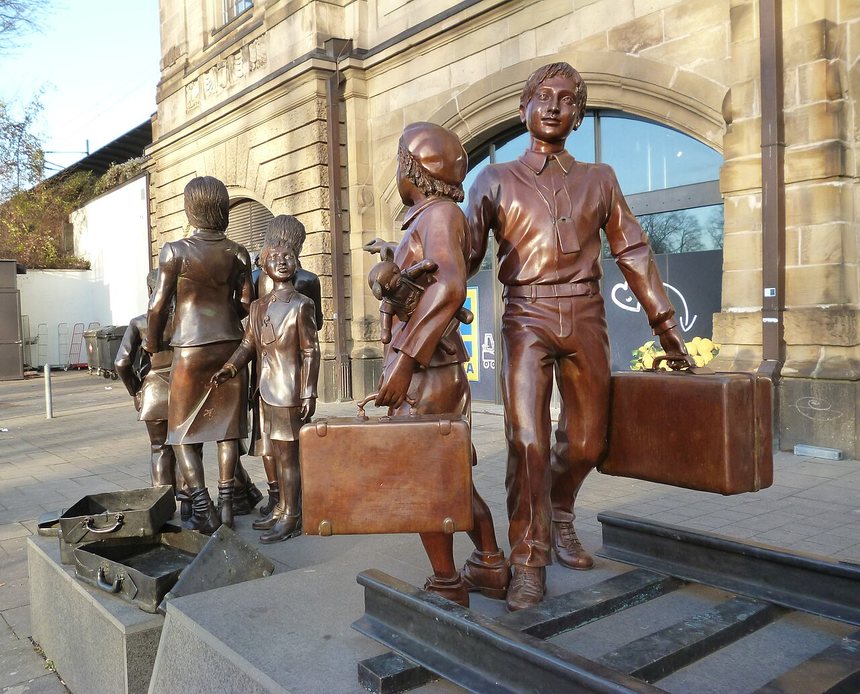
Children sent to safety, without their parents.
After Kristallnacht, the nationwide Nazi attack on synagogues, Jewish businesses, and homes of November 9–10, 1938, the danger to Jewish children inside the Reich was no longer deniable. Some 30,000 Jewish men had been arrested and sent to Dachau, Buchenwald, and Sachsenhausen. Jewish families across Germany, Austria, and the annexed Czech lands looked for any route out. The Kindertransport, German for “children’s transport”, was the rescue operation that answered that search for nearly ten thousand of them.
On November 21, 1938, the British government agreed to admit unaccompanied Jewish children under the age of seventeen on temporary visas. Each child required a fifty-pound guarantee to fund an eventual re-emigration, and the children had to travel without their parents. The operation was run by the Movement for the Care of Children from Germany, a coalition of Jewish, Quaker, and other volunteers. The first transport reached the English port of Harwich on December 2, 1938. The last left in the final days before the war began on September 1, 1939. The children came from Germany, Austria, Czechoslovakia, Poland, and the Free City of Danzig, and the majority were Jewish.
They traveled by train across the Reich and by ferry across the North Sea, each child wearing a numbered tag and carrying a single small case. Parents said their goodbyes on station platforms, in most cases for the last time. The transports out of Prague, which brought 669 children out of Czechoslovakia, were organized largely by a young London stockbroker, Nicholas Winton, whose part in the rescue became widely known only decades later.
The visas placed the children in Britain, but homes had to be found for them one at a time. Until foster families, hostels, and farms could take them in, many of the new arrivals were housed together in reception camps of their own. Among them were the Dovercourt Bay holiday camp near Harwich and the camp at Pakefield near Lowestoft, seaside summer camps pressed into winter use. There the children waited, often in the cold, to be placed.
The visas covered children only. Most of their parents could not get out, and many were later deported and murdered. Large numbers of the rescued children never saw their families again. For what children faced where the rescue did not reach, see the Camp System Chapter.
Contested elements in the resistance record
The honest accounting.
The scholarship on Holocaust resistance argues over hard questions. The main ones:
- The scale question. The armed resistance during the Holocaust involved far smaller numbers than the Jewish population under Nazi rule. Historians have asked what that limited scale reflects: the near-impossible conditions the regime imposed, or a limited Jewish response. The consensus, set out above all by Yehuda Bauer and Yisrael Gutman, is that the conditions made armed resistance extraordinarily difficult, and that the resistance that did occur shows what was possible under them.
- The "lambs to the slaughter" question. Early postwar writing, including much early Israeli political debate, used the phrase "lambs to the slaughter" (Hebrew: ka-tzon la-tevach) for Jewish behavior under Nazi rule. The phrase came from Abba Kovner's 1942 Vilna manifesto, where it was a call to resistance. After the war it was widely turned into a criticism of Jewish passivity. That framing has been deeply revised since the 1960s. Today's scholarship largely rejects it as inadequate to the record. How the phrase shaped later Holocaust memory is its own field of study.
- The Judenrat question. The Jewish Councils (Judenräte), the Jewish leadership bodies that the Nazi regime imposed on each ghetto, operated under coercion. Did the councils, in practice, ease the deportations by cooperating? Or did cooperation under coercion buy rescue that would otherwise have been impossible? The argument has run for decades, including the famous Hannah Arendt controversy treated in the Hannah Arendt Chapter. The consensus, set out above all in Isaiah Trunk's Judenrat (1972), is that the record varied widely from council to council. Some Judenrat leaders engaged in real resistance. The reference case is Adam Czerniaków in Warsaw, who took his own life on July 23, 1942 rather than sign the deportation orders. Calling the councils simply collaborative does not fit the documentary record.
- The rescue scale question. The rescue documented in this Chapter, the diplomats, the national operations, the roughly 28,000 Righteous, stands against a hard reality: the great majority of Jews under Nazi rule were not rescued. How to weigh that record against the wider world's failure to rescue more has been argued ever since. The questions include the Allied decision not to bomb the rail lines to Auschwitz, the U.S. refusal to loosen immigration limits, and the British restrictions on refugee immigration to Palestine.
Key takeaways
The record in brief.
- Holocaust resistance took armed, unarmed, spiritual, and documentary forms. In Yehuda Bauer’s scholarship these fall under the Hebrew term amidah, “standing firm.”
- The Warsaw Ghetto Uprising (April 19 – May 16, 1943) was the largest single armed Jewish revolt of the Holocaust, fought by roughly 700 fighters of the ŻOB and ŻZW.
- Armed revolts broke out at three killing centers: Treblinka (August 1943), Sobibór (October 1943), and the Auschwitz-Birkenau Sonderkommando (October 1944).
- Jewish partisan units operated in the forests of Eastern Europe. The Bielski group in Belarus combined armed action with a forest refuge that sheltered about 1,200 people.
- Emanuel Ringelblum’s Oneg Shabbat group buried the Warsaw Ghetto’s records in milk cans and tin boxes. Two of the three caches were recovered after the war.
- Yad Vashem has recognized about 28,000 non-Jewish rescuers as Righteous Among the Nations. Rescue ranged from individual diplomats to the near-total national rescue of Danish Jewry in October 1943.
- The Kindertransport brought nearly 10,000 unaccompanied Jewish children to Britain in 1938–39. Most never saw their parents again.
- Rescue saved a minority. The wider world, including the Allied governments, declined many chances to admit or protect Jewish refugees.
Object Spotlight
The milk cans of Oneg Shabbat.
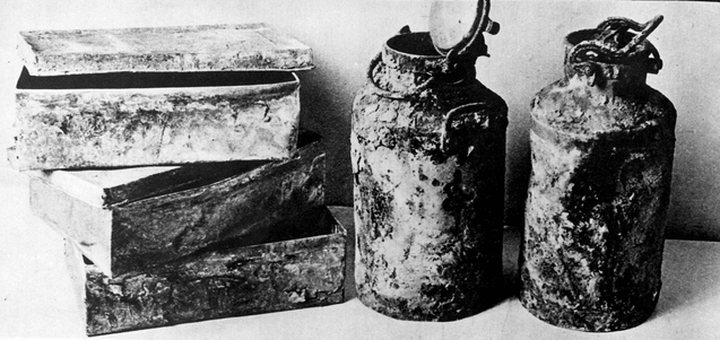
They are ordinary dairy cans, dented tin with clamped lids, the kind that stood outside any Warsaw shop. Into them, and into metal boxes, Emanuel Ringelblum’s Oneg Shabbat group sealed the archive this Chapter describes, and buried it in three caches under the ghetto’s streets.
Ten metal boxes came out of the rubble in September 1946. The two milk cans were found in December 1950, under a destroyed house on Nowolipki Street. The third cache has never been found. Somewhere under Warsaw it remains.
The containers are preserved at the Jewish Historical Institute in Warsaw. The cans did exactly what their buriers asked of them: they carried the ghetto’s own testimony past the people who destroyed it.
Discussion questions
Working from the evidence.
- Historians broadened the definition of “resistance” after the 1960s to include unarmed and spiritual acts. What is gained, and what might be lost, by defining resistance so broadly?
- The fighters at Warsaw and Vilna knew armed revolt would not save the ghetto population. How should we weigh acts whose purpose was to leave a record rather than to win a battle?
- Ringelblum’s group risked their lives to bury an archive. Why might documenting events be considered a form of resistance under those conditions?
- Compare the rescue of Danish Jewry with the rescues carried out by individual diplomats. What conditions made a near-total national rescue possible in Denmark?
- The Judenrat record is contested among historians. What makes the actions of leaders operating under coercion difficult to judge from the outside?
- About 28,000 people have been recognized as Righteous Among the Nations, while millions were not rescued. How should a study of the rescuers account for the much larger record of those who did not act?
Classroom Connections
Where this Chapter fits.
Teaching Connections
The disciplines and courses this Chapter naturally supports, for any educator, anywhere.
- World History. Examines Jewish armed and spiritual resistance, rescue, documentation, and survival, the human-agency dimension of the Holocaust.
- Classroom Applications. Students can:
- compare the many forms of resistance (armed, spiritual, cultural, and rescue);
- evaluate rescue efforts and the choices behind them;
- weigh moral agency under extreme conditions;
- analyze memoirs and underground archival evidence;
- construct evidence-based historical arguments.
- International Classroom Relevance. Supports Holocaust education, civic and character education, genocide studies, and human-rights instruction.
Standards Alignment
- NYS Social Studies Framework: NY Grade 8 (United States History) 8.6 and NY Global History 10.5 and 10.10 (World War II, the Holocaust, and human rights).
- NYS Holocaust Education Mandate, Education Law §801. Supports Holocaust instruction by correcting misconceptions about Jewish resistance while documenting the many forms resistance took under genocidal conditions.
- Common Core, Reading in History/Social Studies (grades 6–12). Students assess purpose and point of view (RH.6–8.6, RH.9–10.6, RH.11–12.6) and integrate multiple sources (RH.6–8.9, RH.9–10.9, RH.11–12.9), working from memoirs, underground archives, photographs, diplomatic records, and survivor testimony. These grade 6–8 literacy standards anchor the Chapter for grade 7, where resistance and rescue are widely taught in humanities and ELA.
- C3 Framework, D2.His.1 and D2.His.14 (grades 6–8 and 9–12). Students investigate context, evidence, moral choice, and interpretation.
Resources, lessons, and video
Where to teach this well.
The resistance and rescue record is one of the best-documented and best-supported parts of Holocaust instruction. This Chapter supplies the framework. The lessons, testimony, and primary sources below are where to teach from.
Teacher materials & lesson plans
- Jewish Partisan Educational Foundation, short films, survivor interviews, and ready, standards-aligned lessons built entirely around the forest partisans.
- USHMM · Teaching Materials, lessons and the searchable Holocaust Encyclopedia entries on armed and unarmed resistance.
- Yad Vashem · International School for Holocaust Studies, resistance and rescue units by grade band, plus the searchable Righteous Among the Nations database.
- Echoes & Reflections, a full classroom curriculum with a dedicated unit on resistance, built around survivor testimony.
Primary sources & testimony
- The Jewish Historical Institute · Warsaw, the home of the recovered Oneg Shabbat (Ringelblum) archive, the records the ghetto buried before it burned.
- USC Shoah Foundation · IWitness, survivor video testimony, including partisans and rescuers, with built-in activities.
- Smithsonian Magazine · “A New Holocaust Exhibition Tells the Story of Jewish Resistance”, background reading on how museums are bringing the resistance record to the public.
Films & video
- USHMM · “Jewish Resistance”, an authoritative overview carrying short archival film and survivor-testimony clips. All grades. Strong for teacher preparation and projection.
- Jewish Partisan Educational Foundation · short films, brief, classroom-length films built around the forest partisans, each paired with a lesson. Grades 8–12.
- Defiance (2008), the story of the Bielski partisans, a dramatic feature rated R for combat violence. Preview before classroom use. Teacher discretion.
For New York–region teachers. The Holocaust Memorial & Tolerance Center of Nassau County (Glen Cove, Long Island) runs in-school programs and a Speakers Bureau on resistance and rescue, and offers a free virtual guide to its galleries.
Sources and citations
Primary sources
A primary source is a record from the time. It was made by people who were there. Examples: letters, diaries, photos, decrees, trial records, and newspapers.
- The children’s drawings from the Terezín ghetto, 1942–1944. Collection of the Jewish Museum in Prague, about 4,500 drawings.
- Friedmann, Pavel. “The Butterfly.” Theresienstadt, June 4, 1942. Jewish Museum in Prague.
- Edelman, Marek. The Ghetto Fights. New York: American Representation of the General Jewish Workers' Union of Poland, 1946.
- Stroop, Jürgen. The Stroop Report: The Jewish Quarter of Warsaw Is No More! Translated by Sybil Milton. New York: Pantheon, 1979.
- Ringelblum, Emanuel. Notes from the Warsaw Ghetto. Edited by Jacob Sloan. New York: Schocken, 1958.
- Greif, Gideon. We Wept Without Tears: Testimonies of the Jewish Sonderkommando from Auschwitz. New Haven: Yale University Press, 2005.
- The Jewish Historical Institute (Żydowski Instytut Historyczny), Warsaw, holdings include the Oneg Shabbat / Ringelblum Archive. jhi.pl/en →
- Yad Vashem · The Righteous Among the Nations Database. righteous.yadvashem.org →
Secondary sources
A secondary source was written later. It is a book or article by a historian who studied those records and explains what they mean.
- Bauer, Yehuda. Rethinking the Holocaust. New Haven: Yale University Press, 2001.
- Bauer, Yehuda. A History of the Holocaust. Rev. ed. New York: Franklin Watts, 2001.
- Gutman, Israel. The Jews of Warsaw, 1939–1943: Ghetto, Underground, Revolt. Bloomington: Indiana University Press, 1982.
- Gutman, Yisrael. Resistance: The Warsaw Ghetto Uprising. Boston: Houghton Mifflin, 1994.
- Tec, Nechama. Defiance: The Bielski Partisans. New York: Oxford University Press, 1993.
- Tec, Nechama. Resilience and Courage: Women, Men, and the Holocaust. New Haven: Yale University Press, 2003.
- Arad, Yitzhak. The Partisan: From the Valley of Death to Mount Zion. New York: Holocaust Library, 1979.
- Arad, Yitzhak. Belzec, Sobibor, Treblinka: The Operation Reinhard Death Camps. Bloomington: Indiana University Press, 1987; rev. ed. 1999.
- Cohen, Asher, et al., eds. The Jews in European Resistance Movements During World War II. New York: Holmes & Meier, 1985.
- Suhl, Yuri, ed. They Fought Back: The Story of the Jewish Resistance in Nazi Europe. New York: Crown, 1967.
- Ainsztein, Reuben. Jewish Resistance in Nazi-Occupied Eastern Europe. New York: Barnes & Noble, 1974.
- Kassow, Samuel D. Who Will Write Our History? Emanuel Ringelblum, the Warsaw Ghetto, and the Oyneg Shabes Archive. Bloomington: Indiana University Press, 2007.
- Trunk, Isaiah. Judenrat: The Jewish Councils in Eastern Europe under Nazi Occupation. New York: Macmillan, 1972.
- Bauer, Yehuda. The Death of the Shtetl. New Haven: Yale University Press, 2009.
- Paldiel, Mordecai. The Path of the Righteous: Gentile Rescuers of Jews During the Holocaust. Hoboken: KTAV, 1993.
- Paldiel, Mordecai. Diplomat Heroes of the Holocaust. Jersey City: KTAV, 2007.
- Bierman, John. Righteous Gentile: The Story of Raoul Wallenberg, Missing Hero of the Holocaust. New York: Viking, 1981.
- Levine, Paul A. Raoul Wallenberg in Budapest: Myth, History and Holocaust. London: Vallentine Mitchell, 2010.
- Levine, Hillel. In Search of Sugihara: The Elusive Japanese Diplomat Who Risked His Life to Rescue 10,000 Jews from the Holocaust. New York: Free Press, 1996.
- Fralon, José-Alain. A Good Man in Evil Times: The Story of Aristides de Sousa Mendes. New York: Carroll & Graf, 2000.
- Yahil, Leni. The Rescue of Danish Jewry: Test of a Democracy. Philadelphia: Jewish Publication Society, 1969.
- Todorov, Tzvetan. The Fragility of Goodness: Why Bulgaria's Jews Survived the Holocaust. Princeton: Princeton University Press, 2001.
- Zuccotti, Susan. The Italians and the Holocaust: Persecution, Rescue, and Survival. Lincoln: University of Nebraska Press, 1996.
- The Jewish Partisan Educational Foundation. jewishpartisans.org →
- USHMM Holocaust Encyclopedia · Resistance during the Holocaust. encyclopedia.ushmm.org →
Finding these documents: many primary sources are free online. Good places to start are the Fordham Internet Jewish History Sourcebook, Yale’s Avalon Project (law and diplomacy), German History in Documents, the collections of the US Holocaust Memorial Museum and Yad Vashem, the National Library of Israel, and Sefaria (for Jewish texts). Search the document’s name and date.
The next Unit turns from how Jews were treated to what Jewish civilization created, its scholars, writers, and scientists.
Comments?
Write to editor@makorproject.org. Last updated: September 2026. Makor is the Hebrew word for source.