The Camp System, imprisonment, forced labor, and systematic murder
The Nazis documented their system in obsessive detail: prisoner numbers, transport manifests, roll calls counted twice a day. And yet many of the people they killed were never registered at all: at the killing centers, they were taken from the train straight to the gas, dead within hours. Their numbers can only be estimated.
Why this Chapter exists
A camp was not a single kind of place.
Most school lessons about the Nazi camp system use one term, "concentration camp," for the whole system, with Auschwitz as the most familiar example. That usage is conventional. It is also historically imprecise. The Nazi regime ran several distinct types of camps. They had different purposes, different prisoner populations, and different death rates. And they played different parts in the wider machinery of the genocide. The most important distinction is between a concentration camp and a killing center. Concentration camps were places of imprisonment, brutality, and forced labor, where death was common. Killing centers were built to murder entire populations on arrival. Both existed within the same Nazi system. But each type served a different purpose, and each left a different kind of historical record. Those differences are what make the documents, the testimony, the photographs, and the postwar evidence make sense.
A note on scope
The Holocaust was more than the camps. The camp system is one part of a much larger history. The full record includes the long ideological inheritance before 1933, and the legal machinery of Nazi anti-Jewish policy built across 1933–1939. It includes the mass shootings of the Einsatzgruppen across the occupied Soviet territories, the "Holocaust by bullets." About 1.5 to 2 million Jews were murdered in those shootings. Those shootings began before the killing centers existed and continued alongside them. It includes the Nazi ghetto system across occupied Eastern Europe, the deportations from Western and Central Europe, and the documented history in the Middle East and North Africa. And it includes the resistance and rescue record, the testimony archive, and the postwar legal, institutional, and theological reckoning. The camps were one part of the Holocaust. To understand the Holocaust, the camps must sit within that broader history: ideology, persecution, mass shootings, deportations, collaboration, resistance, and the reckoning that followed.
Where to find the other dimensions. Unit 3 traces the long evolution of antisemitism through the nineteenth-century racial turn. Unit 4 provides the year-by-year chronology including the ghettos, the Einsatzgruppen, the deportations, and the liberation. Chapter · The Ghetto System distinguishes the early-modern European institution from the Nazi-era ghettos. Chapter · The Holocaust in MENA documents the Middle Eastern and North African dimension. Unit 6 treats the postwar reckoning, including Nostra Aetate, the Catholic Church’s 1965 declaration on the Jews.
The main scholarly reference for the camp system as a whole is the United States Holocaust Memorial Museum's Encyclopedia of Camps and Ghettos, 1933–1945. This multi-volume project has so far identified more than 44,000 individual sites across occupied Europe. The sites include concentration camps, forced-labor camps, transit camps, and ghettos. They also include prisoner-of-war camps with substantial Jewish populations, and other categories.
Common misconceptions this Chapter addresses
Most people picture a single place, “the concentration camp,” with Auschwitz standing in for all of it. The reality was a network of different camp types. The SS (the Schutzstaffel, the Nazi organization that ran the camp system, see the glossary) built each type for a different purpose.
- "All the Nazi camps were the same kind of place." see the dedicated entry →
- "Auschwitz was the only death camp." see the dedicated entry →
- "The death camps were inside Germany." see the dedicated entry →
- "Everyone sent to a camp was registered and tattooed." see the dedicated entry →
The categories of camps
Five types, briefly distinguished.
Historians distinguish five main categories of Nazi camps. The lines between them are not absolute. Some sites combined more than one function over time. But the categories capture how the system was built.
- Concentration camps: places of imprisonment, forced labor, and systematic brutality. The original Nazi camp system, beginning at Dachau in March 1933. Prisoners included political opponents of the regime, people labeled racially or socially "undesirable," and, from the late 1930s, growing numbers of Jewish prisoners. Death rates were high. But these camps were not designed to murder people on arrival.
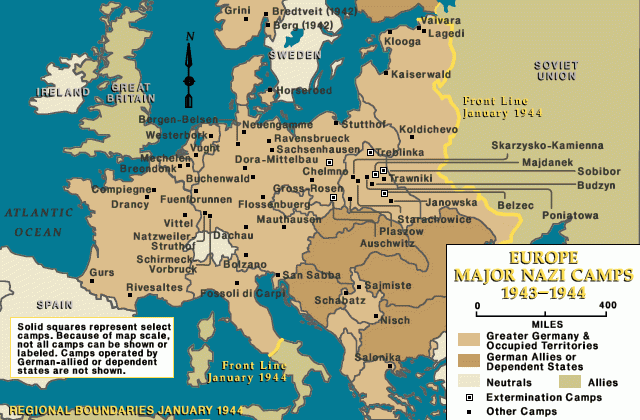
- Killing centers (extermination camps): built for the systematic murder of people on arrival, primarily by gas. Six killing centers operated, all on Polish territory under German rule, four in the General Government and two in areas annexed to the Reich: Chełmno, Bełżec, Sobibór, Treblinka, Auschwitz-Birkenau, and Majdanek. The killing centers are where the largest share of the Holocaust's murders took place.
- Forced-labor camps: camps where Jewish and other prisoners were worked as forced labor for German industry, agriculture, the military, and construction. The largest single category in the USHMM Encyclopedia of Camps and Ghettos, thousands of sites of every size across occupied Europe.
- Transit camps: holding camps for people awaiting deportation, usually to the killing centers. The major transit camps included Westerbork (Netherlands), Drancy (France, run by French police until mid-1943), Theresienstadt (in the Protectorate of Bohemia and Moravia, also functioning as a ghetto and a propaganda site), and Mechelen (Belgium).
- Prisoner-of-war camps with substantial Jewish populations. A distinct category. The regime held Jewish prisoners of war, especially Soviet Jewish soldiers, under separate and more deadly conditions than other prisoners of war. Their treatment is part of the record of the genocide, far outside the protections the Geneva Convention promised prisoners of war.
Concentration camps
The original Nazi camp system, 1933–1945.
The Nazi concentration-camp system took lasting shape from March 22, 1933, with the opening of Dachau near Munich, the first camp under SS control and the model for the system; dozens of improvised SA and police camps had opened in the same weeks and were later closed or absorbed. That was less than two months after Adolf Hitler became Chancellor of Germany. The SS set up Dachau under Heinrich Himmler, who would soon become the chief architect of the whole camp system. Dachau's first purpose was imprisoning the regime's political opponents: communists, social democrats, trade unionists, and others. Its design became the model for the system that grew from it.
Across 1933–1939, the SS built the main pre-war concentration camps. Sachsenhausen opened in 1936 near Berlin, and Buchenwald in 1937 near Weimar. Flossenbürg followed in 1938, Mauthausen in August 1938 in annexed Austria, and Ravensbrück, the camp for women, in 1939. In these years the prisoners were mostly political prisoners, along with people the regime labeled repeat criminals under its expanded rules. Others were targeted on racial or social grounds: Roma and Sinti, people the regime labeled "asocial," gay men under Paragraph 175 of the criminal code, Jehovah's Witnesses, and others. Jewish prisoners were a smaller part of the pre-war camp population. The major exception came after Kristallnacht, the regime’s nationwide anti-Jewish pogrom of November 1938. Some 30,000 Jewish men were arrested and sent mainly to Dachau, Buchenwald, and Sachsenhausen.
After September 1939, the war changed the camp system's scale and purpose. New camps went up across occupied Europe. Among them: Auschwitz I (May 1940), Stutthof near Danzig (September 1939), Gross-Rosen (1940), Natzweiler-Struthof in annexed Alsace (1941), and many others. The prisoner population grew too. It now included Polish political prisoners and intellectuals, Soviet prisoners of war held under the deadly conditions noted above, and Jewish prisoners from the occupied territories. It also included people across the conquered countries targeted as racial or political enemies. By 1944, the concentration-camp system included more than twenty principal camps and over a thousand subcamps.
Death rates in the concentration camps varied across camps, periods, and prisoner categories. Conditions at Mauthausen and its subcamps were exceptionally severe. The same was true of Gross-Rosen and of certain subcamps of Buchenwald. Among them was Dora-Mittelbau, where prisoners built the V-2 rocket under conditions that killed prisoners at catastrophic rates, as construction schedules were driven past what a human being could survive. But in the concentration camps, death came from the conditions rather than being the camp's purpose. That is the line that separates them from the killing centers.
The six killing centers
The dedicated facilities of the Final Solution, the Nazi program to murder all of Europe’s Jews.
The killing centers were the principal sites of systematic mass murder during the Holocaust. They are the places where the greatest number of Jews were murdered. All six stood on Polish territory under German rule. They ran under different structures. Three ran under Operation Reinhard: Bełżec, Sobibór, and Treblinka. Operation Reinhard was the code name for the plan to murder the roughly two million Jews of the General Government, the German-run zone of occupied Poland. One, Chełmno, was run by an SS special detachment under the Nazi governor of the annexed Wartheland, outside both structures. Two, Auschwitz-Birkenau and Majdanek, combined killing-center and concentration-camp functions in one place. Together, the six killing centers murdered an estimated three million people, the great majority of them Jewish.
The history of each killing center is documented in detail in the scholarly literature. The foundational account is Yitzhak Arad's Belzec, Sobibor, Treblinka: The Operation Reinhard Death Camps (Indiana University Press, 1987, revised 1999). The various works of Christopher Browning, the USHMM Encyclopedia of Camps and Ghettos Volume I, and the documentation of each surviving memorial site fill out the record.
Chełmno · December 1941 – March 1943, briefly reactivated 1944
The first dedicated killing center.
The killing center at Chełmno (German: Kulmhof) opened on December 8, 1941, at a former manor estate about 50 kilometers northwest of Łódź in occupied Poland. It was the first Nazi facility built to murder people on arrival.
The killing method at Chełmno was the gas van, a sealed truck into which the exhaust was channeled. Victims were brought to the manor house and told they would be processed for resettlement. They were then loaded into the gas vans in groups of about 50 to 70 people. The vans drove to a nearby forest, and the killing took place during the drive. The bodies were buried. Beginning in 1942, they were dug up and burned to destroy the evidence.
Chełmno operated in two phases. The first phase, December 1941 to March 1943, was the main period of operation. About 152,000 to 180,000 people were murdered there, the great majority Jewish. Most came from the Łódź Ghetto and the surrounding region of the Wartheland, the part of western Poland Germany had annexed. The second phase ran briefly in June and July 1944, during the final liquidation of the Łódź Ghetto. Some 7,000 to 8,000 more people were murdered before the camp was abandoned ahead of the Soviet advance.
Seven Jewish men are known to have escaped Chełmno. At least three survived the war, among them Mordechai Podchlebnik and Szymon Srebrnik. Their testimony is among the earliest direct survivor accounts of the killing-center system. Srebrnik's testimony is preserved on film in Claude Lanzmann's Shoah (1985). Both survivors testified at postwar trials. The site at Chełmno is preserved as the Chełmno Museum.
Bełżec · March 1942 – December 1942
The first Operation Reinhard killing center.
The killing center at Bełżec opened on March 17, 1942, in the Lublin district of the General Government (occupied Poland). It was the first of the three killing centers built under Operation Reinhard. The operation is generally understood to have been named after Reinhard Heydrich, the SS officer who had convened the Wannsee Conference, the January 1942 meeting that coordinated the murder program across the German government. Heydrich was attacked in May 1942 by Czechoslovak soldiers trained in Britain and parachuted home for the mission and died of his wounds in June.
The killing method at Bełżec was carbon-monoxide gas chambers. The gas was produced by engine exhaust and pumped into sealed chambers. Victims were brought by train from the Jewish communities of the General Government, primarily from Lwów (Lviv), Lublin, Kraków, and the surrounding regions. They were murdered on arrival, usually within hours of the train reaching the camp.
Bełżec operated for about nine months. Some 434,508 people are documented as murdered there in those months, the overwhelming majority Jewish. The figure is among the most precisely documented in the killing-center system. That precision rests on the survival of a single document from the time: a January 1943 radiogram from SS officer Hermann Höfle to Berlin. It reported the running Operation Reinhard murder figures, camp by camp, through the end of 1942. British intelligence intercepted and decoded the Höfle Telegram. It was released to scholars in 2000, and it established the precise documentary record for Bełżec, Sobibór, Treblinka, and Majdanek through the end of 1942.
Two prisoners survived Bełżec. Chaim Hirszman was murdered in Lublin in March 1946 by Polish nationalist gunmen. Rudolf Reder testified at postwar trials. The site at Bełżec is preserved as the Bełżec Museum.
Sobibór · May 1942 – October 1943
The killing center that ended in revolt.
The killing center at Sobibór opened in May 1942 in the Lublin district. The killing method was carbon-monoxide gas chambers, parallel to Bełżec. Sobibór received transports primarily from the General Government, from the Netherlands (the Westerbork transit camp), from France (via Drancy), and from other Western European countries. Roughly 167,000 people are estimated to have been murdered at Sobibór, the overwhelming majority Jewish.
Sobibór stands out for the revolt of October 14, 1943. About 300 prisoners of the special detail, the men forced to operate the killing process, organized an armed uprising. It was led by Alexander "Sasha" Pechersky, a Soviet Jewish prisoner of war who had arrived that September. He worked with the Polish Jewish prisoner Leon Feldhendler. The uprising killed eleven SS men, and some 300 prisoners escaped. An estimated 50 of them survived the war.
The revolt ended the camp. The regime closed it within days, tore down the buildings, and planted trees over the buried evidence to hide what the site had been. The site at Sobibór is preserved as the Sobibór Museum, where archaeologists have recovered much of the site since the 2000s.
Treblinka · July 1942 – November 1943
The killing center that murdered the Warsaw Ghetto.
The killing center at Treblinka opened on July 23, 1942, in the General Government, about 80 kilometers northeast of Warsaw. Its precise name is Treblinka II. The name separates the killing center from the forced-labor camp next to it, Treblinka I. The killing method was carbon-monoxide gas chambers.
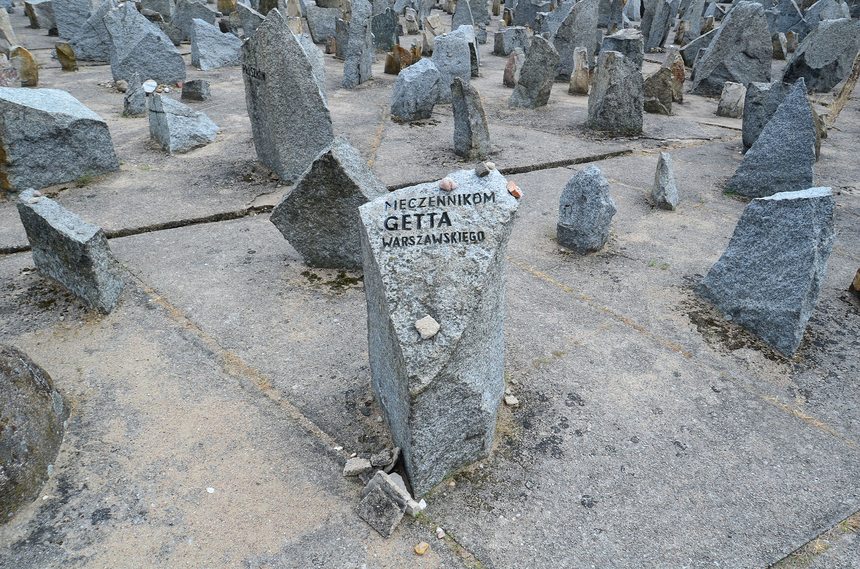
Treblinka was the principal killing center for the Jewish community of Warsaw. The deportations from the Warsaw Ghetto to Treblinka began on July 22, 1942, and continued through September 1942, the "Great Deportation." They murdered roughly 265,000 of the ghetto’s roughly 380,000 inhabitants at the time. Starvation and disease had already brought the population down from its peak of over 400,000. The systematic murder of the Warsaw Jewish community at Treblinka is documented in survivor testimony, in postwar trial records, and in the Ringelblum Archive. That was the secret archive kept inside the Warsaw Ghetto by the historian Emanuel Ringelblum and his associates. It was preserved in milk cans and metal boxes buried beneath the ghetto and recovered after the war.
The total number of people murdered at Treblinka is estimated at between roughly 780,000 and 925,000. That is the second-largest killing-center death toll after Auschwitz-Birkenau. Almost all of those murdered at Treblinka were Jewish. Smaller numbers of Roma were also murdered there. On August 2, 1943, a prisoner uprising, parallel to the later Sobibór revolt, killed several SS men. More than 300 prisoners escaped. Most were hunted down. Some 70 are known to have survived the war. The Nazi authorities dismantled the Treblinka site after the uprising. The site is preserved as the Treblinka Museum, with a substantial postwar memorial designed by Adam Haupt and Franciszek Duszeńko.
Majdanek · October 1941 – July 1944
The composite camp on the edge of Lublin.
Majdanek (formally KL Lublin) was a case of its own. It ran at the same time as a concentration camp, a forced-labor camp, a Soviet prisoner-of-war camp in its earliest phase, and a killing center. The camp was established in October 1941 on the southeastern outskirts of Lublin in occupied Poland. The gas chambers were installed in late 1942 and operated into September 1943. On November 3, 1943, in the shooting operation called Aktion Erntefest, some 18,000 Jews were murdered at the camp in a single day.
Majdanek stood apart in two more ways. First, it sat at the edge of a major Polish city rather than in a remote place. Because it stood so close to the civilian population, it left a larger body of documentation from the time than the isolated Operation Reinhard sites. Second, Majdanek was the first major killing center to be liberated by Allied forces. Soviet forces overran the camp on July 23, 1944, and captured the gas chambers intact; the SS had set fire to the crematorium the day before they withdrew. What they found became the first photographic and documentary evidence of the killing-center system to reach the world’s press.
Scholars estimate that some 80,000 people were murdered at Majdanek. About 60,000 of them were Jewish. The site is preserved as the Majdanek State Museum, with the original gas chambers, crematorium, and substantial parts of the camp infrastructure intact.
Auschwitz-Birkenau · May 1940 – January 1945
The largest of the killing centers.
Auschwitz was the largest of the Nazi camps. It was really a complex: three main camps and roughly 45 subcamps spread across the Silesian region of annexed Poland. The three main camps:
- Auschwitz I (Stammlager): the original camp, established on May 20, 1940, in the former Polish military barracks at Oświęcim. It functioned as the administrative center of the complex and as a concentration camp for political prisoners, at first mostly Polish. After the killing operations began, it too became a site of mass murder. Holds the iconic Arbeit Macht Frei (“Work sets you free”) gate.
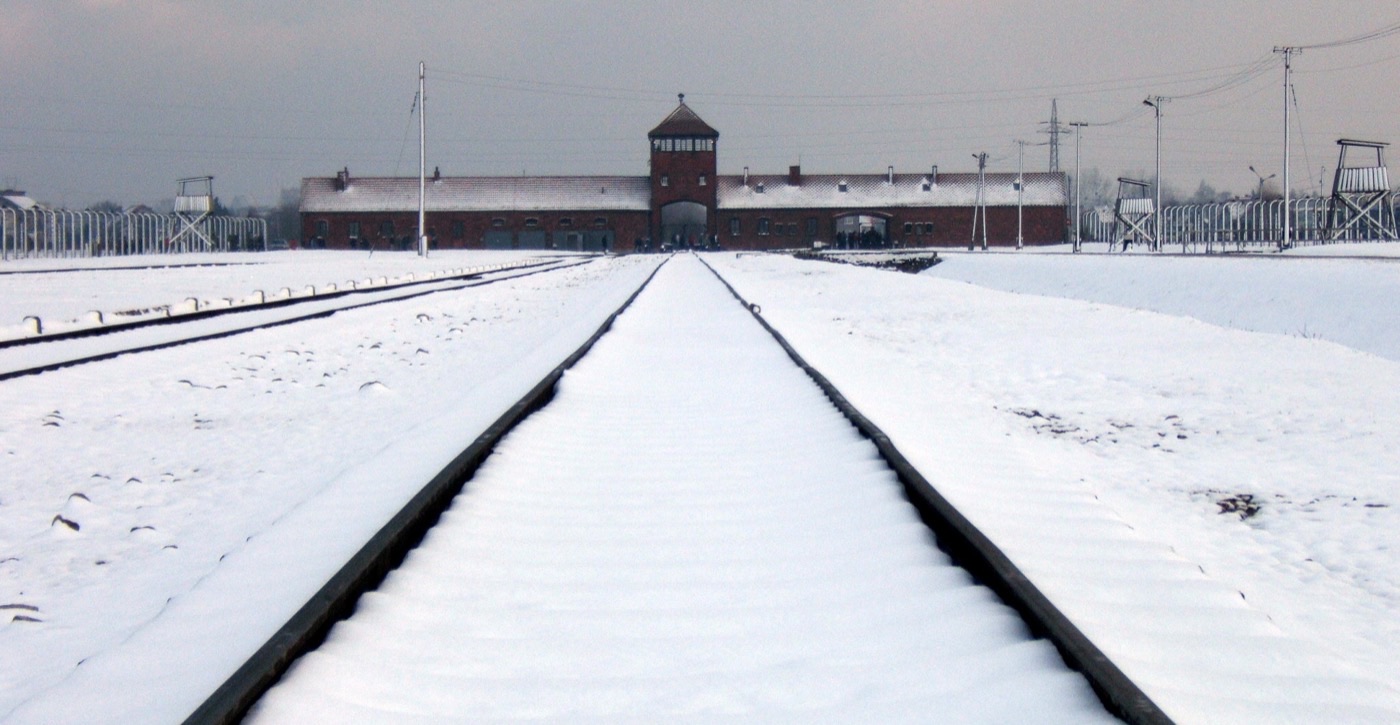
- Auschwitz II–Birkenau: the main killing center, established in October 1941 about three kilometers from Auschwitz I, in the village of Brzezinka. Birkenau held the main gas chambers and crematoria of Auschwitz: four major complexes (Crematoria II, III, IV, and V). It also held the railhead where incoming transports were processed and the selections made: the sorting of arrivals between forced labor and the gas chambers.
- Auschwitz III–Monowitz: established in October 1942 as the Buna labor camp for the IG Farben synthetic-rubber plant. It became the main forced-labor part of the complex. Primo Levi, the Italian Jewish chemist and writer, was imprisoned at Monowitz. His memoir If This Is a Man is among the most influential survivor accounts.
The total number of people murdered at Auschwitz is about 1.1 million. The figure was established by Franciszek Piper of the Auschwitz-Birkenau State Museum, in Auschwitz: How Many Perished, Jews, Poles, Gypsies (1994). Of those, some 1.0 million were Jewish, roughly 70,000–75,000 were Polish political prisoners, about 21,000 were Roma and Sinti, some 14,000 were Soviet prisoners of war, and roughly 10,000–15,000 were prisoners of other nationalities and categories.
The killing at Auschwitz-Birkenau reached its peak in spring and summer 1944, with the deportation of the Hungarian Jewish community. Between May 15 and July 9, 1944, about 437,000 Hungarian Jews were deported, nearly all to Auschwitz. An estimated 320,000 were murdered on arrival, in under two months. The Hungarian deportations were the largest and most concentrated phase of mass murder in the Holocaust.
The Auschwitz complex was liberated by Soviet forces on January 27, 1945. At liberation, some 7,000 prisoners remained in the camp. The rest had been forced westward in death marches in mid-January 1945. The site is preserved as the Auschwitz-Birkenau State Memorial and Museum, the largest Holocaust memorial site in the world. The complex was inscribed on the UNESCO World Heritage List in 1979.
Forced-labor camps
The largest single category of camps.
Forced-labor camps were the places where Jewish and other prisoners were worked for German industry, agriculture, the military, and construction. The category includes:
- SS-administered forced-labor camps: labor camps directly under the SS Economic and Administrative Main Office (SS-WVHA), the office that had absorbed the camp inspectorate in March 1942 and turned the whole system toward war production, often as subcamps of the major concentration camps. The SS leased prisoner labor to German firms for substantial fees.
- Wehrmacht-administered camps: labor camps under German military administration, particularly in the early war years.
- Civil-administration camps: labor camps under German civilian bodies, including the Organisation Todt, which ran major military and construction projects.
- Industry-administered camps: labor camps for civilian forced workers run by German firms themselves (IG Farben, Krupp, Siemens, Daimler-Benz, BMW, and many others); camps at company plants that held concentration-camp prisoners remained SS installations, with the labor leased to the firm.
Death rates varied widely. Camps doing heavy construction, or working with dangerous materials, killed at high rates. Dora-Mittelbau at Nordhausen, where prisoners produced the V-2 rocket, was among the deadliest. So were the Dora-Ellrich subcamp and many of the Mauthausen subcamps. Other camps kept more of their prisoners alive, on the logic that the work required it.
The labor system and the killing system worked together. At Auschwitz-Birkenau and at Majdanek, prisoners judged fit for work at the arrival selection were sent to labor within the complex or to subcamps. Prisoners judged unfit were murdered on arrival. The two systems were distinct, but tightly linked. A prisoner selected for work could still die later, from starvation, disease, execution, or transfer to a killing center.
The USHMM Encyclopedia of Camps and Ghettos project has identified some 30,000 forced-labor camp sites, including subcamps of all sizes. The record is extensive. Individual camp histories are documented in varying detail in the scholarly literature.
Transit camps
The way-stations to the killing centers.
The Nazi regime operated a network of transit camps in occupied Western and Central Europe. These were camps where deportees were held for a short time before transport, usually eastward to the killing centers. The major transit camps:
- Westerbork (Netherlands): the principal transit camp for the deportation of the Dutch Jewish community. The Dutch government had built Westerbork in 1939 as a camp for Jewish refugees from Germany. The German occupation turned it into a transit camp in 1942. Roughly 107,000 of the Netherlands’ 140,000 Jews were deported, most of them through Westerbork, primarily to Auschwitz and Sobibór. Anne Frank and her family were deported from Westerbork to Auschwitz on September 3, 1944.
- Drancy (France): the principal French transit camp, in a suburb of Paris. About 65,000 French Jews and Jews resident in France were deported through Drancy, the great majority to Auschwitz.
- Mechelen (Belgium): the principal Belgian transit camp, in the Mechelen Kazerne (military barracks). Some 25,000 Belgian Jews and Jews resident in Belgium were deported through Mechelen, primarily to Auschwitz.
- Theresienstadt (Terezín, in the German-run Protectorate of Bohemia and Moravia): the distinctive case. Theresienstadt was officially a transit camp and "model ghetto." The regime used it for elderly German and Austrian Jews, for decorated First World War veterans, and for prominent Jewish figures. It also served as a Nazi propaganda site. The regime staged it for international observers, most prominently the International Red Cross in June 1944, as proof of supposedly humane treatment. Roughly 33,000 prisoners died at Theresienstadt itself. An estimated 88,000 were deported east to the killing centers, primarily Auschwitz. Its prisoners built a rich cultural life all the same: concerts, lectures, art, and the surviving children's drawings from Friedl Dicker-Brandeis's classes. That legacy anchors much of the postwar memorial and educational work.
- Risiera di San Sabba (Italy): the only Nazi camp with a crematorium on Italian soil, in Trieste. Functioned as a transit camp and as a site of murder, particularly for Italian Jews and partisans.
The transit camps were where the deportations from Western Europe were organized on paper. Registration lists, transport records, and correspondence survive from them. Those records provide much of the primary-source material for documenting the Western European Jewish communities that did not survive.
The camps and the towns around them
How close the camps were to ordinary life.
The camps were not hidden away in secret wilderness. Many stood beside the towns and cities where people lived. Dachau sat at the edge of a Bavarian market town of the same name. Majdanek was built on the outskirts of Lublin, a city of more than 100,000, its watchtowers visible from the streets. Buchenwald overlooked Weimar, the city of Goethe and German high culture. Residents saw the columns of prisoners marched out to work, watched the transports come and go, and lived with the smoke and the smell from the crematoria.
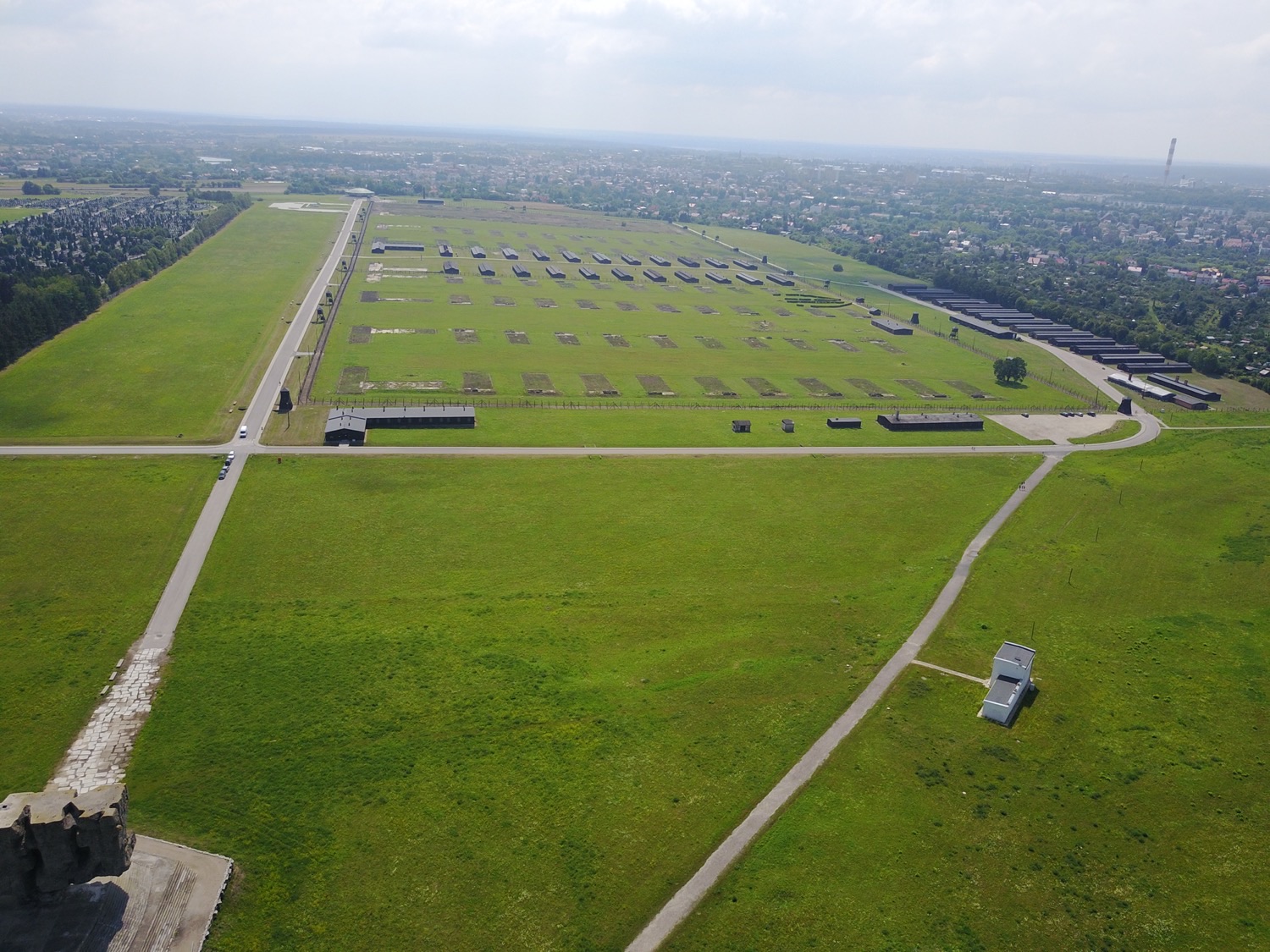
The camps were woven into the economy around them. The SS leased prisoner labor to German firms (among them IG Farben, Krupp, and Siemens, and hundreds of smaller companies) for a daily fee per prisoner. Local builders, suppliers, railway crews, and civil servants did business with the camps. The camps were run openly, by salaried officials, and recorded in ordinary paperwork.
The killing centers were the exception. The Reinhard camps and Chełmno were placed in remote locations and disguised as transit stations; Auschwitz and Majdanek, by contrast, stood in plain sight. The goal was to conceal the murder itself, even where the deportations that fed them were public. How much surrounding populations knew, how that knowledge varied from place to place, and how individuals responded remain important questions in Holocaust scholarship.
The youngest victims
Children in the camp system.
Children occupied a specific place in how the camps worked. At the killing centers, the selection on the arrival ramp turned on a single question: could this person be put to work? SS physicians made that decision. Children (like the elderly, the sick, and pregnant women) almost always could not. They were sent straight to the gas chambers, unregistered, within hours of stepping off the train. Most of the roughly 1.5 million Jewish children murdered in the Holocaust were killed this way, or earlier, in the mass shootings and the ghettos.
A small number of children were kept alive for specific reasons. At Auschwitz, the SS doctor Josef Mengele selected twins and certain other children for medical experiments. Older teenagers were sometimes registered for forced labor. The transit camp and “model ghetto” of Theresienstadt was an exception of a different kind. The imprisoned adults, among them the artist Friedl Dicker-Brandeis, organized secret lessons, concerts, and art classes for the children held there. By the traditional count, about 15,000 children passed through Theresienstadt and only a few hundred survived. The figures are remembered rather than documented, and scholars treat them with care. Roughly 4,500 of their drawings, hidden and recovered after the war, are held today by the Jewish Museum in Prague.
The Nazis also built camps specifically to hold children. The largest was the children’s camp at Litzmannstadt, the German name for Łódź. It opened in December 1942 in a fenced-off section carved out of the Łódź Ghetto. It held Polish children, most of them not Jewish: orphans, the children of arrested resistance members, and others taken off the streets, some as young as six. They were put to forced labor (weaving baskets, making straw shoes, sewing and repairing uniforms) on starvation rations. An unknown number died of hunger, disease, and beatings before the camp was liberated in January 1945. Inside Germany, the regime ran two youth concentration camps of its own, Moringen for boys and Uckermark for girls, for adolescents it labeled “asocial” or “criminal.” The prisoners there were examined, sorted by the regime’s racial rules, and worked.
Of the more than 230,000 children and teenagers deported to Auschwitz, only a few hundred were alive when Soviet forces reached the camp in January 1945.
The Nazi ghetto distinction
A reminder of the categorical separation.
The Nazi-era ghettos are a related but distinct category. The best known are Warsaw, Łódź, Vilna, Kraków, Lublin, and Białystok, alongside about 1,000 smaller ghettos across occupied Eastern Europe. They were sealed city districts, mainly in Poland and the Baltic states. Jews were packed inside under extreme overcrowding, starvation, and forced labor. They were held there until deportation to the killing centers.
The Nazi-era ghettos are wholly distinct from the early-modern European ghettos documented in Chapter · The Ghetto System. The early-modern ghettos were lasting neighborhoods that operated across centuries. The Nazi-era ghettos were short-lived concentration sites. Most lasted months, a few as long as four years, before their populations were deported to killing centers or shot at killing sites nearby. The terminology is the same. The reality is not.
The Nazi-era ghettos are treated in full in the Nazi Ghettos Chapter and in Unit 4's chronology. The Warsaw Ghetto Uprising of April–May 1943 is the most documented case. The Łódź Ghetto under Mordechai Chaim Rumkowski is the most debated case. Three more are each the subject of substantial scholarly literature: the Vilna Ghetto and its cultural and resistance institutions, the Białystok Ghetto Uprising of August 1943, and the Kraków Ghetto with Tadeusz Pankiewicz's pharmacy at its edge.
The final months
Evacuations, death marches, and liberation.
As the Soviet army advanced from the east through 1944, the SS began emptying the camps in its path rather than let the prisoners be freed. Majdanek was overrun so quickly in July 1944 that much of it was captured intact. It was the first major camp the Allies reached, and early physical proof of what the killing centers had been. To keep that from happening again, the SS drove the prisoners of the remaining camps westward, on foot and in open rail cars, through the winter of 1944–45.
These forced evacuations became known as the death marches. Prisoners already starved and worked to exhaustion were moved for days or weeks in the cold with little or no food. Those who fell behind or could not keep pace were shot at the roadside. The largest began in mid-January 1945, when about 56,000 prisoners were marched out of the Auschwitz complex days before Soviet troops arrived. Historians estimate that a quarter of a million prisoners or more died on the marches and in the overcrowded camps they were driven into. Among those camps was Bergen-Belsen, which had no gas chambers and yet saw tens of thousands die of starvation and typhus in the final weeks.
Liberation came unevenly, camp by camp, as the front lines reached them. Soviet forces entered Auschwitz on January 27, 1945, finding about 7,000 prisoners too weak to be moved. That spring, American and British troops reached the camps inside the Reich (Buchenwald, Dachau, and Bergen-Belsen in Germany, Mauthausen in annexed Austria). What they found was recorded on film and in photographs that carried the evidence to the world. For many survivors, liberation was not an ending but the start of years in displaced-persons camps, searching for family who in most cases had not survived. January 27, the date Soviet forces entered Auschwitz, was later designated by the United Nations as International Holocaust Remembrance Day.
The documentary record
How we know what we know.
The Nazi camp system is among the most extensively documented subjects in modern history. The documentary record is preserved across multiple channels:
- The Nazi regime's own administrative records: preserved in large part, despite extensive Nazi efforts to destroy evidence in the final months of the war. The principal categories include the Höfle Telegram, a January 1943 Operation Reinhard radiogram that British intelligence intercepted and decrypted, released to scholars in 2000. They include the Wannsee Conference minutes, drafted by Adolf Eichmann, the SS officer who managed the deportations. They include the surviving records of the SS Economic and Administrative Main Office, and the records of the killing centers themselves where they survived. And they include the corporate records of the German firms that took part in the system.
- The postwar trial records: the Nuremberg Trials (1945–1949), the Frankfurt Auschwitz Trial (1963–1965), the Düsseldorf Treblinka Trial (1964–1965), and the Eichmann Trial in Jerusalem (1961). A long series of further trials followed in Germany, Israel, Poland, and other countries. Together they produced extensive documentary records, witness testimony under oath, and the cumulative documentation that has anchored the scholarly literature.
- The survivor testimony archive: the testimony archives at Yad Vashem, the USHMM, the USC Shoah Foundation, the Fortunoff Video Archive at Yale, and the collections of the major Jewish historical archives.
- The research of the major memorial museums: particularly the Auschwitz-Birkenau State Museum, Yad Vashem's research institutes, and the USHMM's Center for Advanced Holocaust Studies. The Auschwitz-Birkenau State Museum has produced a continuous body of scholarly research on the camp since its establishment in 1947.
- The USHMM Encyclopedia of Camps and Ghettos: the systematic documentation of more than 44,000 individual sites across the Nazi system, conducted by the USHMM's Mandel Center and published by Indiana University Press beginning in 2009. Four volumes have appeared so far, with three more planned.
The camps today
The preserved sites and what to know before visiting.
The principal camp sites are preserved as memorial museums. They are open to scholars, teachers, students, and the general public. The major sites have built substantial teaching programs across decades.
Auschwitz-Birkenau State Memorial and Museum
The principal Holocaust memorial site in the world. Receives well over a million and a half visitors a year. UNESCO World Heritage Site since 1979. Educational programs in many languages, calibrated for grade band and audience type.
Treblinka Museum of Struggle and Martyrdom
The 17,000-stone memorial designed by Adam Haupt and Franciszek Duszeńko (completed 1964). The site itself was systematically destroyed by the SS in 1943. The memorial reconstructs the record.
Bełżec Museum
Memorial site opened in 2004. The 1942 facility was substantially destroyed by the SS. The memorial reconstructs the record through landscape design and the documentation.
Sobibór Museum
Memorial site with substantial archaeological recovery since the 2000s. The gas chamber foundations were located in 2014.
Majdanek State Museum
The most intact of the killing centers because of its rapid liberation in July 1944. Original gas chambers, crematorium, and substantial camp infrastructure preserved.
Chełmno Museum (Muzeum byłego Niemieckiego Obozu Zagłady)
Two-part site (the manor site at Chełmno and the forest killing site at Rzuchów). A two-site memorial museum.
Dachau Concentration Camp Memorial Site
The original Nazi camp, the model. Substantial museum and educational center.
Buchenwald Memorial
One of the largest German concentration-camp memorials. Has a substantial postwar history of its own as a site of Soviet internment.
Terezín Memorial
The preserved site of Theresienstadt, with the Small Fortress (used by the Gestapo as a prison) and the Magdeburg Barracks (which housed the ghetto's cultural and administrative life). Substantial collections of the surviving Theresienstadt artworks and children's drawings.
Key takeaways
The record in brief.
- The Nazi camp system consisted of several distinct types of camps, each created for different purposes.
- Concentration camps imprisoned, exploited, and brutalized prisoners, and death was common. Killing centers were built to murder arriving populations, primarily by gas.
- All six killing centers (Chełmno, Bełżec, Sobibór, Treblinka, Majdanek, and Auschwitz-Birkenau) operated in occupied Poland.
- Auschwitz-Birkenau and Majdanek combined killing-center, concentration-camp, and forced-labor functions in one complex.
- Forced-labor camps were the largest category by number of sites. The SS leased prisoner labor to German firms for a daily fee.
- Transit camps such as Westerbork, Drancy, Mechelen, and Theresienstadt held deportees from Western and Central Europe before transport eastward.
- The system is documented across Nazi records, postwar trials, survivor testimony, and the USHMM Encyclopedia of Camps and Ghettos, which has catalogued more than 44,000 sites.
Object Spotlight
The Höfle Telegram.
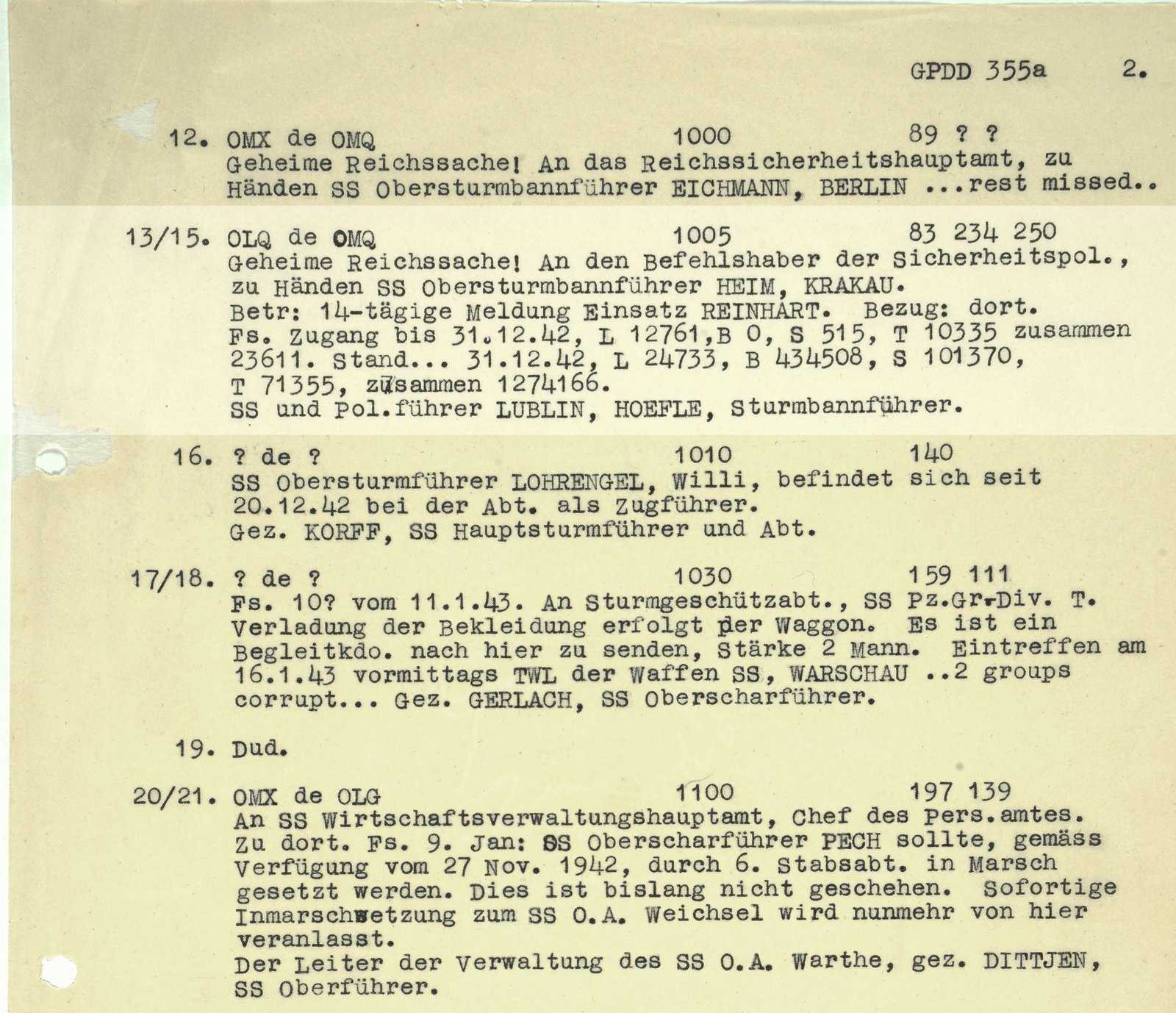
It is one page of intercepted radio traffic: a message sent in January 1943 by SS officer Hermann Höfle, reporting to Berlin the cumulative arrivals at the Operation Reinhard camps. British listeners caught the transmission and decoded it, and the decrypt sheet was filed away with the war’s other secrets.
The figures on that single page, including 434,508 for Bełżec, are the perpetrators’ own running totals, radioed in code at the height of the killing. Released to scholars in 2000, the intercept anchored the documentary record for Bełżec, Sobibór, Treblinka, and Majdanek that this Chapter reports.
The sheet is preserved among the decoded intercepts in the British National Archives. A camp system built to leave no witnesses was counted, precisely, by its own radio messages.
Discussion questions
Working from the evidence.
- The Chapter distinguishes a concentration camp from a killing center by purpose. How would you explain that distinction to someone who has only ever heard the phrase “concentration camp”?
- Many camps stood near towns and cities, while the killing centers were placed in more remote locations. What does that difference suggest about what the regime tried to make public and what it tried to conceal?
- The Höfle Telegram and the Ringelblum Archive reached historians by very different routes. What does each kind of source allow us to know, and what are the limits of each?
- The Sobibór and Treblinka revolts are documented in survivor testimony. What questions would you want to ask before drawing conclusions from a single survivor’s account?
- Using the Auschwitz selection process, how were the forced-labor system and the killing system linked?
- Why might historians treat the number of victims at some camps as well-documented while describing others as estimates?
Classroom Connections
Where this Chapter fits.
Teaching Connections
The disciplines and courses this Chapter naturally supports, for any educator, anywhere.
- World History. Examines the structure and function of concentration camps, labor camps, transit camps, and killing centers within the Holocaust.
- Classroom Applications. Students can:
- distinguish the camp types by purpose;
- use the historical terms precisely (concentration camp, killing center, transit camp);
- interpret documentary evidence, including the Höfle decrypt;
- test common misconceptions against the record.
- International Classroom Relevance. Supports Holocaust education, genocide studies, and museum education.
Standards Alignment
- NYS Social Studies Framework: NY Global History 10.5 (World War II and the Holocaust).
- NYS Holocaust Education Mandate, Education Law §801. Supports Holocaust instruction by distinguishing the different types of camps and correcting common misconceptions.
- Common Core RH.11–12.6 & RH.11–12.9. Students analyze camp records, maps, photographs, survivor testimony, and historical scholarship.
- C3 Framework, D2.His.1, D2.His.14. Students investigate historical categorization, chronology, and evidence.
Resources, lessons, and video
Where to teach this well.
The major Holocaust institutions have built decades of classroom material on the camps. This Chapter supplies the framework. The lessons, testimony, and visual material below are where to teach from. The platform points to that work rather than duplicating it.
Teacher materials & lesson plans
- USHMM · Teaching Materials, guidelines for teaching the Holocaust, ready lessons, and the searchable Holocaust Encyclopedia entries on every camp named here.
- Yad Vashem · International School for Holocaust Studies, lesson plans and units organized by grade band.
- Echoes & Reflections, a full classroom curriculum (its unit on the “Final Solution” covers the camps and killing centers) with survivor testimony built in.
- Facing History & Ourselves, lessons that set the camps within the choices and steps that led to them.
Testimony & video
- USC Shoah Foundation · IWitness, survivor video testimony with built-in, standards-aligned activities.
- The National WWII Museum · “The Liberation of Auschwitz”, a sourced classroom article on what the liberators found and how the world learned of it.
- Auschwitz-Birkenau Memorial · online panorama, a guided virtual walk through the preserved site for classrooms that cannot travel.
- USHMM · classroom film, The Path to Nazi Genocide, the museum’s free 38-minute overview film for secondary classrooms, with a viewing guide. Grades 9–12.
For New York–region teachers. The Holocaust Memorial & Tolerance Center of Nassau County (Glen Cove, Long Island) runs in-school programs and a Speakers Bureau, and offers a free virtual guide to its galleries, including one on life in the camps.
Sources and citations
Primary sources
A primary source is a record from the time. It was made by people who were there. Examples: letters, diaries, photos, decrees, trial records, and newspapers.
- Lanzmann, Claude. Shoah. 1985. Documentary film with extended interviews with survivors and perpetrators including Mordechai Podchlebnik and Szymon Srebrnik of Chełmno.
- Höfle Telegram. January 11, 1943. SS radiogram from Lublin to Berlin reporting Operation Reinhard murder totals. Intercepted and decrypted by British intelligence; released to scholars in 2000.
- Eichmann, Adolf, drafter. Minutes of the Wannsee Conference, January 20, 1942. Political Archive of the German Foreign Office, Berlin.
- Levi, Primo. If This Is a Man (Se questo è un uomo). Turin: De Silva, 1947.
- Wiesel, Elie. Night. New York: Hill and Wang, 1960.
- Delbo, Charlotte. Auschwitz and After. New Haven: Yale University Press, 1995.
- Klüger, Ruth. Still Alive: A Holocaust Girlhood Remembered. New York: Feminist Press at CUNY, 2001.
- The Vrba-Wetzler Report (the Auschwitz Protocols), April 1944. The escapees' detailed account of Auschwitz-Birkenau that reached the Allies.
- The Auschwitz Album, May–June 1944. The SS photographic record of the arrival of Hungarian Jews at Birkenau. Yad Vashem.
Secondary sources
A secondary source was written later. It is a book or article by a historian who studied those records and explains what they mean.
- United States Holocaust Memorial Museum. The United States Holocaust Memorial Museum Encyclopedia of Camps and Ghettos, 1933–1945. 4 vols. to date. Bloomington: Indiana University Press, 2009–.
- Arad, Yitzhak. Belzec, Sobibor, Treblinka: The Operation Reinhard Death Camps. Bloomington: Indiana University Press, 2nd ed. 1999.
- Browning, Christopher R. The Origins of the Final Solution: The Evolution of Nazi Jewish Policy, September 1939 – March 1942. Lincoln: University of Nebraska Press, 2004.
- Piper, Franciszek. Auschwitz: How Many Perished, Jews, Poles, Gypsies. Krakow: Frap-Books, 1994. (The principal scholarly study of the Auschwitz death toll.)
- Gutman, Yisrael, and Michael Berenbaum, eds. Anatomy of the Auschwitz Death Camp. Bloomington: Indiana University Press, 1994.
- Długoborski, Wacław, and Franciszek Piper, eds. Auschwitz, 1940–1945: Central Issues in the History of the Camp. 5 vols. Oświęcim: Auschwitz-Birkenau State Museum, 2000.
- Hilberg, Raul. The Destruction of the European Jews. 3 vols. New Haven: Yale University Press, 3rd ed. 2003.
- Friedländer, Saul. Nazi Germany and the Jews. 2 vols. New York: HarperCollins, 1997 and 2007.
- Bauer, Yehuda. A History of the Holocaust. New York: Franklin Watts, revised ed. 2001.
- Snyder, Timothy. Bloodlands: Europe Between Hitler and Stalin. New York: Basic Books, 2010.
- Mailänder, Elissa. Female SS Guards and Workaday Violence: The Majdanek Concentration Camp, 1942–1944. East Lansing: Michigan State University Press, 2015.
- Sereny, Gitta. Into That Darkness: An Examination of Conscience. New York: McGraw-Hill, 1974. (On Franz Stangl, commandant of Sobibór and Treblinka.)
- Auschwitz-Birkenau State Memorial and Museum, Oświęcim. auschwitz.org. (Collections and research.)
- Yad Vashem, the World Holocaust Remembrance Center. yadvashem.org.
- United States Holocaust Memorial Museum, Mandel Center for Advanced Holocaust Studies. ushmm.org.
- United States Holocaust Memorial Museum, “Major Nazi Camps in German-Controlled Europe, 1943–1944,” map, Holocaust Encyclopedia. encyclopedia.ushmm.org. The map in this Chapter.
- Treblinka Museum of Struggle and Martyrdom. muzeumtreblinka.eu.
- Bełżec Museum (Muzeum-Miejsce Pamięci w Bełżcu). belzec.eu.
- Sobibór Museum (Muzeum byłego niemieckiego obozu zagłady w Sobiborze). sobibor-memorial.eu.
- Majdanek State Museum (Państwowe Muzeum na Majdanku). majdanek.eu.
- Chełmno Museum (Muzeum byłego Niemieckiego Obozu Zagłady Kulmhof w Chełmnie nad Nerem). chelmno-muzeum.eu.
- Terezín Memorial. pamatnik-terezin.cz.
- The National Archives (UK), HW 16/23, German Police decrypts, January 1943: the Höfle message, item 13/15 of summary GPDD 355a. discovery.nationalarchives.gov.uk. The document in this Chapter’s Object Spotlight.
- Peter Witte and Stephen Tyas, “A New Document on the Deportation and Murder of Jews during ‘Einsatz Reinhardt’ 1942,” Holocaust and Genocide Studies 15, no. 3 (2001): 468–486. The first scholarly publication of the decrypt.
Finding these documents: many primary sources are free online. Good places to start are the Fordham Internet Jewish History Sourcebook, Yale’s Avalon Project (law and diplomacy), German History in Documents, the collections of the US Holocaust Memorial Museum and Yad Vashem, the National Library of Israel, and Sefaria (for Jewish texts). Search the document’s name and date.
The mass shooting of some 1.5 to 2 million Jews across the occupied Soviet lands from 1941, including Babyn Yar, the killing that came before the death camps.
Comments?
Write to editor@makorproject.org. Last updated: September 2026. Makor is the Hebrew word for source.