The Protocols Forgery
It claims to be the stolen minutes of a secret meeting where Jewish leaders plot to rule the world. No such meeting ever happened. The text was copied from a French satire that never mentioned Jews at all, and it is still being sold today.
The Protocols of the Elders of Zion, the most widely circulated forgery of the modern age
Why this Chapter exists
A forgery exposed a century ago, still in print today.
In August 1921, a correspondent for The Times of London set two books side by side. One was The Protocols of the Elders of Zion, a text then circulating across Europe and America as the stolen minutes of a secret Jewish plot to rule the world. The other was a French political satire from 1864 that was not about Jews at all. Page after page, the words matched. The Protocols had been copied, almost line for line, from the older book, with the target changed.
That should have been the end of it. It was not. More than a century after the forgery was demonstrated in print, the Protocols is still published, still translated, still sold, in 2026, in many languages, in many countries, online and on paper.
The Protocols belongs here because it raises a question that extends far beyond a single forged document: how can a text that has been publicly and repeatedly disproven continue to persuade readers? Understanding what the Protocols claimed, where it came from, and how historians proved it false is basic source literacy.
Above all, this is a story of historical method: how historians authenticate documents, establish provenance, identify plagiarism, and compare texts. The Protocols is ultimately less important for the lie it tells than for the methods by which that lie was exposed.
What it is
A fabricated text presented as authentic.
The Protocols of the Elders of Zion is a short text, roughly a hundred printed pages in most editions, organized into twenty-four chapters or "protocols." Some editions carry the longer title The Protocols of the Meetings of the Learned Elders of Zion. Each chapter is presented as the minutes of a secret meeting of a council of Jewish leaders. The supposed plan: seize control of the world through banking, the press, the schools, parliaments, organized labor, and the law. The document presents itself as an authentic stolen record of a real conspiracy.
It is a forgery. Every meaningful part of it is invented. No such council ever met. No such proceedings ever took place. The text is the work of identifiable Russian writers around the turn of the twentieth century, drawing on identifiable earlier sources. The major scholarly studies, Norman Cohn's Warrant for Genocide (1967), Stephen Eric Bronner's A Rumor About the Jews (2nd ed. 2019), Cesare De Michelis's The Non-Existent Manuscript (2004), and Hadassa Ben-Itto's The Lie That Wouldn't Die (2005), have settled the text's origin, its sources, and the record of its fabrication beyond serious dispute.
Historians do not study the Protocols for what it claims about Jews. Every claim in it is invented. They study it because it shows how a fabricated document can gain political power, survive public refutation again and again, and keep shaping belief long after it has been proven false.
Common misconceptions this Chapter addresses
The Protocols survives partly on a set of false framings. Each is answered in detail in the Misconceptions reference. Here they are in brief.
- "The Protocols may be of debated or uncertain origin." Its origin is not in doubt. It was traced line by line to an 1864 French satire that never mentions Jews, and exposed in The Times of London in 1921. The scholarly consensus that it is a forgery is complete. See the entry →
- "It must contain some truth, or it wouldn't have spread so widely." Wide circulation reflects how useful a forgery was to those who spread it, not any authenticity. The test is provenance, not plausibility. See the entry →
- "Once it was exposed as a forgery, it stopped mattering." The forgery was proven a century ago, and the text still circulates today, which is exactly what makes it worth studying. See the entry →
- "The Protocols survived because historians never proved it was false." No. The forgery was publicly exposed through textual comparison in 1921, reinforced by decades of scholarship, and examined extensively during the Bern Trial. Its continued circulation reflects the persistence of conspiracy literature, not unresolved historical evidence. See the entry →
The Russian origin
The Imperial secret police, the 1890s, the Paris connection.
The Protocols was produced in the late Russian Imperial period. The regime of Tsar Nicholas II, the emperor of Russia, faced rising revolutionary pressure, and antisemitism was woven into the ideology of the state itself. Most historians conclude that the forgery emerged within circles connected to the Okhrana, the Russian Imperial secret police. The trail points specifically to its foreign operations division, based in Paris. The precise chain of authorship remains uncertain.
Those Paris operations were run by Pyotr Rachkovsky (1853–1910), a senior security official. He built a network of agents and writers across Europe, and he used planted stories and forged documents, black propaganda, to discredit the movements ranged against the Tsar. Most historians place the text in Russian radical-right circles with secret-police connections around 1900–03. Cohn's Warrant for Genocide argued for Rachkovsky's Paris operation; De Michelis's textual study points instead to compilation inside Russia, and the chain of authorship remains genuinely unsettled. The exact authorship has been heavily investigated. Mathieu Golovinski, a Russian writer working in Paris, has been proposed as a principal compiler, along with other figures connected to Rachkovsky.
The text's first job was domestic. It was meant to tie the Empire's revolutionary and reformist movements (populist, liberal, Marxist) to an imagined Jewish conspiracy. That gave the autocracy an ideological weapon against them. For its first decade the Protocols was mainly a Russian political tool. Its international career, the one that would make it the most influential antisemitic document of the modern era, began only when the Revolution of 1917, which overthrew the empire, scattered Russian exiles (émigrés) across Europe.
The Joly source
A French political satire of 1864.
The most striking feature in the whole record is what the forgers copied from. Long stretches of the Protocols are lifted (paragraph by paragraph, in places word for word) from an 1864 French political satire: Dialogue aux enfers entre Machiavel et Montesquieu (Dialogue in Hell Between Machiavelli and Montesquieu). Its author was the French lawyer and writer Maurice Joly (1829–1878).
Joly's Dialogue is an attack on the regime of Napoleon III, then the emperor of France, written as an imagined underworld conversation between two famous political philosophers. In it, Machiavelli explains how a modern despot could hollow out a constitutional democracy from within: manage the press, corrupt parliament, steer public opinion, centralize power. It is a critique of Bonapartist rule. It contains not one reference to Jews, to Judaism, or to any Jewish conspiracy.
The Protocols took the Machiavelli speeches, stripped out Napoleon III, and reassigned the words to the imagined Jewish "elders." Detailed comparisons establish the plagiarism conclusively. Lucien Wolf argued the forgery case in 1920 from older sources; the Joly comparison itself was Philip Graves's demonstration of 1921, and Cohn, De Michelis, and Bronner have refined the case since. The same phrases, the same examples, the same paragraph structures appear in both, with only the target changed. This comparison remains the single strongest piece of evidence in the case. A document cannot simultaneously be the authentic minutes of a secret Jewish meeting and a rewritten version of an 1864 French political satire. The textual parallels settle the question of authenticity beyond reasonable historical dispute.
| Maurice Joly, Dialogue in Hell (1864) attacking Napoleon III, no mention of Jews | The Protocols of the Elders of Zion the same words, the target changed |
|---|---|
| “If a loan is at 5%, the State, after 20 years, has paid out a sum equal to the borrowed capital.” | “If a loan is at 5%, then in 20 years the Government would have unnecessarily paid out a sum equal to that of the loan.” |
| “Like the god Vishnu, my press will have a hundred arms, and these arms will give their hands to all the different shades of opinion.” | “These newspapers, like the Indian god Vishnu, will be possessed of hundreds of hands, each of which will be feeling the pulse of varying public opinion.” |
| “You have a hundred arms like the Indian idol, and each of your fingers touches a spring.” | “Each of our hundred hands will hold one spring of the social machinery of State.” |
Parallels as documented by Philip Graves, The Times (London), August 16–18, 1921; analyzed in Norman Cohn, Warrant for Genocide (1967).
For historians, this is how authenticity is tested. The test is not whether a document seems believable. It is tracing its origin, comparing its wording with earlier sources, and establishing how it entered the historical record.
Joly's book had been suppressed by the Second Empire's censors in 1864, and Joly himself jailed for fifteen months. It survived in a handful of copies among French political readers. To a Russian audience it would have been wholly obscure, unless someone knew the French political literature of the 1860s. The Paris operation of the Okhrana is the link that puts Joly's text into the chain.
First publication · 1903
The text enters the public record.
The first known publication of the Protocols ran in the Russian newspaper Znamya ("The Banner"), serialized in August and September 1903. The paper's editor was the antisemitic publisher Pavel (Pavolachi) Krushevan. The timing matters. Just months earlier, in April 1903, the Kishinev pogrom had struck: a mob massacre of Jews in a provincial city of the Russian Empire, among the most violent of the era. The Russian Pogroms Chapter tells that story. Krushevan had been implicated as an ideological instigator of that pogrom through another of his papers. The first publication, in other words, came directly out of the same political-publishing network as a major antisemitic massacre.
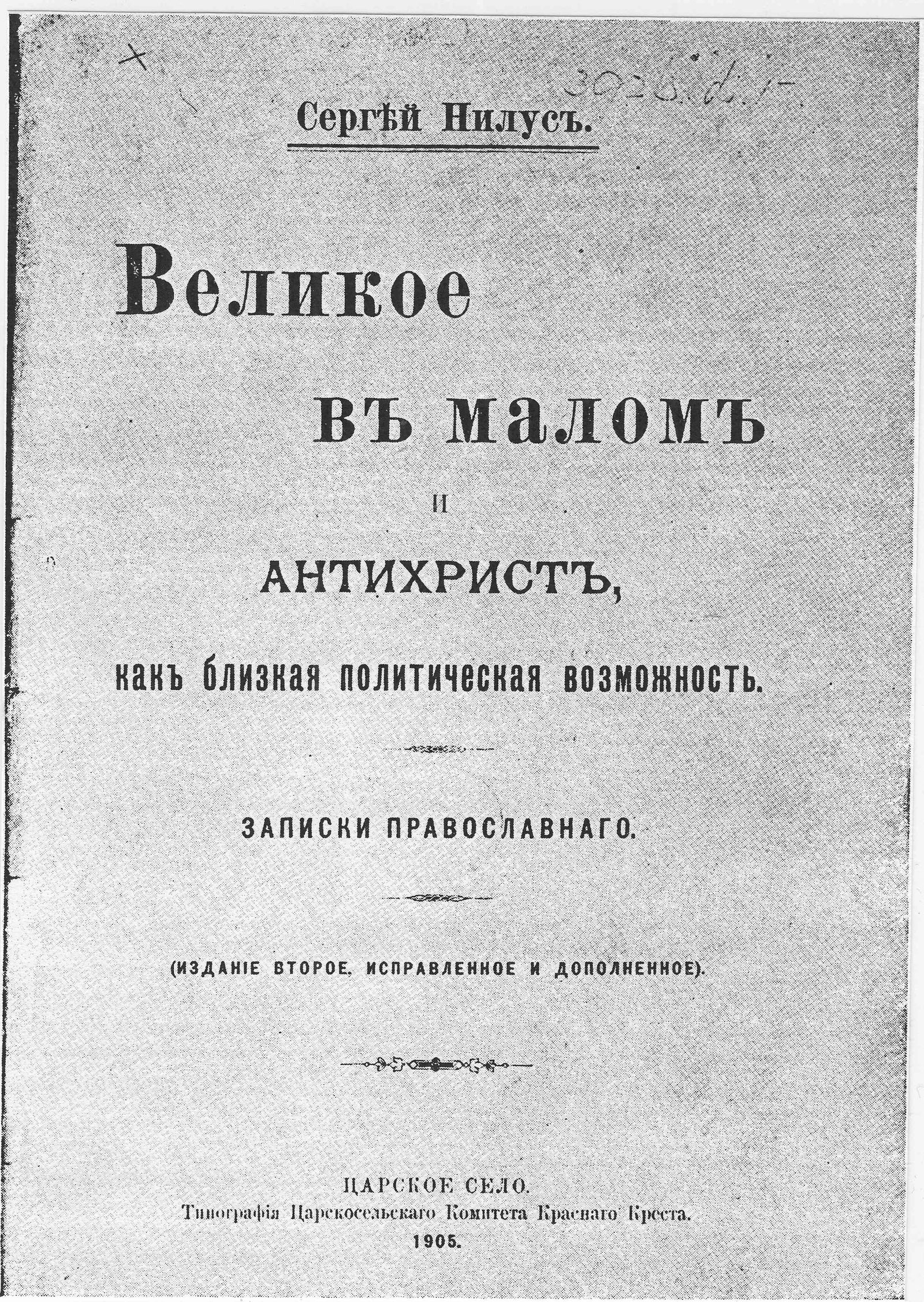
In 1905 a more elaborate version appeared as the closing chapter of the second edition of a book by the mystical writer Sergei Nilus, The Great in the Small. The Nilus version became the form in which the Protocols would travel internationally. Its provenance story shifted from edition to edition. A later version claimed the text came from the First Zionist Congress, the 1897 founding meeting of the movement to build the Jewish people a country of their own. Nilus's 1905 text supplied the base for most later translations; his editions of 1911 and 1917 recycled and expanded it.
Through the prewar decade the text circulated mainly inside the Empire. The regime did not adopt it as official policy, but it ran freely in pro-regime publications. It also entered the materials of the Black Hundreds, the violently antisemitic movement aligned with the state in its final years. Then came the First World War, the Revolutions of 1917, and the Civil War of 1918–1921. Those upheavals dispersed Russian émigrés across Europe, and the Protocols went with them.
The global spread · 1917–1925
From a Russian text to an international phenomenon.
The decisive turn is the text's move out of Russian and into the other languages of Europe between the Revolution and the mid-1920s. Three channels carried it.
The Russian émigré press. Russians loyal to the old regime, the “Whites,” fled the Bolsheviks, the communists who had seized power. They carried Nilus's edition across Europe and to the Americas, and reissued it in Russian in Berlin, Paris, Belgrade, and other émigré centers. They added a new claim: the Revolution itself had been the work of the supposed Jewish conspiracy. The charge was used to discredit the Bolshevik regime and rally opinion against it in the West.
The German translation of 1920. The first German edition, Die Geheimnisse der Weisen von Zion, was the work of a publisher of Germany’s racial-nationalist (völkisch) right writing as "Gottfried zur Beek" (the retired captain Ludwig Müller von Hausen). It went through multiple printings in the early 1920s. It supplied the text through which the Protocols entered German nationalist and early Nazi circles.
The English translation of 1920. The first English edition, published by Eyre and Spottiswoode as The Jewish Peril, brought the text into the English-speaking world. A separate Boston edition the same year extended its reach in the United States.
By the end of 1920 the Protocols existed in Russian, German, English, French, Polish, and Czech, with Italian, Spanish, and Arabic translations following over the next five years. Many editions added introductions and fake scholarly notes that sharpened the antisemitic reading. Within a few years, a document created for late-Imperial Russian politics had become one of the most widely circulated antisemitic texts in the world. Conspiracy literature moves easily across languages, borders, and movements.
Henry Ford and The Dearborn Independent · 1920–1927
The Protocols enter American mass circulation.
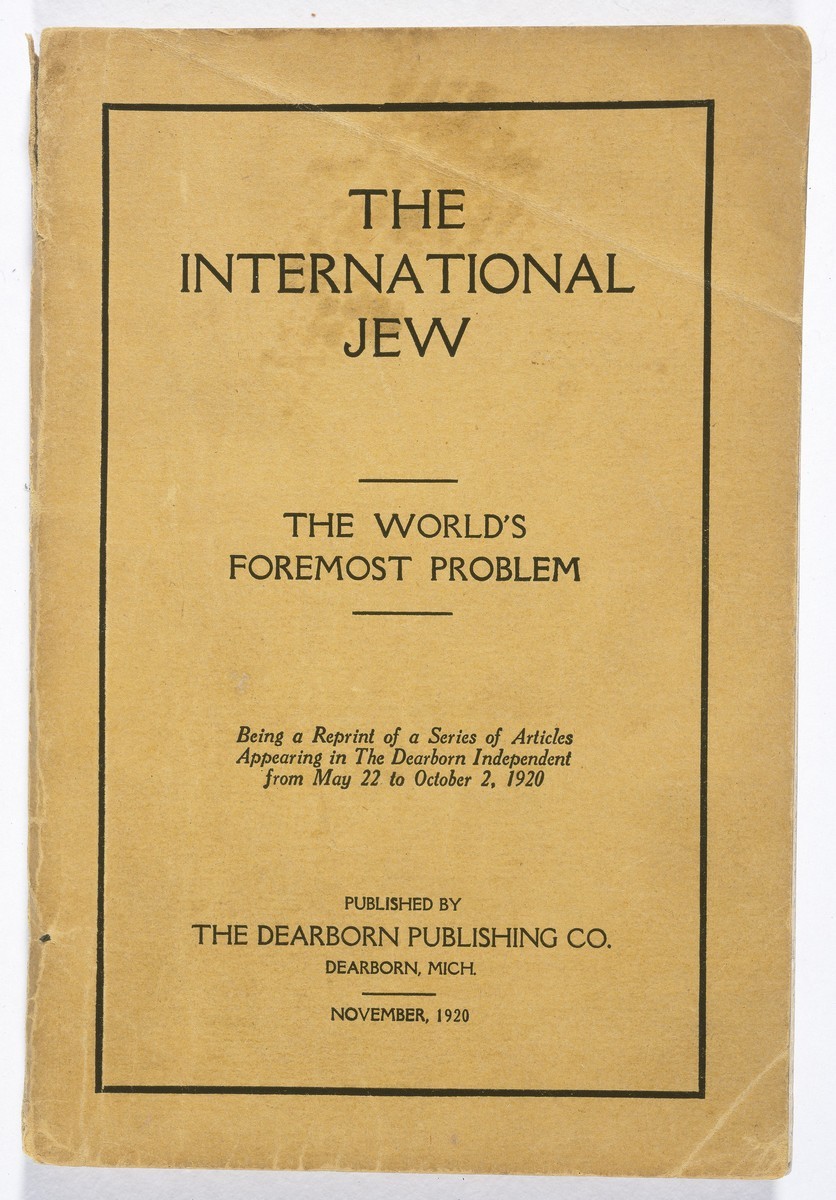
The main vehicle for bringing the Protocols to a mass American audience was The Dearborn Independent, a newspaper owned and controlled by Henry Ford, the automaker whose Model T had put America on wheels. Between May 1920 and January 1922 the Independent ran a long series of antisemitic articles under the title "The International Jew: The World's Foremost Problem." The series drew heavily on the Protocols. The articles were collected into four bound volumes that circulated internationally in several translations.
Ford's promotion put the text in front of a far larger readership than the European editions had reached. At its 1925 peak the paper’s circulation approached 900,000. The bound volumes of The International Jew circulated widely in Germany. Hitler reportedly kept a portrait of Ford in his Munich office in the early 1920s. Ford is the only American named in the first editions of Mein Kampf, Hitler’s 1925 political manifesto.
Ford withdrew his sponsorship in 1927 under the pressure of a libel suit and of falling car sales in markets the campaign had alienated. He issued a public apology in July 1927, shut down the Dearborn Independent, and arranged to recall the bound volumes. The apology and withdrawal are themselves part of the record. But they did not end what he had launched. Pirated editions of The International Jew kept circulating, especially in Germany, through the Nazi period and after.
The 1921 exposure
Philip Graves and the establishment of the fraud.
The decisive demonstration that the Protocols was a forgery came in August 1921, in three articles by Philip Graves, the Constantinople correspondent of The Times of London. A Russian émigré contact had given Graves a copy of Maurice Joly's 1864 Dialogue. Setting it beside the Protocols, Graves found the plagiarism that all later scholarship has confirmed and extended.
The articles ran in The Times on August 16, 17, and 18, 1921, under the headline "The Truth About the Protocols: A Literary Forgery." They laid out the Joly–Protocols parallels in detail. They showed, beyond reasonable doubt, that the Protocols was a rewrite of Joly's text with the target changed and Jewish elements inserted. The Times, then one of the most authoritative papers in the English-speaking world, had previously given the Protocols some credence. That made the August articles a formal retraction as well as an exposure.
The articles entered the international press at once. Further investigations, by Lucien Wolf, by Herman Bernstein in the United States (his 1921 book The History of a Lie), and, in 1924, by the Galician Jewish writer Binjamin Segel, confirmed and extended the analysis. Within months, the Protocols had been established in the international press as a forgery. The documentary record of its plagiarism was available to anyone who cared to check.
This marks the turning point in the history of the Protocols. From 1921 onward, the document's authenticity was no longer an open historical question. Its continued circulation reflects not unresolved evidence but continuing political usefulness. The question shifts from whether the document is genuine to why a forgery kept influencing readers after its exposure.
The Bern Trial · 1934–1935
A Swiss court rules.
In June 1933 the Swiss Federation of Jewish Communities and the Bern Jewish Community sued five Swiss Nazis who had handed out copies of the Protocols at a meeting in Bern. The suit used a law of the canton (the Swiss state) of Bern against "indecent literature." The statute was not written for political material, but the plaintiffs argued it covered a knowingly fraudulent text used for incitement.
The Bern Trial, running from 1934 to 1935, became one of the most fully documented legal proceedings ever held on the Protocols' authenticity. The court heard expert testimony from historians, received the Joly textual parallels in evidence, and produced a detailed record that has been preserved and studied since. Historians study the Bern Trial not because courts decide historical truth. They study it because the proceedings assembled, tested, and preserved the evidence of forgery in a public legal record, where anyone could examine it.
On May 14, 1935, the court ruled the Protocols "ridiculous nonsense" and "forgeries" and convicted two defendants under the statute. The conviction was overturned on appeal in 1937, on the narrow ground that the cantonal law did not cover political literature. The appeals court explicitly left the finding of forgery intact. The trial added to the record at the very moment the Nazi regime was actively weaponizing the text.
Nazi use of the Protocols
State-sponsored circulation, 1933–1945.
After seizing power in 1933, the Nazi regime made the Protocols a central part of its propaganda machinery. The text was folded into the German school system and distributed through party publishing. It was broadcast through the ministry of Joseph Goebbels, the regime's propaganda chief. It was reprinted in dozens of German editions across the life of the regime. The regime did all this in full knowledge of the 1921 exposure and the scholarship that followed it. Goebbels's diaries show his position plainly: the text's literal truth mattered less than the "reality" it supposedly depicted.
During the Second World War the Protocols circulated across Nazi-occupied Europe through Nazi-controlled channels, in German, French, Polish, Dutch, and other translations. It sat alongside Der Stürmer, the crudest of the Nazi antisemitic weeklies, the broader Goebbels-coordinated press, and Nazi Arabic-language broadcasting.
The major studies of Nazi propaganda (Bytwerk's Bending Spines, Herf's The Jewish Enemy, and others) treat the Protocols as one of several elements the regime fused and weaponized. The Protocols did not cause the Holocaust. It did not stand alone within Nazi ideology either. It was one element in a much broader system of propaganda, one that combined older religious prejudice, nineteenth-century racial theory, conspiracy thinking, and modern state-controlled media. The case matters because it shows how a forged document could be built into official state ideology.
The Arabic translations · 1920s and after
The Protocols enter the Middle East.
The first Arabic translations were circulating by the mid-1920s. An early edition was published in Cairo by the Maronite priest Antoine Yamin, in the Lebanese Maronite-affiliated press in Egypt. Further Arabic editions followed across the interwar and postwar decades. By the late twentieth century the Protocols had appeared in dozens of Arabic editions across the Arabic-speaking world.
This was not the simple “spread” of a single object. As it moved into the Arabic-speaking world, the forgery entered new political and media worlds, found new audiences, and was put to new purposes.
The Arabic circulation intersected with Nazi Arabic-language broadcasting and with the postwar politics of the region. The text has kept circulating in Arabic into the present, with printings in Beirut, Cairo, Damascus, Tehran (in Persian), and elsewhere across the late twentieth and early twenty-first centuries.
The principal scholarly references on the Arabic reception are Esther Webman's The Global Impact of the Protocols of the Elders of Zion: A Century-Old Myth (2011), the fullest single survey, and Gilbert Achcar's The Arabs and the Holocaust (2010). Both treat the subject with precision rather than as one undifferentiated story.
Why a refuted text persists
The analytical question.
The Protocols was established in print as a forgery in August 1921. The evidence (Joly's text, the Okhrana context, the textual parallels, the refutations by Wolf, Bernstein, and Segel) was available to any literate reader within months. The Bern Trial added a judicial finding in 1935. Scholarship has treated the text for over a century as the forgery it is.
And still it circulates. New editions appear every year. Online distribution has made it more accessible in the twenty-first century than it was in the twentieth. National book fairs in various countries have carried editions within the past decade. The text turns up in the conspiracy literature moving through fringe political networks, across the spectrum, in the United States and Europe.
The scholarship offers several converging explanations:
Conspiratorial framing as a portable instrument. The Protocols supplies a recognizable form, the secret minutes of a secret meeting of a hidden authority, that travels across political contexts. The same structure, with the target swapped, recurs in conspiracy literature aimed at many other groups. The Protocols is the most influential model of the form.
The function of conspiracy theory in mobilization. The literature on conspiracy theory, from Cohn's foundational work to the later scholarship of Fenster, Knight, Barkun, and Uscinski, treats it as a political instrument. It explains events by pointing to the hidden hand of a designated enemy. The Protocols is an unusually long-lived example.
The use of refuted texts under political mistrust. Where established authorities have lost credibility, refuted texts can return as alternatives to the discredited mainstream. The post-Revolutionary émigré use, the Nazi state use, and the contemporary online resurgence all share this dynamic.
No single explanation accounts for the Protocols' longevity. Historians study the convergence: political circumstance, conspiracy thinking, distrust of institutions, and propaganda. Together they have kept a proven forgery in circulation for more than a century after its exposure.
The contemporary record
The continuing circulation, 2026.
The Protocols continues to circulate in 2026. The Anti-Defamation League documents editions in print and online. The Simon Wiesenthal Center, the Stephen Roth Institute at Tel Aviv University, and the Vidal Sassoon International Center for the Study of Antisemitism at Hebrew University all track the text's circulation.
Major institutions periodically respond to high-visibility moments. The text has been formally repudiated by, among others, UNESCO, the European Union, and multiple national governments. In 2002, Egyptian channels, state-owned and private, broadcast Horseman Without a Horse, a Ramadan television series drawing on the Protocols. Several governments protested formally, and the research institutions documented it.
The circulation of 2026 is part of the same long record. The text is what it has been for a century: a documented forgery that stays politically useful in settings where its falsity is beside the point. The answer to it is the record itself: the proof of fabrication, the scholarship, and the formal repudiations.
Object Spotlight
Three articles in The Times, August 1921.
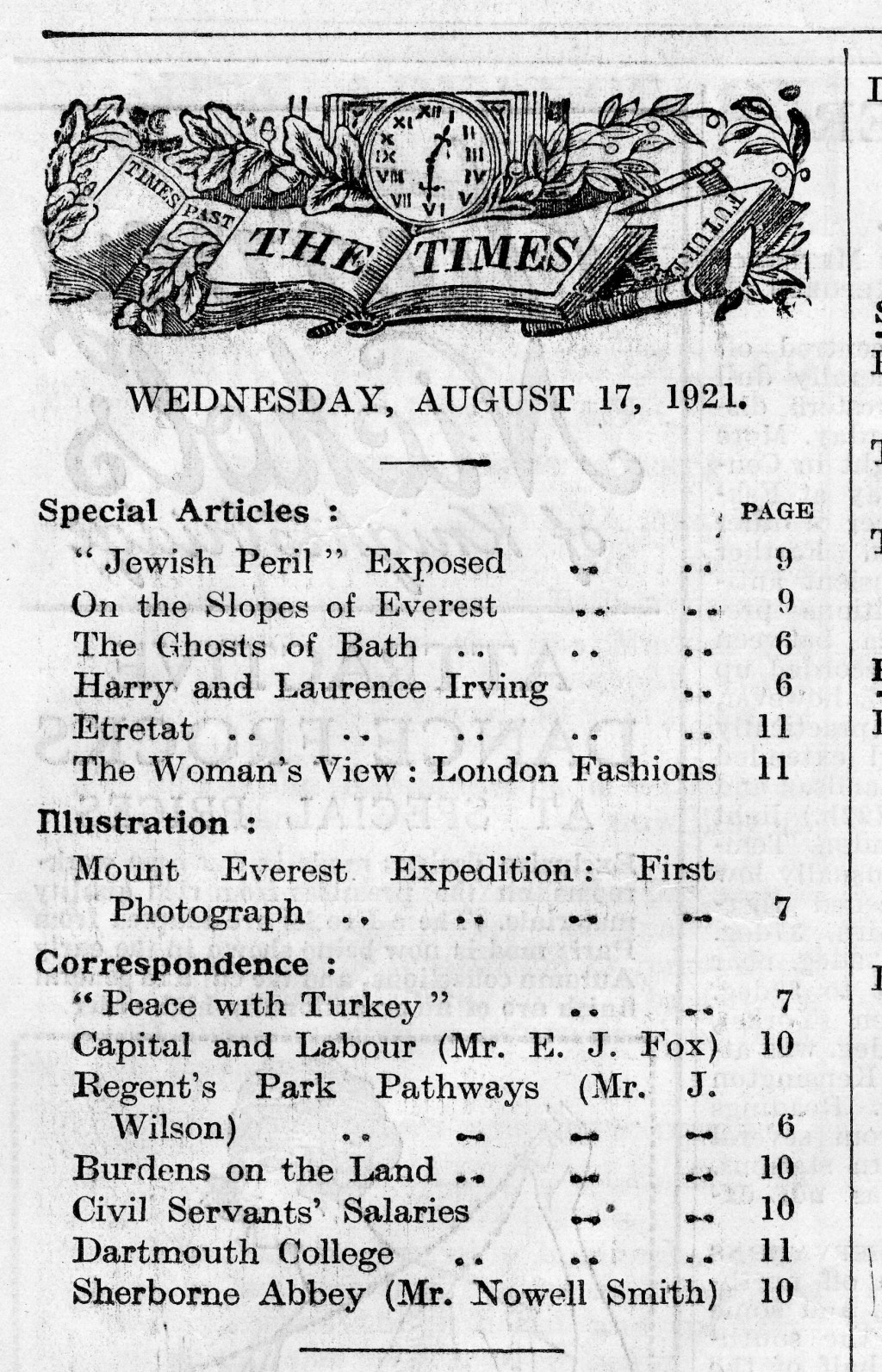
Three newspaper columns, printed in plain type, ran on three days in a row. No pictures, no drama in the layout, just dense paragraphs under a flat headline: "The Truth About the Protocols: A Literary Forgery." It looks like the least exciting object you could spotlight. It is also the one that took apart the most dangerous forgery of the twentieth century.
To see why, you need the document being exposed. The Protocols of the Elders of Zion was a book that claimed to be the secret minutes of a Jewish plot to take over the world. It was a fake, but a wildly successful one, printed in many languages and believed by millions. What these three articles in The Times of London, in August 1921, did was prove it was fake. Their author, the correspondent Philip Graves, had been handed an old French book: Maurice Joly's Dialogue aux Enfers of 1864, a satire that attacks the French emperor Napoleon III and never mentions Jews. (It is the title page of that book in this Chapter's banner.) A Russian reader had made the connection: the Protocols seemed to be copied from it.
The dull columns matter because Graves made the simplest possible move: he set the two texts side by side and printed the matching passages in parallel, line against line. Any reader could see that whole stretches of the "secret Jewish plot" had simply been lifted from a book about French politics, with "Napoleon" swapped for "the Jews." No secret knowledge, no special access. Just two books, read closely. The forgery's authority collapsed the moment the copying was visible on the page.
The method is repeatable: anyone can do it. A reader in 1921 could check Graves's work the same way a student can today, by comparing the texts. The exposure is source-evaluation done in public. The proof is not "trust the expert." It is "look at both pages yourself."
The history does not end with the exposure. A document can be completely disproven and still continue to circulate if readers value the narrative it offers more than the evidence against it. That is why these three newspaper articles endure. They show not only how the forgery was exposed, but how historical method works in practice: compare sources, establish provenance, and let the evidence guide the conclusion.
Why it still matters
A case study in how a forgery survives.
What endures about the Protocols is not what it claims. It is what its history teaches. A fabricated document can acquire authority, survive repeated public refutation, and keep shaping public belief across generations. For historians, the Protocols remains one of the clearest case studies in why provenance, source criticism, and documentary evidence matter. Those are the tools that settle what a historical claim is worth.
Key takeaways
- The Protocols of the Elders of Zion is a forgery, which most historians trace to circles connected to the Russian Imperial secret police (the Okhrana) in the first years of the twentieth century. It was first published in 1903.
- Long passages were copied almost word-for-word from Maurice Joly's 1864 French political satire, which attacked Napoleon III and never mentioned Jews at all, the clearest proof of the fraud.
- The forgery was demonstrated publicly in The Times of London in 1921 and confirmed by a Swiss court in 1935, yet the text kept circulating regardless.
- Henry Ford spread it across America in the 1920s. The Nazi regime made it state propaganda. It later entered the Middle East in translation. One unchanging text served many different political purposes.
- Its survival despite total refutation is the point: the Protocols is a case study in how a false claim persists, and a direct lesson in evaluating sources by provenance rather than plausibility.
Discussion questions
Working from the evidence.
Grounded in the sourced record above.
- Long passages of the Protocols were copied from Maurice Joly's 1864 satire, which attacked Napoleon III and never mentioned Jews. Why is a match between two texts stronger evidence of forgery than an expert simply declaring the document false?
- The Protocols was exposed in The Times in 1921, yet it kept circulating. What does the gap between an exposure and its effect tell you about how a false claim survives?
- Henry Ford promoted the text, then issued a public apology in 1927 and recalled the volumes, but the editions kept circulating anyway. What does that reveal about who controls a text once it is released into the world?
- The same forged document was used by the Russian Imperial police, by the Nazi regime, and by conspiracy networks today. How can one unchanging text serve such different political purposes across more than a century?
- Goebbels held that the text's literal truth mattered less than the "reality" it supposedly depicted. What does it mean to defend a document you know to be false, and where else might you see that move?
Classroom Connections
Where this Chapter fits.
Teaching Connections
The disciplines and courses this Chapter naturally supports, for any educator, anywhere.
- Historical Thinking & Source Analysis: how historians authenticate a document, demonstrate plagiarism, and weigh provenance over plausibility. The strongest single forgery case study on the site.
- Modern European History: the late-Imperial-Russian origin (the Okhrana) and the post-1917 global spread of the forgery.
- Holocaust & Genocide Studies: the Protocols in the Nazi ideological arsenal.
- Modern Middle East: the Arabic translation and reception from 1925 onward.
- Media & Information Literacy: how a publicly refuted text keeps circulating, and conspiracy literature as a portable instrument.
Standards Alignment
- NYS Global History & Geography: 10.5 (the global conflicts of 1914–1945: the Protocols in the Nazi ideological arsenal) and 10.7 (the modern Middle East: the Arabic translation and its circulation from 1925).
- Common Core ELA-Literacy: RH.9–10.8 and RH.11–12.8 (evaluating an author’s claims and the documentary basis of a source) and RH.11–12.6 (authorial purpose and political function).
Further Teaching Resources
- USHMM Holocaust Encyclopedia, “Protocols of the Elders of Zion”, the forgery, its origin, and its use.
- USHMM, the text as a historical object, the editions, including the Ford “International Jew” series, treated as evidence.
- ADL · backgrounder and current tracking, an overview and the ongoing record of the text in circulation today.
- Films & Video: The Longest Hatred, Antisemitism: A Sickness of the Soul, and others, in the full Films & Video collection.
Sources and citations
Primary sources
A primary source is a record from the time. It was made by people who were there. Examples: letters, diaries, photos, decrees, trial records, and newspapers.
- Joly, Maurice. Dialogue aux enfers entre Machiavel et Montesquieu. Brussels, 1864. (The plagiarized source; English translation: The Dialogue in Hell Between Machiavelli and Montesquieu, trans. John S. Waggoner, Lexington Books, 2002.)
- Nilus, Sergei. The Great in the Small. 1905; expanded ed. 1911. (The edition that carried the Protocols into international circulation.)
- Graves, Philip. "The Truth About the Protocols: A Literary Forgery." The Times (London), August 16, 17, and 18, 1921.
- The Bern Trial (Switzerland), 1934–1935: the court proceedings and ruling that examined the Protocols and declared them a forgery.
- Ford, Henry (publisher). The International Jew: The World's Foremost Problem. The Dearborn Independent, 1920–1922. The American mass circulation of the forgery; Ford publicly retracted and apologized in 1927.
Secondary sources
A secondary source was written later. It is a book or article by a historian who studied those records and explains what they mean.
- Cohn, Norman. Warrant for Genocide: The Myth of the Jewish World-Conspiracy and the Protocols of the Elders of Zion. New York: Harper & Row, 1967. (The foundational scholarly study.)
- Bronner, Stephen Eric. A Rumor About the Jews: Antisemitism, Conspiracy, and the Protocols of Zion. Oxford: Oxford University Press, 2nd ed. 2019.
- De Michelis, Cesare G. The Non-Existent Manuscript: A Study of the Protocols of the Sages of Zion. Lincoln: University of Nebraska Press, 2004.
- Ben-Itto, Hadassa. The Lie That Wouldn't Die: The Protocols of the Elders of Zion. London: Vallentine Mitchell, 2005.
- Webman, Esther, ed. The Global Impact of the Protocols of the Elders of Zion: A Century-Old Myth. London: Routledge, 2011.
- Achcar, Gilbert. The Arabs and the Holocaust: The Arab-Israeli War of Narratives. New York: Metropolitan Books, 2010.
- Wolf, Lucien. The Jewish Bogey and the Forged Protocols of the Learned Elders of Zion. London: Press Committee of the Jewish Board of Deputies, 1920.
- Bernstein, Herman. The History of a Lie: "The Protocols of the Wise Men of Zion." New York: J. S. Ogilvie, 1921.
- Bytwerk, Randall L. Bending Spines: The Propagandas of Nazi Germany and the German Democratic Republic. East Lansing: Michigan State University Press, 2004.
- Herf, Jeffrey. The Jewish Enemy: Nazi Propaganda During World War II and the Holocaust. Cambridge, MA: Harvard University Press, 2006.
- Anti-Defamation League. Ongoing documentation of the Protocols in print and online. adl.org →
- Vidal Sassoon International Center for the Study of Antisemitism, Hebrew University of Jerusalem. sicsa.huji.ac.il →
Finding these documents: many primary sources are free online. Good places to start are the Fordham Internet Jewish History Sourcebook, Yale’s Avalon Project (law and diplomacy), German History in Documents, the collections of the US Holocaust Memorial Museum and Yad Vashem, the National Library of Israel, and Sefaria (for Jewish texts). Search the document’s name and date.
The Nazi Synthesis, how racial pseudoscience, the conspiracy myth, centuries of religious and economic hostility, nationalism, and propaganda converged into a single worldview and, for the first time, became the official policy of a modern state.
Comments?
Write to editor@makorproject.org.
Last updated: September 2026.