By 1900 roughly five million Jews lived in the Russian Empire, the largest Jewish population on earth, nearly all of them confined by law to a single western zone, and increasingly under attack inside it.
Population figure from the 1897 Imperial Russian census, the first empire-wide count; see John D. Klier, Russians, Jews, and the Pogroms of 1881–1882 (Cambridge University Press, 2011)
Why this Chapter exists
The word the world borrowed from this story.
At the dawn of the twentieth century, the largest Jewish community in the world lived inside the Russian Empire. Nearly five million Jews lived across thousands of cities, market towns, and villages, most of them within the Pale of Settlement, the belt of western provinces where the law confined Jewish residence (mapped below). Within a generation, repeated waves of anti-Jewish violence would transform that world and redirect the course of modern Jewish history.
The English language did not originally have a word for these attacks. It borrowed one from Russian: pogrom, derived from a verb meaning “to wreak havoc” or “to demolish.” The Oxford English Dictionary records its first English use in the Times of London on March 17, 1882, in a report on the attacks.
Behind the attacks stood a legal system that confined millions of Jews and a run of political crises that set off outbreak after outbreak. The migrations that followed reshaped Jewish life in America and the Land of Israel.
The world that was attacked
Five million people, a thousand towns.
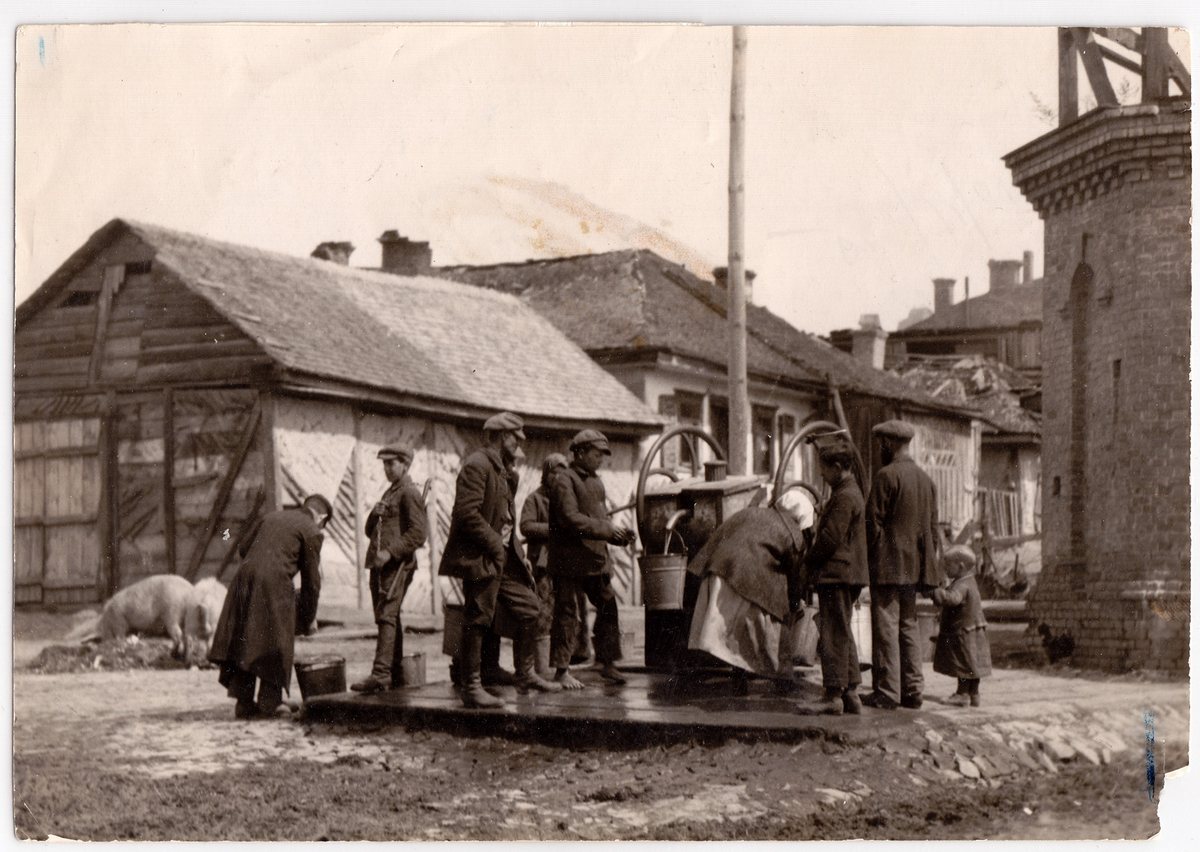
Before it is a story about violence, this is a story about a place, or rather about thousands of places. The Jews of the Russian Empire lived in cities such as Warsaw, Vilna, Odessa, and Kishinev, and in the small market towns that Yiddish, the everyday language of Eastern European Jews, called shtetlekh. They worked as artisans, traders, peddlers, tailors, water-carriers, and laborers. They prayed in synagogues and study-houses, argued in the press in three languages, sent their children to traditional schools and, increasingly, to Russian ones. They produced the Yiddish literature of Mendele Mocher Sforim and Sholem Aleichem and the Hebrew poetry of Hayim Nahman Bialik. By 1900 it was the demographic and cultural center of the Jewish world.
A residence fixed by law
The Pale of Settlement.
From 1791 until 1917, Jews in the Russian Empire were permitted to live, with narrow exceptions, only within a designated western zone known as the Pale of Settlement. The Pale was not a ghetto in the medieval European sense, not a walled quarter inside a city, but a territory about twice the size of France, covering what is today Lithuania, Belarus, Moldova, much of Ukraine, and eastern Poland. Within it, Jews were further barred from certain cities and from the countryside in some provinces. Outside it, residence was forbidden except, after reforms of 1859 to 1865, to a few permitted categories: merchants of the wealthiest guild, holders of university degrees, some military veterans, and certain artisans.
The Pale took shape from the 1790s, after the partitions of Poland, the carving up of that country by Russia, Prussia, and Austria in 1772, 1793, and 1795, brought the largest Jewish population in the world under Russian rule. Statutes of 1804 and 1835 fixed the provinces where Jews could live. The state sought both to control and to contain a community it regarded as culturally and religiously distinct, and to keep it out of the empire’s interior. The Pale was a legal system governing where millions of Jews could live, as well as a line on a map.
The state also reached into Jewish families for soldiers. On August 26, 1827, Tsar Nicholas I made Jews liable to the military draft, and the kahal, each town’s Jewish council, had to draw up the lists. Recruits served twenty-five years. Boys between eight and thirteen were taken as cantonists, named for the schools for soldiers’ children, and sent to battalions away from their parents until the age of eighteen, when the twenty-five years began. There they were denied kosher food and often pressed into Russian Orthodox baptism, a campaign the tsar himself authorized in 1842. Official reports, written to please him, claimed that about a third of some 15,000 Jewish cantonists converted between 1827 and 1840. Some 40,000 Jewish boys passed through the system before the drafting of children was stopped in 1856, under Alexander II. Hundreds of baptized cantonists then publicly reclaimed their Jewish names.
The violence of 1881 was not the first these lands had seen. In 1648 this region still belonged to Poland. That year the Cossacks, the peasant-soldier communities of the Ukrainian steppe, rose under Bohdan Khmelnytsky against Polish rule. The mass killing of Jews was concentrated in 1648–49, and the uprising itself ran on for years. Jews were visible across the countryside as managers, leaseholders, and tax agents of the Polish estates, and the rebels attacked them both as religious outsiders and as agents of the Polish estate system. The rebels massacred many Jewish communities. Nathan of Hanover, who lived through those years, wrote the chronicle that fixed the catastrophe in Jewish memory. For centuries it was mourned as the deepest wound before the twentieth century. Traditional accounts put the Jewish dead in the hundreds of thousands. The modern reassessment is the historian Shaul Stampfer’s demographic study. It starts from about forty thousand Jews in the affected regions in 1648. Stampfer puts the Jewish dead at up to twenty thousand, and most of the rest fled. The communities rebuilt within half a century.
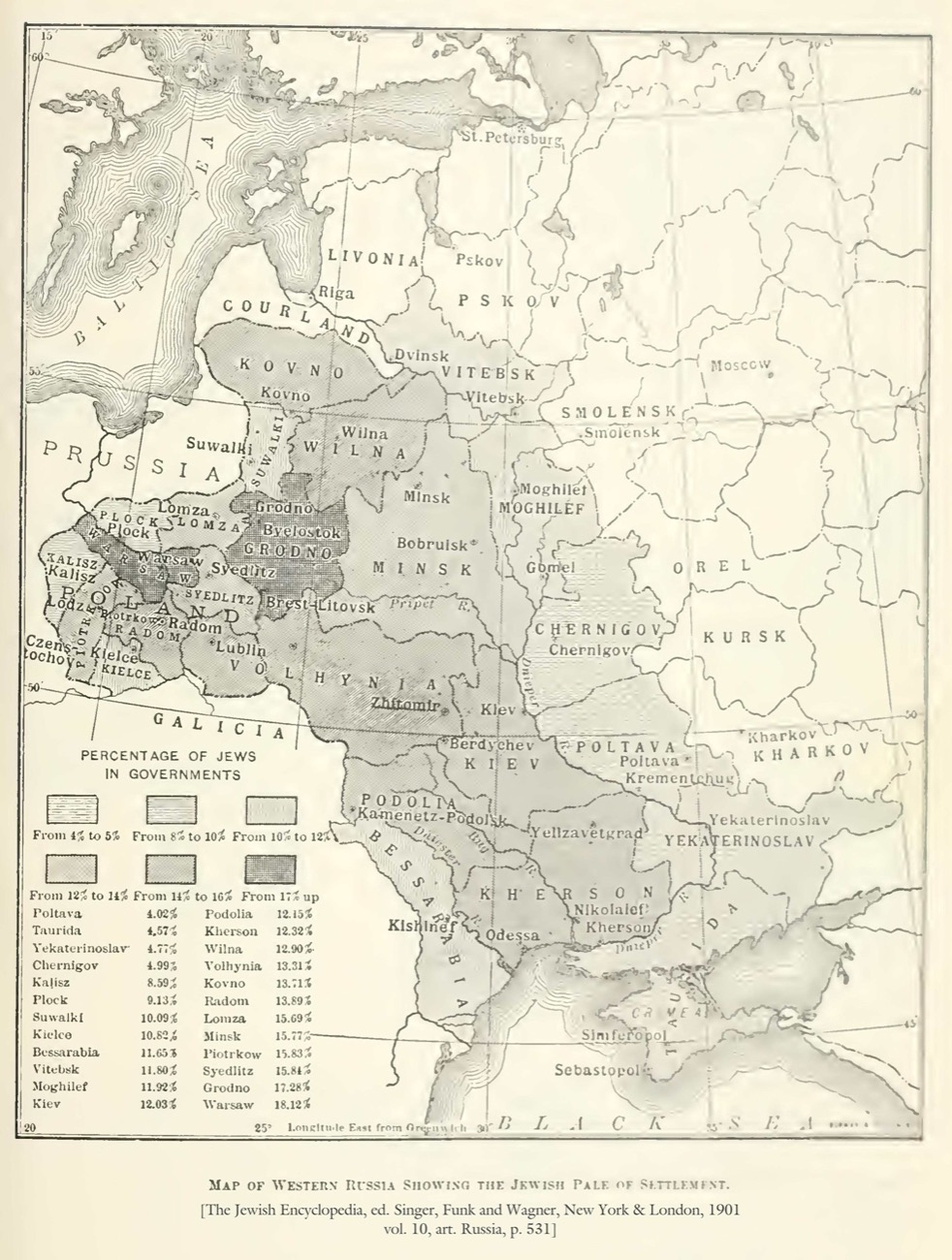
From The Jewish Encyclopedia, vol. 10 (New York: Funk & Wagnalls, 1905). Public domain.
Common misconceptions this Chapter addresses
Three claims blur this history: that the state planned the pogroms, that the forgery they helped inspire exposed a real plot, and that the pogroms were the Holocaust.
- “The Tsarist government secretly planned and ordered the pogroms.” See the entry →
- “The Protocols of the Elders of Zion exposed a real plot.” See the entry →
- “The Russian pogroms were the Holocaust.” No. The pogroms and the Holocaust were different historical events separated by decades. The pogroms consisted of repeated episodes of mob violence within the Russian Empire, while the Holocaust was a systematic campaign of genocide carried out by Nazi Germany and its collaborators. See the entry →
Object Spotlight
A year’s passport, issued inside the Pale.
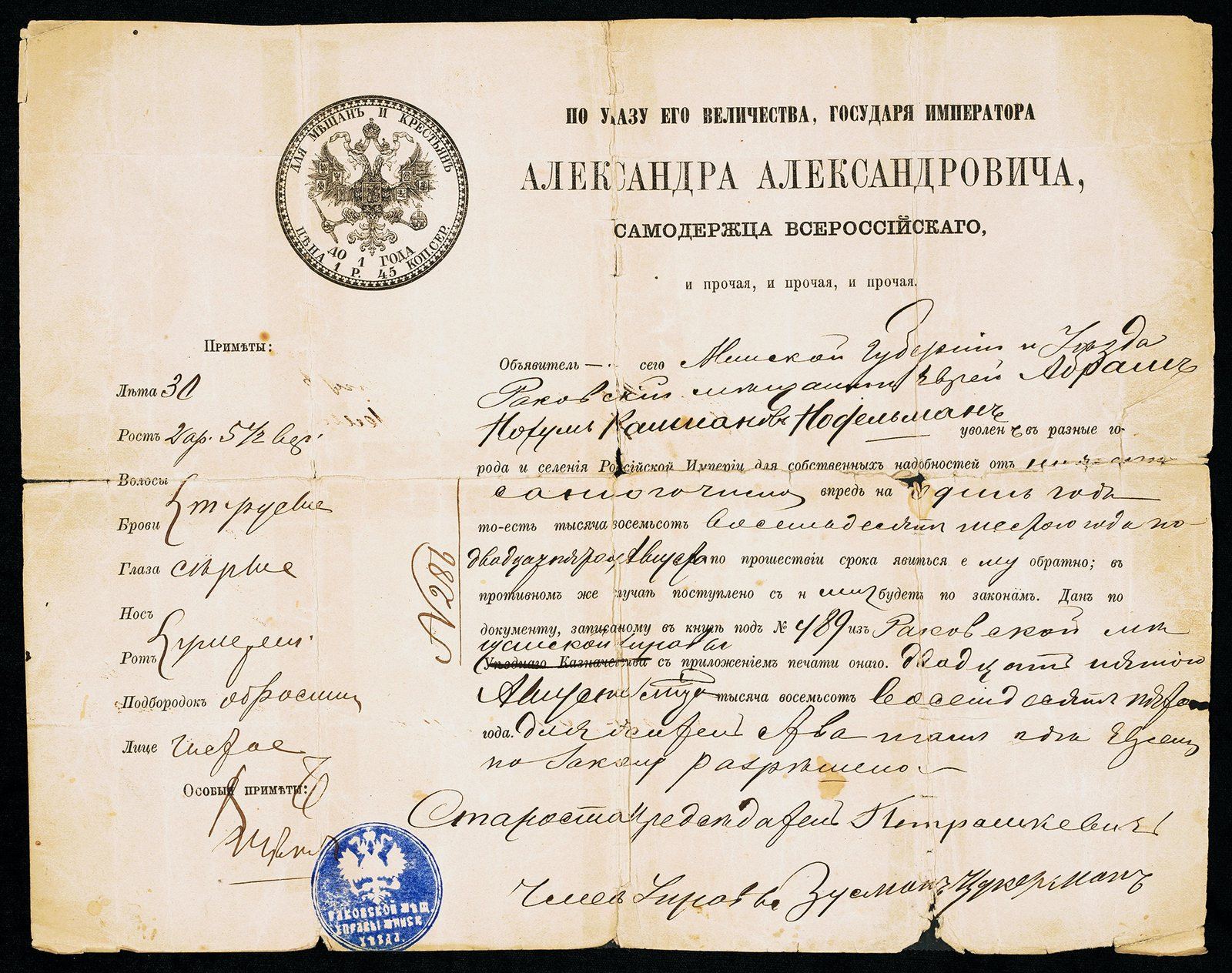
It is a single worn sheet of paper, printed in Russian, soft at the folds from being carried. At the top sits a double-headed eagle, an official stamp. Below the printed lines, someone has filled in blanks by hand: a person’s description, a place, a date. There is an inked stamp down in one corner. It looks like the kind of form anyone would throw away.
This is an internal passport, issued in 1885 to a Jewish townsman of Rakov, a small town in the province of Minsk. To understand it you need one piece of background: in the Russian Empire, Jews were not allowed to live wherever they wanted. By law they were confined to a region along the empire’s western edge called the Pale of Settlement (“pale” being an old word for a fenced-in area). Rakov lay inside it. The passport let its holder leave his town for one year and travel to “various towns and villages of the Russian Empire” on his own affairs. Wherever he went, the law of the Pale still decided where he could live.
The pogroms, the mob attacks, are the loud part of the story. Underneath them ran a quieter, constant pressure: a state that controlled where five million people could stand, sleep, and earn a living, and did it through ordinary paperwork. The passport shows confinement as a routine rather than a wall: stamped, filed, and renewable. The printed form was the standard one issued to townsmen and peasants. For a Jew, the rules of the Pale traveled with it.
Look closely at the handwritten lines: a physical description of the holder down the left side, his town and province, and the date the passport ran out. The freedom most people never think about, to get on a road and go, was, for this traveler, spelled out, dated, and stamped by a clerk.
The paperwork had an end point. As the restrictions tightened and the pogroms spread through the 1880s and after, the answer for millions was to leave the empire altogether. The little passport, designed to control movement, belongs to the system that finally drove that movement out of the country entirely. The descendants of the people who carried papers like this one now live across the world.
Following the evidence
Were the pogroms spontaneous?
The question: were the pogroms simply spontaneous outbreaks of violence, or did earlier government policies help make them possible? Use four pieces of evidence from this Chapter. Two appear above, and two are treated in the sections that follow:
- the map of the Pale of Settlement,
- the 1885 passport in the Object Spotlight above,
- the May Laws of 1882, and
- the description of the Kishinev pogrom.
Trace how three factors combined to create the conditions in which repeated violence could occur. The first is legal restriction (the Pale and the passport). The second is inflammatory accusation, such as the blood libel, the medieval false charge that Jews murder Christian children, revived in print in the weeks before Kishinev. The third is inconsistent government protection from a state that restricted the victims and whose officials stood aside during the violence.
The waves of 1881
The assassination, and the storm that followed.
The assassination of 1881. In March 1881, revolutionaries assassinated Tsar Alexander II. One of the conspirators was a young Jewish woman, and that fact was seized upon. Beginning that spring and continuing into 1882, a wave of anti-Jewish riots swept the southwestern provinces of the Empire, more than 250 separate outbreaks, concentrated in present-day Ukraine. Mobs looted and destroyed Jewish homes, shops, and synagogues, beat and raped Jews, and dozens of people were killed. The mix differed from town to town, though the single word can suggest one uniform kind of event.
Many Jews at the time believed the government had organized the riots. Research by the historians Hans Rogger, I. Michael Aronson, and John Klier challenged that view, and Klier found no evidence of instigation or planning in the archival record. In his account, the riots typically began in large cities and spread along rivers and railroads to surrounding villages, driven by local tensions and rumor. Officials were often slow, careless, or unwilling to protect their Jewish subjects.
The state’s response
The May Laws of 1882.
The interior minister, Nikolai Ignatiev, presented the riots as a protest by peasants against “Jewish exploitation,” and the government answered them with new restrictions. The “Temporary Regulations” of May 1882, known as the May Laws, barred new Jewish settlement in villages even inside the Pale. They limited Jewish trade on Sundays and Christian holidays. Five years later, in 1887, the state added the quotas that capped how many Jewish students could enter high schools and universities. Rules passed as temporary stayed in force until 1917. The May Laws did not create the Pale, which was already a century old. They made its restrictions harsher.
Kishinev · 1903
The pogrom the whole world read about.
Kishinev, April 1903. At Easter, in the city of Kishinev (today Chișinău, the capital of Moldova), a pogrom broke out that would become the era’s defining episode. Over two days rioters killed 49 Jews and injured 586. They looted and destroyed some 700 Jewish homes and looted some 600 shops and businesses. Beforehand, the local newspaper Bessarabets, edited by Pavolachi Krushevan, had run a series of antisemitic articles. Before Passover it accused the city’s Jews of the ritual murder of a Christian child. The charge was the blood libel, and it was shown that the child had not been killed by Jews. Some of the rioters were later tried in Russian courts and received light sentences.
What set Kishinev apart was its reach. Photographs of the aftermath circulated internationally, and detailed accounts ran in the world press. Protest meetings filled halls across Western Europe and the United States, and relief funds were raised across the Atlantic. The killing drew formal diplomatic protest, including a petition to the Tsar that President Theodore Roosevelt agreed to transmit and that Russia refused to receive. In Russia, the writers Leo Tolstoy and Maxim Gorky published condemnations. Many at the time blamed the interior minister, Viacheslav Plehve, on the strength of a dispatch published in the Times of London that historians have since shown to be a forgery.
The Hebrew poet Hayim Nahman Bialik was sent to interview survivors and wrote “In the City of Slaughter,” a poem whose fury was aimed at the killers and at what he saw as Jewish passivity. In the pogrom’s wake, organized self-defense groups began to form across the Pale, and armed Jewish self-defense units first appeared during the pogrom in Gomel later that year. Kishinev pushed many toward the conclusion that safety would require departure, self-protection, or both.
The violence of 1905
Revolution, and a second, larger wave.
The wave of 1905. In October 1905, defeated in war with Japan and facing revolution, Tsar Nicholas II issued the October Manifesto granting civil liberties and an elected assembly. The concession set off a counter-reaction. Right-wing groups, among them the militias known as the Black Hundreds, blamed Jews for the revolution and for the humiliation of the autocracy, and in the weeks that followed, hundreds of pogroms broke out across the Empire’s south and southwest.
The worst fell on Odessa, the great Black Sea port where Jews were about a third of the city. Estimates of the dead there run from several hundred to more than a thousand. The historian Robert Weinberg judges it the most destructive pogrom of 1905. Odessa had seen anti-Jewish riots four times before, in 1821, 1859, 1871, and 1881, and in the first three, Greek merchants of the grain export trade were prominent among the attackers. Across the Empire, the autumn of 1905 brought hundreds of separate attacks and thousands of Jews killed or wounded in a matter of weeks. In many places, Jewish self-defense groups, formed after Kishinev, fought back. In Odessa, police and soldiers stood by or joined in the looting and killing. Historians have found no firm evidence that the central government ordered the attacks.
In June 1906, three days of attacks in Białystok, in today’s Poland, killed 70 Jews and left 90 gravely injured. A commission of inquiry named by the Duma, the elected assembly the October Manifesto had granted, held both the local police and the central authorities to blame.
The blood libel reached a Russian courtroom a few years later. In 1911 the authorities charged Mendel Beilis, a Jewish manager at a Kiev brick factory, with the ritual murder of a Christian boy, and in 1913 a jury acquitted him. The full story of the trial is told in the Blood Libel Chapter.
The civil-war pogroms
The worst was still to come.
Then the empire itself collapsed. Russia’s defeats in World War I broke it. Two revolutions in 1917 ended the Tsar’s rule, and the Pale fell with it. The Bolsheviks, the communists who seized power that autumn, then fought a civil war against their enemies. The pogroms of the Tsarist period were exceeded by the violence that engulfed the former Empire during the Russian Civil War of 1918–1921. As Bolshevik, anti-Bolshevik “White,” Ukrainian nationalist, and other forces fought across Ukraine and Belarus, Jewish communities were attacked on a scale without precedent in the region. All the contending armies carried out pogroms. The YIVO Encyclopedia singles out two as particularly prone to them: General Anton Denikin’s anti-Bolshevik Volunteer Army, and forces fighting in the name of the Ukrainian government headed by Symon Petliura, which had little effective control over them. Red Army commanders occasionally punished their troops for pogroms.
At least 50,000 Jews were killed, and the historian Jeffrey Veidlinger counts more than 100,000. Hundreds of thousands more were left homeless, orphaned, or destitute. This was the largest wave of anti-Jewish violence anywhere between the late-nineteenth-century pogroms and the Holocaust. Historians tie it to hatred of Jews, sharpened by the charge that Jews were behind the revolution, and to the collapse of government, the brutality of years of war, and looting. The White forces, the anti-Bolshevik armies, used that hatred to rally support. General Denikin’s army proclaimed the slogan “Strike at the Jews and save Russia.”
Writing it down while it happened
The people who documented their own catastrophe.
During those same years, a quieter effort began. Even as the pogroms were still going on, a group of Jewish scholars and activists in Kiev, in Ukraine, set out to record them, collecting eyewitness accounts, photographs, lists of the dead, and official papers, town by town. They understood that if no one wrote it down, it could later be denied or simply forgotten. Their collection, the Mizrakh Yidisher Historisher Arkhiv (Archives for the History of Eastern European Jews), is, in YIVO’s description, one of the world’s most extensive sources for the study of the 1919–1921 pogroms.
The part of that archive which survived the Holocaust is now held at the YIVO Institute for Jewish Research in New York, within the papers of the historian Elias Tcherikower. It is being cataloged and digitized so that anyone can study it. Among the documents is a building-by-building list of people wounded in a single pogrom in Kiev, the kind of record that turns an unimaginable number back into named individuals on specific streets.
You can explore some of these materials, and the story of the scholars who saved them, at the YIVO Edward Blank Vilna Online Collections.
One turn of a recurring cycle
The shape of it, seen again.
The Russian pogroms followed a sequence that turns up again and again across this Unit. A community is already set apart by law. A moment of stress arrives, an assassination, a lost war, a revolution. An old accusation is pulled out to explain the crisis. Rumor and incitement spread, often in print. Violence follows. Officials stand aside, or take the mob’s side. Afterward come both new restrictions and the slow work of rebuilding. The same steps appear in the medieval blood libel, and, at its most extreme, in the Holocaust era.
What the violence set in motion
Two movements, born from the same pressure.
The pogrom era also redirected the course of modern Jewish history, along two paths that still shape the world.
The first was migration. Between 1881 and 1924, roughly two million Jews left the Russian Empire, the great majority bound for the United States, with others going to Britain, Argentina, South Africa, and beyond. This is the migration that built American Jewry, the story told in the Chapter on American Jewry. The second path led to the Land of Israel. The waves of immigration known as the First and Second Aliyah (aliyah, Hebrew for “ascent”) drew on the same pressures as the westward migration, poverty and legal disability, with the pogroms as the events that gave the movement its urgency. Societies of Hovevei Zion, “Lovers of Zion,” and the student group BILU formed after the riots. With a parallel movement in Romania, they founded new farming villages by the end of 1882, among them Rishon LeZion, Zikhron Ya’akov, and Rosh Pinah, as told in the Modern Israel Chapter. Kishinev in particular sharpened the urgency felt by Theodor Herzl and the early Zionist movement, the movement to build the Jewish people a country of their own, a story told in the Chapter on Herzl and the Land of Israel.
Key takeaways
- By 1900 the Russian Empire held roughly five million Jews, the largest Jewish population on earth, nearly all confined by law to the western zone called the Pale of Settlement.
- The Pale was not a city ghetto but a territory about twice the size of France. It concentrated millions of people in one place and limited their movement and schooling.
- The English word pogrom was borrowed from Russian in the 1880s, carried on the news of the mob attacks that came in waves after 1881.
- Kishinev (1903) became the era’s defining episode, 49 killed, worldwide press coverage, and a turning point that spurred both Jewish self-defense and the urgency of the early Zionist movement.
- The violence redirected modern Jewish history along two paths: the migration of roughly two million Jews, mostly to America, between 1881 and 1924, and the early waves of settlement in the Land of Israel.
- Historians have found no archival evidence that the government planned the major Tsarist pogroms. They grew from local conditions, incitement, and official neglect or complicity.
Discussion questions
Working from the evidence.
Each question is anchored in a fact this Chapter documents. Answer from the evidence on the page.
- The Pale of Settlement and the medieval ghetto were different in scale, a vast territory versus a few city streets, but shared a logic. Using what the page says about both, what did confinement by law actually do to the people inside it, and why might a government choose it?
- The passport in the Object Spotlight let one man travel the empire for a year, while the law still limited where a Jew could live. What does it tell you that this freedom came on a dated, stamped form that ran out?
- Historian John Klier found no evidence that the pogroms of 1881–1882 were ordered from the capital. Why does it matter whether catastrophic violence was planned, and how does the answer change who bears responsibility?
- Kishinev in 1903 became the pogrom the world read about. What role did the press play, and how does the way an event is reported shape whether the world responds?
- Between 1881 and 1924 roughly two million Jews left the Russian Empire, and others joined the first waves of settlement in the Land of Israel. Using the Chapter, which pressures pushed people to leave, and which events gave the departures their urgency?
Classroom Connections
Where this Chapter fits.
Teaching Connections
- World History, Nationalism & the Nation-State: how a modern state controlled a minority through law, and how political crisis turned prejudice into violence.
- Migration & Diaspora: the exodus that built American Jewry and the settlement that reshaped Jewish life in the Land of Israel.
- Historical Thinking & Source Analysis: reading the Pale map, the 1885 passport, and the press record of Kishinev as evidence of how violence became possible.
- Civic Education: legal discrimination, official indifference, and the conditions in which mob violence recurs.
- Bridge to Unit 4: the recurring pattern of restriction, propaganda, indifference, and violence, without equating the pogroms with the Holocaust.
Standards Alignment
- NYS Global History & Geography: 10.2 (Enlightenment, Revolution, and Nationalism: the nation-state and the place of minorities within it).
- NYS US History & Government: 11.5b (demographic trends in urbanization and immigration, 1840–1920, including push-pull factors behind immigration from eastern Europe).
- Common Core ELA-Literacy: RH.11–12.6 and RH.11–12.7 (source perspective, and integrating a map, a document, and narrative accounts).
Further Teaching Resources
- YIVO Encyclopedia · The Pale of Settlement, the standard scholarly reference on the legal zone.
- Yad Vashem · Education & E-Learning, classroom materials on Jewish life in Eastern Europe before the Holocaust.
Sources and citations
Primary sources
A primary source is a record from the time. It was made by people who were there. Examples: letters, diaries, photos, decrees, trial records, and newspapers.
- Nathan (Natan) of Hanover. Yeven Metzulah (“The Abyss of Despair”). 1653. Chronicle of the 1648–49 massacres by a writer who lived through the uprising years. English translation: Abraham J. Mesch, Abyss of Despair, 1950.
- Bialik, Hayim Nahman. “In the City of Slaughter” (1904), written after the Kishinev pogrom of 1903. Available in standard English translations.
- First General Census of the Russian Empire, 1897 (population data on the Jewish communities of the Pale).
- The May Laws (Temporary Regulations Concerning the Jews), Imperial Russia, May 15, 1882.
- The decree of Catherine II, 1791, restricting where Jews could live and trade: the legal origin of the Pale of Settlement.
- Davitt, Michael. Within the Pale: The True Story of Anti-Semitic Persecution in Russia. 1903. The journalist’s eyewitness investigation of the Kishinev pogrom.
Secondary sources
A secondary source was written later. It is a book or article by a historian who studied those records and explains what they mean.
- Stampfer, Shaul. “What Actually Happened to the Jews of Ukraine in 1648?” Jewish History 17 (2003). The modern demographic assessment of the death toll.
- Klier, John D. Russians, Jews, and the Pogroms of 1881–1882. Cambridge: Cambridge University Press, 2011.
- Stampfer, Shaul. “Gzeyres Takh Vetat.” The YIVO Encyclopedia of Jews in Eastern Europe. (The 1648–49 uprising: about 40,000 Jews in the affected regions, most of whom fled, and up to 20,000 deaths.) encyclopedia.yivo.org.
- Klier, John D., and Shlomo Lambroza, eds. Pogroms: Anti-Jewish Violence in Modern Russian History. Cambridge: Cambridge University Press, 1992. (Includes Robert Weinberg, “The Pogrom of 1905 in Odessa: A Case Study.”)
- Weinberg, Robert. “The Pogrom of 1905 in Odessa: A Case Study.” Chapter reproduced by the University of Maryland Department of History. (On police and soldiers who stood by or joined in.) faculty.history.umd.edu.
- “Pogroms.” Encyclopaedia Judaica, 2nd ed. Detroit: Macmillan Reference USA, 2007. (On the 1905 attacks and the Denikin army’s slogan.) encyclopedia.com.
- Veidlinger, Jeffrey. In the Midst of Civilized Europe: The Pogroms of 1918–1921 and the Onset of the Holocaust. New York: Metropolitan Books, 2021. (More than 100,000 Jews killed, 1918–1921.) Publisher’s description at the Jewish Book Council.
- Klier, John D. Imperial Russia’s Jewish Question, 1855–1881. Cambridge: Cambridge University Press, 1995.
- Dekel-Chen, Jonathan, David Gaunt, Natan M. Meir, and Israel Bartal, eds. Anti-Jewish Violence: Rethinking the Pogrom in East European History. Bloomington: Indiana University Press, 2011.
- Pinkus, Benjamin. The Jews of Russia and the Soviet Union: A History of a National Minority. Cambridge: Cambridge University Press, 1988.
- Klier, John. “Pogroms.” The YIVO Encyclopedia of Jews in Eastern Europe. (The 250 outbreaks of 1881–82, the disputed death toll, Klier’s archival finding, the 1905 record, and the civil-war estimates.) encyclopedia.yivo.org.
- Klier, John. “Pale of Settlement.” The YIVO Encyclopedia of Jews in Eastern Europe. (Ignatiev and the May Laws, and the 1917 abolition.) encyclopedia.yivo.org.
- Petrovsky-Shtern, Yohanan. “Military Service in Russia.” The YIVO Encyclopedia of Jews in Eastern Europe. (The conscription statute of 1827, the cantonist battalions, the conversion campaign, and the end of child conscription in 1856.) encyclopedia.yivo.org.
- Stanislawski, Michael. “Ḥibat Tsiyon.” The YIVO Encyclopedia of Jews in Eastern Europe. (The Lovers of Zion after 1881 and Pinsker’s Autoemancipation.) encyclopedia.yivo.org.
- Ury, Scott. “Zionism and Zionist Parties.” The YIVO Encyclopedia of Jews in Eastern Europe. (BILU and the villages founded by the end of 1882.) encyclopedia.yivo.org.
- “Kishinev.” Encyclopaedia Judaica, 2nd ed. (On the 700 homes looted and destroyed and the 600 shops looted.) encyclopedia.com.
- Moskovich, Wolf. “Kishinev.” The YIVO Encyclopedia of Jews in Eastern Europe. (The 1903 casualty figures and the Bessarabets accusation.) encyclopedia.yivo.org.
- Meir, Natan. “Beilis, Mendel.” The YIVO Encyclopedia of Jews in Eastern Europe. encyclopedia.yivo.org.
- Weinberg, Robert. Blood Libel in Late Imperial Russia: The Ritual Murder Trial of Mendel Beilis. Bloomington: Indiana University Press, 2014.
- Levin, Edmund. A Child of Christian Blood: Murder and Conspiracy in Tsarist Russia: The Beilis Blood Libel. New York: Schocken, 2014.
- Newman, Roberta. “They Never Taught Us About This.” YIVO, Edward Blank YIVO Vilna Online Collections, November 29, 2017. (The Mizrakh Yidisher Historisher Arkhiv and the Tcherikower papers.) vilnacollections.yivo.org.
- YIVO Institute for Jewish Research. The YIVO Encyclopedia of Jews in Eastern Europe, articles on the Pale of Settlement and on pogroms. encyclopedia.yivo.org.
- Encyclopaedia Judaica, 2nd ed. (2007), “Pale of Settlement.” (The Pale covered about one million square kilometers.) jewishvirtuallibrary.org.
- “Odessa.” Encyclopaedia Judaica, 2nd ed. Detroit: Macmillan Reference USA, 2007. (On the anti-Jewish outbreaks of 1821, 1859, 1871, 1881, and 1905.) encyclopedia.com.
- Gelber, Nathan Michael. “Bialystok.” Encyclopaedia Judaica, 2nd ed. Detroit: Macmillan Reference USA, 2007. (On the pogrom of June 1906 and the Duma commission.) encyclopedia.com.
Finding these documents: many primary sources are free online. Good places to start are the Fordham Internet Jewish History Sourcebook, Yale’s Avalon Project (law and diplomacy), German History in Documents, the collections of the US Holocaust Memorial Museum and Yad Vashem, the National Library of Israel, and Sefaria (for Jewish texts). Search the document’s name and date.
The Protocols of the Elders of Zion, a fabricated text, its Russian origin, the 1864 French satire it plagiarized, its 1921 exposure as a forgery, and how a refuted text kept circulating for a century.
Comments?
Write to editor@teachjewishhistory.org.
Last updated: November 2026.