The Eastward Turn
The Protocols of the Elders of Zion is a forged text that claims to reveal a Jewish plot to rule the world. It was circulating in Arabic by 1925, twenty-three years before the State of Israel was founded. During the Second World War, Nazi Germany broadcast antisemitic propaganda in Arabic every day while the Holocaust was underway in Europe. That European material traveled into the Arabic-speaking world through a forgery, a radio station, a charter, and a classroom.
The Eastward Turn · Unit 3
Key takeaways
- Arabic translations of the Protocols carried European antisemitism into the Arabic-speaking world by the mid-1920s, before the State of Israel existed and before the 1948 war.
- From 1939 to 1945, Nazi Germany broadcast daily antisemitic propaganda in Arabic to the region. From 1942 one of its voices from Berlin was Haj Amin al-Husseini, the exiled former Mufti of Jerusalem.
- Between the broadcasts and the charter the forgery stayed in print. It was reissued across the Arab states after 1945, and Egypt’s President Nasser vouched for it. The editor’s notes to a 1970 edition of Sayyid Qutb’s essay quoted it.
- The 1988 Hamas covenant cites the Protocols as fact in Article 32, sixty-seven years after the text was proven a forgery. Hamas has not annulled the charter.
- In 2007 a Hamas television program for children urged its viewers to fight Israel. The European Union’s commissioned study found antisemitic passages in specific Palestinian Authority textbooks, one of them later altered, and the European Parliament condemned hate content in the books.
Why this Chapter exists
A European hatred arrives in a new language.
In the Islamic world, Jews had lived under a different system from Europe’s, the dhimma, the protected but subordinate legal status of Jews and Christians under Islamic rule. It was formally ended in the Ottoman Empire by reform decrees of 1839 and 1856, though it persisted in Morocco, Iran, and Yemen into the twentieth century. Then the European hatred traced in this Unit crossed into that world. In the same decades that this hatred led to the Holocaust in Europe, it was being translated and broadcast in a new region and a new language.
The trail runs through translations, wartime radio, a charter, a children’s television program, and school textbooks.
Common misconceptions this Chapter addresses
- “Antisemitism in the modern Islamic world is a recent phenomenon unrelated to European antisemitic traditions.” See the entry →
- “The Protocols of the Elders of Zion are an authentic document of debated origin.” See the entry →
- “The crisis in the Middle East is thousands of years old.” See the entry →
What came before
Centuries of coexistence and subordination, without this text.
Jewish communities lived across the Middle East and North Africa for well over two thousand years. Under Islamic rule their legal position was second-class, with special taxes and restrictions, and they faced periodic anti-Jewish violence. The violence included the massacre of Granada’s Jews, in Muslim Spain, in 1066, and the persecutions under the Almohads, a North African dynasty, in the 1100s. As late as 1912, the Jewish quarter of Fez, in Morocco, was sacked. The same centuries also included long periods of stability and achievement. Moses Maimonides (1138–1204), the leading Jewish philosopher of the Middle Ages, was born in Muslim-ruled Córdoba. The Almohads forced his family to leave, and he settled in Fustat, part of Cairo, where he became famous as a physician. That record is the region’s own, and the previous Chapter, The Dhimma, tells it. But the specific European tradition this Unit has traced did not come from Islamic tradition. The secret-conspiracy myth and the racial pseudoscience were made in Europe. The blood libel (the invented charge that Jews murder Christian children) reached the region through its Christian communities. When the blood libel was raised in Damascus in 1840, the accusers were Capuchin friars, members of a European Catholic order. The French consul took their side and ran the investigation with the governor of Damascus. Jews were arrested and tortured, and two died. In the twentieth century these imports joined an older tradition of religious writing against Jews, and some writers drew on both.
What arrived in the twentieth century was layered onto that older record. The Departure from MENA Chapter (MENA: the Middle East and North Africa) documents what happened to the region’s Jewish communities in the decades that followed.
The 1920s
The Protocols changes languages.
The first Arabic translations of the Protocols of the Elders of Zion appeared in the mid-1920s. The United States Holocaust Memorial Museum records a translation available in Syria by 1925. In January 1926, the Jewish Telegraphic Agency reported that an Arabic translation had been issued in Beirut. It also reported that Rakib Sion, the paper of the Latin (Roman Catholic) patriarch in Jerusalem, had recommended it to its readers. (USHMM; JTA archive, January 25, 1926.)
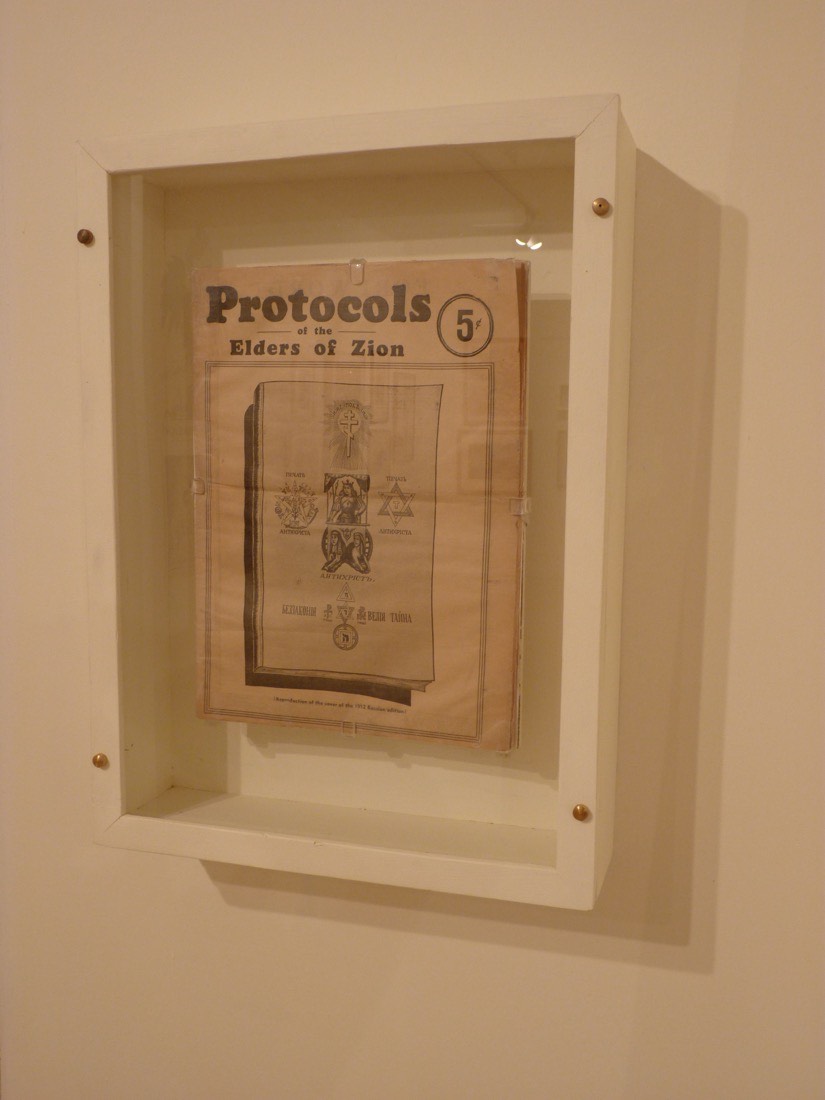
The forgery had been publicly exposed in 1921, when the Times of London showed that much of it was copied from an 1864 French satire. The Arabic translations came anyway, in Syria and Lebanon, both then under French rule. The State of Israel and the 1948 war were more than two decades away.
The story of the forgery itself, its Russian origin, its French source, and its exposure, is told in the Protocols Chapter.
1939–1945
The radio years.
From 1939 to 1945, Nazi Germany broadcast daily Arabic-language radio programming to the Middle East and North Africa from its shortwave station at Zeesen, outside Berlin. The historian Jeffrey Herf reconstructed the broadcast record from surviving transcripts. He documents programs that mixed music and news with antisemitic propaganda, broadcast seven days and nights a week. Some broadcasts told listeners to kill Jews. Herf also found that the broadcasts drew selectively on Islamic tradition, presenting it as compatible with Nazism. He describes the result as a fusion of Nazi ideology with “certain strains of Arab nationalism and Islamic religious traditions,” built on “a selective appropriation and reception of the traditions of Islam.” (Herf, Central European History, 2009.)
One well-known voice of the Arabic service from 1939 was the Iraqi broadcaster Yunis Bahri. From 1942 it carried a second, more notorious voice. Haj Amin al-Husseini had been Mufti of Jerusalem (the city’s highest Muslim religious official) until 1937. He had fled British-ruled Palestine during the crackdown on the Arab Revolt of the late 1930s and made his way to Germany. On November 28, 1941, Hitler received him in Berlin. The German Foreign Ministry’s own record of the meeting survives and has been published. Al-Husseini spent the rest of the war in exile in Europe, broadcasting to the Arab world from Berlin. The United States Holocaust Memorial Museum documents his propaganda role in detail. It also notes that despite such broadcasts, “no significant uprising occurred between the Mediterranean Sea and the Persian Gulf during 1942.” (USHMM, “Hajj Amin al-Husayni: Wartime Propagandist”; the meeting record is Documents on German Foreign Policy 1918–1945, Series D, Volume XIII, Document 515.)
The Holocaust in the Middle East and North Africa Chapter tells what the war years meant inside the region itself, including for its Jewish communities. The photograph of the 1941 meeting appears there.
1948–1988
Between the broadcasts and the charter.
The region’s politics were transformed after 1945 by the founding of Israel in 1948 and the wars that followed. The forgery stayed in print. In 1951 a new Arabic translation, by Muhammad Khalifa al-Tunisi, appeared with a foreword by the Egyptian writer Abbas Mahmud al-Aqqad, and it has been reprinted ever since. The Encyclopaedia Judaica records that after 1945 the Protocols “were reissued in numerous Arab states,” and that Gamal Abdel Nasser, Egypt’s president from 1956 to 1970, “publicly vouched for their authenticity.” (Encyclopaedia Judaica, “Elders of Zion, Protocols of the Learned”; on the 1951 translation, Koerber 2018 and Matussek.)
Sayyid Qutb, an Egyptian writer executed in 1966, became the chief thinker of the Muslim Brotherhood, an Islamist movement founded in Egypt in 1928. In the 1950s he wrote an essay called “Our Struggle with the Jews.” In it he blamed Jews for the modern ideas he rejected. “Behind the doctrine of atheistic materialism was a Jew; behind the doctrine of animalistic sexuality was a Jew; and behind the destruction of the family and the shattering of sacred relationships in society was a Jew,” he wrote, in Ronald Nettler’s translation. He pointed to three thinkers who shaped the modern West, all three from Jewish families. Karl Marx was the German thinker behind communism. Sigmund Freud was the Austrian doctor who founded psychoanalysis, a way of treating the mind. Émile Durkheim was the French scholar who founded sociology, the study of how societies work. The scholar Michał Moch found that some of the essay’s arguments were probably borrowed from European antisemitic writing. When a Saudi government press reprinted the essay in 1970, the editor added notes quoting the Protocols. (Nettler, 1987, as quoted in Küntzel, 2005; Aaron, RAND, 2008; Moch, 2008; Küntzel, 2021.)
1988
A forgery in a founding charter.
In August 1988, Hamas, a Palestinian Islamist movement founded the year before in Gaza, published its founding covenant. Article 32 states: “Their plan is embodied in the Protocols of the Elders of Zion, and their present conduct is the best proof of what we are saying.” Article 7 quotes a hadith, a saying attributed to the Prophet Muhammad, stating that the Day of Judgement will not come until Muslims fight and kill the Jews. (Hamas Covenant 1988 · Avalon Project, Yale Law School.)
In May 2017, Hamas released a new document of general principles at a press conference in Doha. It stated that the movement’s conflict is “with the Zionist project not with the Jews because of their religion.” Within days, a senior Hamas official, Mahmoud al-Zahar, told reporters there was “no contradiction” between the new document and the pledge in the founding covenant. Hamas has not annulled the 1988 charter. (Reuters, May 10, 2017.)
2007
Broadcast to children.
In April 2007, Al-Aqsa TV, the Hamas-run television station in Gaza, began airing a children’s program called Tomorrow’s Pioneers. It starred Farfour, a costumed Mickey Mouse lookalike, who urged children, between skits and songs, to fight Israel. In the final Farfour episode, aired June 29, 2007, the character was beaten to death on screen by an actor playing an Israeli official. The child presenter told viewers Farfour was “martyred while defending his land.” He was replaced by Nahoul the bee, who vowed to continue on Farfour’s path.
International news organizations reported the broadcasts at the time. The state-run Palestinian Broadcasting Corporation, controlled by a rival party, opposed the program, but the Hamas station kept it on the air. The clips are kept by MEMRI, the Middle East Media Research Institute, a Washington-based group that records and translates the region’s broadcasts. (NBC News/AP, 2007; CBS News, 2007; MEMRI TV, clip and transcript.)
The classroom record
What reviews of the textbooks found.
In 2019 the European Union asked the Georg Eckert Institute to review the curriculum of the Palestinian Authority. The institute is a German research center that specializes in textbook analysis. The Palestinian Authority is the Palestinian government that administers parts of the West Bank, separate from Hamas in Gaza. The study, published in June 2021, examined 156 of the 309 textbooks then available, along with teachers’ manuals. It described “a complex picture”: the books adopted UNESCO standards on subjects such as human rights, and they also expressed antagonism toward Israel. One religious-education textbook, in the institute’s words, “contains cumulative stereotypes and accusations that can clearly be characterised as anti-Semitic.” It portrays the Jews, as a group, as enemies who sought to kill the Prophet Muhammad or were hostile to the Muslim community. Passages tying Israeli policy in East Jerusalem to an implied Jewish conspiracy fall, it found, within “classic anti-Semitic ideas.” A follow-up review of 18 textbooks released in 2020 found “the alteration of a specific teaching unit that included anti-Semitic content by several significant changes of the narrative.” (Georg Eckert Institute, Executive Summary and FAQ.)
In its budget resolutions of May 2020 and April 2021, the European Parliament voiced concern about hate speech and violence in the textbooks. The 2021 resolution, adopted on April 29, insisted that EU funding for teachers’ salaries depend on teaching material meeting UNESCO standards of peace, tolerance, coexistence, and non-violence. In April 2024 Parliament condemned content in the books “spreading antisemitism and inciting hatred.” (European Parliament, resolution of April 29, 2021.) IMPACT-se, an Israel-based monitoring group, reviews the curriculum every year and reports the same pattern each time. The pattern includes material on martyrdom and jihad (here, armed struggle) in subjects as far from politics as mathematics. (IMPACT-se, annual reviews.)
UNRWA, the UN agency that runs schools for Palestinian refugees, uses the textbooks of the government where it works. In the West Bank and Gaza, those are the Palestinian Authority’s. A 2022 IMPACT-se review looked at study materials produced by UNRWA itself. It found grammar drills for Gaza students built on sentences about “jihad warriors,” and a poem that described dying as a martyr as a “hobby.” Its 2023 review of textbooks used in UNRWA schools cited a fourth-grade math exercise that asks students to add up the “martyrs” of the two intifadas, the Palestinian uprisings. (IMPACT-se, July 2022; IMPACT-se, November 2023.)
In April 2024 an independent review of UNRWA reported to the UN Secretary-General. Its chair was Catherine Colonna, a former French foreign minister. It found host-country textbooks “with problematic content” in some UNRWA schools. “Even if marginal,” it wrote, such content is “a grave violation of neutrality.” It recommended banning hate speech, incitement to violence, and antisemitic references from the textbooks used there. (Independent Review, April 2024.)
Across the region. In its reports for 2020 and 2021, the U.S. State Department wrote that Syria’s national curriculum “did not include materials on religious tolerance or the Holocaust.” After the government of President Bashar al-Assad fell in December 2024, the new education ministry ordered the deletion of content glorifying the former regime. A peer-reviewed study of the new books, published in 2026, found “a handful of derogatory remarks against Jews.” Among them is an eleventh-grade exercise that asks students to “count the actions of Jews … that earned them painful punishment” from God. It judged these milder than the Assad-era books of the early 2000s, which called Jews “traitors and backstabbers in every age and place.” IMPACT-se reported in October 2026 that a sixth-grade lesson carried over from the Assad-era edition still teaches that “treason and backstabbing are among the traits of the Jews.” For 2023, the State Department reported that Jordan’s national curriculum “did not mention the Holocaust,” though some private schools taught it. Citing IMPACT-se, it reported that Egypt is revising its curriculum one grade at a time, from 2018 to 2030. Revised books “promoted general concepts of peace and tolerance,” while unrevised books “reflected harmful attitudes toward Jews.” It reported, also citing IMPACT-se, that Qatar’s national curriculum in 2023 “continued to include content that was antisemitic in nature.”
Other governments changed their books. The State Department reported that Saudi Arabia had completed a textbook review, “removing almost all problematic references to persons of religions other than Islam.” In December 2020, Morocco announced that Jewish history and culture would be taught in the final year of primary school. The United Arab Emirates’ education ministry confirmed that the Holocaust would enter the public school curriculum in the 2023–24 school year. In Bahrain, a May 2023 revision meant to remove antisemitic language and language critical of Israel drew objections from clerics. The government halted further changes, but the removed lessons on the Israeli-Palestinian conflict were not restored. (US State Department, International Religious Freedom Reports: Syria 2020, Syria 2021, Jordan 2023, Egypt 2023, Qatar 2023, Saudi Arabia 2023, United Arab Emirates 2023, Bahrain 2023; Voice of America, January 2, 2025; Britt Leake, Comparative Education, 2026; IMPACT-se, October 2026; AFP via Arab News, December 13, 2020.)
Object Spotlight
A document you can read yourself.
The 1988 Hamas covenant can be read in English translation at the Avalon Project of Yale Law School. Article 32 cites the Protocols by name.
The forgery was published in Russia in 1903 and exposed in London in 1921. It was translated into Arabic in the 1920s, and Nazi radio carried its conspiracy myth in Arabic in the 1940s. It was reissued across the Arab states after 1945. In 1988 a founding charter cited it as evidence.
The analytical question
What a translation changes, and what it does not.
Across Unit 3, anti-Jewish hatred takes different forms: theology in the ancient and medieval world, pseudo-science in the nineteenth century, politics in the twentieth. The conspiracy myth arrived in Arabic in the 1920s, while the conflict over the land was taking shape. That conflict gave it a local vocabulary and a daily subject. The underlying text was sometimes literally the same.
In 1988 the Hamas charter cited the forgery as proof of a Zionist plan to expand “from the Nile to the Euphrates.”
Discussion questionsQuestions that work from the evidence in this Chapter.
Discussion questions
Working from the evidence.
Answer from the evidence on the page.
- The first Arabic translations of the Protocols appeared in the mid-1920s, in Syria and Lebanon under the French Mandate, more than two decades before the State of Israel existed. What does that timing suggest about the relationship between the imported material and the conflict over the land?
- Article 32 of the 1988 covenant cites a document that had been publicly proven false in 1921. What does citing a known forgery as evidence tell you about the relationship between a movement’s beliefs and the documentary record?
- Comparing the Zeesen broadcasts with Tomorrow’s Pioneers, what changed, and what stayed the same?
- Several findings in this Chapter come from bodies that fund or run the schools: the EU’s commissioned study, the European Parliament’s resolutions, and the review the UN ordered. Others come from an Israel-based monitoring group. How should the source of a finding affect the weight a reader gives it?
- Some sources in this Chapter are governments, state broadcasters, and school systems. Does it matter whether a message comes through official channels or from the fringe?
- Choose one news report about a textbook finding in this Chapter. Find the primary source the report relies on. What does the report add, leave out, or change? The Source vs. Headline lesson walks through the method.
Classroom ConnectionsWhere this Chapter fits, standards alignment, and teaching resources.
Classroom Connections
Where this Chapter fits.
Short on time? There is a 15-minute lesson for this Chapter.
Teaching Connections
- Modern Middle East: the documented arrival and institutionalization of European antisemitic material in the region, from the 1920s translations to the present curriculum record.
- Media & Information Literacy: propaganda across four media generations, print, radio, television, and textbooks.
- Holocaust & Genocide Studies: the Nazi Arabic-language broadcasting effort and the al-Husseini record as documented by the USHMM.
- Civics & International Institutions: how the EU, the European Parliament, the U.S. State Department, and the UN reviewed what schools teach.
- Historical Thinking & Source Analysis: a chain-of-custody exercise, tracing one text from forgery to charter through dated, checkable documents.
Standards Alignment
- NYS Global History & Geography: 10.5 (the global conflicts of 1914–1945: the wartime propaganda apparatus) and 10.7 (decolonization and nationalism, 1900–2000, which includes nationalism in the Middle East: the translations and their later use).
- Common Core ELA-Literacy: RH.9–10.8 and RH.11–12.8 (evaluating claims against documentary evidence) and RH.11–12.7 (integrating evidence across print, broadcast, and institutional sources).
Further Teaching Resources
- USHMM Holocaust Encyclopedia, “Hajj Amin al-Husayni: Wartime Propagandist”, the wartime broadcasting record.
- Georg Eckert Institute, the EU-commissioned textbook study, with the institute’s own FAQ on its findings.
- IMPACT-se annual curriculum reviews, the ongoing monitoring record.
Sources and citationsThe primary and secondary sources this Chapter cites.
Sources and citations
Primary sources
A primary source is a record from the time. It was made by people who were there. Examples: letters, diaries, photos, decrees, trial records, and newspapers.
- Hamas. The Covenant of the Islamic Resistance Movement. August 18, 1988. English translation preserved by the Avalon Project, Yale Law School. Cited only; this site does not link to hate texts.
- Hamas. A Document of General Principles and Policies. Doha, May 1, 2017. Cited without link; the 1988 covenant was not annulled by it, per Hamas officials’ own statements (Reuters, May 10, 2017).
- German Foreign Ministry. Record of the meeting between Hitler and Haj Amin al-Husseini, November 28, 1941. Documents on German Foreign Policy 1918–1945, Series D, Volume XIII, Document 515.
- Jewish Telegraphic Agency. “Elders of Zion Protocols Translated into Arabic.” January 25, 1926. jta.org.
- European Parliament. Resolution of April 29, 2021 (2019 discharge: hate speech and violence in Palestinian Authority textbooks), P9_TA(2021)0164. europarl.europa.eu.
- European Parliament. Resolution of May 2020 (2018 discharge), P9_TA(2020)0114. europarl.europa.eu.
- European Parliament. Resolution of April 11, 2024 (2022 discharge), P9_TA(2024)0228. europarl.europa.eu.
- IMPACT-se. Review of 2022 UNRWA-Produced Study Materials in the Palestinian Territories (July 2022). impact-se.org.
- IMPACT-se. UNRWA Education: Textbooks and Terror (November 2023). impact-se.org.
- Independent Review of Mechanisms and Procedures to Ensure Adherence by UNRWA to the Humanitarian Principle of Neutrality. Final report to the UN Secretary-General, chaired by Catherine Colonna. April 20, 2024. un.org.
- MEMRI TV. Tomorrow’s Pioneers broadcast recordings and transcripts, Al-Aqsa TV, 2007. memri.org.
- The Protocols of the Elders of Zion. 1903. Citation only; this site does not link to hate texts.
- Qutb, Sayyid. Ma’rakatuna ma’a al-Yahud (“Our Struggle with the Jews”). Essay of the 1950s; Saudi edition, ed. Zayn al-Din al-Rakkabi, Jeddah: The Government Printer, 1970. English translation in Nettler (below). Citation only; this site does not link to hate texts.
- US Department of State, Office of International Religious Freedom. Report on International Religious Freedom: Syria (2020, 2021); Jordan, Egypt, Qatar, Saudi Arabia, United Arab Emirates, and Bahrain (2023). state.gov; state.gov; state.gov; state.gov; state.gov.
Secondary sources
A secondary source was written later. It is a book or article by a historian who studied those records and explains what they mean.
- Encyclopaedia Judaica. “Damascus Affair.” (The Capuchin accusers and the French consul.) encyclopedia.com.
- Encyclopaedia Judaica. “Elders of Zion, Protocols of the Learned” (Léon Poliakov). (The postwar Arabic reissues and Nasser’s endorsement.) encyclopedia.com.
- Koerber, Benjamin. Conspiracy in Modern Egyptian Literature. Edinburgh: Edinburgh University Press, 2018. Introduction. (The 1951 al-Tunisi translation, al-Khatar al-Yahudi, as the first “faithful and complete” Arabic version.) cambridge.org.
- Matussek, Carmen. “The Protocols of the Elders of Zion in the Arab World.” World Jewish Congress analysis. (The 1951 translation by Muhammad Khalifa al-Tunisi, its al-Aqqad foreword, and its reprints.) worldjewishcongress.org.
- “Sayyid Qutb” and “Gamal Abdel Nasser.” Encyclopaedia Britannica. britannica.com.
- Aaron, David. In Their Own Words: Voices of Jihad. Santa Monica: RAND Corporation, 2008. Free online. (English excerpts from Qutb’s essay, p. 159.) rand.org.
- Nettler, Ronald L. Past Trials and Present Tribulations: A Muslim Fundamentalist’s View of the Jews. Oxford: Pergamon Press, for the Vidal Sassoon International Center for the Study of Antisemitism, Hebrew University of Jerusalem, 1987. (Translation of and commentary on Qutb’s essay.)
- Moch, Michał. “‘Nasza walka z Żydami’ Sayyida Qutba” (Sayyid Qutb’s “Our Struggle with the Jews”: an Arab fundamentalist pamphlet in the context of European antisemitic discourse). Kultura i Społeczeństwo 52, no. 2 (2008): 177–188. In Polish, with an English summary. doi.org.
- Küntzel, Matthias. “National Socialism and Anti-Semitism in the Arab World.” Jewish Political Studies Review 17:1–2 (Spring 2005). (Quotes Qutb’s essay in Nettler’s translation.) jcfa.org.
- Küntzel, Matthias. “How to Challenge Islamic Antisemitism?” In Confronting Antisemitism in Modern Media, the Legal and Political Worlds, edited by Armin Lange, Kerstin Mayerhofer, Dina Porat, and Lawrence H. Schiffman. Berlin: De Gruyter, 2021. Open access. doi.org.
- “Maimonides.” Stanford Encyclopedia of Philosophy. plato.stanford.edu.
- Herf, Jeffrey. Nazi Propaganda for the Arab World. New Haven: Yale University Press, 2009.
- Herf, Jeffrey. “Nazi Germany’s Propaganda Aimed at Arabs and Muslims During World War II and the Holocaust: Old Themes, New Archival Findings.” Central European History 42, no. 4 (December 2009): 709–736. cambridge.org.
- Georg Eckert Institute. Report on Palestinian Textbooks (EU-commissioned). Braunschweig, June 2021. gei.de.
- United States Holocaust Memorial Museum, Holocaust Encyclopedia. “Hajj Amin al-Husayni: Wartime Propagandist” and “Protocols of the Elders of Zion.” encyclopedia.ushmm.org.
- Lewis, Bernard. Semites and Anti-Semites: An Inquiry into Conflict and Prejudice. New York: W. W. Norton, 1986.
- Leake, Britt. “Controversial curriculum: ambiguities, silences, and the politics of religious and political pluralism in post-Assad Syrian textbooks.” Comparative Education, published online August 29, 2026. doi.org.
- IMPACT-se. The New Syria: Education Under al-Sharaa. October 2026. impact-se.org.
- Kajjo, Sirwan. “Amendments to school textbooks by Syria’s new authorities draw outcry.” Voice of America, January 2, 2025. voanews.com.
- Agence France-Presse. “Moroccan schools to teach Jewish history and culture.” Rabat, December 13, 2020, via Arab News. arabnews.com.
- Berger, Robert. “Israel Rejects New Hamas Policy Document.” Voice of America, May 2, 2017. (Khaled Mashaal’s news conference in Doha, Qatar, on May 1, 2017.) voanews.com
- U.S. House of Representatives. House Resolution 185, 110th Congress, agreed to April 1, 2008. (“Jews have lived mostly as a minority in the Middle East, North Africa, and the Persian Gulf region for more than 2,500 years.”) govinfo.gov
- “Nasser, Gamal Abdel.” International Encyclopedia of the Social Sciences, via Encyclopedia.com (president of Egypt from 1956 to 1970). encyclopedia.com | “Qutb, Sayyid.” Encyclopedia of Religion, via Encyclopedia.com (executed on August 29, 1966). encyclopedia.com
A finding note. The broadcast record for 1939–1945 rests on the transcript reconstruction in Herf (2009). The wartime meeting record is in the published German diplomatic documents. The 2007 broadcasts survive on film in the MEMRI archive and in international press coverage of the time. The textbook record is drawn from the reviewing institutions’ own publications.
Finding these documents: many primary sources are free online. Good places to start are the Fordham Internet Jewish History Sourcebook, Yale’s Avalon Project (law and diplomacy), and German History in Documents. Others are the collections of the US Holocaust Memorial Museum and Yad Vashem, the National Library of Israel, and Sefaria (for Jewish texts). Search the document’s name and date.
The documented record of organized violence against Jews as Jews since 1920: the hijacking era, Munich, Entebbe, the diaspora bombings, the intifadas, and October 7, in courts, archives, and memorials.
Comments?
Write to editor@teachjewishhistory.org.
Last updated: November 2026.