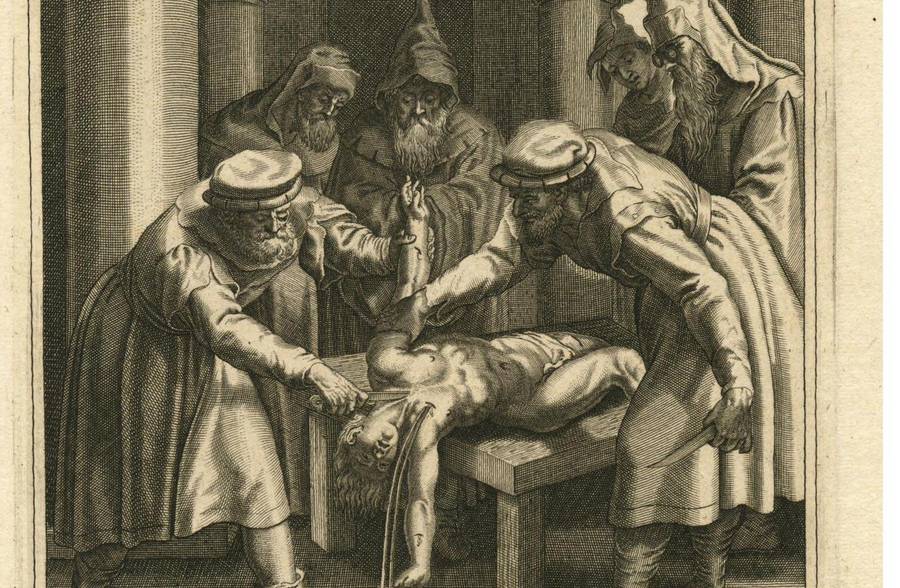
The accusation that founded the blood libel: a murdered English boy, the 1144 text claimed, had been seized by his Jewish neighbors and “fixed to a cross in mockery of the Lord's Passion.”
Thomas of Monmouth, The Life and Passion of William of Norwich, c. 1150 (trans. Miri Rubin, Penguin Classics): quoted as the charge, never as fact
Why this Chapter exists
How one false accusation links the medieval world to the modern one.
This Unit traces how antisemitism changed shape over time, from the religious teaching of the medieval Church, through the walls of the ghetto, to the forged conspiracy theories of the modern age. The blood libel sits in the middle of that story and connects its parts.
Three features make it worth studying closely. It is the bridge between the religious antisemitism of the Middle Ages and the racial, political antisemitism of the modern era. The wording shifts, but the core accusation stays the same. It is among the best-documented antisemitic myths in the historical record, from the first Norwich case through its spread across Europe, its repudiation by popes beginning in 1247, and its survival into our own time. And it is a clear case study in how a false claim, once it takes hold, can outlast even the authorities who later condemn it.
Misconceptions
What the historical record corrects.
Common misconceptions this Chapter addresses
The blood libel is the founding case of a fabricated antisemitic charge that would not die. Institutions condemned it again and again. It persisted anyway, century after century. The dedicated Misconceptions entries document both halves: the charge was made up, and it has returned in modern forms.
- "The blood libel had some basis in actual Jewish religious practice." see the dedicated entry →
- "The medieval blood libel was a popular belief without institutional Church opposition." see the dedicated entry →
What the accusation was
In plain terms.
The blood libel was the accusation that Jews murdered Christian children and used their blood in Jewish religious rituals. The killings were typically said to happen around the Christian Easter period, sometimes in mimicry of the Christian theological narrative of the crucifixion. The blood was most commonly said to go into the preparation of matzah, the flat unleavened bread eaten during Passover, the spring festival that usually falls near Easter. Every part of the accusation was false. Jewish law prohibits consuming blood, a prohibition rooted in the biblical dietary code and elaborated in later halakhic (Jewish religious) law. Jewish ritual practice uses no blood, not in Passover, not in any other ritual. And kosher slaughter (shechita) is designed to drain blood from meat before it can be eaten.
So the accusation fastened blood onto the one tradition whose law most strictly forbids it. Scholars of the libel return to that irony as one of its defining features. The standard scholarly treatments are Gavin Langmuir's Toward a Definition of Antisemitism (University of California Press, 1990) and Magda Teter's Blood Libel: On the Trail of an Antisemitic Myth (Harvard University Press, 2020). For the law itself, see a plain-language account from Conservative Judaism's The Observant Life, which quotes the biblical scholar Edward L. Greenstein calling the blood ban "the most basic eating rule in the Torah."
William of Norwich · 1144
The emergence.
The accusation took its specific form at Norwich, in eastern England, in 1144. A twelve-year-old apprentice tanner named William was found dead in Thorpe Wood, outside the town, on Holy Saturday, the day before Easter. Local Christians accused Norwich's Jews of killing him as part of a religious rite. The sheriff, John de Caineto, gave the Jewish community refuge in Norwich Castle, which protected them from immediate violence.
The development of the William of Norwich case into the foundational blood libel narrative came not from the original 1144 events but from the work of Thomas of Monmouth, a monk of the Norwich Cathedral priory writing to celebrate William as a saint. Thomas composed his Vita et Passio Sancti Willelmi Martyris Norwicensis ("The Life and Passion of Saint William the Martyr of Norwich") across about 1149–1173, beginning to write five years after the original events. Thomas's text articulated the specific accusation, in its developed form, that the Jewish community had carried out a ritual murder of William in mimicry of the Christian Passion narrative. The text became the template for subsequent blood libel narratives across the medieval period. Scholars caution, however, against treating Norwich as the sole point of origin. John M. McCulloh, writing in Speculum (1997), argues that word of William's supposed martyrdom had already reached southern Germany before Thomas completed his account, and that a separate accusation arose at Würzburg in 1147; other historians, among them Israel Yuval, trace antecedents to the massacres of Jews in the Rhineland, in western Germany, during the First Crusade in 1096 and to still earlier tales. On this view, Thomas did not invent the charge so much as give it its first fully articulated, widely copied form.
The scholarly literature on the emergence of the blood libel at Norwich is extensive. The principal references include E. M. Rose's The Murder of William of Norwich: The Origins of the Blood Libel in Medieval Europe (Oxford University Press, 2015) and the engagement in Magda Teter's Blood Libel (2020) cited above. The scholarly consensus is that the Norwich event was the starting point of the blood libel as a specific, named accusation. General anti-Jewish theological hostility was many centuries old; the specific story of ritual child murder is attested from 1144 onward, as a distinct phenomenon.
The medieval pattern
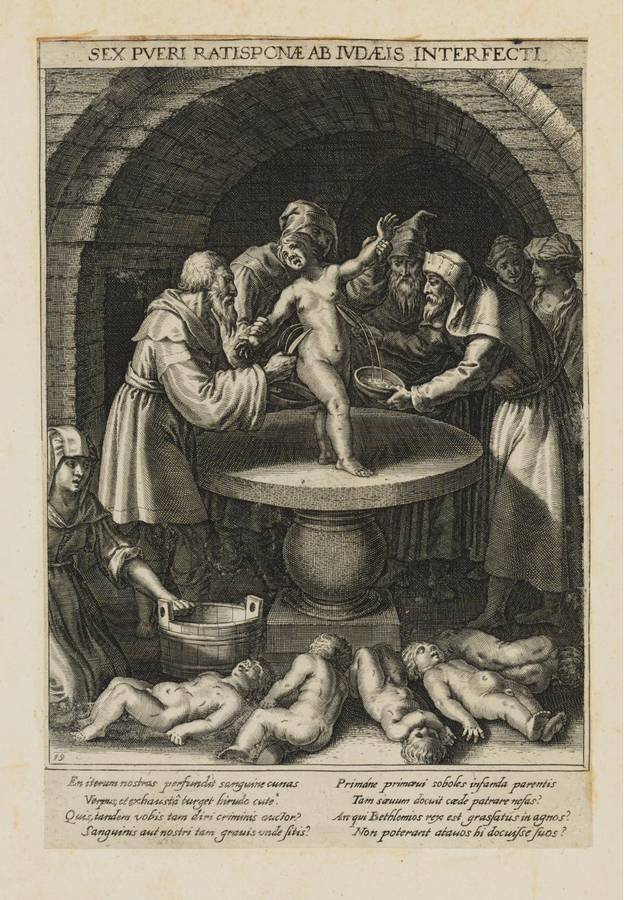
The spread across Christian Europe.
Across the late twelfth and thirteenth centuries, the blood libel accusation spread across Christian Europe. The cases came quickly:
- Gloucester (1168), Bury St. Edmunds (1181), and Bristol (1183): English cases in the immediate aftermath of the Norwich narrative's dissemination. English Jewish communities bore the brunt of these years.
- Blois (1171): the French case at Blois produced one of the most consequential medieval blood-libel-related massacres. Some thirty-one members of the Jewish community were burned at the stake under Christian authority following the accusation. The rabbinic literature preserves detailed records of the Blois events, including piyyutim (liturgical poems) composed by Rabbi Ephraim of Bonn and others.
- Pontoise (1179), Saragossa (1182), Fulda (1235): cases across the broader continental European Christian world.
- Lincoln (1255): "Little Saint Hugh": the English case at Lincoln in 1255 put royal power behind the accusation and fixed it in English culture for centuries. A nine-year-old boy named Hugh was found dead in a well; the Lincoln Jewish community was accused of ritual murder. Roughly nineteen Jewish men were executed by Henry III; the Lincoln events were celebrated in subsequent Christian culture (Geoffrey Chaucer's Prioress's Tale, c. 1390, refers to "Little Saint Hugh" in articulating the blood libel narrative). The shrine to "Little Saint Hugh" at Lincoln Cathedral was destroyed at the Reformation, but the site and the legend persisted, and in 1959 the cathedral placed a disclaiming plaque by the shrine's remains.
- Trent (1475): Simon of Trent: the Trent case is treated in its own section below; it drove the early-modern intensification of the blood libel.
The medieval pattern is traced across a large scholarly literature, including Joshua Trachtenberg's The Devil and the Jews (Yale University Press, 1943), Gavin Langmuir's Toward a Definition of Antisemitism (1990), R. Po-chia Hsia's The Myth of Ritual Murder (Yale University Press, 1988), and Miri Rubin's Gentile Tales (Yale University Press, 1999).
A related accusation · host desecration
The same logic, fitted to Christian theology.
The blood libel did not travel alone. Medieval Europe produced related accusations that ran on the same underlying logic, the fabricated charge that Jews secretly attacked Christians or what Christians held sacred, refitted to different circumstances. Seeing them beside the blood libel is the point: the family resemblance is what shows how durable the logic was, and how readily it adapted to whatever a given moment made plausible.
The host desecration accusation depended entirely on a specifically Christian belief. The Fourth Lateran Council of 1215 had formally defined the doctrine of transubstantiation, the teaching that in the Mass the consecrated host, the communion wafer, becomes the literal body of Christ. Once the wafer was understood to be Christ, a new accusation became possible: that Jews obtained consecrated hosts and stabbed, pierced, or burned them to attack Christ a second time, re-enacting the crucifixion.
The narratives followed a fixed script. A Jew was said to acquire a host by theft or bribery and to torture it; the host, miraculously, was said to bleed, cry out, or rise into the air, exposing the crime. The accused were executed, their communities often expelled, and a church or shrine was frequently raised on the site of the supposed miracle, drawing pilgrims for centuries. The best-documented cases include Paris (1290); Brussels (1370), whose alleged “Sacrament of Miracle” was commemorated in the stained glass of the city’s cathedral into the twentieth century; Passau (1478); and Sternberg (1492). The accusation generated its own visual culture: altarpieces and predella panels (Paolo Uccello’s Profanation of the Host, c. 1465–1469, is the famous example), reliquaries built to house the “surviving” hosts, and illuminated manuscripts. Miri Rubin’s Gentile Tales (Yale University Press, 1999) is the standard study.
The distinction to hold is exact. Host desecration was not the blood libel: it made no claim about children or about blood in Jewish ritual, and it depended on Catholic sacramental theology that the blood libel did not. But it operated through the identical mechanism, a fabricated accusation of a secret Jewish assault on the sacred, “proven” by miracle, punished by death, and preserved in devotion. The same logic; a different vehicle.
A related accusation · well poisoning
The same logic, fitted to a catastrophe.
Where host desecration fitted the accusation to a point of doctrine, the well-poisoning charge fitted it to a crisis. Between 1347 and 1351 the Black Death killed perhaps a third of Europe’s population. No one understood how the plague spread, and into that terror came an explanation and a target: the accusation that Jews had poisoned the wells and rivers to destroy Christendom.
The charge moved through a now-familiar machinery. “Confessions” were extracted under torture, most influentially at Chillon, in Savoy, in 1348, where the tortured testimony was copied and circulated to other towns as if it were proof. Massacres followed across the Rhineland and beyond: Strasbourg, where some two thousand Jews were burned on February 14, 1349; Basel, Mainz, Erfurt, Cologne, and dozens of smaller communities. In many towns the Jews were killed before the plague had even reached them, evidence that the accusation, not the disease, drove the violence. Samuel K. Cohn’s “The Black Death and the Burning of Jews” (Past & Present, 2007) traces the pattern.
As with the blood libel, the institutional Church condemned the charge: Pope Clement VI issued two bulls (formal papal decrees) in 1348 noting that Jews were dying of the plague alongside Christians and that it spread in places where no Jews lived. And as with the blood libel, the official repudiation did not stop the local massacres, the same gap between papal policy and local practice traced in the next section. The well-poisoning accusation shows the libel’s logic running on new fuel: the same fabricated charge of a secret Jewish assault, refitted from theology to epidemic. That adaptability, the same underlying claim refitting itself to Eucharistic doctrine in one generation and mass death in the next, is precisely what let this family of accusations survive every repudiation and resurface, in new forms, for centuries.
The Church repudiations
A record across eight centuries.
In the centuries since the blood libel emerged, the Catholic Church has issued a series of repudiations of the accusation. That record matters. It documents that the Church's official position, even during the medieval period, was more critical of the libel than the behavior of local Christian populations and some local clergy. The major repudiations:
- Pope Innocent IV · Lachrymabilem Judaeorum · July 1247. The papal bull issued at Lyon, addressed to the prelates of Germany, with a parallel text sent to France, that rejected the blood libel accusation. The Innocent IV bull articulated the position that the accusation was false, that Jewish religious practice did not require the use of Christian blood (citing the Jewish dietary law prohibition on blood consumption), and that the accusations were producing unjust persecution of Jewish communities. The bull was reissued by Pope Innocent IV in 1253 and by subsequent popes across the medieval period.
- Pope Gregory X · Sicut Judaeis renewal · October 7, 1272. A renewal of the standing bull of papal protection for Jews, issued at Orvieto and elaborating the position further. Gregory X's text decreed that "Christians need not be obeyed against Jews in a case or situation of this type," ordered Jews seized on the "silly pretext" freed, and required that Christian testimony against Jews be corroborated by a Jewish witness, sharply constraining the legal procedure under which blood libel accusations could be pursued. The Sicut Judaeis tradition was renewed by about twenty subsequent popes across the medieval period.
- Pope Martin V (1422), Pope Nicholas V (1447), Pope Sixtus IV (1475): additional medieval papal interventions, with varying degrees of force.
- Pope Benedict XIV · 1755. The record here is mixed. In Beatus Andreas (1755), Benedict XIV confirmed the local veneration of Andreas of Rinn, a child whose death had been blamed on Jews, while declining to canonize him, which left the ritual-murder story in that case standing. The most thorough Roman rejection came four years later, through the Ganganelli inquiry below, a Holy Office consultation approved by the congregation though never issued as a papal decree.
- Lorenzo Ganganelli · 1758–1759. The Ganganelli Report, approved by the Holy Office in December 1759, is treated in its own section below.
Why didn't these repeated repudiations end the accusations? Scholars have studied that question closely. Across the medieval period, a wide gap separated the papal position from the behavior of local Christian populations, local clergy, and local political authorities. The papal repudiations set the Catholic ceiling on the phenomenon. They could not suppress the local practice.
Simon of Trent · 1475
The early-modern intensification.
The Trent case of 1475 was consequential because it occurred at the moment when the Hebrew printing revolution (the first dated printed Hebrew book had appeared in February 1475 at Reggio di Calabria, recounted in the Rashi Chapter) and the Christian printing revolution were producing a sharp expansion in the distribution of texts. The result: the Trent case became the first blood libel narrative to be circulated across Christian Europe through print.
In Trent, an Alpine city then ruled by its own prince-bishop within the Holy Roman Empire, the German-centered empire of central Europe, in late March 1475, a two-year-old Christian boy named Simon was found dead in a cellar near the Jewish quarter. The Trent Jewish community was accused of ritual murder; some fifteen members of the community were tortured under judicial procedure and executed in consequence. The bishop of Trent, Johannes IV Hinderbach, promoted the cult of "Little Saint Simon", an organized Church devotion to the boy as a saint, as part of the theological response to the case.
Pope Sixtus IV intervened. The papal investigation under Sixtus IV's commission (the investigation by Battista de' Giudici, bishop of Ventimiglia and the pope's commissioner) concluded that the Trent proceedings had been deeply irregular and that the Trent community had been treated unjustly. The pope, however, did not adopt his own commissioner’s finding: the Sixtus IV bull Facit nos pietas (June 20, 1478) declared the Trent proceedings properly conducted, while restating the standing papal prohibition on the blood libel accusation and on harm to Jews. The gap between what the investigation found and what the bull said is itself part of the record. Yet Sixtus IV's position still permitted the local Trent cult of "Little Saint Simon" to continue at the local level, even as it rejected the broader validity of the case.
The consequence of the Trent case was far-reaching. The printed materials produced after the Trent events, including illustrated broadsheets, the reference in Hartmann Schedel's Nuremberg Chronicle (1493) circulating the blood libel narrative to a far broader audience than prior medieval narratives had reached, and the Latin and German-language printed materials, helped entrench the blood libel as an early-modern Christian phenomenon. The "Little Saint Simon" cult continued at the Trent local level until the Catholic Church formally suppressed it in 1965, in the immediate aftermath of Nostra Aetate.
Object Spotlight
The Trent woodcut, Nuremberg Chronicle, 1493.
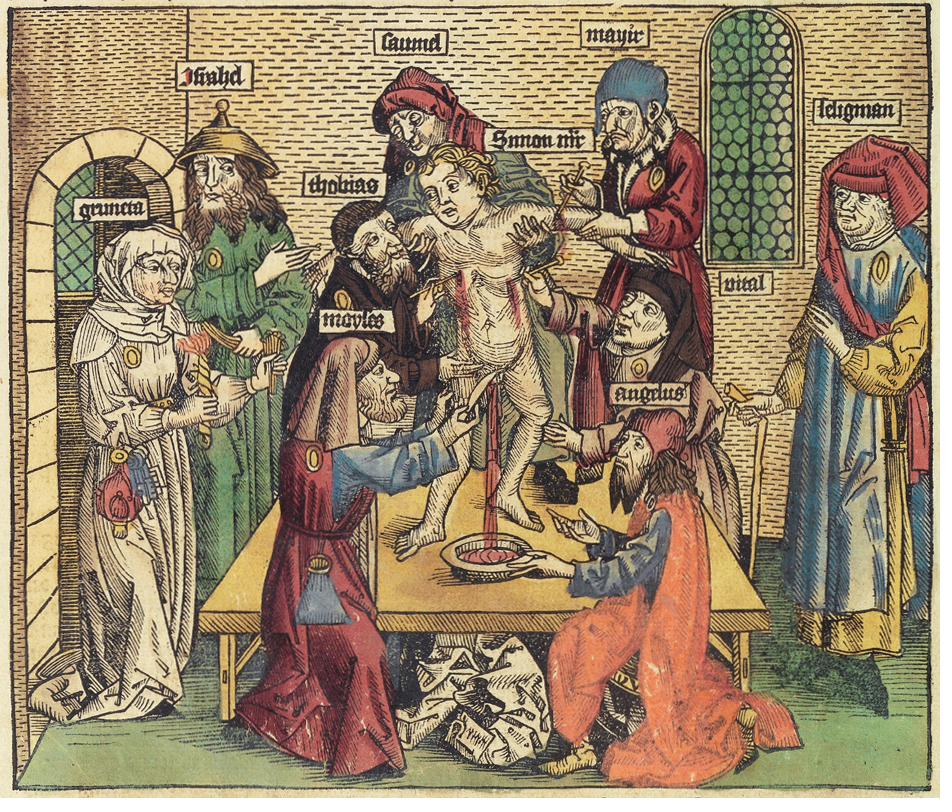
A small child lies in the center of the picture. Around him stand grown men in dark robes, leaning in, their hands busy at his body. Above each man, in careful lettering, is a name, Samuel, Tobias, Mayir, Seligman. The scene is crowded, deliberate, almost calm. It is drawn the way you would draw something that really happened, by someone who wants you to believe it did.
None of it happened. This is a woodcut, a picture carved into a block of wood, inked, and pressed onto a page so it can be printed again and again. It was made in 1493 for a giant illustrated history book called the Nuremberg Chronicle, by two of the most successful print-shop artists in Germany, Michael Wolgemut and Wilhelm Pleydenwurff. The scene it shows is the city of Trent, in the Alps, in 1475, where a Christian toddler named Simon had been found dead and the town's Jews were accused of killing him for his blood. There was no evidence. Roughly fifteen Jewish men were tortured until they "confessed," and they were burned at the stake in 1475 and 1476.
The little picture matters more than it looks. For three hundred years the blood libel had spread the slow way, one preacher telling one crowd, a story carried town to town by travelers. The woodcut changed the speed. Because it was carved into a block, the same image could be printed thousands of times, identical every time, and bound into a best-selling book that reached readers across Europe. The lie no longer needed a storyteller; it could travel on its own, in print, looking like settled fact.
One choice the artist made stands out: the names. He did not have to letter them. By writing "Samuel," "Tobias," "Mayir" over the figures, he turned a general rumor about "the Jews" into an accusation against specific, real people, the very men the court had already killed. A reader in another country, who would never meet anyone from Trent, now "knew" their names and their supposed crime. That is what made the image so effective and so cruel at once.
And it worked. The Trent case became the first blood libel to be carried across Christian Europe in print, and the local cult of "Little Saint Simon" drew pilgrims to Trent for centuries. Popes investigated and found the charge baseless; the broader Church repudiated the libel again and again. None of it caught up with the picture. The cult was only formally shut down by the Catholic Church in 1965, nearly five hundred years later, and only after the reckoning of Nostra Aetate. The woodcut holds the whole story in one page: a fabrication, dressed as sober record, naming real people as its villains, reproduced at scale, and far harder to kill than the truth that disproved it.
The decrees, trial records, and printed sources behind these accusations are gathered in the Museum, under Documents and primary papers, with the major archival holdings.
The Ganganelli Report · 1758–1759
The most thorough pre-modern Catholic investigation.
The Ganganelli Report is one of the most thorough pre-modern investigations of the blood libel. During the 1750s, a series of blood libel accusations had swept across Poland. The Polish-Jewish community appealed to the Vatican for protection. In 1758 the Sacred Congregation of the Holy Office, the Vatican office charged with guarding doctrine, took up the appeal: it assigned the cases to Lorenzo Ganganelli, then one of its consultors, created cardinal in 1759. Ganganelli would go on to become Pope Clement XIV in 1769.
Ganganelli's report, presented in 1758 and approved by the Holy Office in December 1759, set out a wide-ranging review of the historical record of blood libel accusations. The report is preserved in the Vatican archives. It lay unpublished for about 130 years; the first printings came in the late nineteenth century, and the standard English edition appeared in 1935. His findings:
- The review of past papal positions. Ganganelli examined the prior papal interventions (Innocent IV 1247, Gregory X 1272, the broader record) and confirmed that the Church's official position had been critical of the blood libel accusation across the centuries.
- The examination of the specific Polish cases. Ganganelli reviewed the specific Polish blood libel cases of the 1750s and concluded that the evidence for the accusations was insufficient.
- The acknowledgment of two contested cases. Ganganelli's report granted the two cases the Church had permitted cults for, Andreas of Rinn (1462) and Simon of Trent (1475), treating those deaths as real martyrdoms, and that concession is the report's central limitation, even as it rejected the accusation as a general phenomenon. The Ganganelli position on these two cases remained controversial in the subsequent scholarly literature; the Simon of Trent cult was suppressed in 1965, after Nostra Aetate; the Rinn cult’s feast was struck from the calendar in 1953, but veneration there was formally banned only in 1994, three decades after Nostra Aetate.
- The condemnation of contemporary accusations. Ganganelli's report concluded that the contemporary Polish blood libel accusations of the 1750s should be rejected and that papal intervention should be directed toward protecting the Polish Jewish community from further persecution.
The report stands as the major Catholic pre-modern examination of the blood libel. Scholars writing after Nostra Aetate cite it widely. The reason: it documents that the Catholic position was critical of the popular practice even before the twentieth-century reckoning. The contemporary edition is Cecil Roth's (The Ritual Murder Libel and the Jew: The Report by Cardinal Lorenzo Ganganelli (Pope Clement XIV), Woburn Press, 1935, with much later scholarship building on it).
Damascus Affair · 1840
The translation of the medieval accusation into the modern Western press.
For centuries the blood libel had stayed mostly inside local Christian European contexts. The Damascus Affair of 1840 carried the medieval accusation somewhere new: into the Western press and the consular-diplomatic record of the modern period. In February 1840, a Capuchin friar named Father Thomas and his Muslim servant disappeared in Damascus. The French consul in the city, Ulysse de Ratti-Menton, promoted the accusation that the Damascus Jewish community had ritually murdered Father Thomas. Several leading members of the community were tortured. Some of the accused died under interrogation, the number is disputed, one converted to Islam to stop the torture, and confessions were extracted from others.
The case drew international attention. Sir Moses Montefiore of the United Kingdom, Adolphe Crémieux of France, and Salomon Munk led a Jewish diplomatic mission to the Ottoman Sultan Abdulmejid I and to Muhammad Ali of Egypt (then the ruler of Damascus). The mission succeeded. On November 6, 1840, an Ottoman firman, a formal decree of the empire that then ruled Damascus, repudiated the blood libel accusation in formal Ottoman state terms. It declared the Jewish community innocent of a charge without foundation, and ordered them protected, calling the accusation, in the standard English rendering, a calumny.
Damascus was not alone. In the same months, on the Ottoman island of Rhodes, the Greek Orthodox community accused the island’s Jews of murdering a Christian boy who had gone missing. Jews were arrested and tortured, the Jewish quarter was blockaded for twelve days, and several European consuls initially backed the charge. The Ottoman central government investigated and established the community’s innocence in July 1840, and the November firman that closed the Damascus case spoke for Rhodes too: protection for the empire’s Jews as a whole. The accusation kept returning across the Ottoman East for the rest of the century, in ports and towns from the Aegean to Egypt, usually beginning inside local Christian communities and often with a European consul involved. The libel had reached the region from Europe, and it traveled with Europeans.
The Damascus Affair reached beyond its immediate resolution. For the first time, the blood libel accusation was widely covered in the liberal and conservative European press alike, which put it before the broader Western public. The response was sharply divided. Much of Western public opinion rejected the accusation; other parts retained the medieval framework. That divide kept Jewish attention fixed on a hard question: how to respond to a medieval accusation that persisted into the modern period. The answers shaped the development of the broader modern Jewish defense and civic organizations.
The reference scholarly work on the Damascus Affair is Jonathan Frankel's The Damascus Affair: "Ritual Murder," Politics, and the Jews in 1840 (Cambridge University Press, 1997).
The Beilis Trial · 1911–1913
The modern blood libel case.
The Beilis Trial in Kiev, from 1911 to 1913, was the most consequential modern blood libel case before the contemporary period. In March 1911, a thirteen-year-old Christian boy named Andrei Yushchinsky was found murdered in a cave near a brick factory in Kiev, in the Russian Empire. The Russian state accused Menahem Mendel Beilis, a Jewish clerk at the brick factory, of the ritual murder of Yushchinsky, for the Jewish religious purposes the medieval blood libel narrative had always attributed. Behind the charge stood political pressure aligned with the Black Hundreds, ultranationalist and violently antisemitic Russian movements, and the anti-Jewish climate of the late Russian Imperial period.
The trial itself, across 1913, was a major international event. The Russian Imperial state poured resources into the prosecution. The Jewish defense mobilized international support: Western European and American Jewish figures, liberal Russian figures, and much of the international press. The Russian state produced "expert" testimony from a Catholic priest, Justinas Pranaitis, who testified that the Jewish religious tradition required the ritual use of Christian blood. Under cross-examination, the defense dismantled that testimony.
On October 28, 1913, the verdict came in: Mendel Beilis was acquitted. The Russian Imperial jury, made up mostly of conservative non-Jewish Russian peasants and townspeople, cleared him of the specific charge of having killed Yushchinsky. But the verdict was split. The jury also affirmed the prosecution’s description of the crime scene, in terms that left the ritual-murder theory standing even as the specific defendant went free. The acquittal was a sweeping international vindication of the Jewish defense's case. The partial verdict, though, preserved the possibility of the broader accusation framework.
The Beilis Trial is the subject of a large historical literature. Key references include Robert Weinberg's Blood Libel in Late Imperial Russia: The Ritual Murder Trial of Mendel Beilis (Indiana University Press, 2014) and Edmund Levin's A Child of Christian Blood: Murder and Conspiracy in Tsarist Russia: The Beilis Blood Libel (Schocken, 2014). Beilis himself later emigrated to the United States. He published his memoir, The Story of My Sufferings, in Yiddish in 1925 and in English in 1926, and died in New York in 1934.
The twentieth century
The persistence into the modern period.
The blood libel accusation persisted into the twentieth century across multiple contexts. The major cases:
- Massena, New York · 1928. An American blood libel case. A four-year-old child went missing in the upstate New York town of Massena on September 22, 1928, days before Yom Kippur, the holiest day of the Jewish year. The local Christian community accused the Massena Jewish community of having abducted the child for ritual purposes. The New York state police questioned the local rabbi about Jewish religious practices. The child was found the following day, unharmed, having become lost in the woods. The case drew a strong response from the American Jewish community over the question of how the medieval blood libel accusation had appeared in twentieth-century America, and produced responses including formal apologies from the Massena civic leadership and a public response from the American Jewish Committee.
- Kielce, Poland · July 4, 1946. The post-Holocaust Kielce pogrom, an organized outbreak of mob violence against Jews, was precipitated by a blood libel accusation. An eight-year-old Christian boy named Henryk Błaszczyk had been missing for two days and returned home claiming the Kielce Jewish community had abducted him for ritual purposes. The result was a deadly Polish pogrom: roughly 42 Jewish survivors of the Holocaust who had returned to Kielce were killed in the violence; about 40 additional Jewish residents were wounded. The Kielce pogrom showed that the blood libel framework had survived the Holocaust, even within the Polish national context where most of pre-war European Jewish life had been destroyed.
- Damascus, retold by a state · 1983 and 2003. In 1983 Syria’s defense minister, Mustafa Tlass, published The Matzah of Zion, a book presenting the 1840 Damascus accusation as true. He remained in office for another two decades. In 2003 a Syrian-produced television series, Ash-Shatat, put the libel on screen, a Christian child murdered for his blood, and Hezbollah’s Al-Manar network broadcast it across the region during Ramadan, the Islamic holy month. Those broadcasts were a principal reason European regulators later forced the channel off European satellites. The medieval accusation, repudiated by the Church that produced it, had found state sponsorship elsewhere.
- Throughout the twentieth century: further cases across Eastern Europe, the Middle East, Latin America, and elsewhere, treated in the broader scholarship cited above.
Nostra Aetate and beyond
The postwar Catholic reckoning.
The postwar Catholic reckoning with the blood libel inheritance was far-reaching. The major moments:
- The Lincoln Cathedral plaque, 1959. The plaque installed at the site of the former shrine reads: "Trumped up stories of 'ritual murders' of Christian boys by Jewish communities were common throughout Europe during the Middle Ages and even much later. These fictions cost many innocent Jews their lives. Lincoln had its own legend and the alleged victim was buried in the Cathedral in the year 1255. Such stories do not redound to the credit of Christendom, and so we pray: 'Lord, forgive what we have been, amend what we are, and direct what we shall be.'"
- Nostra Aetate · October 28, 1965. Treated in the Nostra Aetate Chapter. The Catholic Church's repudiation of the deicide accusation, the charge that Jews collectively killed Jesus, and of the broader Adversus Judaeos ("against the Jews") teaching tradition reached the theological foundation of the blood libel accusation.
- The 1965 suppression of the "Little Saint Simon" cult at Trent. In the immediate aftermath of Nostra Aetate, the Catholic Church formally suppressed the Trent cult that had operated since 1475. The Bishop of Trent, Alessandro Maria Gottardi, declared the cult invalid and removed the Simon shrine.
- The 1985 Vatican Notes. The document Notes on the Correct Way to Present the Jews and Judaism in Preaching and Catechesis in the Roman Catholic Church elaborated the post-Nostra Aetate Catholic position on the broader anti-Jewish inheritance.
- The 1998 We Remember: A Reflection on the Shoah. The Vatican document addressing the Catholic Church's engagement with the Holocaust period, discussed in the Nostra Aetate Chapter.
- The 2015 The Gifts and the Calling of God Are Irrevocable. The Vatican document elaborating the contemporary Catholic position on the broader Catholic-Jewish relationship.
The contemporary persistence
The record into the present.
The blood libel accusation has not disappeared from the contemporary record. That record includes:
- The Anti-Defamation League (ADL) annual surveys: the documentation of blood libel-derived antisemitic content in contemporary media, social media, and political discourse across multiple geographic regions.
- The contemporary scholarly engagement: Magda Teter's Blood Libel: On the Trail of an Antisemitic Myth (Harvard University Press, 2020), winner of the National Jewish Book Award in History, is the contemporary scholarly synthesis. Teter's study traces the persistence of the blood libel accusation across the centuries, including its reappearance in contemporary forms, and the question of why such accusations have proven so resistant to repudiation.
- The contemporary political-discourse record: blood libel-derived political rhetoric across multiple regional contexts, tracked by ADL, by the European Union Agency for Fundamental Rights, and by the academic literature on contemporary antisemitism. The connection between the medieval accusation and contemporary conspiratorial political frameworks, including the QAnon family of conspiracy theories that appropriated blood-libel-derived narrative structures, is traced in that literature.
- The Holocaust education response: the inclusion of blood libel material in the Holocaust education programs of USHMM, Yad Vashem, Facing History and Ourselves, and the broader Holocaust education infrastructure as part of the documentation of the long evolution of antisemitism that produced the Holocaust era.
The record runs side by side. Eight centuries of Catholic Church repudiation. The Damascus Affair's exposure in the Western press. The Beilis verdict. The Nostra Aetate framework, and the postwar reckoning that followed it. The blood libel outlived them all, and it persists as a recognizable accusation in contemporary form. Why it persists is one of the central questions in the scholarly literature on antisemitism today.
Key takeaways
- The blood libel is a false accusation that Jews murdered Christian children for ritual purposes. It began at Norwich, England, in 1144.
- It had no basis in fact and was repudiated by medieval popes, yet it spread across Europe for centuries.
- The same accusation resurfaced in the modern era, Damascus (1840), the Beilis trial in Russia, and even in the United States at Massena, New York (1928).
- It endures as a case study in how a fabricated claim can survive repeated debunking across centuries and continents.
Discussion questions
Working from the evidence.
Grounded in the sourced record above.
- The 1144 Norwich text was written by a monk who arrived in the town years after the boy's death. What does it tell us that the earliest, most detailed version of the accusation comes from someone who was not there?
- The Trent woodcut letters a name above each accused figure. How does naming specific people change the way an accusation is received, compared with a general rumor?
- Cardinal Ganganelli's 1758 Vatican inquiry concluded the evidence for the charge was insufficient, yet the accusation persisted for centuries afterward; the report itself lay unpublished in the archives for about 130 years. What does the gap between what the Church’s own inquiry found and what kept happening on the ground reveal about how the libel survived?
- The accusation centered on the ritual use of blood, while Jewish dietary law contains some of the most extensive prohibitions on consuming blood of any religious tradition. Why might an accusation take the exact shape of what its target most strictly forbids?
- The same false accusation reappears at Norwich (1144), Trent (1475), Damascus (1840), Kiev (1911), and into the present. What makes a claim durable enough to cross eight centuries and many cultures, even after being repeatedly disproven?
Classroom Connections
Where this Chapter fits.
Teaching Connections
The disciplines and courses this Chapter naturally supports, for any educator, anywhere.
- Medieval European History: the blood libel as a documented medieval phenomenon, and how the Adversus Judaeos theological tradition translated into one specific accusation.
- Early-Modern History: Trent (1475) at the moment of the print revolution, which carried the medieval inheritance into the early-modern world.
- Modern European & Russian History: the Damascus Affair (1840) and the Beilis Trial (1911–1913) as modern recurrences of the medieval charge.
- Historical Thinking & Source Analysis: the blood-libel record (medieval sources, trial transcripts, modern scholarship) as primary-source material; and keeping the accusation, official institutional responses, and local actions distinct.
- Pairs with Adversus Judaeos and the Protocols: the theological tradition, the medieval-to-modern phenomenon, and the modern conspiratorial framework.
Standards Alignment
- NYS Global History & Geography: 9.6 (social and cultural conflict in medieval Europe: the blood libel as a documented medieval phenomenon).
- Common Core ELA-Literacy: RH.11–12.6 and RH.11–12.9 (source perspective and the integration of multiple complex sources).
Further Teaching Resources
- Fordham Internet History Sourcebook, original medieval documents on the persecution of Jews.
- USHMM · “Blood Libel”, the Holocaust Encyclopedia’s article on the accusation and its modern afterlife.
- ADL · explainer video, a short classroom introduction to the blood libel.
Sources and citations
Primary sources
A primary source is a record from the time. It was made by people who were there. Examples: letters, diaries, photos, decrees, trial records, and newspapers.
- Thomas of Monmouth. The Life and Passion of Saint William the Martyr of Norwich. c. 1149–1173. Critical edition: M. R. James and Augustus Jessopp, eds., Cambridge University Press, 1896. New edition: Miri Rubin, trans., Penguin Classics, 2014.
- Pope Innocent IV. Lachrymabilem Judaeorum. July 1247. Critical edition in Bullarium Romanum.
- Pope Gregory X. Sicut Judaeis renewal. October 7, 1272. Critical edition in Bullarium Romanum.
- The Trent ritual-murder trial, 1475: the records of the proceedings against the Jews of Trent following the death of Simon of Trent.
- The Ganganelli Report (Cardinal Lorenzo Ganganelli, later Pope Clement XIV), 1758: the papal inquiry that examined and rejected the ritual-murder charge. Edited edition: Cecil Roth, ed., The Ritual Murder Libel and the Jew. London: Woburn Press, 1935.
- The Beilis Trial, Kyiv, 1913: the proceedings in which Mendel Beilis was tried on a ritual-murder charge and acquitted.
- Beilis, Mendel. The Story of My Sufferings. New York: Mendel Beilis Publishing Co., 1926. (Memoir of the Beilis Trial defendant.)
- Firman of Sultan Abdülmecid I, November 6, 1840. The Ottoman edict issued after the Damascus Affair, declaring the blood libel a slander without truth.
Secondary sources
A secondary source was written later. It is a book or article by a historian who studied those records and explains what they mean.
- Teter, Magda. Blood Libel: On the Trail of an Antisemitic Myth. Cambridge, MA: Harvard University Press, 2020. (The standard contemporary scholarly synthesis; National Jewish Book Award for History.)
- Rose, E. M. The Murder of William of Norwich: The Origins of the Blood Libel in Medieval Europe. Oxford: Oxford University Press, 2015.
- McCulloh, John M. "Jewish Ritual Murder: William of Norwich, Thomas of Monmouth, and the Early Dissemination of the Myth." Speculum, vol. 72, no. 3 (July 1997), pp. 698–740. University of Chicago Press / Medieval Academy of America.
- Langmuir, Gavin I. Toward a Definition of Antisemitism. Berkeley: University of California Press, 1990.
- Langmuir, Gavin I. History, Religion, and Antisemitism. Berkeley: University of California Press, 1990.
- Drazen, Paul S. "Why Kosher Food Shouldn't Have Visible Blood" (adapted from The Observant Life: The Wisdom of Conservative Judaism for Contemporary Jews). Exploring Judaism / The Rabbinical Assembly. (On the biblical and halakhic prohibition against consuming blood; quotes the biblical scholar Edward L. Greenstein.) exploringjudaism.org
- Hsia, R. Po-chia. The Myth of Ritual Murder: Jews and Magic in Reformation Germany. New Haven: Yale University Press, 1988.
- Hsia, R. Po-chia. Trent 1475: Stories of a Ritual Murder Trial. New Haven: Yale University Press, 1992.
- Tartakoff, Paola. Conversion, Circumcision, and Ritual Murder in Medieval Europe. Philadelphia: University of Pennsylvania Press, 2020.
- Rubin, Miri. Gentile Tales: The Narrative Assault on Late Medieval Jews. New Haven: Yale University Press, 1999.
- Trachtenberg, Joshua. The Devil and the Jews: The Medieval Conception of the Jew and Its Relation to Modern Antisemitism. New Haven: Yale University Press, 1943.
- Frankel, Jonathan. The Damascus Affair: "Ritual Murder," Politics, and the Jews in 1840. Cambridge: Cambridge University Press, 1997.
- Weinberg, Robert. Blood Libel in Late Imperial Russia: The Ritual Murder Trial of Mendel Beilis. Bloomington: Indiana University Press, 2014.
- Levin, Edmund. A Child of Christian Blood: Murder and Conspiracy in Tsarist Russia: The Beilis Blood Libel. New York: Schocken, 2014.
- Dundes, Alan, ed. The Blood Libel Legend: A Casebook in Anti-Semitic Folklore. Madison: University of Wisconsin Press, 1991.
- Friedman, Saul S. The Incident at Massena: The Blood Libel in America. New York: Stein and Day, 1978.
- Gross, Jan T. Fear: Anti-Semitism in Poland after Auschwitz. New York: Random House, 2006. (On the Kielce pogrom and the postwar Polish antisemitism context.)
- Cohn, Samuel K., Jr. “The Black Death and the Burning of Jews.” Past & Present 196 (2007): 3–36.
Finding these documents: many primary sources are free online. Good places to start are the Fordham Internet Jewish History Sourcebook, Yale’s Avalon Project (law and diplomacy), German History in Documents, the collections of the US Holocaust Memorial Museum and Yad Vashem, the National Library of Israel, and Sefaria (for Jewish texts). Search the document’s name and date.
The early-modern European ghetto (born in Venice in 1516, dismantled three centuries later) its origin, its daily life, what it produced, and how it differs from the Nazi-era ghettos that took its name.
Comments?
Write to editor@makorproject.org.
Last updated: August 2026.