
Hannah Arendt
Some of the most contested words used to discuss mass violence and political responsibility run through Hannah Arendt’s work: “totalitarianism,” “the banality of evil,” “the right to have rights,” and “the human condition.”
Why this Chapter exists
The vocabulary we still use.
Arendt was one of a small number of postwar thinkers whose vocabulary became the common language for understanding totalitarian states, mass violence, and political responsibility, words now used across many academic fields and in ordinary public debate. This Chapter treats her as a historical figure, with the full complexity the record carries. That means the biography alongside the major books, the controversies, and the contested parts of the story: the Eichmann book, her relationship with Martin Heidegger, her uneasy relationship with Zionism, and the long argument over her work that continues today. She anchors the unit's treatment of memory and responsibility, because those were her own central questions.
Common misconceptions this Chapter addresses
Arendt's work on the Holocaust and on totalitarian institutions, especially The Origins of Totalitarianism (1951) and Eichmann in Jerusalem (1963), built frameworks the standard curriculum mostly skips.
- "Holocaust denial is a fringe academic position that mainstream scholarship debates." see the dedicated entry →
- "The Holocaust began in 1933 with the Nazi seizure of power." see the dedicated entry →
A child of German Jewish life
A child of German Jewish life.
Johanna "Hannah" Arendt was born on October 14, 1906, in Linden, a district of Hannover, Germany, to Paul and Martha Cohn Arendt. The family belonged to the educated German Jewish middle class of the late imperial period, Paul was an engineer at an electrical firm; Martha came from a Königsberg merchant family with strong cultural interests. They kept a Jewish identity without religious orthodoxy: well integrated into German culture, and openly Jewish at the same time.
The family moved to Königsberg, Martha's home city, in 1909 as Paul's illness worsened. He died there in 1913, when Hannah was about seven, and she grew up in the city. Königsberg in those years was a center of German cultural and academic life, the home of the philosopher Immanuel Kant, whose work would deeply shape Arendt's own, and home to a sizable Jewish community.
Arendt's schooling there, at the girls' secondary school, came with early, serious reading. Martha kept the household as a place of cultural and intellectual life, and Hannah read Goethe, Kant, and Kierkegaard young, with solid training in Greek and Latin.
The academic formation
The academic formation.
Arendt began university at Marburg in 1924, at seventeen. The faculty there included Martin Heidegger (1889–1976), whose philosophy courses she attended. Her relationship with Heidegger, both intellectual and personal, began at Marburg and would shape much of her later philosophy and a good deal of her personal life. It has its own section below.
She spent a semester at Freiburg studying with Edmund Husserl, then moved to Heidelberg, where she completed her doctoral dissertation under Karl Jaspers (1883–1969). Jaspers became her intellectual mentor and lifelong correspondent; their letters, exchanged over some forty years until his death in 1969 and published in 1992, are among the main sources for her intellectual development.
Her dissertation, The Concept of Love in Augustine, was finished in 1928 and published in 1929. The choice of Augustine, the same Church figure treated in the Adversus Judaeos Chapter, is striking, though she engaged him on the philosophy of love rather than on his theology about Jews. The idea she drew from it, amor mundi ("love of the world"), runs through her later political thought.
She earned her doctorate from Heidelberg, and in 1929 married Günther Stern, a philosopher and writer of Berlin Jewish background. The marriage lasted about seven years; they divorced in 1937, and in 1940 she married Heinrich Blücher.
The Gestapo arrest and escape
The Gestapo arrest and the escape.
The Nazi takeover on January 30, 1933 broke Arendt's life apart. For the German Jewish academic world the consequences came fast: dismissals from university posts that spring, accelerating emigration, the start of the twelve-year machinery of Nazi anti-Jewish policy.
Arendt's response was to set aside the academic philosophy she had been doing and turn to Jewish politics. Working with the German Zionist Organization (Zionism: the movement to build a Jewish homeland in Palestine), under its leader Kurt Blumenfeld, she began collecting evidence of antisemitic statements and acts in Germany for use against the Nazis. The work put her under Gestapo surveillance.
In the spring of 1933 the Gestapo, the Nazi secret police, arrested her, along with her mother. The interrogation lasted about eight days. They were released without charge, but with it clear that the kind of research she had been doing could not continue. So she left Germany, crossing into Czechoslovakia, passing through Geneva (where she did work for the World Zionist Organization), and reaching Paris by late 1933. The exile had begun. She would never live in Germany again.
The refugee years in Paris
The refugee years in Paris.
In Paris, Arendt became a working figure in Jewish refugee politics rather than an academic philosopher. The main threads:
- Youth Aliyah. From 1935 to 1939 she worked for Youth Aliyah, the organization founded by Recha Freier and directed by Henrietta Szold from Jerusalem, which arranged the emigration of Jewish children from Nazi-controlled lands to Palestine. Arendt's Paris office ran the French side of the work, helping bring thousands of children out before the war.
- Walter Benjamin. The Paris years brought her close friendship with the German Jewish philosopher and critic Walter Benjamin (1892–1940). Benjamin's suicide at Portbou, on the French-Spanish border, on September 26, 1940, facing arrest after Spain refused to let him pass toward Lisbon and America, hit her hard. She carried his manuscript of the Theses on the Philosophy of History to America, and her 1968 essay on him became a foundation for later Benjamin scholarship.
- Marriage to Heinrich Blücher. In January 1940 she married Heinrich Blücher (1899–1970), a German former communist turned political thinker who had fled Germany. Their marriage lasted until his death in 1970, and their constant conversation across thirty years shaped much of her thinking.
- Internment at Gurs. When Germany invaded France in May 1940, the French Republic classified Arendt, like many German Jewish refugees, as an enemy alien and interned her at the Gurs camp in southwestern France. She escaped in the chaos right after the June 1940 armistice, the surrender that ended the fighting, reunited with Blücher and her mother, and obtained the emergency U.S. visas (helped by Varian Fry and the Emergency Rescue Committee) that brought the family to the United States in May 1941.
The American career
The American career.
Arendt reached New York in May 1941, at thirty-four. The American period lasted thirty-four years and produced the body of work that shaped later political thought. Its main features:
- Early work. Her first American years were spent in Jewish organizations: research director at the Conference on Jewish Relations, editor at Schocken Books (the German Jewish publisher reestablished in New York), and research director of the Jewish Cultural Reconstruction Commission, which recovered and redistributed Jewish cultural and religious property taken by the Nazis.
- Academic posts. After The Origins of Totalitarianism appeared in 1951, she moved into major academic positions: at Princeton (where in 1959 she became the first woman to hold the rank of full professor, as a visiting professor of politics), at Berkeley, at the University of Chicago, and from 1967 at the New School for Social Research in New York, where she stayed until her death.
- Citizenship. Arendt became a U.S. citizen at the start of the 1950s, ending the statelessness that had begun when Germany stripped her citizenship in 1937. That experience shaped her thinking about "the right to have rights."
- Books. The American period produced her major works: The Origins of Totalitarianism (1951), The Human Condition (1958), Eichmann in Jerusalem (1963), On Revolution (1963), Men in Dark Times (1968), On Violence (1970), Crises of the Republic (1972), and the unfinished Life of the Mind (published after her death in 1978).
Her first major work
The Origins of Totalitarianism.
The Origins of Totalitarianism (1951) was Arendt's first major book and the one that established her as a leading American intellectual. It comes in three parts:
- Antisemitism. A study of how modern antisemitism developed across the nineteenth and early twentieth centuries. Arendt set the modern racial form apart from the older theological tradition, placing its rise within the political and economic life of nineteenth-century Europe.
- Imperialism. An argument that the European imperial project of the late nineteenth century laid the ground for twentieth-century totalitarianism, that the administrative habits, racial thinking, and methods of mass rule developed in the colonies were carried back into European politics during the crises of the First World War and after.
- Totalitarianism. A study of Nazi Germany and Stalinist Russia as a single new political form, marked by total control of the population, the destruction of private life, terror as a permanent tool of government, and the replacement of political reality with ideology. The claim that Nazism and Stalinism were comparable as totalitarian regimes, controversial when she made it, became a foundational idea in Cold War political thought.
The book was widely engaged in the major American journals, and the category of "totalitarianism", still argued over in the specifics of both regimes, entered the standard vocabulary of postwar political analysis. Its idea of "the right to have rights," drawn from the refugee experience Arendt had lived, has been influential in later human rights thinking. Her argument: when the European nation-state system collapsed in the early twentieth century, it left whole populations stripped of citizenship and therefore of any standing from which to claim rights at all, so the right to belong to a political community must itself be treated as a right.
Her work on the political
The Human Condition.
The Human Condition (1958) is Arendt's major philosophical work, a sustained look at what makes a distinctively human life possible. It is built around three kinds of activity she distinguished:
- Labor: the activity that keeps us biologically alive, producing what gets consumed in the act of living.
- Work: the activity that builds the durable world, the objects and structures that outlast their makers and form the human environment.
- Action: the activity through which people engage one another politically, the speech and deed by which we appear to each other as distinct persons. Arendt looked to the ancient Greek polis as the model for the space where action happens.
Her argument is that modern society has blurred these three together, with real costs: labor has become the organizing category (in both capitalist and Marxist forms), work has shrunk to industrial production, and political action has been displaced by administrative management, shrinking the human capacity for the political life she valued most. The Human Condition is her most-cited book today, influential across political theory, philosophy, and sociology, and far less controversial than the Origins or the Eichmann book.
The most contested book
Eichmann in Jerusalem.
Eichmann in Jerusalem: A Report on the Banality of Evil (1963) is Arendt's most controversial book and the one that has most shaped how she is received. The background: Adolf Eichmann, an officer of the SS, the Nazi Party’s elite corps, who had coordinated the deportation of Jewish populations to the killing centers, was captured by Israeli intelligence in Buenos Aires in May 1960, brought to Israel, and tried from April to August 1961 for crimes against the Jewish people, crimes against humanity, and war crimes. The verdict came in December 1961; he was sentenced to death and hanged on May 31, 1962.
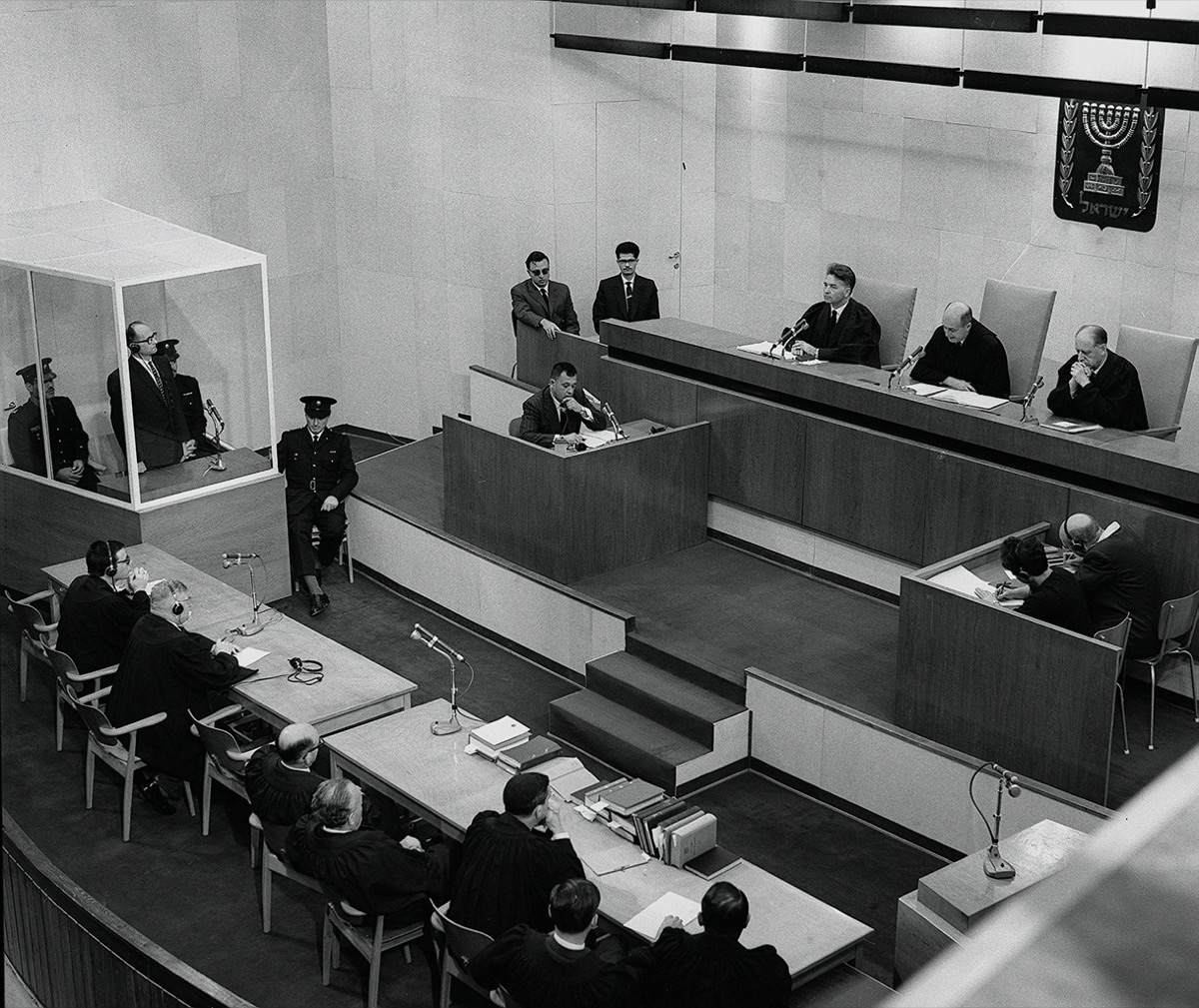
Arendt covered the trial for The New Yorker, on assignment from its editor William Shawn. Her reports ran in five installments in February and March 1963, then as a book that May.
The book's central argument is in its subtitle, "A Report on the Banality of Evil." Watching Eichmann at the trial, Arendt argued that the man she saw was not a monstrous fanatic but a bureaucratic functionary, someone who had carried out genocide through administrative routine, who showed what she called "thoughtlessness" rather than fierce ideological hatred, and whose capacity for it came from a collapse of moral and political judgment rather than from sadistic intent. Her larger point was that the Holocaust was possible because ordinary functionaries suspended their judgment in favor of compliance.
The book also made two secondary arguments that became controversies of their own:
- The Israeli trial. She raised questions about the legal framework, Israel's jurisdiction over crimes committed before the state existed, and its trial procedures.
- The Jewish Councils. She argued that the cooperation of the Jewish Council leadership (the Judenräte) with the Nazi deportation system had aided the genocide more than other responses might have. This was deeply controversial, both as a historical claim about what alternatives those leaders actually had under Nazi coercion, and in its tone, over whether she fairly reckoned with the impossible position they were in.
The controversy that followed
The controversy that followed.
The response to the Eichmann book was large and, within much of the Jewish community, sharply negative. Its main parts:
- The Scholem exchange. Gershom Scholem (1897–1982), the great scholar of Jewish mysticism, wrote to Arendt on June 23, 1963 with a serious critique: that her book showed too little "love of the Jewish people" (Ahavat Yisrael) and that her treatment of the Judenräte was unjust. Arendt's reply of July 24, 1963, among the most-cited documents in the whole controversy, held that she did not "love" peoples or collectives in general, that her love was for individuals, and that she was Jewish without grounding her judgments in collective loyalty.
- The critics. Much of the Jewish community, including the Anti-Defamation League, parts of the American Jewish establishment, the Israeli intellectual world, and figures such as Lionel Abel, Norman Podhoretz, Marie Syrkin, and Jacob Robinson, responded with strong criticism. Robinson's book And the Crooked Shall Be Made Straight (1965) was the most detailed point-by-point rebuttal of her factual claims.
- The defenders. She also had defenders, Mary McCarthy, Karl Jaspers, Alfred Kazin, Dwight Macdonald, Hans Morgenthau, who argued that her thesis about the banality of evil held even where particular claims in the book were disputed.
- The scholarship since. Over six decades, scholars have kept engaging both the argument and the criticism. The picture is mixed. Her thesis about administrative, functionary participation in genocide has been influential in later Holocaust scholarship (Christopher Browning's Ordinary Men, 1992, is part of that line), while her specific picture of Eichmann himself has been revised: Bettina Stangneth's Eichmann Before Jerusalem (2014) showed, from his Argentine-period writings, that his courtroom self-presentation as a mere bureaucrat badly understated his ideological commitment. The Judenräte question has likewise been reexamined in later scholarship, including Isaiah Trunk's Judenrat (1972) and the work of Yehuda Bauer.
The effect has been lasting. Her thesis is one of the most-cited single ideas in the twentieth-century reckoning with mass violence; her standing within the Jewish community has stayed divided; and how to read the book remains contested. They are set out below, without choosing among them.
The final years
The final years.
Arendt's later books were completed between 1963 and 1975:
- On Revolution (1963): a comparison of the American and French Revolutions as the founding moments of two different political traditions. Her argument that the American Revolution succeeded in establishing freedom while the French subordinated freedom to the problem of poverty has been influential in American political thought.
- Men in Dark Times (1968): essays on twentieth-century figures including Jaspers, Rosa Luxemburg, Walter Benjamin, Pope John XXIII, and Bertolt Brecht. The Benjamin essay is foundational for later scholarship on him.
- On Violence (1970): a study of violence as a political category, which she argued was distinct from power rather than identical to it.
- Crises of the Republic (1972): essays on American politics of the moment: the Pentagon Papers, civil disobedience, the late 1960s.
- The Life of the Mind (1978, posthumous): her unfinished return to philosophy, planned in three volumes on "Thinking," "Willing," and "Judging." The first two were mostly done; the third was unwritten at her death. The published edition, edited by Mary McCarthy, includes the first two and notes for the third.
Arendt died of heart failure at her New York apartment on December 4, 1975, at sixty-nine. The page in her typewriter at her death, the opening of the "Judging" volume, has been much remarked on since. She is buried at Bard College, where Heinrich Blücher had taught, beside him.
The Heidegger question
The Heidegger question.
Arendt's relationship with Martin Heidegger is among the most complicated parts of her record. Its dimensions:
- Marburg (1924–1926). Arendt entered an intimate relationship with Heidegger at Marburg, beginning when she was about eighteen and he was thirty-five, married, and the rising star of German philosophy. The relationship, documented in their later-published correspondence (1998), lasted about four years and shaped much of her intellectual development.
- The break and the Nazi years. The relationship broke off in the late 1920s, and the break was sharpened by Heidegger's joining the Nazi Party on May 1, 1933 and his appointment as Rector of the University of Freiburg that April. His Nazi engagement, his 1933 Rectoral Address celebrating the Nazi takeover, the university's forced alignment with the regime under his rectorate, his denunciations of colleagues, the dedication to his teacher Edmund Husserl that he later removed from Being and Time, and the broader record documented by scholars and in his posthumously published Black Notebooks (which contain antisemitic passages), are well established.
- The postwar reconnection. Arendt and Heidegger reconnected in February 1950, when she visited him at Freiburg during her work with the Jewish Cultural Reconstruction Commission. The renewed relationship, no longer romantic but real in intellectual and personal terms, lasted the next twenty-five years, until his death in 1976, six months after her own. She engaged his philosophy seriously in the postwar years and supported the rehabilitation of his academic standing.
- The contested question. How to read her postwar engagement with Heidegger, given his Nazi record, is contested. Some see it as consistent with her own view that philosophical work can be separated from political conduct; others see it as a serious ethical failure on her part. The question remains open.
The Heidegger relationship is recorded honestly as part of the historical record. This Chapter does not rule on whether her postwar engagement was justified or wrong; the scholarship is divided, and this Chapter preserves that division rather than resolving it.
The honest accounting
The honest accounting.
Beyond the Eichmann book and the Heidegger relationship, several parts of the Arendt record remain contested:
- The ambivalence about Zionism. Arendt's relationship to Zionism was complicated throughout her life. Her work in 1933 for the German Zionist Organization, and from 1935 to 1939 for Youth Aliyah, put her at the operational center of Zionist refugee work. Her 1940s essays (collected in The Jewish Writings, 2007) argued for binationalism, one state shared by Jews and Arabs, the position associated with the thinkers Martin Buber and Judah Magnes, distinct from the Labor Zionist mainstream that led the founding of the state, and her later engagement with Israel was critical from that binationalist standpoint. How to read this, neither mainstream Labor Zionist nor an opponent of Jewish national life, is contested in the scholarship.
- Jewish identity. Her sense of her own Jewishness was complex. Her rule, as she put it in a 1964 television interview, was that if one is attacked as a Jew, one must defend oneself as a Jew. But her later writing described a Jewishness mostly separate from religious practice, ethnic-national identification, and collective loyalty. What her Jewishness amounted to, and whether her work should be read as Jewish thought, German philosophy, American political theory, or some blend, is debated.
- The scholarly reception. Scholars themselves are divided, between those who regard her as the most important political theorist of the twentieth century and those who see her work as seriously flawed in its handling of specific historical material. The debate is recorded here without being settled.
The continuing engagement
The continuing engagement.
Arendt's work has been engaged steadily in the half-century since her death:
- The Hannah Arendt Center at Bard College, founded in 2006 at the campus where she and Blücher are buried, holds annual conferences and maintains the Arendt Library.
- The Hannah Arendt Centre at the University of Oldenburg, the home of Arendt scholarship in Germany, holding the working copies of her papers.
- The Arendt Papers, held at the Library of Congress, and digitized for research access.
- The scholarship. The standard biography is Elisabeth Young-Bruehl's Hannah Arendt: For Love of the World (1982, revised 2004); Samantha Rose Hill's Hannah Arendt (2021) is a recent study. Thematic work includes Richard Bernstein, Dana Villa, Margaret Canovan, Seyla Benhabib, and George Kateb. The published correspondences, with Jaspers, Heidegger, McCarthy, and Scholem, have widened the primary-source base.
- The cultural reception. Her reach extends past the academy. The 2012 film Hannah Arendt (directed by Margarethe von Trotta, with Barbara Sukowa) brought the Eichmann controversy to a wider audience, and "the banality of evil" and "the right to have rights" are now common in journalism and public debate.
She was stateless for fourteen years, hunted out of two countries, and she answered with the driest weapon there is: thinking in public. The categories she built from her own displacement, the right to have rights, the machinery of totalitarianism, the ordinary man inside the crime, are now standard equipment for understanding the century that tried to erase her. The refugee became the reference.
Key takeaways
The record in brief.
- Hannah Arendt (1906–1975) was arrested by the Gestapo in 1933, fled Germany, spent stateless refugee years in Paris, and reached New York in 1941.
- The Origins of Totalitarianism (1951) treated Nazism and Stalinism as a new form of rule and gave the postwar world its working concept of totalitarianism.
- The Human Condition (1958) distinguished labor, work, and action. It is her most cited and least controversial book.
- Reporting the Eichmann trial for The New Yorker, she argued the man in the glass booth was an ordinary functionary rather than a monster. “The banality of evil” became the most argued-about phrase of the postwar era.
- The book set off a fierce controversy, above all over her treatment of the Jewish Councils. The argument has never fully closed.
- Her relationship with Martin Heidegger, who joined the Nazi Party, remains the hardest question in her biography.
- Her vocabulary, totalitarianism, statelessness, “the right to have rights,” still frames how mass violence is discussed.
Object Spotlight
The glass booth.
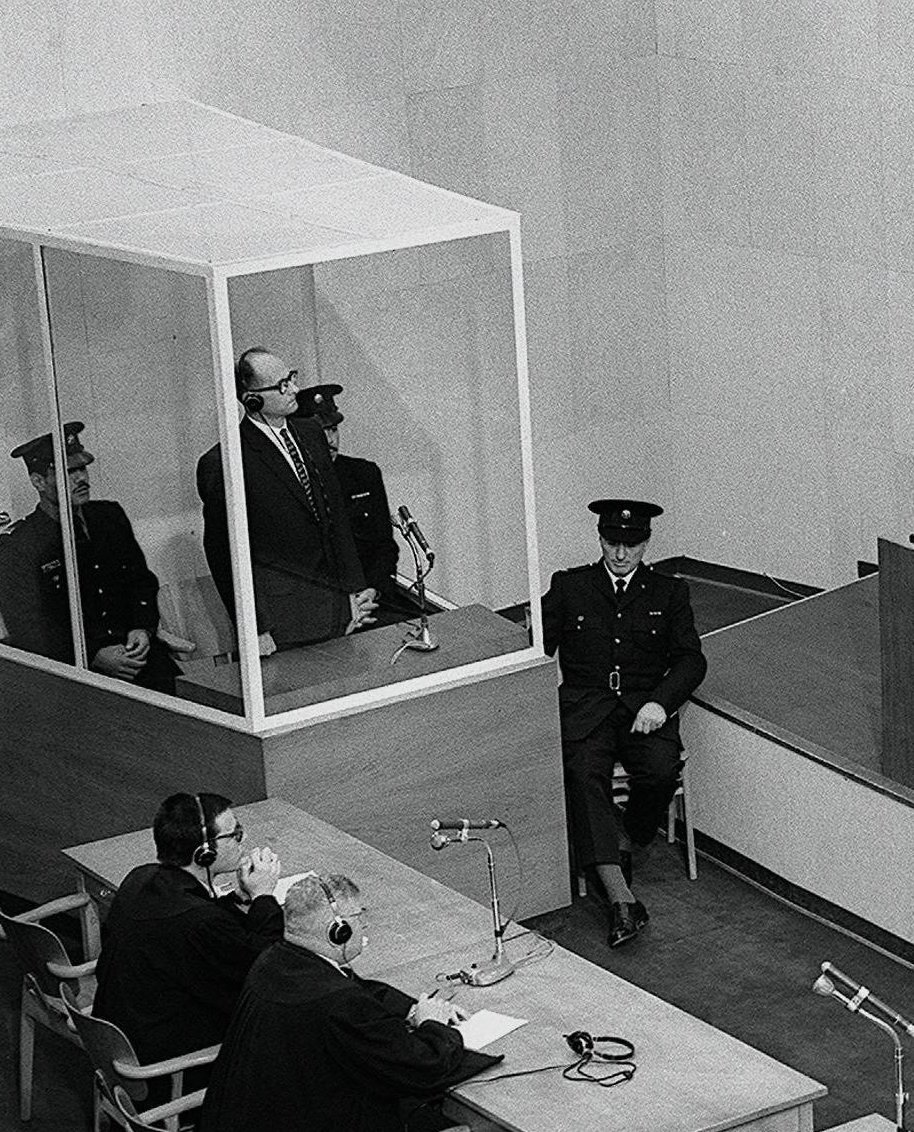
The most famous object of the trial was built in a hurry, for one man. It was a booth of bulletproof glass on a dark metal frame, set at the left of the stage at Beit Ha’am, the Jerusalem hall converted into a courtroom. Israel had brought Eichmann from Argentina to stand trial, and it intended the trial to finish. The glass was there to make sure no one could kill him before the court had judged him.
Inside it he sat for four months with headphones on. The trial ran in Hebrew, a language he did not speak. The headphones carried the interpreters to him in German, and his answers went back out through the microphone. A few meters away, more than a hundred witnesses testified. Cameras recorded it all, and the trial became the first to be televised around the world.
Hannah Arendt sat in the press section, watching the man in the glass. What she believed she saw there, an ordinary careerist rather than a monster, became the most argued-about phrase of the postwar era.
The booth outlived its trial. It was preserved after the execution, and in recent decades it has traveled to museum exhibitions in the United States and back. Today it stands, empty, in the Ghetto Fighters’ House Museum in Israel’s Western Galilee, a museum founded in 1949 by Holocaust survivors, among them veterans of the ghetto uprisings. The glass built to keep one man alive is kept now by survivors of the system he helped run.
Discussion questions
Working from the evidence.
Each question is anchored in something this Chapter documents. Students should answer from the evidence on the page.
- Arendt wrote that the stateless lose “the right to have rights.” Drawing on her own fourteen years without a country, explain what she meant, and why citizenship sits at the center of her thought.
- “The banality of evil” became one of the most argued-over phrases of the twentieth century. From this Chapter’s account, what exactly did Arendt claim about Eichmann, and what did her critics say she got wrong?
- The controversy over Eichmann in Jerusalem cost Arendt friendships and standing, and she did not retract. What was at stake for her in holding the argument, and what was at stake for the survivors and scholars who answered her?
- Arendt’s relationship with Heidegger, a philosopher who joined the Nazi Party, is part of her documented record. Does that history change how her work should be read? Argue from the evidence, not from instinct.
- This Chapter and The Postwar Trials both treat the Eichmann trial, one from inside the courtroom, one through its most famous observer. What does each see that the other misses?
- The page in her typewriter at her death was the opening of “Judging.” Based on her life as this Chapter tells it, why might the human capacity to judge have been her final subject?
Classroom Connections
Where this Chapter fits.
Teaching Connections
The disciplines and courses this Chapter naturally supports, for any educator, anywhere.
- World History. This Chapter supports study of the postwar world by examining how one major political thinker interpreted totalitarianism, statelessness, mass violence, responsibility, and the legal and moral aftermath of the Holocaust.
- Classroom Applications. Students can:
- analyze how historical concepts are created and contested;
- compare Arendt’s interpretation of Eichmann with later scholarship (e.g., Bettina Stangneth);
- evaluate the criticism of Arendt’s treatment of the Jewish Councils;
- examine the relationship between biography and interpretation;
- distinguish a thinker’s argument from the historical record itself;
- construct evidence-based arguments using primary and secondary sources.
- International Classroom Relevance. Because this Chapter examines totalitarianism, refugee experience, statelessness, political theory, Holocaust interpretation, and the Eichmann trial, it supports Holocaust education, political thought, human rights education, philosophy, civics, and source-based historical inquiry.
Standards Alignment
- NYS Social Studies Framework: NY Global History 10.10 (Human Rights, Genocide, and the Postwar World).
- NYS Holocaust Education Mandate, Education Law §801. Supports Holocaust instruction by examining the postwar interpretation of the Holocaust, the Eichmann trial, perpetrator accountability, and the continuing scholarly debate over responsibility under totalitarian rule.
- Common Core RH.11–12.6 & RH.11–12.9. Students analyze philosophical writing, trial reporting, correspondence, criticism, biography, and historical scholarship while evaluating point of view, authorial purpose, competing interpretations, and source-based argument.
- C3 Framework, D2.His.1 & D2.His.14. Students investigate historical context, continuity and change, historical interpretation, and evidence-based inquiry while examining how later thinkers interpreted the meaning of totalitarianism and mass violence.
For further classroom use
- Comparative biography. Arendt pairs well with other twentieth-century figures whose work shaped the reckoning with mass violence, Primo Levi, Elie Wiesel, Viktor Frankl, Simon Wiesenthal.
- Unit 6 anchor. This Chapter sits within the Memory, Responsibility, and Today unit alongside the Nostra Aetate and Adversus Judaeos Chapters, together covering the postwar reckoning with the events of the Holocaust era.
Learn more · take this further
Verified resources from outside organizations for teachers and students.
Sources
Primary sources
A primary source is a record from the time. It was made by people who were there. Examples: letters, diaries, photos, decrees, trial records, and newspapers.
- Arendt, Hannah. The Origins of Totalitarianism. New York: Harcourt Brace, 1951; rev. ed. 1973.
- Arendt, Hannah. The Human Condition. Chicago: University of Chicago Press, 1958; 2nd ed. 1998.
- Arendt, Hannah. Eichmann in Jerusalem: A Report on the Banality of Evil. New York: Viking Press, 1963; rev. ed. Penguin, 2006.
- Arendt, Hannah. On Revolution. New York: Viking Press, 1963.
- Arendt, Hannah. Men in Dark Times. New York: Harcourt Brace, 1968.
- Arendt, Hannah. On Violence. New York: Harcourt Brace, 1970.
- Arendt, Hannah. Crises of the Republic. New York: Harcourt Brace, 1972.
- Arendt, Hannah. The Life of the Mind. Edited by Mary McCarthy. 2 vols. New York: Harcourt Brace, 1978.
- Arendt, Hannah. The Jewish Writings. Edited by Jerome Kohn and Ron H. Feldman. New York: Schocken, 2007.
- Arendt, Hannah, and Karl Jaspers. Correspondence, 1926–1969. Edited by Lotte Köhler and Hans Saner. New York: Harcourt Brace, 1992.
- Arendt, Hannah, and Martin Heidegger. Letters, 1925–1975. Edited by Ursula Ludz. Orlando: Harcourt, 2004.
- Arendt, Hannah, and Mary McCarthy. Between Friends: The Correspondence of Hannah Arendt and Mary McCarthy, 1949–1975. Edited by Carol Brightman. New York: Harcourt Brace, 1995.
- Arendt, Hannah, and Gershom Scholem. The Correspondence of Hannah Arendt and Gershom Scholem. Edited by Marie Luise Knott. Chicago: University of Chicago Press, 2017.
- The Hannah Arendt Papers at the Library of Congress · loc.gov →
Secondary sources
A secondary source was written later. It is a book or article by a historian who studied those records and explains what they mean.
- Young-Bruehl, Elisabeth. Hannah Arendt: For Love of the World. New Haven: Yale University Press, 1982; 2nd ed. 2004.
- Hill, Samantha Rose. Hannah Arendt. London: Reaktion Books, 2021.
- Bernstein, Richard J. Hannah Arendt and the Jewish Question. Cambridge, MA: MIT Press, 1996.
- Villa, Dana. Politics, Philosophy, Terror: Essays on the Thought of Hannah Arendt. Princeton: Princeton University Press, 1999.
- Villa, Dana, ed. The Cambridge Companion to Hannah Arendt. Cambridge: Cambridge University Press, 2000.
- Canovan, Margaret. Hannah Arendt: A Reinterpretation of Her Political Thought. Cambridge: Cambridge University Press, 1992.
- Benhabib, Seyla. The Reluctant Modernism of Hannah Arendt. Lanham: Rowman & Littlefield, rev. ed. 2003.
- Kateb, George. Hannah Arendt: Politics, Conscience, Evil. Totowa, NJ: Rowman & Allanheld, 1984.
- Stangneth, Bettina. Eichmann Before Jerusalem: The Unexamined Life of a Mass Murderer. New York: Knopf, 2014.
- Browning, Christopher R. Ordinary Men: Reserve Police Battalion 101 and the Final Solution in Poland. New York: HarperCollins, 1992.
- Trunk, Isaiah. Judenrat: The Jewish Councils in Eastern Europe under Nazi Occupation. New York: Macmillan, 1972.
- Robinson, Jacob. And the Crooked Shall Be Made Straight: The Eichmann Trial, the Jewish Catastrophe, and Hannah Arendt's Narrative. New York: Macmillan, 1965.
- Ott, Hugo. Martin Heidegger: A Political Life. New York: Basic Books, 1993.
- The Hannah Arendt Center for Politics and the Humanities at Bard College · hac.bard.edu →
Finding these documents: many primary sources are free online. Good places to start are the Fordham Internet Jewish History Sourcebook, Yale’s Avalon Project (law and diplomacy), German History in Documents, the collections of the US Holocaust Memorial Museum and Yad Vashem, the National Library of Israel, and Sefaria (for Jewish texts). Search the document’s name and date.
The postwar restitution architecture, from Adenauer's 1951 acceptance of responsibility and the 1952 Luxembourg Agreement through the Swiss banks and slave-labor settlements, what was paid, by whom, to whom, on what legal basis, and what remains unresolved.
Comments?
Write to editor@makorproject.org.
Last updated: August 2026.