

Historians reading the government census of 1764–1765 count about 750,000 Jews in Poland and Lithuania. It was the largest Jewish community of its time, perhaps a third of all the Jews in the world. Until the Holocaust, most of the world’s Jews could trace their families to these lands.
Why this Chapter exists
Where most of the world’s Jews once lived.
For more than seven hundred years, Poland and Lithuania held one of the great centers of Jewish life. Jews there ran their own councils and courts, built schools and study houses, and argued in print about religion and politics.
Many readers first meet the Jews of Poland in the Holocaust, behind a ghetto wall. This Chapter begins seven centuries earlier, with the people. Among them are a leaseholder’s grandson who became a philosopher in Berlin and a seamstress who opened a school for girls in her own apartment. Others are a former lawyer who turned his Warsaw apartment into a meeting place for writers, and a young writer who sent a life story to a contest in Vilna.
How to read this Chapter
Three points to set straight first.
Common misconceptions this Chapter addresses
A few assumptions get in the way of seeing this community clearly.
- “The Jews of Poland always lived in ghettos.” Old Poland had no formal ghettos of the West European kind. Most towns had a Jewish quarter, and in many towns some Jews and Christians lived side by side. See The Ghetto System →
- “Polish Jews were village people.” Jews were mostly town and city people. In the eighteenth century they were under 7 percent of the population but as much as half of the town dwellers.
- “They all spoke Yiddish.” Most did. In the 1931 census about 80 percent of Poland’s Jews named Yiddish as their mother tongue, about 8 percent named Hebrew, and about 12 percent named Polish.
Invited east
Settlers with a charter.
No one knows the year the first Jews reached Poland. The earliest written traces are passing mentions from the eleventh century, such as a ruling by a rabbinic court in Kraków and a chronicle of 1085 that mentions Jewish traders. By about 1200 the communities were there to stay. Between 1177 and 1296, Jewish minters struck Polish coins stamped with Hebrew letters. Their roots lay to the west, in Ashkenaz, the Jewish world of the German lands.
Jews came east for two reasons. In Western Europe, persecution and expulsions were growing, as told in The Expulsions. In the east, Poland was growing, and its rulers wanted trade, credit, and taxes. Jews were one stream in a much larger migration into Poland from the German-speaking lands.
In 1264, in the town of Kalisz, Prince Bolesław the Pious of Greater Poland issued a charter for the Jews of his lands. The Statute of Kalisz set penalties for desecrating a synagogue or a Jewish cemetery, laid down rules for lending and trade, and addressed the blood libel, the false charge that Jews used Christian blood. Casimir the Great approved it in the fourteenth century, and Polish kings kept confirming it down to Stanisław August, the last king. In Lithuania, Grand Duke Vytautas granted a charter in 1388 that promised Jews protection of person and property, freedom of movement, and the right to run their own communal affairs.
A charter was a bargain. The ruler protected the Jews, let them run their own affairs, and kept them out of the town and church courts. In return Jews paid high taxes and brought trade and credit.
The Commonwealth
Two towns in one.
In 1569 the Kingdom of Poland and the Grand Duchy of Lithuania joined in the Union of Lublin. By the early 1600s their Polish–Lithuanian Commonwealth was the largest country in Europe, stretching across today’s Poland, Lithuania, Belarus, Latvia, and most of Ukraine.
In political terms, each town was really two. The Christian town answered to a town council. The Jewish town answered to its own council, the kahal, which collected taxes, judged civil cases between Jews, kept up the synagogue and the cemetery, and cared for the poor. From about 1580, delegates from across Poland met at the great trade fairs of Lublin and Jarosław as the Council of Four Lands, and Lithuania had a council of its own. The fairs drew the leading Jewish merchants and many important rabbis. The councils divided the tax bill and settled disputes until the state abolished them in 1764.
Many Jews earned their living by leasing. A noble landowner would rent out a mill, a tavern, a toll, or a whole set of villages to a Jewish leaseholder, who ran it and collected its revenues. Solomon Maimon was born about 1754 near Nieśwież, today Nesvizh in Belarus. He opened his life story in that world: “My grandfather, Heimann Joseph, was farmer of some villages in the neighbourhood of the town of Mir, in the territory of Prince Radzivil.” A “farmer” here means a leaseholder. Leasing fed many families. It also put Jewish leaseholders in the position of collecting the dues that peasants owed their lords.
Many Jews lived in small market towns, each called a shtetl in Yiddish. In many of them a Catholic church stood on one side of the market square and a synagogue on the other. On market day, Jewish traders bought the peasants’ produce and sold them spices, tools, and cloth that were not made locally. Charters often kept market days and fairs off the Sabbath and Jewish holidays.
Life was not always safe. Blood libels and other accusations brought local attacks, and Christian merchants and craftsmen pushed back against Jewish competition. Some of these quarrels were settled on paper. In 1670 the townspeople and the Jews of Tarnów, in southern Poland, reached an agreement on taxes and on buying grain and wood. The count of Tarnów, Prince Aleksander Janusz Zasławski-Ostrogski, signed and sealed it to confirm the terms. One leading rabbi took a measured view. David ha-Levi (1586–1667), in a commentary published in 1689, judged that in Poland “most of the time the gentiles do no harm; on the contrary they do right by Israel.” (“Israel” here means the Jewish people.)
Object Spotlight
A tailors’ agreement, Lublin, 1792.
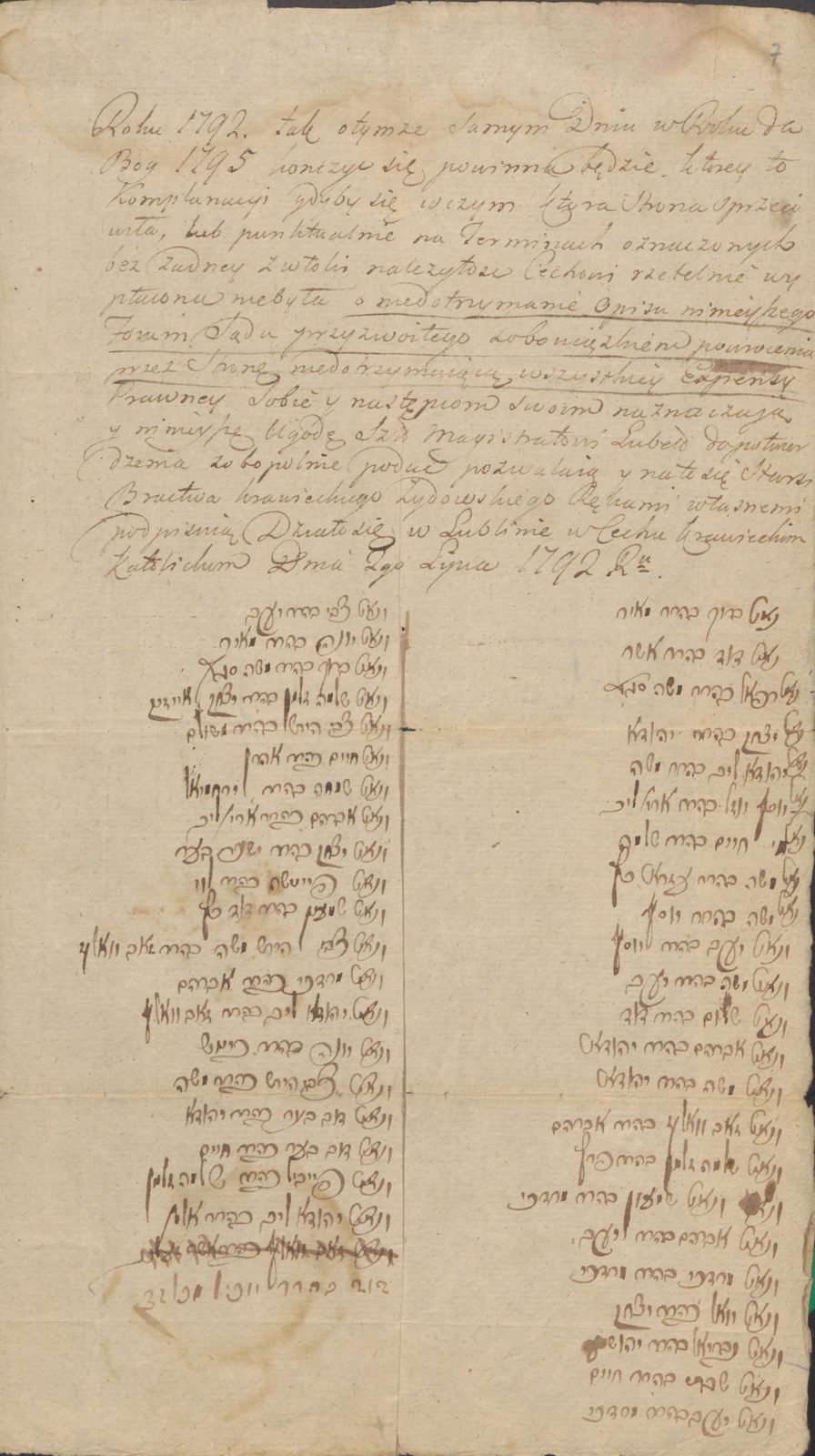
Collection of the Hieronim Łopaciński Provincial Public Library, Lublin (manuscript 342)
On July 2, 1792, Lublin’s Catholic tailors’ guild and the city’s Jewish tailors settled their dispute on paper. A guild was the association that controlled a craft in a town. For three years, the guild would admit forty-four Jewish tailors “to the freedom of practicing the tailor’s craft,” and the Jewish tailors’ own association, their brotherhood, would pay the guild in two payments of 180 złoty.
Look at the bottom of the page. The elders of the brotherhood sign “with their own hands,” in two columns of Hebrew script. Most lines begin ואני, “And I,” then a name and a father’s name: “And I, David, son of Asher.” Forty-four names stand, the number the agreement admits.
The document calls these tailors “the pact Jews.” In royal cities like Lublin, the historian Moshe Rosman writes, such pacts set “the limits of Jewish economic activity” and were often renegotiated. This one was meant to last until 1795, the year the third partition ended the Commonwealth, as told below in Divided among three empires.
1648
The uprising and its memory.
In 1648 the Cossacks, warrior bands of the Ukrainian steppe, rose with the peasants of Ukraine against Polish rule, led by Bohdan Khmelnytsky. Ukraine was then part of the Commonwealth. The peasants were heavily taxed and mistreated, and the Polish authorities tried to suppress the Eastern Orthodox Church, the church of most Ukrainian peasants. Many Jews worked for the Polish lords as leaseholders and tax collectors, and the rebels treated them as part of the system they were fighting. Whole Jewish communities, among them Nemyriv and Tulchyn, were destroyed. Polish counterattacks also killed many Ukrainian civilians.
Jewish memory of 1648 was shaped by Nathan of Hanover’s chronicle Yeven Metzulah (“The Abyss of Despair,” 1653). Hanover wrote with sympathy about the suffering of Ukrainian peasants, and he recorded cases of friendship between Jews and Ukrainians. His casualty figures, though, were greatly exaggerated. Readers came away with a picture of total destruction, and with a belief the evidence does not support: that Ukrainian peasants hated Jews more than other peoples did. The historian Shaul Stampfer finds that most of the roughly 40,000 Jews in the affected regions fled and that fewer than 20,000 died, very possibly far fewer. The communities rebuilt within half a century. The Unit 3 Chapter The Russian Pogroms returns to 1648 as background to the violence of 1881.
Study house and rebbe
Scholars, mystics, and their opponents.
Learning was the community’s pride. Boys began in the heder, a one-room elementary school, and a few went on to a yeshiva, a Talmud academy. Girls were usually taught at home. In the 1500s Rabbi Moses Isserles of Kraków wrote the notes that set Ashkenazi practice beside Joseph Karo’s code of Jewish law, told in the Joseph Karo Chapter.
Solomon Maimon was seven when he was sent to a teacher in Mir. One day he came from school with red eyes, and his older brother asked what was wrong. “I weep,” the boy answered, “because we dare not tell tales out of school.” Describing the schools of his day, Maimon wrote: “The school is commonly a small smoky hut, and the children are scattered, some on benches, some on the bare earth.” He wrote for Berlin readers who wanted Polish Jewish life reformed, so historians read him as a vivid witness with a point of view. Maimon later became a philosopher whom Immanuel Kant praised.
In the 1700s a new religious movement grew in the Ukrainian lands of the Commonwealth. Its founder was Israel ben Eliezer, known as the Baal Shem Tov (about 1700–1760), a healer and mystic in the town of Międzybóż, today Medzhybizh in Ukraine. His followers, the Hasidim, stressed direct, experiential devotion and gathered around a rebbe, a spiritual leader.
In Lithuania, Elijah ben Solomon (1720–1797) rallied the communities against the movement from 1772. People called him the Gaon of Vilna, a title that honored his extraordinary learning, though he held no official post. His camp became known as the Mitnagdim, “opponents.” His student Hayim of Volozhin founded a new kind of yeshiva at Volozhin in 1803, the model for the great Lithuanian academies. Vilna came to be called “the Jerusalem of Lithuania.” The books both camps wrote are in The Sacred Texts. In the early 1800s a third camp reached these lands, the Haskalah or Jewish Enlightenment, whose followers urged secular study and reform.
The partitions
Divided among three empires.
In 1772, 1793, and 1795, Russia, Prussia, and Austria carved up the Commonwealth until it vanished from the map. As the end neared, Berek Joselewicz raised a Jewish regiment that fought in the Kościuszko uprising of 1794 against Russia, hoping to show that Jews belonged to Poland as well as living in it. Russia’s share brought the largest Jewish population in the world under the tsars, who confined most of it to the Pale of Settlement, a western zone of the empire where Jews were permitted to live. That story continues in The Russian Pogroms and Soviet Jewry.
A modern Jewish world
Writers, teachers, and actors.
By the late 1800s, Warsaw was a center of a new Jewish culture, and one apartment sat near its heart. Y. L. Peretz had been a lawyer in his hometown of Zamość until 1887, when he lost his license, accused of promoting Polish nationalism and socialism. In Warsaw he took a job in the burial department of the Jewish community council and divided his days between that job and his writing. He kept regular visiting hours at home for writers. Yekhiel Yeshaye Trunk, one of the many who came, remembered his first walk to Peretz’s apartment as “the most decisive walk in [his] life.”
Jewish politics was a loud argument about the future. The Bund, a Jewish socialist party founded in Vilna in 1897, organized Jewish workers and backed schools taught in Yiddish. Zionist parties worked toward a Jewish homeland in the Land of Israel and ran schools taught in Hebrew. Agudas Yisroel spoke for Orthodox Jews, with Hasidic rebbes and Lithuanian yeshiva heads behind it.
Sarah Schenirer of Kraków came from a Hasidic family and worked as a seamstress, studying Jewish philosophy and scripture on her own. Orthodox girls then received no formal Jewish education. In 1917, with the blessing of the rebbe of Belz, she opened a school for 25 girls in her own apartment and called it Beys Yankev (Beth Jacob). It grew into a network of schools across Poland.
Ida Kaminska was born in a theatrical hotel in Odessa, while her parents were on tour, and began acting beside her mother at the age of five. Her mother, Ester-Rokhl Kaminska, a seamstress turned actress, was so loved that audiences called her Di Mame, “the mother.” In 1920s Warsaw, Ida co-founded the Warsaw Yiddish Art Theater, and she became one of a handful of women directing plays in interwar Poland.
In 1925 Yiddish scholars founded YIVO, the Yiddish Scientific Institute, and made Vilna its home. Much of its material came from volunteer collectors called zamlers, ordinary men and women who gathered documents and data in their own towns. Nearly a third were poor manual laborers. Some wrote to YIVO asking for small sums to cover the cost of paper and postage.
In those same interwar years, Isaac Bashevis Singer, the son and grandson of rabbis, worked in Warsaw as a proofreader for a literary journal and published his first stories. His first novel, Satan in Goray, published as a book in Warsaw in 1935, is set in the years after 1648.
Interwar Poland, 1918–1939
About one person in ten.
Poland regained its independence on November 11, 1918. In the 1931 census about 3.1 million people gave their religion as Jewish, almost one in ten, the largest Jewish community in Europe. Warsaw alone had 352,000 Jews, a community second in the world only to New York’s.
Life in Poland was hard. The country was poor, and Jews met discrimination in government jobs, public works, and bank credit. Conditions eased somewhat after Marshal Józef Piłsudski took power in 1926, then worsened after his death in 1935. The nationalist National Democrats promoted a boycott of Jewish shops and market stalls. More and more universities capped the number of Jewish students, a quota called numerus clausus. Then they seated the Jewish students apart, on so-called “ghetto benches.” In March 1936 a riot in the market town of Przytyk left two Jews and one Polish man dead. Jewish representatives protested but could do little.
Young people wrote about these years themselves. In 1932, 1934, and 1939, YIVO held autobiography contests for Jewish youth in Poland, and hundreds sent in their life stories, most of them in Yiddish. One writer, identified only as “the Stormer,” hoped that young readers would learn “what path to take in their lives, so that they may be better situated than I am when they reach my age.” The same writer added: “May my life, such as it is, serve others as a guide.”
The world of 1939
A community that kept its own record.
In 1939 more than three million Jews lived in Poland, in Warsaw, Vilna, and Kraków and in hundreds of market towns. They studied in Hasidic study houses and Lithuanian-style yeshivas, read newspapers in Yiddish, Hebrew, and Polish, and argued hard about the party, the school, and the language that would shape their future.
What German occupation did to them is told in Unit 4, beginning with The Nazi Ghettos. Much of the record of how they lived survived. In the Warsaw ghetto the historian Emanuel Ringelblum, one of the young scholars of interwar Poland, and his circle buried an archive in metal boxes and milk cans. In Warsaw today, POLIN Museum tells the thousand-year story in its core exhibition. The town agreements, the census counts, the newspapers, and the young people’s life stories are still there to read.
Key takeaways
- Jews settled in Poland by about 1200 and lived there under charters from princes and kings. The Statute of Kalisz (1264) and the Lithuanian charter of 1388 promised protection in return for taxes and trade.
- In the Polish–Lithuanian Commonwealth, Jews governed themselves through local councils (the kahal) and national councils such as the Council of Four Lands (from about 1580 to 1764). By 1764 they numbered about 750,000, the largest Jewish community of the time.
- The uprising of 1648 destroyed many Jewish communities in Ukraine. Modern research puts the Jewish dead at fewer than 20,000, far below the chronicles’ figures, and the communities rebuilt.
- Poland and Lithuania produced the great Lithuanian yeshivas, the Vilna Gaon, and Hasidism. Later came writers like Y. L. Peretz, new schools like Sarah Schenirer’s for Orthodox girls, a Yiddish stage, and political parties of every kind.
- In 1931 about 3.1 million Jews lived in Poland, almost 10 percent of the country. Warsaw had the largest Jewish community in Europe. The 1930s brought boycotts, university quotas, and violence.
Discussion questions
Working from the evidence.
Each question is anchored in evidence this Chapter documents. Answer from the evidence on the page.
- Kings issued charters that protected Jews, and townspeople and Jews signed agreements that set terms on trade. Using the Statute of Kalisz and the Lublin tailors’ agreement of 1792, what did each side want, and what did each side get?
- Solomon Maimon described his school harshly, and he wrote for readers who wanted Polish Jewish life reformed. How should a historian use a vivid source written with a purpose?
- Nathan of Hanover’s chronicle of 1648 gave casualty figures that modern research finds greatly exaggerated. Why might a survivor write that way, and what can his chronicle still tell a historian?
- In 1931 four out of five Polish Jews named Yiddish as their mother tongue. Yet the Bund backed schools taught in Yiddish, Zionist parties ran schools taught in Hebrew, and Beys Yankev schools taught Orthodox girls. What do these choices tell you about the debates inside the community?
- In the 1930s YIVO asked young Jews to write their own life stories. What can a record written by ordinary people tell historians that laws and census tables cannot?
Classroom Connections
Where this Chapter fits.
Teaching Connections
The disciplines and courses this Chapter naturally supports, for any educator, anywhere.
- World History: Medieval and Early Modern Europe: migration eastward, royal charters, and how a multireligious state governed its minorities.
- World History: Nationalism and the Interwar Years: minorities in a new nation-state, 1918–1939.
- World Religions: the yeshiva tradition, Hasidism, and its opponents.
- Historical Thinking & Source Analysis: charters, town agreements, a memoir written with a purpose, a chronicle set against population research, and youth autobiographies.
- Languages & Literature: Yiddish, Hebrew, and Polish as languages of one community’s press, theater, and schools.
Standards Alignment
- NYS Global History & Geography: 10.2d (cultural identity and nationalism, and the challenges to multinational states) and 10.5d (nationalism and ideology between the world wars).
- Common Core ELA-Literacy: RH.11–12.6 (evaluating authors’ differing points of view: the 1648 chronicle and modern population research) and RH.11–12.9 (integrating primary and secondary sources).
- C3 Framework: D2.His.6.9-12 (how the perspectives of those writing history shaped the history they produced: Maimon and Nathan of Hanover) and D2.His.4.9-12 (factors that shaped people’s perspectives in different eras).
Sources
Primary sources
A primary source is a record from the time. It was made by people who were there. Examples: letters, diaries, photos, decrees, trial records, and newspapers.
- The Statute of Kalisz, issued by Prince Bolesław the Pious, August 16, 1264. The original has not survived. Its text was reprinted in nine languages in Artur Szyk’s illustrated edition of 1928, a copy of which is held by POLIN Museum. polin.pl →
- The charters of Grand Duke Vytautas for the Jews of Lithuania, 1388 and 1389.
- Agreement between the townspeople and the Jews of Tarnów on the payment of taxes and the purchase of grain and wood, May 28–29, 1670, signed and sealed by Aleksander Janusz, prince of Ostrog and Zasław. Museum of Tarnów Land, MT-H/245. POLIN Museum Collections →
- Agreement between the Catholic tailors’ guild of Lublin and the Jewish tailors’ brotherhood, Lublin, July 2, 1792 (folios 6–7), in [Documents on the disputes between the Lublin tailors’ guild and the Jewish tailors’ brotherhood], 1792–1795. Polish, with signatures in Hebrew. Hieronim Łopaciński Provincial Public Library, Lublin, manuscript 342. polona.pl →
- Nathan (Natan) of Hanover. Yeven Metzulah (“The Abyss of Despair”). 1653. Chronicle of the 1648–49 massacres by a writer who lived through the uprising years. English translation: Abraham J. Mesch, Abyss of Despair, 1950.
- David ben Samuel ha-Levi (the Taz). Divre David, 1689. Quoted in Moshe Rosman, “Poland before 1795,” The YIVO Encyclopedia of Jews in Eastern Europe.
- The census of the Jews of the Polish–Lithuanian Commonwealth, 1764–1765.
- Maimon, Salomon. Lebensgeschichte (Life Story). Berlin, 1792–1793. English translation: Solomon Maimon: An Autobiography, translated by J. Clark Murray, 1888. archive.org →
- The Second General Census of Poland, 1931 (religion and mother tongue).
- Photograph. The corner of Nalewki and Franciszkańska Streets, Warsaw, about 1934. Photographer not recorded. National Library of Poland (Biblioteka Narodowa), F.7257/III. polona.pl →
- Youth autobiographies submitted to the YIVO contests of 1932, 1934, and 1939. YIVO Institute for Jewish Research, New York. Excerpts published in Jeffrey Shandler, ed., Awakening Lives: Autobiographies of Jewish Youth in Poland before the Holocaust (Yale University Press, 2002). vilnacollections.yivo.org →
Secondary sources
A secondary source was written later. It is a book or article by a historian who studied those records and explains what they mean.
- Polonsky, Antony. “The Jews in Poland between the Two World Wars.” In The Jews in Poland and Russia: A Short History. Littman Library of Jewish Civilization / Liverpool University Press, 2013. (The 1931 census by religion and mother tongue.) cambridge.org →
- Hundert, Gershon David. Jews in Poland-Lithuania in the Eighteenth Century: A Genealogy of Modernity. University of California Press, 2004.
- Rosman, Moshe. “Poland before 1795.” The YIVO Encyclopedia of Jews in Eastern Europe. (Earliest records, charters, demography, the kahal, leasing, and the 1764–65 census.) encyclopedia.yivo.org.
- Bacon, Gershon. “Poland from 1795 to 1939.” The YIVO Encyclopedia of Jews in Eastern Europe. (Interwar population, politics, schools, press, and the pressures of the 1930s.) encyclopedia.yivo.org.
- Polonsky, Antony. “Warsaw.” The YIVO Encyclopedia of Jews in Eastern Europe. encyclopedia.yivo.org.
- Węgrzynek, Hanna. “Kalisz.” The YIVO Encyclopedia of Jews in Eastern Europe. encyclopedia.yivo.org.
- Levin, Dov. “Lithuania.” The YIVO Encyclopedia of Jews in Eastern Europe. (The charters of Vytautas and interwar Lithuania.) encyclopedia.yivo.org.
- Teller, Adam. “Councils.” The YIVO Encyclopedia of Jews in Eastern Europe. encyclopedia.yivo.org.
- Kassow, Samuel. “Shtetl.” The YIVO Encyclopedia of Jews in Eastern Europe. encyclopedia.yivo.org.
- Stampfer, Shaul. “Gzeyres Takh Vetat.” The YIVO Encyclopedia of Jews in Eastern Europe. (The 1648–49 uprising and the estimate of Jewish losses.) encyclopedia.yivo.org.
- Wodziński, Marcin. “Maimon, Salomon.” The YIVO Encyclopedia of Jews in Eastern Europe. encyclopedia.yivo.org.
- Rosman, Moshe. “Ba‘al Shem Tov.” The YIVO Encyclopedia of Jews in Eastern Europe. encyclopedia.yivo.org.
- Etkes, Immanuel. “Eliyahu ben Shelomoh Zalman.” The YIVO Encyclopedia of Jews in Eastern Europe. encyclopedia.yivo.org.
- Nadler, Allan. “Misnagdim.” The YIVO Encyclopedia of Jews in Eastern Europe. encyclopedia.yivo.org.
- Kuznitz, Cecile Esther. “YIVO.” The YIVO Encyclopedia of Jews in Eastern Europe. encyclopedia.yivo.org.
- Moseley, Marcus. “Autobiography and Memoir.” The YIVO Encyclopedia of Jews in Eastern Europe. (The YIVO youth autobiography contests.) encyclopedia.yivo.org.
- Wisse, Ruth R. “Peretz, Yitskhok Leybush.” The YIVO Encyclopedia of Jews in Eastern Europe. encyclopedia.yivo.org.
- Sherman, Joseph. “Singer, Isaac Bashevis.” The YIVO Encyclopedia of Jews in Eastern Europe. encyclopedia.yivo.org.
- Kaniel, Asaf. “Schenirer, Sarah.” The YIVO Encyclopedia of Jews in Eastern Europe. encyclopedia.yivo.org.
- Steinlauf, Michael C. “Kaminski Family” and “Yiddish Theater.” The YIVO Encyclopedia of Jews in Eastern Europe. encyclopedia.yivo.org.
- Zalkin, Mordechai. “Vilnius.” The YIVO Encyclopedia of Jews in Eastern Europe. encyclopedia.yivo.org.
- Etkes, Immanuel. “Haskalah.” The YIVO Encyclopedia of Jews in Eastern Europe. encyclopedia.yivo.org.
- The YIVO Encyclopedia of Jews in Eastern Europe, articles on the Bund (Daniel Blatman), Agudas Yisroel (Gershon Bacon), Beys Yankev (Asaf Kaniel), and the Przytyk Pogrom (Antony Polonsky). encyclopedia.yivo.org.
- United States Holocaust Memorial Museum. “Warsaw.” Holocaust Encyclopedia. (The prewar Jewish population of Warsaw.) encyclopedia.ushmm.org →
- POLIN Museum of the History of Polish Jews, Warsaw. “About the Museum.” polin.pl →
Finding these documents: many primary sources are free online. Good places to start are the Fordham Internet Jewish History Sourcebook, Yale’s Avalon Project (law and diplomacy), German History in Documents, the collections of the US Holocaust Memorial Museum and Yad Vashem, the National Library of Israel, and Sefaria (for Jewish texts). Search the document’s name and date.
More than two million Jews kept from leaving, and the movement that got them out, the dismantling of Jewish life under the Soviet state, the Black Years, the refuseniks, Jackson-Vanik, and the great exodus to Israel, America, and Germany.
Comments?
Write to editor@teachjewishhistory.org.
Last updated: November 2026.