In 597 and 586 BCE, Babylon carried thousands of people from Judah into exile, and they began one of the oldest Jewish communities outside the Land of Israel, in the place we now call Iraq. It lasted more than 2,500 years. In the 1940s it was still there: roughly 135,000 people across Iraq. Within about a decade, almost all of them were gone.
Why this Chapter exists
A center of the Jewish world for more than two thousand years.
The Jews of Iraq formed one of the oldest and largest Jewish communities anywhere. For long stretches of history the community was the center of the Jewish world. It was the place where the most important book in Judaism after the Bible was assembled, and the place distant communities wrote to for answers. It was home to a continuous Jewish presence that outlasted the Babylonians, the Persians, the Greeks, the Parthians, the Sasanian Persians, the Arab caliphs, the Mongols, and the Ottomans.
Then, in the middle of the twentieth century, it ended in a few short years. A community that had lived along the Tigris and Euphrates since the sixth century BCE was almost entirely uprooted within a single generation.
Common misconceptions this Chapter addresses
A few assumptions get in the way of seeing this community clearly.
- “Jews in the Middle East were a small, recent, or marginal presence.” See the entry →
- “Jewish history happened in Europe, and the Middle East is only where Jews came from long ago.” The Iraqi community was continuous and central for over 2,500 years, far longer than the Jewish presence in most of Europe.
- “The Jews of Arab lands simply emigrated to Israel by choice.” In Iraq the departure followed a pogrom, mass dispossession, and the stripping of citizenship.
The oldest exile
It began with the Babylonian exile, in 597 and 586 BCE.
The story starts with a catastrophe. A clay tablet in the British Museum, the Babylonian Chronicle, logs the campaigns of Nebuchadnezzar II, king of Babylon, year by year. In his seventh year, it says, he besieged “the city of Judah,” took it on the second day of the month of Adar, in March 597 BCE, captured its king, and installed a king of his own choice. The Bible tells the same event from Judah’s side. Its account in 2 Kings 24 names the captured king, Jehoiachin, and counts ten thousand people deported with him.
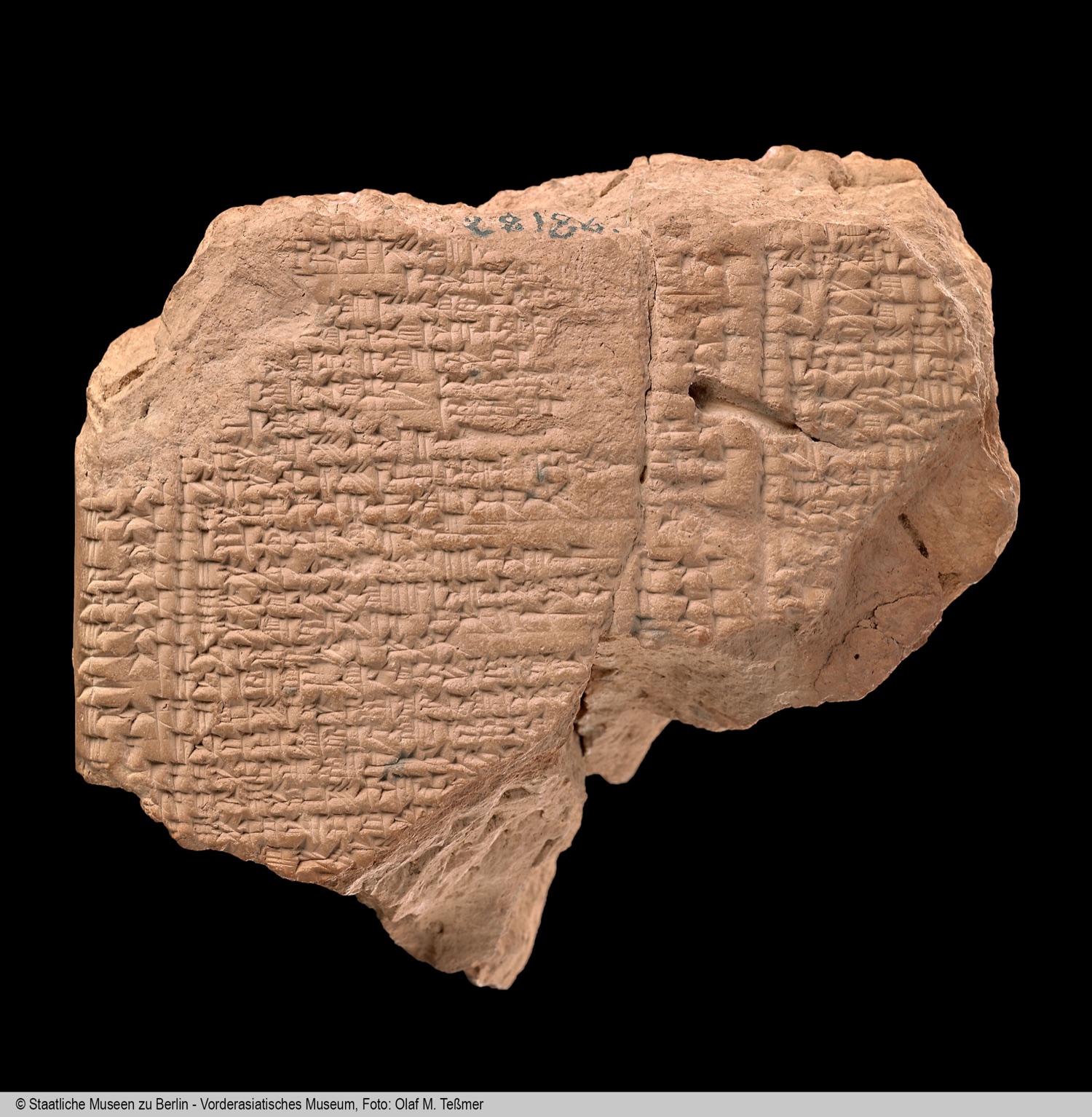
Collection of the Vorderasiatisches Museum, Staatliche Museen zu Berlin (VAT 16378). Photo: Olaf M. Teßmer, Staatliche Museen zu Berlin, CC BY-SA 4.0
The captives can be traced in Babylon itself. Clay tablets found in the storerooms of Nebuchadnezzar’s palace list oil rations for prisoners at the royal court. They name Jehoiachin four times, call him “king of Judah,” and record food for five of his sons. One of the tablets is dated to 592 BCE. The book of Kings ends with the same man, released from prison decades later and given “regular rations” for the rest of his life.
Eleven years after the first capture, Babylon’s army came back. In 586 BCE (some historians date it to 587) it breached the walls of Jerusalem, burned the Temple, and took many of its people captive. The burned houses, arrowheads, and letters that this campaign left in Jerusalem and at the fortress of Lachish are told in Unit 1 · Ch. 04 · The First and Second Temples. The Bible mourns the destruction in Psalm 137 and the Book of Lamentations, and Jewish memory returns to it more than to any other exile.
Records of the exiles’ daily lives survive in Babylonia. In 2014 Laurie Pearce and Cornelia Wunsch published 103 cuneiform tablets (clay tablets in the wedge-shaped script of Babylonia). Many come from a settlement the Babylonians called Al-Yahudu, “the town of Judah.” Written between 572 and 477 BCE, they are ordinary legal records of Judeans farming, building houses, paying taxes, and doing service for the king, with Hebrew names built on the name of God among them.
In 539 BCE the Persian king Cyrus took Babylon. The Book of Ezra quotes his decree letting the Judeans go home and rebuild the Temple, as told in The Jews of Iran. Some went home, and many chose to stay. The latest of these tablets was written in 477 BCE, about sixty years after the return began. The community that began as a forced exile became a permanent home. For the next 2,500 years, through empire after empire, there were Jews in the land between the Tigris and the Euphrates. By the time the rebuilt Temple in Jerusalem, the Second Temple, was destroyed by Rome in 70 CE, Babylonia was already a thriving alternative center of Jewish life.
Where the Talmud was made
The book that shaped world Judaism was written here.
From about the third century to the eleventh century CE, Babylonia was one of the two great centers of Jewish learning, and for much of that time the leading one. In two towns, Sura and Pumbedita, sat the great academies, the most important centers of Jewish learning anywhere. Their scholars produced the single most influential Jewish work after the Bible itself: the Babylonian Talmud.
The Talmud is a vast compilation of law, interpretation, and debate, compiled across centuries and largely completed in these academies by around 500 CE, with editing that continued for generations after. For the next 1,500 years, across nearly the whole rabbinic world, from Spain and Germany to Yemen and India, the foundation of Jewish legal study was the book made in Iraq. Ethiopia’s Beta Israel, cut off from that network, never received it.
The academies’ reach went further. From about 600 to 1040 CE, the heads of these academies were known as the Geonim (singular Gaon, a title meaning “excellency”). Jewish communities across the diaspora sent legal and religious questions to the academies of Babylonia. The responses of the Geonim, among them Saadia Gaon (882–942), shaped Jewish practice for centuries. (This network of letters is the subject of the Diaspora Chapter in Unit 1.)
A thousand years of depth
The community outlasted every empire that ruled it.
Empires rose and fell across Iraq, and the Jewish community persisted through all of them. When Baghdad was founded in 762 CE and became the capital of the Islamic world under the Abbasid caliphs, its Jewish community flourished alongside it: in trade, in scholarship, in medicine, in finance. Jewish merchants were part of networks that reached from the Mediterranean to India and China.
The community had its own internal leader, recognized by the Muslim rulers: the Exilarch (in Aramaic, Resh Galuta, “head of the exile”), traditionally said to descend from the royal line of King David. For centuries the Exilarch governed the Jews of the region as a kind of prince, collecting taxes and appointing judges. Like every Jewish community under Islamic rule, the Jews of Iraq lived as dhimmis, a protected but second-class status, with special taxes and restrictions, and periods that were better and worse. (That framework is explained in the Dhimma Chapter.)
In 1258 the Mongols took Baghdad, and the Abbasid caliphate that had ruled from the city for five centuries came to an end. The Mongols did not mistreat the Jews as they did the city’s Muslims, but the communities of Baghdad and Basra took generations to recover. The Ottomans, the Muslim empire ruled from today’s Turkey, took Baghdad in 1534 and, after fifteen years of Persian rule from 1623, held it again from 1638.
A rabbi from Aleppo, Zedakah Hozin, arrived in 1743, and the community’s fortunes began to turn. In the 1820s a harsh governor, Daud Pasha, drove some of the wealthiest families abroad. One of them, David Sassoon, settled in Bombay in 1832. The trading house he built there opened branches in Calcutta, Rangoon, Shanghai, and Hong Kong, and in 1861 he gave Bombay a synagogue, Magen David. Baghdad itself grew again. In 1860 a visitor counted about 20,000 Jews in the city.
The modern community
By the twentieth century, one Baghdadi in five.
By the early twentieth century, the Jews of Baghdad were a large, modern, urban population of about 50,000 people. By the British count of 1919 they were one in five residents of the Baghdad district, and by other estimates a larger share of the city. They were merchants and bankers, doctors and lawyers, musicians and government officials. After the Ottoman Empire collapsed in World War I, Britain created the modern state of Iraq and kept military rights there. The new country’s first finance minister, Sassoon Eskell (Heskayl), was Jewish. Jewish musicians were so central to Iraqi music that the country’s broadcasting orchestra was made up mostly of them.
It was a world with its own newspapers, hospitals, synagogues, and schools, among them the schools of the Alliance Israélite Universelle, which brought modern education to Jewish children across the Middle East. Families spoke Judeo-Arabic, the local Jewish language.
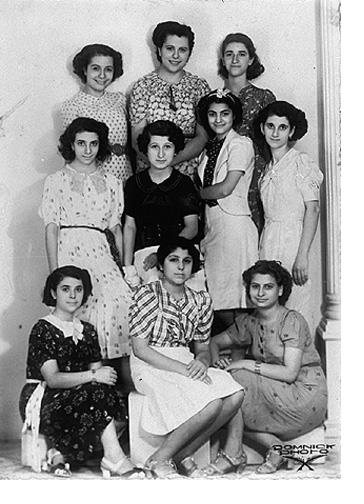
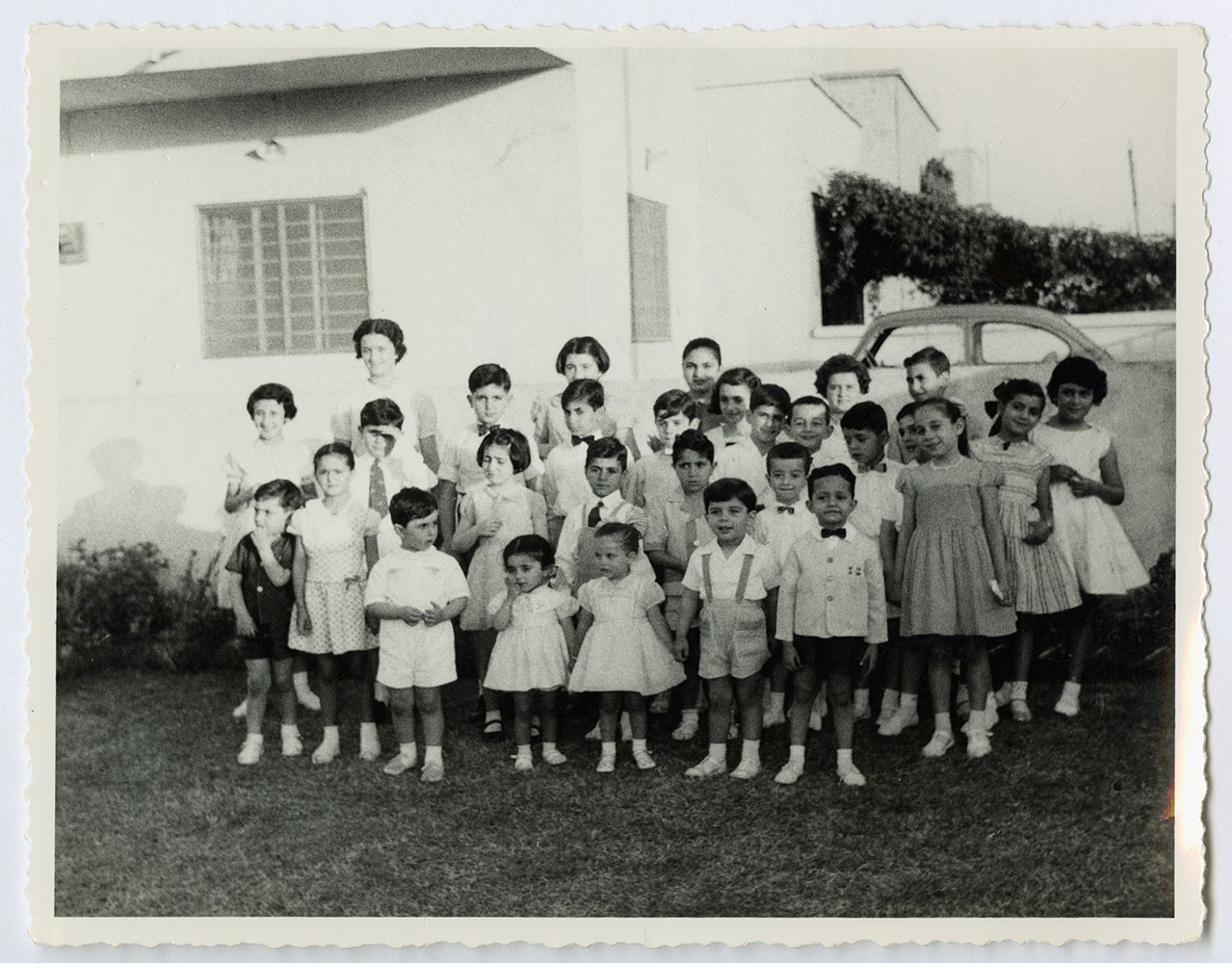
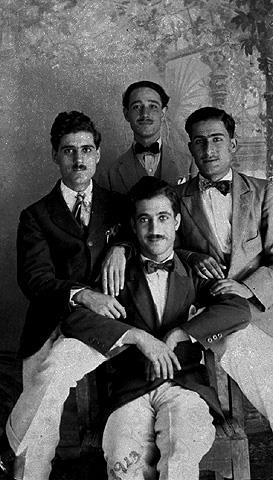
Object Spotlight
A family on the Tigris, October 1957.
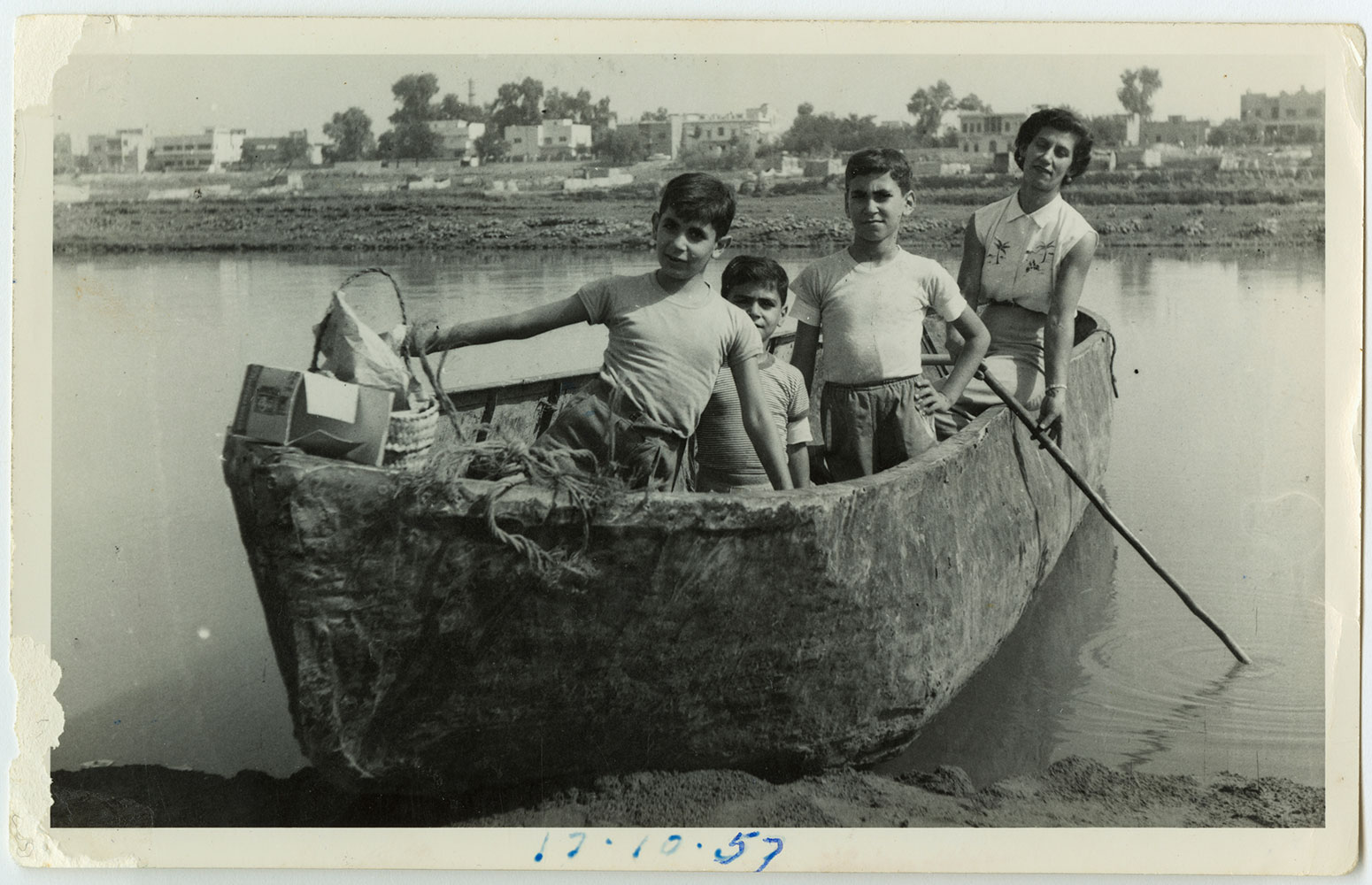
Three boys and a young woman stand in a small boat pulled up on a sandbar, its hull patched and worn. Behind them the Tigris stretches flat and calm, and across the water you can see the low rooflines of Baghdad, ordinary buildings, palm trees, a city going about its day. In the bow sits a picnic basket. One boy rests a hand on his hip, and the woman is half-smiling. Someone has written the date in blue ink along the bottom: 17 · 10 · 57.
An Iraqi Jewish family took this snapshot in Baghdad in October 1957. The Tigris, with the Euphrates, is one of the two rivers that define Iraq, and Jews had lived beside them since the sixth century BCE. The great wave of departure had come and gone in 1950–1952. This family belonged to the small remnant who stayed, in the years before the final departures of the late 1960s and 1970s. Within about fifteen years, almost no Jews would remain in Baghdad.
The print comes from the collection of Maurice Shohet, who shared it with the Iraqi Jewish Archive for its online exhibit.
The Farhud, 1941
A warning, in the middle of the war.
On June 1–2, 1941, during the Jewish holiday of Shavuot, a mob attacked the Jewish community of Baghdad. Shavuot is the festival that marks the giving of the Torah at Mount Sinai. The attack is known as the Farhud, an Arabic word meaning “violent dispossession.” Over two days, rioters killed between 150 and 180 Jews, injured between 600 and 800, by different counts, and looted some 1,500 Jewish stores and homes. By the count of an official Iraqi commission, at least 128 Jews were killed.
Two developments came together: a crisis in Iraqi politics, and years of propaganda over the radio. Two months earlier, in April 1941, a group of Iraqi officers led by the politician Rashid Ali al-Gaylani seized power in a coup and sought military backing from Nazi Germany. Britain sent in forces and, by the end of May, the pro-German government had collapsed and its leaders had fled. The Farhud broke out in the short, lawless gap between that government falling and British-backed authority returning, and British troops, positioned just outside the city, did not move in to stop it.
Since 1939, Nazi Germany had been broadcasting Arabic-language propaganda into Iraq from Berlin. The German legation, Germany’s diplomatic mission in Baghdad, had been cultivating antisemitic messaging there for years. The attackers themselves were Iraqi: soldiers and policemen who had backed the coup, members of a pro-Nazi youth movement called the Futuwwa, and others who joined as the violence spread. No German forces were in Baghdad. Historians weigh these causes differently. Some emphasize the imported Nazi influence, others the local political collapse. Hajj Amin al-Husayni, the former Mufti of Jerusalem and once the leading Muslim cleric of British-ruled Palestine, had lived in Baghdad since 1939 and backed the coup. He later broadcast from Berlin. His role and the full history are told in Unit 4 · Ch. 06 · The Holocaust in the Middle East and North Africa.
On the afternoon of June 1 the pro-British Regent, Abd al-Ilah, returned to Baghdad, and a festive crowd of Jews crossed to the west bank of the Tigris to welcome him. On the way back, soldiers joined by civilians attacked them, killing one and injuring others. The riots spread through the city, worst on the east bank, where most of Baghdad’s Jews lived, and by nightfall a pogrom was under way. Through that night and the next morning rioters murdered, raped, and looted in the Jewish neighborhoods and business districts. It ended at midday on June 2, when the Regent at last ordered the police to fire and Iraqi troops entered the city, killing some hundreds of rioters in the streets. Most of the Jewish dead were buried in a mass grave in the old Jewish cemetery. The pogrom left 242 children orphans, and community leaders estimated that about 2,500 families, 15 percent of the Jewish community of Baghdad, suffered directly from it. Not all Iraqis turned on their Jewish neighbors. In Baghdad itself, the historian Orit Bashkin has written about Muslims who risked their lives to protect their Jewish friends, neighbors, and business partners. In Basra that May, when looting broke out after British forces occupied the city, Arab notables sent night watchmen to guard Jewish property, and many gave Jews refuge in their own homes.
The Farhud changed Jewish life in Iraq. Many decided to leave. By the US Holocaust Memorial Museum’s account, hundreds fled to Iran and others to Lebanon and India, while the Encyclopaedia Judaica counts thousands who left Baghdad, most of them for India and Palestine. Most came back once Baghdad was calm. The pogrom had split the community’s young people from its traditional leaders, and many of the young turned to two underground movements, the Communist party and the Zionist movement. In March 1942 the Zionists formed a youth organization, Tenu’at he-Halutz (the Pioneer Movement), and a self-defense group, the Haganah, which operated until 1951. By 1952, eleven years after the Farhud, almost the entire community had left the country.
The end, 1948–1952
Gone in a single generation.
The State of Israel was founded in 1948, and Arab states, Iraq among them, went to war against it. The position of Jews across the Arab world grew rapidly worse, and Iraq was among the harshest cases. Zionism, the movement to build the Jewish people a country of their own, was made a crime. Jews were dismissed from government jobs, barred from many professions, and arrested. In September 1948 the businessman Shafiq Ades was publicly hanged in front of his house in Basra after a military court convicted him of treason, on a charge of selling scrap metal to Israel.
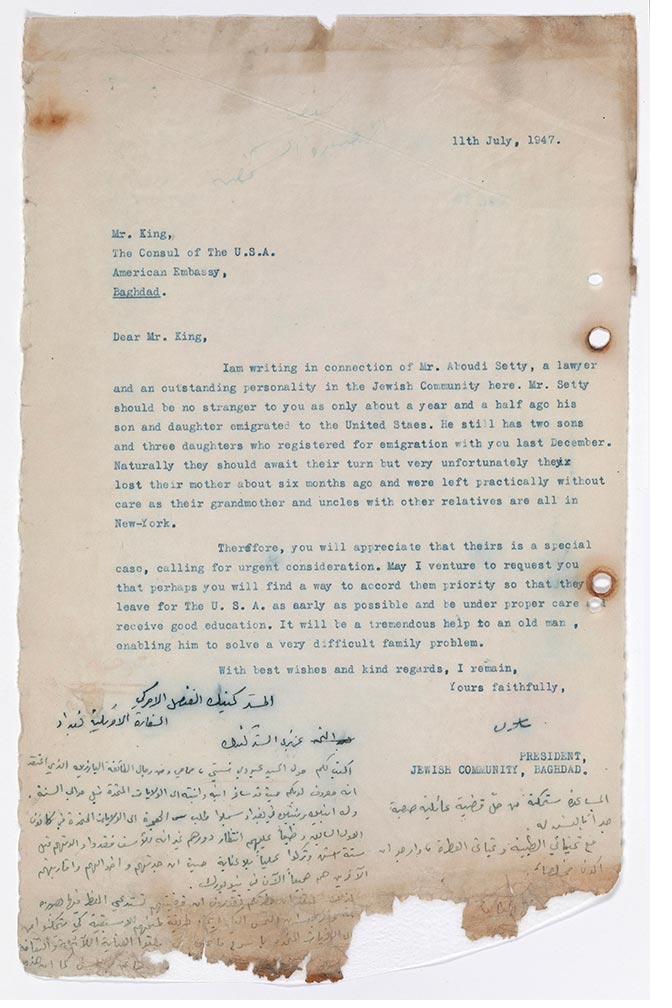
On March 3, 1950, parliament passed Law No. 1 of 1950, which let Jews leave the country for good if they gave up their Iraqi citizenship. Officials expected 6,000 to 10,000 people to use it. At the end of Passover, on April 8, the Zionist underground called on Jews to register at centers set up in the major synagogues, and the overwhelming majority of the community chose to leave. A family that registered gave up its citizenship and then waited for a flight. On March 10, 1951, one day after registration closed and with nearly 65,000 Jews still waiting, a second law froze the assets of every Jew who had given up citizenship. Many were reduced to poverty, allowed to take out only 50 dinars per adult, about 140 US dollars at the time, and 20 to 30 dinars per child. In the airlift known as Operation Ezra and Nehemiah (1950–1952), roughly 120,000 to 130,000 Iraqi Jews were flown out, mostly to Israel. During the registration period, a series of bombs struck Jewish targets in Baghdad. The deadliest killed at least three people at the Masuda Shemtob synagogue, where Jews gathered before leaving. An Iraqi court convicted two members of the Zionist underground of some of the attacks, and they were hanged in 1952. Who planted the bombs is still disputed.
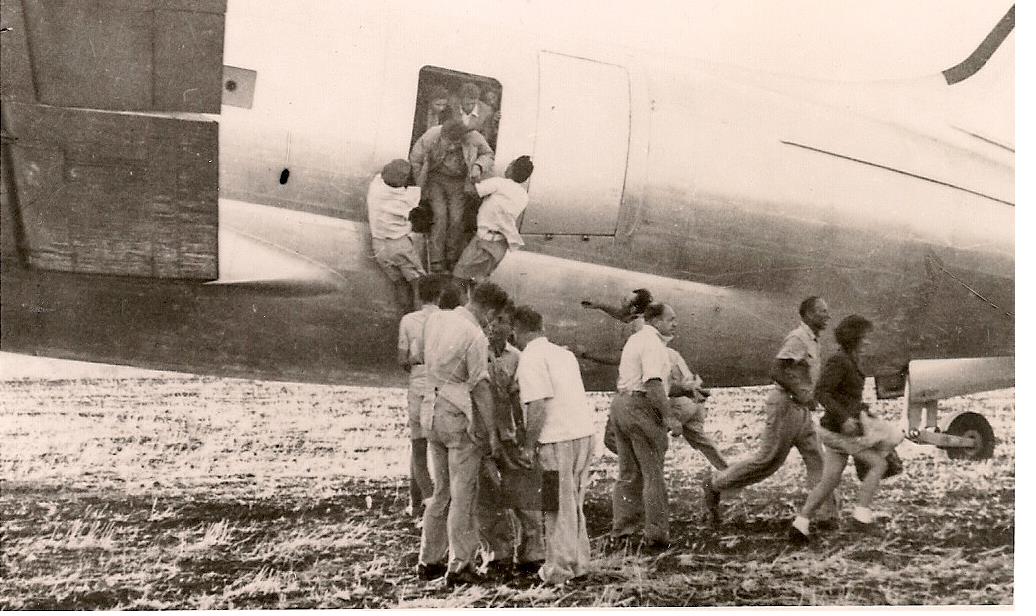
The Iraqi Jews who reached Israel landed in a country that was housing its newcomers in ma’abarot, transit camps where tents soon gave way to canvas-walled huts and tin shacks. By May 1952 there were 113 of these camps holding 250,000 people. In Iraq, a community of roughly 135,000 people shrank to about 6,000, most of them from wealthy families who believed the danger would pass. All but two of the Jewish schools closed in 1952, and of the 60 synagogues of Baghdad in 1950, only seven remained in 1960. A government law of December 1951 abolished the rabbinical court of Baghdad, and in 1954 the state nationalized the Meir Elias Hospital, the largest and most modern in Iraq. Conditions eased under Abd al-Karim Qasim, who ruled from 1958 to 1963. The rulers who overthrew him restored the old restrictions and added more. After the Six-Day War of 1967 the government forbade all dealings with Jews, banks included, and cut the telephone lines to their homes, offices, and stores. On January 27, 1969, the Ba’athist government publicly hanged fourteen men in Baghdad on charges of spying for Israel, nine of them Jews. By 1975 about 350 Jews remained. Today only a tiny handful remain in Iraq. The departure from the whole region is told in The Departure from MENA.
The Iraqi Jewish Archive
What was left behind, and nearly lost.
In 2003, during the American invasion of Iraq, soldiers searching the Baghdad headquarters of Saddam Hussein’s secret police found a flooded basement room. Floating in several feet of water were thousands of Jewish documents and books: community records, school papers, religious texts, personal letters, photographs, that the former regime had seized from the Jewish community over the years and stored away.
These waterlogged, mold-covered materials were among the last surviving records of a 2,500-year-old community. They were shipped to the United States, where the National Archives undertook a painstaking effort to dry, clean, and preserve them. The recovered collection, known as the Iraqi Jewish Archive, was digitized and exhibited, so that the records of a community that no longer exists in Iraq could be read again. The exhibit also gathered family photographs lent by Iraqi Jews who left, like the one in the Object Spotlight above.
Not every piece could be saved. Rabbis judged 50 fragments of Torah and Book of Esther scrolls from the basement to be beyond repair. On December 15, 2013, 49 of them were buried in a Jewish cemetery in New York, with the honor Jewish tradition gives a person: a coffin covered with a prayer shawl, and those present shoveling earth into the grave. Maurice Shohet of the World Organization of Jews from Iraq led the ceremony, and Iraq’s ambassador to the United States, Lukman Faily, attended.
Where the archive belongs is an open question: with the Iraqi state from which it was recovered, or with the community whose lives it records.
Key takeaways
- The Jewish community of Iraq began with the Babylonian exiles of 597 and 586 BCE and lasted more than 2,500 years, far longer than the Jewish presence in most of Europe.
- From about the third century to the eleventh century CE, Babylonia was a leading center of the Jewish world: the academies of Sura and Pumbedita produced the Babylonian Talmud and answered questions sent from communities thousands of miles away.
- By the early twentieth century the Jews of Baghdad were a large, modern, urban community, about one in five people in the Baghdad district by the 1919 count, woven into Iraqi trade, music, medicine, and government.
- The Farhud of June 1941, a two-day pogrom in Baghdad, killed between 150 and 180 Jews, left 242 children orphans, and drew many young Jews into the underground Zionist and Communist movements. After 1948, discrimination and dispossession made life untenable.
- A 1950 law made Jews give up their citizenship to leave, and in 1951 the state froze the property of those who had. In a vast airlift in 1950–1952, roughly 120,000–130,000 Iraqi Jews left or were forced out, mostly to Israel. Within a few years a community 2,500 years old was almost gone from Iraq.
Discussion questions
Working from the evidence.
Each question is anchored in a fact this Chapter documents. Answer from the evidence on the page.
- The community began as a forced exile in 597 and 586 BCE, yet when the Jews were later allowed to return to Jerusalem, many chose to stay. Why might a community that started in catastrophe become a permanent, even thriving, home?
- The Babylonian Talmud, made in Iraq, became the foundation of Jewish law across nearly the whole Jewish world for 1,500 years. What does it mean for one place to produce a text that shapes communities that far away?
- The Object Spotlight is an ordinary family photo from 1957, a picnic on the river. What can a snapshot show about Jewish life in Baghdad that a list of laws and dates cannot?
- A community that lasted 2,500 years largely ended in about four. What caused it to end so quickly?
- The Iraqi Jewish Archive is now contested. Should it belong to the Iraqi state it was recovered from, or to the community whose lives it records? Make the strongest case you can for each side.
Classroom Connections
Where this Chapter fits.
Teaching Connections
- World History: the Classical World: the Babylonian academies and the making of the Talmud, and how a religious tradition is transmitted and organized.
- World History, Human Rights: the uprooting of a 2,500-year-old minority, and the 1950–52 airlift after a law made Jews give up their citizenship to leave.
- World History, WWII & the Holocaust: the Farhud (Baghdad, June 1941) within the wider wartime assault on Jewish communities.
- Historical Thinking: continuity and rupture: a community that lasted 2,500 years and largely ended in about four.
- Source Analysis & Archives Education: the Iraqi Jewish Archive (photographs, documents, and personal records).
- Geography: Jewish life across Babylonia and Iraq and the wider Middle East.
Standards Alignment
- NYS Global History & Geography: 9.3 (the classical world), 10.5 (the global conflicts of 1914–1945: the Farhud) and 10.10 (human rights: the 1950–52 departure).
- Common Core ELA-Literacy: RH.6–8.7 (integrating visual and print sources) and RH.11–12.7 (integrating multiple sources): the Iraqi Jewish Archive.
Learn more · take this further
Resources on the Jews of Iraq, for students and teachers.
Films & video
All appear in the full Films & Video collection.
- Remember Baghdad: a documentary tracing five families across a century of Iraqi-Jewish life. rememberbaghdad.com →
- The Last Jews of Baghdad: first-hand accounts of the community’s final decades. UK Jewish Film →
- Forget Baghdad: four men reflect on leaving Iraq and the identities they carried with them.
- What We Left Behind: a short film by Sephardi Voices, about seven minutes, that follows the burial of the scroll fragments. Vimeo →
- The burial of the Torah fragments: the 2013 ceremony, filmed for the National Endowment for the Humanities. YouTube →
Sources and citations
Primary sources
A primary source is a record from the time. It was made by people who were there. Examples: letters, diaries, photos, decrees, trial records, and newspapers.
- The Babylonian Chronicle for the years 605–594 BCE, recording Nebuchadnezzar II’s capture of “the city of Judah” on 2 Adar of his seventh year, 597 BCE. Cuneiform tablet, The British Museum, BM 21946. Edition: A. K. Grayson, Assyrian and Babylonian Chronicles (1975), Chronicle 5. British Museum collection record →
- The Jehoiachin ration tablets, Babylon, sixth century BCE (one dated to 592 BCE). Cuneiform lists of oil rations issued at the court of Nebuchadnezzar II to Jehoiachin, “king of Judah,” and his sons in exile. Vorderasiatisches Museum, Staatliche Museen zu Berlin, VAT 16378. Museum collection record →
- The Al-Yahudu tablets, 572–477 BCE. Cuneiform records of everyday life in “the town of Judah” and neighboring places in Babylonia, the exile community’s own documentary trace. The first 103, from three archives, were published in 2014 by Pearce and Wunsch (below), from the Collection of David Sofer.
- The Babylonian Talmud, compiled in the academies of Sura and Pumbedita in Iraq, c. 500–700 CE. The community’s monumental primary text; free digital edition at Sefaria.
- The Epistle of Rav Sherira Gaon, written from the academy of Pumbedita to the community of Kairouan, 987 CE. The Gaon’s own account of how the Talmud was composed and of the Babylonian academies.
- The Iraqi Jewish Archive (U.S. National Archives). ijarchive.org →
- The Hebrew Bible: 2 Kings 24–25, Ezra 1, Psalm 137, and the Book of Lamentations. The biblical account of the fall of Judah and the deportation to Babylon, the decree of Cyrus, and the poems that mourn the destruction. Free digital edition at Sefaria.
- Iraqi Jewish Archive: Burial of Damaged Torah Fragments. Video of the December 15, 2013 ceremony, National Endowment for the Humanities. YouTube.
Secondary sources
A secondary source was written later. It is a book or article by a historian who studied those records and explains what they mean.
- Stillman, Norman A. The Jews of Arab Lands: A History and Source Book. Jewish Publication Society, 1979.
- Bashkin, Orit. New Babylonians: A History of Jews in Modern Iraq. Stanford University Press, 2012. Chapter 4, “Friends, Neighbors, and Enemies: Fascism, Anti-Semitism, and the Farhud,” pp. 100–140. Her lecture “New Babylonians: The Farhud and Iraqi Jewry,” Alan D. Leve Center for Jewish Studies, UCLA, April 9, 2013 (on the Muslims who risked their lives to protect Jewish friends, neighbors and business partners). levecenter.ucla.edu →
- Meir-Glitzenstein, Esther. Zionism in an Arab Country: Jews in Iraq in the 1940s. Routledge, 2004.
- Gat, Moshe. The Jewish Exodus from Iraq, 1948–1951. Frank Cass, 1997.
- Gat, Moshe. “The Socio-Economic Patterns of Iraqi Jewry in the Twentieth Century.” Jewish Political Studies Review 10, no. 1–2 (Spring 1998). (On the estimate of 40,000 to 50,000 Jews in Baghdad on the eve of the First World War.) jcfa.org →
- Rejwan, Nissim. The Jews of Iraq: 3000 Years of History and Culture. Weidenfeld & Nicolson, 1985.
- Simon, Reeva Spector, et al., eds. The Jews of the Middle East and North Africa in Modern Times. Columbia University Press, 2003.
- Black, Edwin. The Farhud: Roots of the Arab-Nazi Alliance in the Holocaust. Dialog Press, 2010.
- The Babylonian Jewry Heritage Center, Or Yehuda. bjhc.org.il → Its English site on the Farhud (on the rape of women, the 152 identified victims, mostly buried in a mass grave in the old Jewish cemetery of Baghdad, and the 800 injured). bjhcenglish.com →
- Diarna Geo-Museum. diarna.org →
- ANU, Museum of the Jewish People, Tel Aviv. anumuseum.org.il →
- Pearce, Laurie E., and Cornelia Wunsch. Documents of Judean Exiles and West Semites in Babylonia in the Collection of David Sofer. CDL Press, 2014.
- Gross, Simcha. Review of Pearce and Wunsch, Documents of Judean Exiles and West Semites in Babylonia. Ancient Jew Review, February 2015. (On the 103 tablets of 572–477 BCE, the name Al-Yahudu, and the Judeans who “till the land and build houses, pay taxes, and render services to the king.”) ancientjewreview.com →
- Encyclopaedia Judaica. “Exile, Babylonian.” (On the surrender of Jerusalem on March 16, 597 BCE and the destruction of the city in 586 or 587.) encyclopedia.com →
- Encyclopaedia Judaica. “Jehoiachin.” (On the ration lists from the storerooms of Nebuchadnezzar’s palace that name Jehoiachin four times, call him “king of Judah,” and record food for five of his sons, one dated to 592 BCE.) encyclopedia.com →
- Encyclopaedia Judaica. “Zedekiah.” (On the breach of Jerusalem in Zedekiah’s eleventh year, 587 or 586 BCE, and the burning of the Temple.) encyclopedia.com →
- Encyclopaedia Judaica. “Baghdad.” (On the Mongol conquest of 1258, Ottoman rule from 1534, the Persian occupation of 1623–1638, the arrival of Zedakah Hozin in 1743, the flight of wealthy families, David Sassoon among them, under Daud Pasha, 20,000 Jews in 1860, the public hangings of two Zionist leaders in the early 1950s, the hanging of nine Jews on January 27, 1969, the community of about 350 in 1975, the 800 injured in the Farhud and the rape and abduction of women, the thousands who left for India and Palestine in 1941 and came back, the 6,000 Jews left in Baghdad after 1951, the rabbinical court abolished in December 1951, the school closures of 1952, and the fall from 60 synagogues in 1950 to seven in 1960.) Encyclopaedia Judaica text →
- Encyclopaedia Judaica. “Iraq.” (On the Jews who crossed the Tigris to welcome the Regent and were attacked on the way back, the riots on the east bank, the Regent’s order to the police to fire on the rioters, the 242 orphans, the split between the young and the leadership, the founding of Tenu’at he-Halutz and the Haganah in March 1942, Law No. 1 of 1950, the call to register of April 8, 1950, the freeze of March 10, 1951, and the 50 dinars per adult and 20 to 30 per minor that emigrants could take out.) encyclopedia.com →
- Encyclopaedia Judaica. “Land of Israel: Aliyah and Absorption” and “Ma’barah.” (On the transit camps of 1950, where tents soon gave way to canvas-walled huts or tin shacks, and the 113 ma’barot holding 250,000 people by May 1952.) encyclopedia.com → · encyclopedia.com →
- Jewish Virtual Library. “Iraq Virtual Jewish History Tour.” American-Israeli Cooperative Enterprise. (On the Abbasid caliphate to 1258, the Mongol occupation and the long recovery of Baghdad and Basra, the growth of the Baghdad community in the nineteenth century, the 1919 British count of about 50,000 Jews among 250,000 inhabitants of the Baghdad district, the estimate of about 135,000 Jews in Iraq in the late 1940s, the Farhud on the east bank of the Tigris and its 242 orphans, the split between the young and the community’s leaders and their turn to the Communist and Zionist undergrounds, Tenu’at he-Halutz and the Haganah in March 1942, the Ades hanging in front of his house, Law No. 1 of 1950 passed on March 3, 1950, the 6,000 to 10,000 officials expected, the call to register of April 8, 1950, the asset freeze of March 10, 1951 with nearly 65,000 waiting, the 50 dinars per adult, the 6,000 who remained, the Meir Elias Hospital nationalized in 1954, the easing under Qasim, and the measures after 1963 and 1967.) jewishvirtuallibrary.org →
- Encyclopaedia Judaica. “Sassoon.” (On David Sassoon’s flight from Baghdad in 1828, his move to Bombay in 1832, his trading house, and the Magen David synagogue of 1861.) encyclopedia.com →
- Encyclopedia of India. “Sassoon, David.” (On the firm’s branches in Calcutta, Rangoon, Shanghai, and Hong Kong.) encyclopedia.com →
- Iraqi Jewish Archive. “After Millenia.” U.S. National Archives online exhibit. (On the 1948 execution, the 1951 asset law, and the public hanging of nine Jews in January 1969.) exhibit.ijarchive.org →
- Stillman, Norman A., updated by Harvey E. Goldberg. “Jews in the Middle East.” Encyclopedia of the Modern Middle East and North Africa. (On Sassoon Heskayl, Iraq’s first finance minister.) encyclopedia.com →
- United States Holocaust Memorial Museum. “The Farhud.” Holocaust Encyclopedia. (On the Regent’s return on the afternoon of June 1, 1941, the 150 to 180 killed, the 600 injured and the women raped, the 1,500 stores and homes looted, the commission’s 128 dead, the Iraqi troops who ended the riot at midday on June 2, the 2,500 families who suffered directly, the flight to Iran, Lebanon and India and the return, the young who turned to the Zionist and Communist movements, and the Haganah, which functioned until 1951.) encyclopedia.ushmm.org →
- U.S. National Archives and Records Administration. “Ritual Burial of Parchment Fragments,” Iraqi Jewish Archive preservation project. ijarchive.org.
- Sephardi Voices. What We Left Behind. Short film, 2016. Vimeo.
Finding these documents: many primary sources are free online. Good places to start are the Fordham Internet Jewish History Sourcebook, Yale’s Avalon Project (law and diplomacy), German History in Documents, the collections of the US Holocaust Memorial Museum and Yad Vashem, the National Library of Israel, and Sefaria (for Jewish texts). Search the document’s name and date.
One of the oldest Jewish communities on earth, more than 2,500 years in Persia, still present today, though most of its Jews left after the 1979 revolution.
Comments?
Write to editor@teachjewishhistory.org.
Last updated: November 2026.