

The Afterlife of the Image
On the outside wall of a working church in Germany, figures labeled as Jews are carved nursing from a pig, the animal Judaism holds unclean. It was put there around 1305 to humiliate, on the church where Martin Luther, the monk whose break with the Catholic Church launched the Protestant Reformation in the 1500s, later preached. It has weathered seven hundred years of rain. It is still there.
Why this Chapter exists
A hateful object can also be a historical document.
Much of the history of antisemitism is a record of events: a charge made, a law passed, a community uprooted. That hatred also left objects behind in stone. What should a society do with an object built to degrade a living people when the same object is also evidence of how the degrading was done?
Across Germany, and in a few places beyond it, medieval carvings made to insult Jews are still fixed to churches that are in use today. Some have stood for seven hundred years. In recent decades, communities and courts have had to decide whether such carvings stay, come down, or stay with a response added beside them. The same decision arises with many monuments that a later age comes to find shameful.
Common misconceptions this Chapter addresses
- “The Jews killed Jesus.” See the entry →
- “Martin Luther’s writings on the Jews are obscure historical material with no current standing.” See the entry →
Two objects, one purpose
Contempt in two registers.
Medieval Christian art presented Jews in subordinate or degrading roles on the walls of churches, where nearly everyone could see the images and few could read the theological arguments behind them. Two kinds of image were common, and both survive.
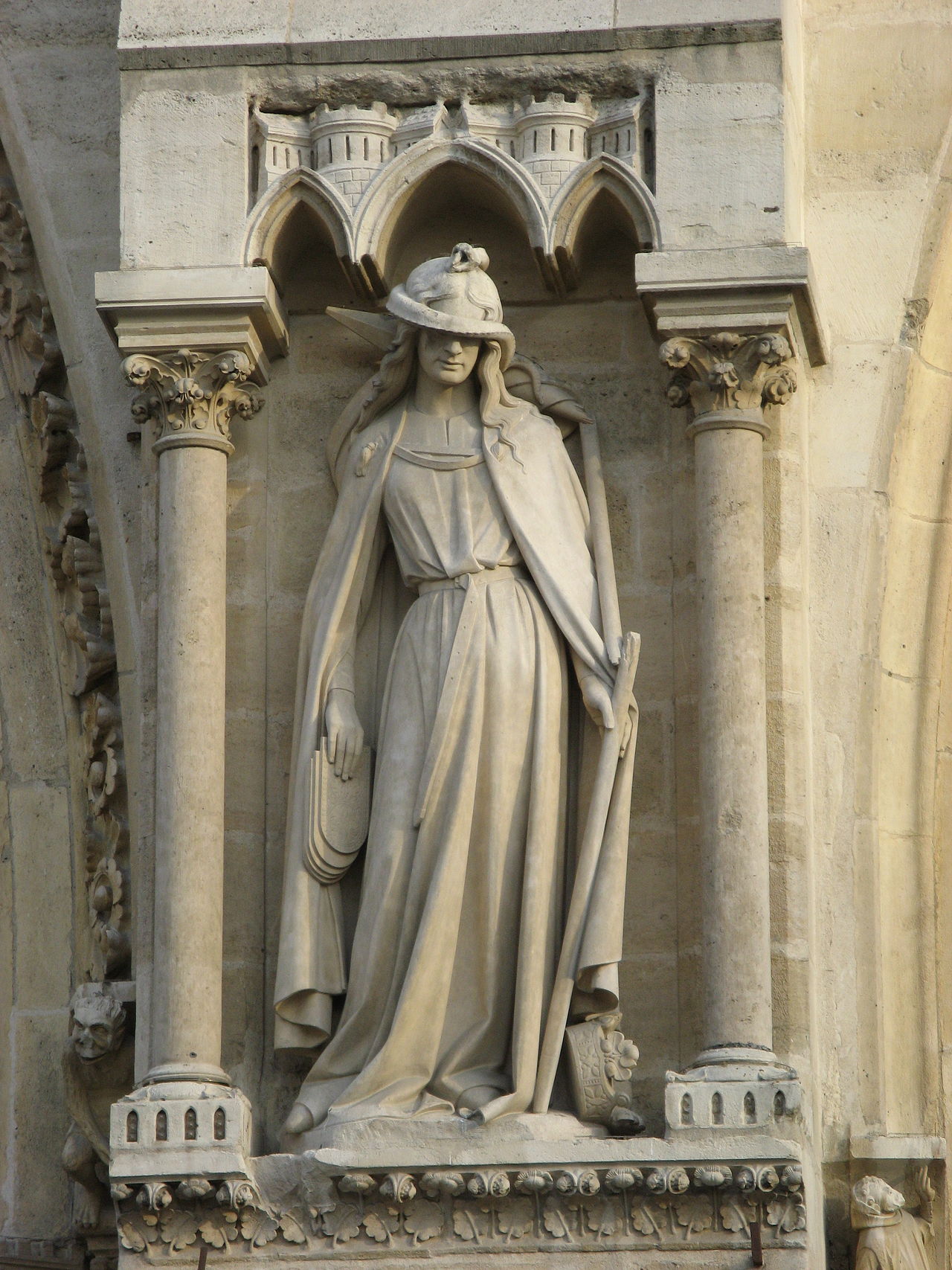
The first kind is dignified in form. In the Ecclesia and Synagoga pairing, two graceful female figures stand on either side of a church doorway. Ecclesia, the Church, stands upright and crowned. Synagoga, Judaism, has her eyes covered, her staff broken, and the tablets of the law slipping from her hand. At some cathedrals her eyes are covered by a simple cloth blindfold. At Notre-Dame de Paris, shown here, a serpent is coiled across her eyes, a detail that can be read as tying her to the serpent of the Garden of Eden. Synagoga is not shown as monstrous. She is shown as blind and superseded. The pairing expresses supersessionism, the teaching that the Church had replaced the Jewish people in God’s covenant, which is traced in the Unit 3 Chapter on Adversus Judaeos.
The figures on Notre-Dame today are nineteenth-century recreations made under the restorer Eugène Viollet-le-Duc. The medieval originals were destroyed during the French Revolution.
These paired figures were carved across medieval Europe, and they survive today in varying conditions. Some still stand where they were placed, on the façades of working cathedrals. Others, fragile after centuries of weather, have been moved indoors to protect them, with copies set in their original outdoor places: the Strasbourg Cathedral pair now stands in the city’s Musée de l’Œuvre Notre-Dame. Some, like the Paris originals, did not survive at all.
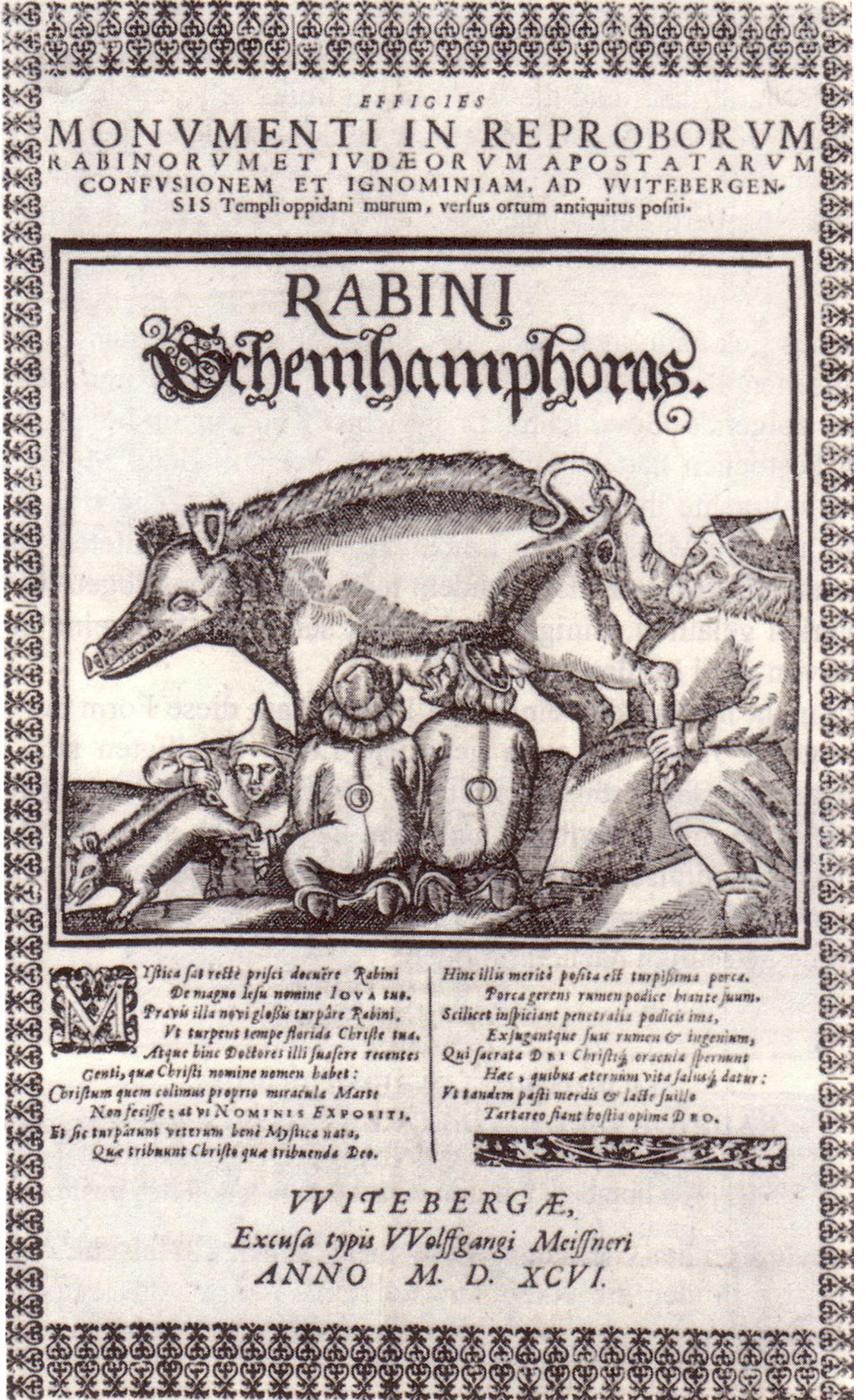
The second kind is openly obscene. The Judensau, German for “Jews’ sow,” shows Jews in degrading contact with a pig, an animal Jewish dietary law forbids. It carries no theological argument. It works through disgust, where Ecclesia and Synagoga worked through idealized subjection. Both kinds of image could be understood by people who could not read, and both were repeated on church buildings across generations.
Where they still are
Most of them never came down.
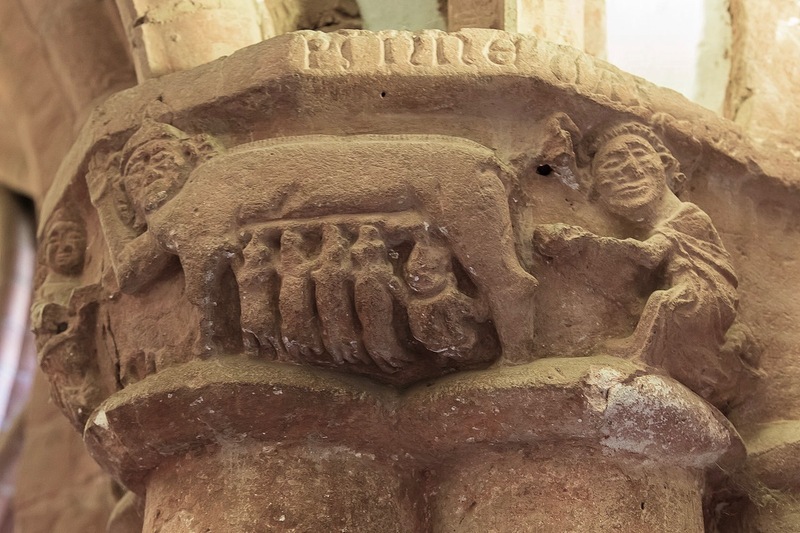
By the counts most often cited, about thirty Judensau carvings survive on churches in Germany and neighboring countries. Most were carved between the 1200s and the 1500s, and most are still in place. Some are on exterior walls, as at Wittenberg. Others are inside, carved into columns and cloisters, like the example at Brandenburg Cathedral below.
The Ecclesia-Synagoga figures, too, still stand on cathedral fronts across Europe, the Notre-Dame pair in Paris among the best known. Art historians study them as evidence of how an idea was taught visually over centuries. The Wittenberg Judensau has drawn the most public argument, partly because of where it is. It is on the church most closely tied to Martin Luther, whose later writings against the Jews the Nazis drew on four centuries afterward.
The knot
Two truths, pulling in opposite directions.
The carving is two kinds of object at once. It is a defamation of Jews, made to insult, and it belongs to a tradition of contempt that accompanied violence against Jewish communities over centuries. It is also physical evidence, fixed in stone, of how anti-Jewish teaching was displayed in public to people who could not read.
Removing it takes down a standing insult, and it also takes the evidence out of the place where the teaching was displayed. Keeping it preserves the evidence in place, and it also keeps the insult on public view. Each choice gives up part of what the other keeps.
Object Spotlight
The Wittenberg Judensau, on the wall, today.
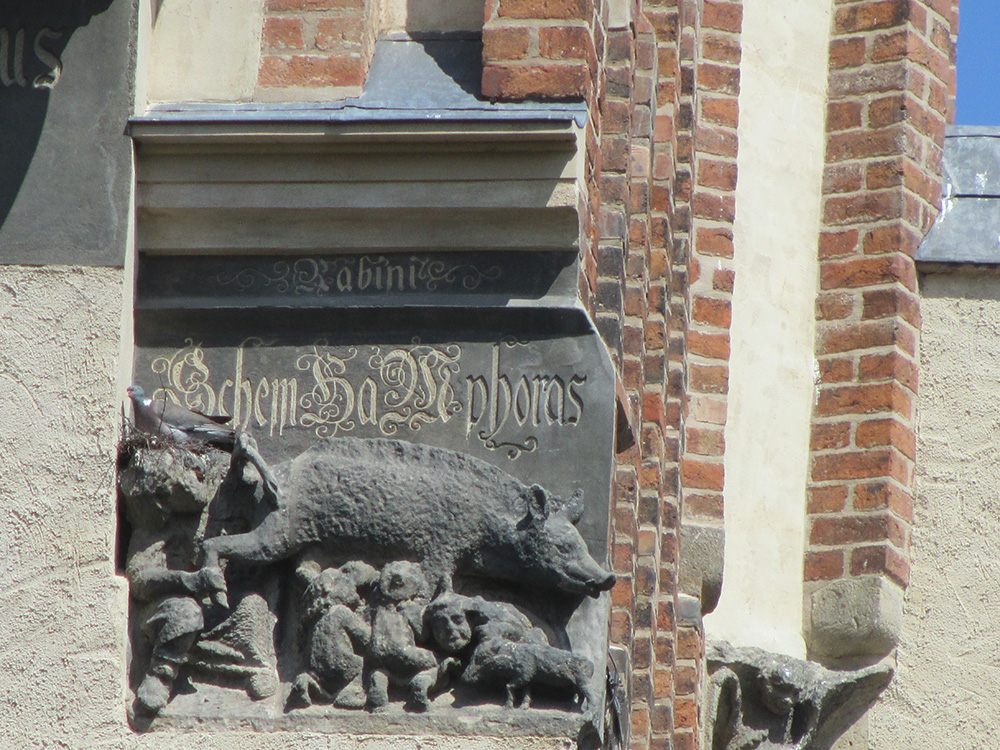
A blackened sandstone carving juts from a brick church wall. A large sow stands in the center. Beneath and around it are several small human figures in contorted poses. Above the carving, set into the stonework, a band of gold Gothic lettering reads “Schem HaMphoras.” A pigeon perches on the carving’s left edge. The whole carving is weathered and streaked, part of the outside of a working church, exposed to weather and birds more than seven hundred years after it was made.
It is a Judensau, a medieval relief made to associate Jews with a pig, the animal their law holds unclean. This one dates to about 1305. It was carved into the exterior of the town church of Wittenberg, where it has remained in full public view ever since. The gold inscription above it is later. “Schem HaMphoras” refers to a 1543 tract by Martin Luther, who preached in this church and whose later writings turned violently against the Jews. The inscription mocks a Hebrew term for the holiest name of God (Shem ha-Meforash, “the explicit name”).
The object has layers: a 1300s carving, a 1500s inscription tying it to Luther, and, out of frame, a 1988 memorial on the ground below, answering both. The image was printed and spread as an engraving in 1596, reaching far past the one wall. An explanatory panel was later placed nearby. In 2022 Germany’s highest civil court let the carving remain because of the memorial and explanation added beneath it. The debate over whether that response is enough is set out below.
The debate
Take it down, or keep it.
Both arguments below have been made in public, including by members of Jewish communities.
Take it down
A church is not a museum. It is a living place of worship. A carving made to degrade Jews has no business on its walls in the twenty-first century, least of all in Germany, and least of all on a building tied to Luther, whose writings against the Jews the Nazis later used. Leaving it up, even with a sign nearby, still means a defamation of a living people is permanently displayed on a sacred building. A small plaque on the ground does not cancel a carving high on the wall. Most people who pass will see the insult and never read the answer. The honest place for such an object is inside a museum, labeled and behind glass, not weathering on a wall where it was placed to wound. To keep it in place is to decide that heritage matters more than the dignity of the people it targets.
Keep it, and confront it
Tearing the carving off the wall does not undo the history. It hides it. The strongest move a society can make is to leave the evidence in place and force itself to reckon with it, to stand beneath the object, in public, and say: this happened here, and it was wrong. An empty patch of wall teaches nothing and comforts everyone. A carving with a memorial and a plain explanation set beneath it teaches the whole truth: the hatred, and a later generation’s judgment of that hatred. Removal also risks a quiet forgetting, the easy sense that such images are safely behind us. Better to keep the wound visible, name it honestly, and let the object testify against the very idea it was built to spread.
How Wittenberg was decided
The carving stays, with the memorial beneath it.
The argument has been to court. Michael Dietrich Düllmann, a Jewish pensioner, sued the parish to have the carving removed. German courts, up to the Federal Court of Justice in 2022, declined to order it taken down. Germany’s Federal Constitutional Court rejected his further complaint in 2024, and in 2026 the European Court of Human Rights declared his complaint inadmissible. The Federal Court of Justice described the relief as antisemitism “carved in stone.” It found, however, that the parish had distanced itself from the carving through the memorial and the explanatory text on site, which present it as a warning. The court treated the object and its added context as a single whole, an indictment of the hatred rather than an endorsement of it.
The same question, elsewhere
Other societies have faced this.
Wittenberg is one case of a recurring problem: what to do with a public monument that a later generation comes to see as shameful. The specifics differ, but the choices usually come down to three: remove it, relocate it, or keep it and add an explanation.
- Denazification. After 1945, the Allied occupation authorities had Nazi symbols, monuments, and street names removed from public space in Germany, on the view that some objects do not belong on display at all.
- Toppled regimes. After the fall of the Soviet Union and the Eastern Bloc (1989–1991), many countries pulled down statues of Lenin, Stalin, and other figures of the old order. Some were destroyed. Others were gathered into open-air parks where the statues are preserved together and presented as history to study rather than to honor.
- Colonial-era statues. In recent years, monuments to figures tied to slavery and empire have been challenged across Britain, South Africa, and elsewhere, where public campaigns to remove or relocate them have been widely debated. Outcomes have ranged from removal to relocation to retention with added explanation.
- Confederate monuments in the United States. Many American towns and cities have faced the same decision over Civil War monuments, most of them erected long after the war itself. Communities reached different answers. Some removed their monuments, some moved them to cemeteries or museums, and some kept them in place with new historical markers. The disagreement itself is part of the public record.
The Wittenberg Judensau is among the oldest objects at the center of such a dispute. It is more than seven hundred years old, and it was still being argued in court in the 2020s.
Three answers a society can give
Recontextualize, repudiate, refute.
Across these cases, responses to a hateful image or idea fall into three kinds.
- Recontextualize the object: leave it in place and build the truth around it, as Wittenberg did with its ground memorial and sign.
- Repudiate the idea behind it: formally reverse the teaching that produced it. The clearest case is the Catholic Church’s 1965 rejection of the charge that the Jewish people were collectively guilty for the death of Jesus, the subject of the Unit 6 Chapter on Nostra Aetate.
- Refute the lie when it returns in new form: answer falsehood with documented evidence. The Holocaust Denial and the Response Chapter covers this kind of answer.
Key takeaways
- Medieval churches across Germany, and a few beyond, still carry carvings made to degrade Jews, in two forms: the Ecclesia and Synagoga pairing, graceful in form but showing Judaism with her eyes covered and her staff broken, and the openly contemptuous Judensau.
- Such a carving is both a standing insult to a living people and evidence of how antisemitism was taught. Removing it ends the public insult but takes the evidence out of its original setting.
- The Wittenberg case went to Germany’s Federal Court of Justice. In 2022 the court allowed the carving to remain, but only because a 1988 memorial and explanation had been added beneath it. Later appeals failed in 2024 and 2026.
- Societies face the same choice with many shameful monuments (denazification, toppled Soviet statues, colonial-era figures, Confederate monuments). The choices usually come down to three: remove, relocate, or keep and add an explanation.
- Three kinds of answer recur: recontextualize the object, repudiate the idea behind it, and refute the lie when it returns.
Classroom Connections
Where this Chapter fits.
Teaching Connections
- World History. What later societies do with monuments and images that preserve a record of contempt (whether to remove, contextualize, or keep them) belongs to the contemporary history of public memory and human rights.
- Classroom Applications. Possible activities:
- analyze monuments and visual culture as historical evidence
- evaluate competing approaches to difficult historical objects (recontextualize, repudiate, refute)
- distinguish preservation from endorsement
- compare public memory across societies (denazification, Soviet monuments, colonial statues, Confederate memorials)
- interpret legal reasoning in historical context (the Wittenberg decision)
- construct evidence-based historical arguments from primary and secondary sources.
- International Classroom Relevance. Because this Chapter examines monuments, public memory, and how societies handle inherited symbols of hatred, it supports Holocaust education, art and visual-culture studies, civics, comparative public history, and source-based historical inquiry.
Standards Alignment
- NYS Social Studies Framework: NY Global History 10.10 (Human Rights Violations).
- NYS Holocaust Education Mandate, Education Law §801. Supports Holocaust instruction by examining how societies confront the surviving material record of antisemitism and decide what to preserve, contextualize, or remove.
- Common Core RH.11–12.6 & RH.11–12.9. Learners analyze the in-place photograph, the 1596 engraving, the Wittenberg court’s reasoning, and the comparative cases while evaluating perspective, purpose, and evidence across sources.
- C3 Framework, D2.His.1 & D2.His.14. Learners investigate context, causation, continuity and change, and evidence-based interpretation while weighing how societies respond to inherited public symbols.
Discussion questions
Each question is anchored in a fact this Chapter documents. Answer from the evidence on the page.
- The carving is both a defamation and a piece of evidence. If you could keep only one (the dignity of removing the insult, or the testimony of keeping the evidence), which would you choose, and what would you lose?
- The Wittenberg court did not order removal, but only because a memorial had been added beneath the carving. Does added context change what an object means, or only what we say about it?
- Compare the Judensau to one modern example on the page: a Soviet statue, a colonial figure, or a Confederate monument. What makes the choices feel alike, and what makes them different?
- Who should decide the fate of a public monument: the community that lives with it, the group it targets, historians, or the courts? Make the strongest case for each.
- Is there a difference between a monument built to honor a person or cause and one built to degrade a people? Should that difference change what we do with it?
Learn more · take this further
Resources from outside organizations for teachers and students.
Sources and citations
Primary sources
A primary source is a record from the time. It was made by people who were there. Examples: letters, diaries, photos, decrees, trial records, and newspapers.
- German Federal Court of Justice (Bundesgerichtshof), judgment of June 14, 2022, case VI ZR 172/20, on the Wittenberg relief.
- The Wittenberg Judensau relief, c. 1305, on the Stadtkirche in Wittenberg, the church where Luther preached. The object at the center of the modern litigation.
- Luther, Martin. Vom Schem Hamphoras. 1543. The tract in which Luther invoked the Wittenberg carving, binding the image to the text.
- Jüdische Allgemeine. “Verfassungsbeschwerde zur Wittenberger ‘Judensau’ verworfen,” August 26, 2024. juedische-allgemeine.de →
- Jüdische Allgemeine. “Straßburg bestätigt deutsche Urteile: Wittenberger ‘Judensau’ bleibt,” February 27, 2026. juedische-allgemeine.de →
Secondary sources
A secondary source was written later. It is a book or article by a historian who studied those records and explains what they mean.
- NPR. “A German Jew Vows To Fight On To Remove Anti-Semitic Sculpture After Court Defeat,” February 8, 2020. npr.org →
- Shachar, Isaiah. The Judensau: A Medieval Anti-Jewish Motif and Its History. London: Warburg Institute, 1974.
- Schreckenberg, Heinz. The Jews in Christian Art: An Illustrated History. New York: Continuum, 1996.
- Ministère de la Culture (France). “Sculptures médiévales de la cathédrale de Strasbourg.” culture.gouv.fr. (The Church and Synagogue figures of the south portal, shown in the Musée de l’Œuvre Notre-Dame since 1939.)
- Consider the Source (New York). “Judensau, Wittenberg.” considerthesourceny.org →
- On Ecclesia and Synagoga: see the Unit 3 Chapter Adversus Judaeos and its cited scholarship.
Finding these documents: many primary sources are free online. Good places to start are the Fordham Internet Jewish History Sourcebook, Yale’s Avalon Project (law and diplomacy), German History in Documents, the collections of the US Holocaust Memorial Museum and Yad Vashem, the National Library of Israel, and Sefaria (for Jewish texts). Search the document’s name and date.
How antisemitism outlived 1945: in postwar Poland and the Soviet Union, in Nazi propaganda that had reached the Middle East, in the forged Protocols, and in the record since October 7, 2023.
Comments?
Write to editor@teachjewishhistory.org.
Last updated: November 2026.