It Didn’t End
The Holocaust in Europe ended on a date you can name: the camps were liberated, the war stopped, the killing was over. That is where most curricula close the story. But the hatred that drove it did not surrender when the German army did.
Why this Chapter exists
The ending was real in one place, and incomplete in others.
This Unit has followed what came after the killing stopped: the trials, the restitution, the memory built into stone and law, the Church’s reversal of an ancient charge. Each of those was a reckoning, a society turning to face what it had done and deciding to answer for it. This final Chapter asks the uncomfortable companion question: what happened to the parts of the hatred that no one turned to face?
Antisemitism did not begin with the Nazis and did not end with them. The earlier Units traced it from a religious charge, to a racial theory, to a forged conspiracy, to industrialized murder. The Nazi defeat closed one chapter of that history with unusual completeness; in Germany, at least, the defeat was total, the reckoning forced, the ideology discredited in public. That reckoning unfolded over decades and remained incomplete in many respects, but it fundamentally changed the public treatment of Nazi ideology within Germany. Yet the ideas had already traveled beyond the reach of that reckoning. This Chapter follows them where they went, and asks what it means that the same hatred is still being taught somewhere in the world right now.
Common misconceptions this Chapter addresses
Because this Chapter reaches from the Holocaust into the present, it draws several predictable misreadings. Each is answered in brief here and in detail in the Misconceptions reference.
- “Antisemitism was defeated when the Nazis were.” The military defeat of Nazi Germany was total, but a hatred is not an army. The ideology was discredited where the reckoning reached, and survived where it did not. More on the Misconceptions page →
- “If Nazi propaganda shaped antisemitism in the Middle East, then the region’s people were Nazis.” No. The documented Nazi role was the atmosphere built over years, not the hand that struck; the same record includes the Muslim and Arab Christian neighbors who sheltered Jews. The point is a propaganda channel, never collective guilt. More on the Misconceptions page →
- “Once the Protocols (the forged “secret Jewish plan” explained below) were exposed, they stopped mattering.” They were proven a forgery in the 1920s and still circulates today. A lie that is never publicly reckoned with does not expire on its own, which is exactly what makes it worth studying. More on the Misconceptions page →
Two different endings
What it means to actually reckon with something.
After 1945, occupied Germany went through a process with a name: denazification. Nazi symbols came down. The ideology was banned from public life. The crimes were tried in open court, the evidence entered into the permanent record, and over the decades that followed, German schools, memorials, and laws were built around the obligation to remember and to teach what had happened. The reckoning was imperfect and slow, but it was real, and it was public. A society looked at the worst it had done and decided, out loud, that it had been wrong.
That kind of reckoning is what breaks a hatred’s transmission. When the ideas are discredited in public, named as lies, and taught against in schools, each new generation meets them already labeled as poison. But that process only happened where the defeat reached. The Nazi project had spent years exporting its antisemitism beyond Europe, and in the places that propaganda reached, there was no denazification, no forced reckoning, no public discrediting. The ideas were not defeated there. They simply stayed.
The strain that was never reckoned with
A documented channel, from Berlin outward.
This is not speculation; it is one of the better-documented chapters of the war, and it is treated in full in the Unit 4 Chapter on The Holocaust in North Africa and the Middle East. The short version: through the 1930s and the war years, Nazi Germany deliberately broadcast antisemitic propaganda beyond Europe, including Arabic-language radio broadcasts from Berlin beginning in 1939. German diplomats cultivated antisemitic agitation in the region. And in 1941, that atmosphere helped produce the Farhud in Baghdad, the deadliest attack in the long history of Iraqi Jewry.
Read The Holocaust in North Africa & the Middle East for the careful version, including its central distinction: the Nazi role in the region was the atmosphere built over years, not the hand that struck, and the historical record there includes Muslim and Arab Christian neighbors who sheltered Jews. The point here is narrower and structural. The propaganda that reached the region during the war did not pass through a postwar reckoning the way it did in Germany. There was no denazification of an idea that had been planted but not defeated. And so a strain of antisemitism that originated in, or was amplified by, the Nazi project outlived the regime that spread it.
Object Spotlight
The voice of Radio Berlin.
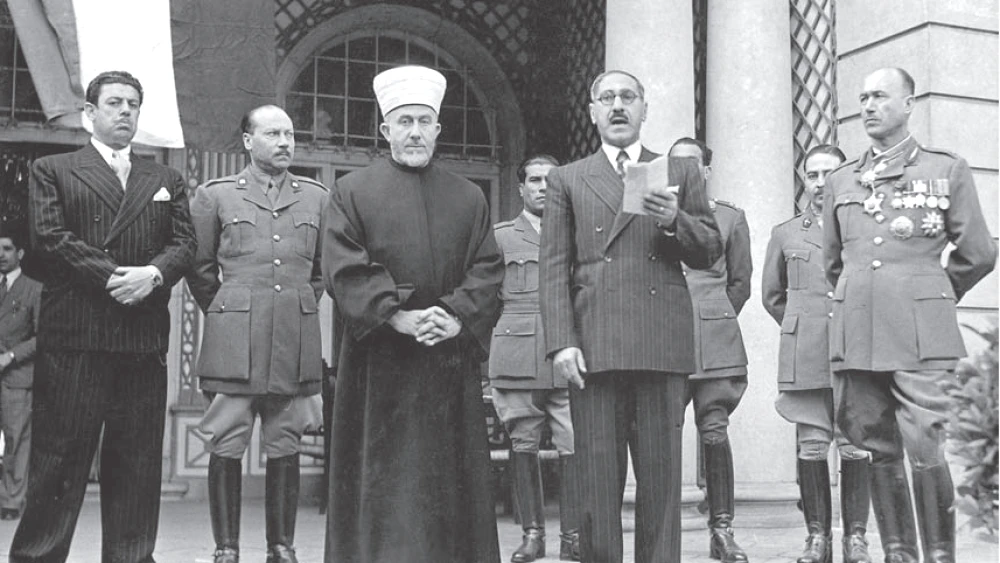
Look at the man reading from the paper, in glasses and a dark suit. He is not a soldier and not a cleric; the uniforms and the robe belong to the men around him. He is something the twentieth century had only recently invented: a broadcaster. His name was Yunis Bahri, and his voice was one of the main ways Nazi propaganda reached the Arabic-speaking world.
This connects directly to the channel just described. Nazi Germany ran an Arabic-language radio service out of Berlin, and Bahri, an Iraqi, was its best-known announcer. Radio was the new mass medium of the 1930s and 1940s: the way news, music, and political messages reached ordinary households for the first time, all at once, in a familiar voice. A government that controlled a powerful transmitter could speak directly into homes across a region, in the listeners’ own language, every night. That is what Berlin did, and Bahri was the voice it used.
He belongs here, and not only in the wartime chapter. The Mufti standing beside him, Amin al-Husseini, is the figure most often pointed to when people discuss Nazi ties in the region, the obvious handshake. Bahri is the subtler and more important half of the story: not a single alliance, but a delivery system. He shows how the ideology actually traveled, not as a treaty between leaders, but as a nightly broadcast in Arabic that carried European antisemitic conspiracy theories to audiences who had no way of knowing where the script had been written. It arrived without a label.
The hatred did not need to announce itself as German or Nazi to take hold. It needed a familiar voice, a trusted medium, and an idea repeated often enough to feel like common sense, and once the war ended, the broadcasts stopped, but the ideas they had planted were never publicly discredited the way they were inside Germany. The channel closed; the content stayed.
Carried forward in print
The clearest single example is a book that never went out of print.
The continuation shows up in several forms, but one is clearer than the rest, because you can follow it object by object. The Protocols of the Elders of Zion, the forged document, manufactured in the early 1900s, that pretends to expose a Jewish plot for world domination, is the single most traceable carrier of the hatred from one century into the next. Its creation and exposure are documented in the Unit 3 Chapter on The Protocols Forgery. It was proven a forgery in the 1920s. That should have ended it. It did not.
The Protocols were embraced by the Nazis, and, crucially for this Chapter, translated and circulated far beyond Europe, including into Arabic, where the forgery has continued to be printed and cited long after every serious authority established that it is a fabrication. A lie that was exposed a century ago is still in circulation today. That is what it looks like when an idea is never reckoned with: the evidence against it exists, is conclusive, and is simply ignored by those who find the lie useful. The forgery is the through-line made visible, the same text, the same lie, passed from hand to hand across a hundred years and several languages.
The Protocols are the clearest example, not the only one. The same continuation can be traced in other forms: in the propaganda channel described above, still produced where it was never discredited; in the old myths that keep returning in new dress, named in the reference page The Recurring Cycle; and, closest to home for anyone reading this, in where these ideas now circulate. A UNESCO survey found antisemitism present in about three-quarters of EU classrooms, and monitoring organizations report antisemitic incidents on school and college campuses in many countries. The lie reaches students directly, before they have the history that would let them recognize it.
What recurs, and what is new
Old myths, new costumes.
Step back from any single channel and a pattern appears, the one named in the reference page on The Recurring Cycle. Antisemitism rarely invents itself from scratch. It reaches for a small set of very old myths and dresses them for the moment: the Jew as poisoner, as conspirator, as disloyal outsider, as secret power behind events. The blood libel, the well-poisoning charge, the Protocols conspiracy, each was built centuries ago, and each returns, adapted to whatever a new audience already fears.
What changes is the costume and the delivery. A charge once carved into a church wall or printed in a forged book now moves at the speed of a network, reaching more people in an hour than a medieval preacher reached in a lifetime. The myth that Jews secretly control finance, or media, or governments, is the same accusation the Protocols forged a century ago, but it now travels in memes, comment threads, and viral video, often stripped of any obvious link to its origins, which makes it harder to recognize and easier to absorb. The continuity is in the content; the novelty is in the reach.
The shape of it today
What the present record shows.
Antisemitism in the present is not a single phenomenon. The historical record and the monitoring organizations that track it describe several distinct currents, which sometimes overlap and sometimes have little to do with one another. They have to be named separately, not collapsed into one enemy:
- The far-right strain: the direct descendant of the racial and conspiracy theories traced in Unit 3, including the Protocols-style claim of hidden Jewish control.
- The strain carried through the never-reckoned channel: the propaganda tradition described above, still produced and circulated in parts of the world where it was never publicly discredited.
- Antisemitism that travels under the cover of political conflict: where hostility to the State of Israel slides into hostility to Jews as a people. Distinguishing legitimate political criticism from antisemitism is precisely the difficult work that the Contemporary Antisemitism Chapter addresses through its published frameworks; this Chapter does not attempt to settle it.
- Everyday, ambient antisemitism: the casual conspiracy joke, the recycled stereotype, the myth absorbed without its history. Often the most widespread, and the most invisible to the people repeating it.
These currents are not historical curiosities. They are active and measurable, and the bodies that track them (among them the Anti-Defamation League, government monitoring agencies, and international organizations) report that antisemitic incidents have risen in many countries in recent years. For the current figures, follow the dated, primary monitoring sources gathered under Learn more below, each of which reports its own year and method.
The register of that record, each incident ending with its verdict or finding, is The Incident Record.
The deadliest day since the Holocaust
October 7, 2023, and what followed.
On October 7, 2023, Hamas, the militant group then governing Gaza, attacked southern Israel and murdered about 1,200 people, taking 251 hostage: the deadliest single day for Jews since the Holocaust, documented in full in The Terror Record. What followed in the world’s cities belongs to this Chapter because of when it happened. On October 8, before any Israeli ground response, the attack was celebrated at a rally in New York. Within days, monitoring institutions in country after country recorded the sharpest surges of antisemitic incidents in their histories.

The currents this page names did not begin in 2023, but they converged that autumn, and they became audible in places that had considered themselves immune: universities, schools, city squares. The Contemporary Antisemitism Chapter documents that record, the frameworks for judging it, and the legal outcomes that followed. The long lesson is this: the hatred did not need to be invented in 2023. It was already there, waiting, unreckoned with. That is what this Chapter’s title means.
Where it could be headed
What history lets us say, and what it does not.
History cannot tell the future. But the pattern in the earlier Units is not random, and it supports a few careful observations, not predictions, but conditions the historical record repeatedly shows.
- Antisemitism intensifies under stress. Across the cases documented across these Units, the charge surges when societies are frightened, unstable, or looking for someone to blame, plague, economic collapse, lost wars, political upheaval. The myth is a tool that gets reached for in hard times. That stress-and-scapegoating sequence is named directly in the reference page The Recurring Cycle.
- New technology is a multiplier, not a cause. The printing press spread the Protocols; radio carried Berlin’s broadcasts; the network carries the meme. Each new medium did not create the hatred but extended its reach. Whatever comes next will likely do the same.
- Unreckoned ideas do not expire on their own. The Protocols are a century past their exposure and still circulate. An idea that is never publicly defeated waits. The alternative to teaching against a lie is leaving it in circulation, undisturbed.
Where it is headed, then, is partly a choice, and the choice is made in classrooms as much as anywhere.
The analytical question
How to recognize it today.
The Protocols work on someone who has never heard of them. A conspiracy meme works on someone who cannot see the century of forgery behind it. The propaganda that was never reckoned with keeps working precisely because each new audience meets it fresh. Having studied the pattern, you meet it already labeled, and a lie that is recognized loses most of its power.
The old material in this Chapter was carved in stone, printed in books, and broadcast on the radio. Its descendants travel differently. Today you are most likely to meet antisemitic propaganda not in a pamphlet but in the ordinary places attention already lives: a short clip in a video feed, a comment under a post, a meme passed sideways between friends, the text or voice channel of an online game, an image board built for anonymity. The setting looks casual, which is part of the design. The point of moving an old charge into a joke or a reaction image is to let it spread fast, stay deniable, and read as harmless to anyone not meant to catch it.
The forms change, but the underlying claims do not, and that is what makes them catchable. The same small set of myths examined across this Unit, set out in full on the Contemporary Antisemitism Chapter as seven recurring tropes, accounts for most of what circulates: that Jews secretly hold power, that they are disloyal, that they are uniquely greedy, that they bear a collective and inhuman guilt, that they commit ritual murder, that the Holocaust was faked or inflated, and that the Jewish state is a stand-in for all of these at once. Name the seven, and you hold a key that fits most of the locks.
Three habits turn that knowledge into recognition. First, look for the fixed structure under the changing target: when the same script, a hidden group pulling the strings, is run with a new name dropped into the same slot, the name is doing less work than the structure. Second, watch for the claim that cannot be disproven: when every piece of contrary evidence is treated as further proof of the cover-up, that closed loop is the signature of a conspiracy theory rather than an argument. Third, notice two meanings at once: a line offered as innocent to outsiders while signaling to those who already know the trope. None of this asks you to settle a political dispute. They are tools for seeing the inherited machinery, the same machinery traced from the church wall to the forged book to the broadcast, now running at the speed of a feed.
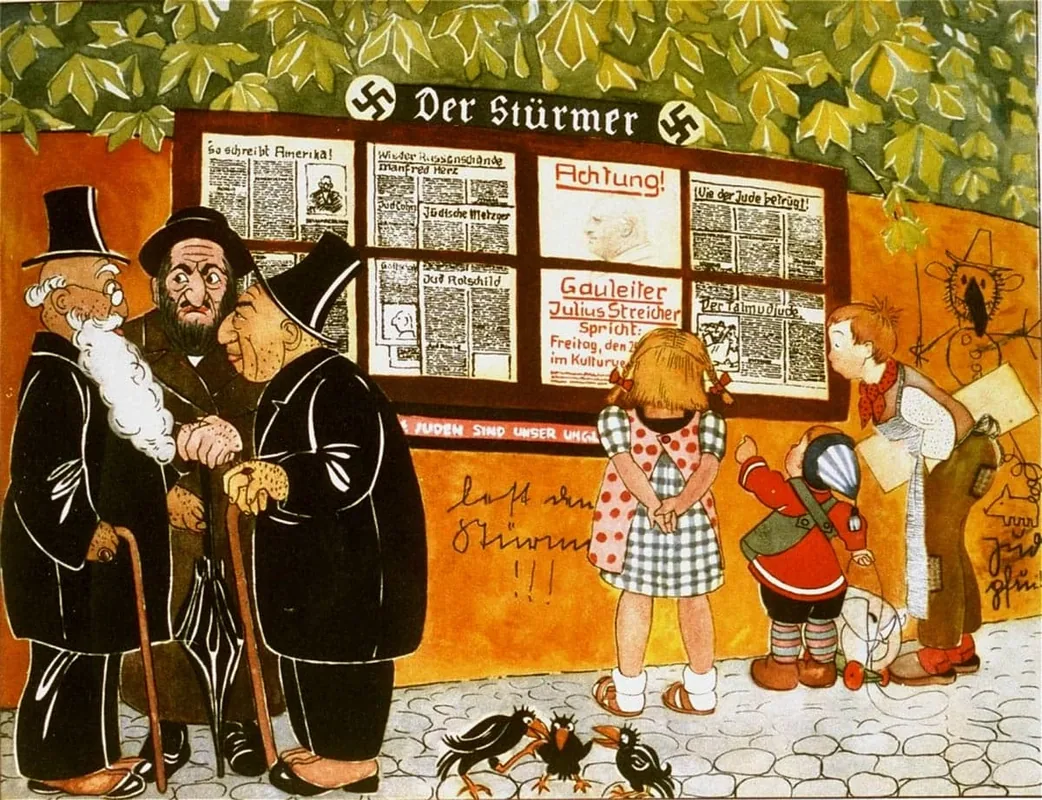
Meeting the history before the propaganda has a practical payoff. The 1936 children's book above worked because it reached children early, before anything truer could. Recognition works the same way in reverse: someone who has seen where the costume comes from is far harder to dress.
Key takeaways
- The Holocaust in Europe ended in 1945, but the antisemitism that produced it did not; a war ends with surrender; a hatred ends only when it is confronted, named, and unlearned.
- Postwar Germany underwent denazification, a public, forced reckoning that discredited the ideology where the defeat reached, but the Nazi project had already exported its antisemitism to places that never went through that process.
- The clearest traceable carrier is the Protocols of the Elders of Zion: proven a forgery in the 1920s, embraced by the Nazis, translated and circulated worldwide, and still in print today. A lie that was never reckoned with does not expire on its own.
- Antisemitism today appears in several distinct currents that should be named separately, not collapsed into one; distinguishing antisemitism from legitimate political criticism is the careful work of the Contemporary Antisemitism Chapter, not this one.
- History supports a few cautious observations, the hatred intensifies under social stress, new technology multiplies its reach, and unreckoned ideas wait rather than fade, which together make education the strongest available answer.
Classroom Connections
Where this Chapter fits.
Teaching Connections
The disciplines and courses this Chapter naturally supports, for any educator, anywhere.
- World History. This concluding Chapter traces how the hatred behind the Holocaust persisted and mutated after 1945, the continuity-and-change question at the center of the postwar and contemporary record.
- Classroom Applications. Students can:
- trace continuity and change across historical periods;
- distinguish historical evidence from contemporary advocacy;
- recognize recurring propaganda structures;
- evaluate primary and secondary sources;
- analyze historical patterns without assuming inevitability;
- construct evidence-based historical arguments.
- International Classroom Relevance. Because this Chapter examines how prejudice persists, mutates, and recurs, it supports Holocaust education, genocide and human-rights studies, media literacy, civic education, and source-based historical inquiry.
Standards Alignment
- NYS Social Studies Framework: NY Global History 10.10 (Human Rights, Genocide, and the Postwar World).
- NYS Holocaust Education Mandate, Education Law §801. Supports Holocaust instruction by teaching students to recognize the recurring structures of antisemitism, the “never again” purpose the mandate exists to serve.
- Common Core RH.11–12.6 & RH.11–12.9. Students analyze historical and contemporary sources, monitoring reports, and the recurring Protocols myth while evaluating perspective, purpose, and the difference between evidence and advocacy.
- C3 Framework, D2.His.1 & D2.His.14. Students investigate continuity and change, causation, and evidence-based interpretation while tracing a pattern across periods without assuming inevitability.
For further classroom use
- The capstone of the arc. This Chapter is designed to be taught last. It assumes students have met the earlier material and asks them to connect it to the present, making it a natural synthesis or final-project anchor.
- Media-literacy crossover. The “old myth, new costume” framing is a ready bridge to digital-literacy instruction, teaching students to trace a claim to its origin rather than absorb it whole.
- Handle with care. Because the material reaches into the present and the political, keep the discussion on documented history and recognition, and off collective blame, the same discipline that credits the Arab and Muslim neighbors who sheltered Jews and separates the strands of present-day antisemitism rather than collapsing them into one enemy.
Discussion questions
Each question is anchored in what this Chapter and the ones it links to document.
- The Chapter argues that a war ends with surrender but a hatred ends only when it is confronted and unlearned. Using denazification as the example, what does it actually take to “unlearn” a hatred at the scale of a society?
- The Protocols were proven a forgery a century ago and still circulate. Why does proof not stop a lie that people find useful, and what, if anything, does?
- The Chapter separates several different currents of present-day antisemitism rather than treating them as one. Why does naming them separately matter, both for accuracy and for fairness?
- “Old myth, new costume”: take one historical myth from an earlier Unit and trace how its core accusation could reappear in a form a modern audience would recognize.
- The Chapter claims that where this is headed is partly a choice made in classrooms. Do you agree that education can change the trajectory of a hatred? What would have to be true for that to work?
Learn more · take this further
Verified resources from outside organizations for students, teachers, and school and organization leaders.
Sources
Primary sources
A primary source is a record from the time. It was made by people who were there. Examples: letters, diaries, photos, decrees, trial records, and newspapers.
- Nazi Germany’s Arabic-language radio broadcasts from Berlin, 1939–1945. Surviving transcripts were preserved in Allied wartime monitoring records, translated and documented in Herf (below).
- Wartime German press photograph of the broadcaster Yunis Bahri with Amin al-Husseini, this Chapter’s Object Spotlight.
- The Protocols of the Elders of Zion: the forgery itself (manufactured in the early 1900s) and its later printings, including the Arabic editions circulating by the mid-1920s. Cited here as an artifact of the hatred, never as a source of fact, and not linked.
- Graves, Philip. “The Truth About the Protocols: A Literary Forgery.” The Times (London), August 16, 17, and 18, 1921.
- Trau keinem Fuchs auf grüner Heid und keinem Jud bei seinem Eid (“Trust No Fox in the Green Meadow and No Jew on His Oath”), children’s book, Germany, 1936; pictured in this Chapter. United States Holocaust Memorial Museum.
Secondary sources
A secondary source was written later. It is a book or article by a historian who studied those records and explains what they mean.
- Herf, Jeffrey. Nazi Propaganda for the Arab World. New Haven: Yale University Press, 2009.
- Boum, Aomar, and Sarah Abrevaya Stein, eds. The Holocaust and North Africa. Stanford: Stanford University Press, 2018.
- Black, Edwin. The Farhud: Roots of the Arab-Nazi Alliance in the Holocaust. Washington: Dialog Press, 2010.
- Anti-Defamation League. Audit of Antisemitic Incidents (annual), and Community Security Trust (UK). Antisemitic Incidents Report (annual): the monitoring series this Chapter refers to for current figures.
Where the fuller records live
- On the Nazi propaganda channel into the region: the Unit 4 Chapter The Holocaust in North Africa and the Middle East and its cited scholarship (Boum & Stein; Bashkin; Black).
- On the forgery and its survival: the Unit 3 Chapter The Protocols Forgery.
- On the recurring structure: the reference page The Recurring Cycle.
- On distinguishing antisemitism from political criticism: the Unit 3 Chapter Contemporary Antisemitism and its published frameworks.
- For current figures and incident data, the dated monitoring sources are gathered under Learn more, each reporting its own year and method.
Comments?
Write to editor@makorproject.org.
Last updated: August 2026.