Liberation and the Displaced Persons
"From bondage to freedom, from darkness to a great light."
Title-page inscription of the Survivors' Talmud, an edition of the central text of Jewish learning printed by Holocaust survivors with the U.S. Army on German presses, 1948 · Read the source (U.S. Holocaust Memorial Museum) →
Why this Chapter exists
The killing ended. The Holocaust did not.
The liberation of the camps ended the killing. It did not end the consequences of the Holocaust. Hundreds of thousands of Jewish survivors remained displaced for years after the war. They could not return to their former homes, or would not. Families had been destroyed, communities no longer existed, property had been taken, and antisemitic violence continued in parts of Europe. Yet this postwar history often gets only brief attention in secondary-school instruction. Understanding liberation means understanding what happened after liberation.
The years before the killing are treated in the 1933–1939 Chapter. This Chapter covers the parallel gap at the other end. The standard secondary-school curriculum, where it treats the Holocaust, cuts off at the end of the killings in 1945. The story as usually told ends with about six million European Jews killed, and stops. What follows is what the usual telling leaves out. What happened to the survivors in the months and years that followed. The documented record of the liberation. The displaced persons period. The return that was impossible, and the postwar antisemitic violence that made it so. And the network that supported survival until the dispersal to permanent homes. That network: the UN relief administration (UNRRA), the International Refugee Organization, the American Jewish relief body known as the Joint, the Jewish Brigade (the Palestinian Jewish unit of the British Army), and the receiving infrastructure.
A history in which the killings simply end in 1945 says nothing about the people who survived them, or the conditions in which they went on living. Nothing about the receiving countries that did or did not admit them. Nothing about the events that shaped the resolution of the displaced-persons question: the Kielce pogrom of July 1946, the Exodus 1947 affair, the founding of Israel as a receiving state for large parts of the DP population. Such a history leaves out what the end of the Holocaust actually meant. This Chapter provides that record.
Editorial discipline
How this Chapter treats the postwar continuation.
What the Chapter does. Document the 1944–1951 period at the level of detail the record supports: the geography and timing of the liberations, the conditions that followed, the structure of the DP system, the events that shaped the outcome, the figures. Cite the established scholarly literature (Yehuda Bauer, Atina Grossmann, Avinoam Patt, Margarete Myers Feinstein, Zeev Mankowitz) and the extensive primary sources (the Harrison Report, the Truman directives, the contemporary press coverage, the DP newspapers and memoirs, the extensive USHMM and Yad Vashem documentary collections).
What the Chapter does not do. Treat the postwar period as a story whose outcome was historically inevitable. The decisions that produced the 1948 founding of Israel, the U.S. Displaced Persons Act, and the later admission expansions were specific choices by specific actors. They were shaped by the failures of receiving states during the 1933–1939 refugee crisis, treated in the 1933–1939 Chapter. The Chapter documents the decisions honestly, including the friction: General Patton's conflict with the Harrison Report, the British opposition to Jewish immigration to Palestine, and the American nativist opposition to wider refugee admission.
Common misconceptions this Chapter addresses
This Chapter covers the Liberation and Displaced Persons period (1945–1957). The story as usually told treats it as the close of the Holocaust era. The record shows a continuation. The dedicated Misconceptions entries show why V-E Day did not end the ordeal for the survivors.
The first liberations · July 1944 – May 1945
The geographic and chronological pattern.
The killings ended at different times in different places. The killing centers and the camps were liberated across some ten months, from the first Soviet entry into Majdanek in July 1944 to the U.S. liberation of Mauthausen in May 1945. The geographic pattern is simple. The Soviet army liberated the major killing centers and concentration camps in the East: Majdanek, Auschwitz-Birkenau, Stutthof, Gross-Rosen. The Western Allied forces liberated the camps in the West: Bergen-Belsen, Buchenwald, Dachau, Mauthausen.
The first major Nazi camp to be liberated was Majdanek, on the outskirts of Lublin in occupied Poland. The Soviet Red Army entered it on July 23, 1944. The Soviet forces found the camp intact. The German guards had tried to destroy the evidence of the killings, but they were forced to retreat before finishing. The Polish-Soviet Extraordinary Commission for Investigation of German-Fascist Crimes then documented Majdanek. That record was the first documentation of the Nazi killing apparatus to reach the broader international public. Soviet war correspondent Konstantin Simonov published his account in August 1944 in Krasnaya Zvezda ("Red Star"). It was the first major published account of a Nazi killing center.
The Soviet 322nd Rifle Division liberated Auschwitz-Birkenau on January 27, 1945. The Soviet forces found some 7,000 prisoners remaining at the complex, weak from forced marches and starvation. The German guards had already marched most of the prisoner population west on the "death marches" of January 17–21, 1945. These were forced evacuations in winter conditions, and they killed roughly 15,000 prisoners in the Auschwitz evacuation alone. The prisoners who reached the Western camps on the death marches were among those the Western Allies liberated in April 1945. In 2005, the United Nations General Assembly made January 27 International Holocaust Remembrance Day.
The Soviet army liberated the other Eastern camps in the 1945 advance: Gross-Rosen (February 1945), Sachsenhausen (April 22, 1945), Ravensbrück (April 29–30, 1945), and Stutthof (May 9, 1945). Each produced extensive additional documentation of the killing apparatus. But Western skepticism toward Soviet reporting, wartime censorship, and the closed borders that followed kept this Soviet documentation from circulating widely in the West. Western public understanding of the Nazi camps was shaped primarily by the April 1945 liberations.
The April 1945 liberations
The camps the Western Allies entered.
The Western Allied liberation of the camps occurred in concentrated form across April 1945 as the Allied forces advanced into central Germany. The major liberations:
- Ohrdruf (April 4, 1945). A subcamp of Buchenwald, liberated by U.S. 4th Armored Division forces. Ohrdruf was the first camp with surviving prisoners that U.S. forces liberated; Natzweiler-Struthof had been found abandoned in late 1944. General Dwight D. Eisenhower, with Generals Omar Bradley and George Patton, visited Ohrdruf on April 12, 1945, shaping Eisenhower's subsequent documentation order.
- Buchenwald (April 11, 1945). Liberated by the U.S. 6th Armored Division. Buchenwald was one of the largest concentration camps in central Germany. About 21,000 prisoners were found alive at liberation, including large parts of the surviving Auschwitz death-march population. Among the liberated prisoners was the future Nobel laureate Elie Wiesel.
- Bergen-Belsen (April 15, 1945). Liberated by British forces of the 11th Armoured Division. Bergen-Belsen had been overwhelmed in the final months of the war as large transports of prisoners from evacuated Eastern camps arrived without corresponding capacity for housing, food, water, or sanitation. The British forces found some 60,000 surviving prisoners and roughly 13,000 unburied corpses. The BBC reporter Richard Dimbleby's broadcast from Bergen-Belsen, delivered April 19, 1945, was the major British public encounter with the Nazi killing apparatus and remains among the most documented single reports of the war. About 14,000 of the surviving prisoners died in the weeks immediately following liberation despite Allied medical intervention.
- Dachau (April 29, 1945). Liberated by the U.S. 42nd and 45th Infantry Divisions. Dachau (the first concentration camp opened by the Nazi regime, on March 22, 1933) was the model for the system and the camp longest in operation (twelve years and one month). Some 32,000 prisoners were found at liberation. Many had been transferred from evacuated Eastern camps in the final weeks.
- Mauthausen (May 5, 1945). Liberated by the U.S. 11th Armored Division. The last major camp liberated by U.S. forces. Roughly 40,000 prisoners were found at the complex.
- Theresienstadt (May 8, 1945). Liberated by Soviet forces on the day of the German unconditional surrender. The "showcase" ghetto-camp the Nazi regime had used to deceive the International Red Cross in June 1944 contained about 30,000 surviving prisoners at liberation, including large numbers of children whose immediate postwar fate became a major focus.
Eisenhower's documentation order
“A tendency to charge these allegations merely to propaganda.”
On April 15, 1945, three days after his visit to Ohrdruf, General Eisenhower ordered the camps photographed, filmed, and documented in detail. He insisted on it personally. His telegram to General George C. Marshall, the U.S. Army Chief of Staff, included a now-famous statement: "The visual evidence and the verbal testimony of starvation, cruelty and bestiality were so overpowering as to leave me a bit sick. In one room, where they were piled up twenty or thirty naked men, killed by starvation, George Patton would not even enter. He said he would get sick if he did so. I made the visit deliberately, in order to be in a position to give first-hand evidence of these things if ever, in the future, there develops a tendency to charge these allegations merely to propaganda."
The order produced the visual record that shaped how the world came to understand the killings. The U.S. Army Signal Corps produced thousands of still photographs and some 80,000 feet of motion picture film documenting the camps in April–May 1945. The American press covered it extensively. Eisenhower personally invited delegations of newspaper editors and members of Congress to see the camps. The record was later used at the Nuremberg trials (treated in the Postwar Trials Chapter) as evidence of the Nazi crimes.
The order did more than record the moment. It anticipated denial, which later became an organized movement in the second half of the twentieth century. The record he insisted on is the foundation the answer to denial still rests on. Much of today's Holocaust education, from USHMM to Yad Vashem, is built on the record his order produced.
Conditions in the immediate aftermath
The killings stopped. The conditions did not.
The conditions of the survivors in the weeks and months following liberation were severe. Much of the surviving population had been kept on starvation rations for years. Allied doctors could not quickly reverse the physical effects: typhus, tuberculosis, dysentery, severe malnutrition. Bergen-Belsen’s post-liberation deaths, noted above, were not unique. Comparable mortality occurred at Buchenwald, Dachau, and the other liberated camps. The Allied medical response brought emergency feeding, typhus inoculations, and temporary hospital facilities. The scale of the survivor population overwhelmed it.
The surviving population was concentrated in the Allied zones of occupied Germany and Austria. The figures across April–July 1945:
- some 50,000 Jewish survivors in the U.S. zone of Germany (mostly in Bavaria) by July 1945, rising past 100,000 during 1946 as the Bricha brought survivors west.
- about 14,000 Jewish survivors in the British zone of Germany (mostly at Bergen-Belsen, which became the major British-zone DP center).
- some 5,000 Jewish survivors in the French zone of Germany.
- roughly 12,000 Jewish survivors in U.S.-occupied Austria.
- about 20,000 Jewish survivors in Italy (mostly the population that had reached Italian territory through the wartime Jewish Brigade and the escape routes).
Many survivors had no immediate destination. Some 90 percent of the prewar Polish Jewish population had been killed. The surviving Polish Jews who tried to return to their prewar communities met severe postwar antisemitic violence, treated in the Kielce section below. That violence made return impossible. Much of the surviving Eastern European Jewish population had no surviving relatives and no surviving prewar communities. For them, the DP system was the only available option.
The Harrison Report · August 24, 1945
"We appear to be treating the Jews as the Nazis treated them."
In June 1945, President Harry Truman appointed Earl G. Harrison to investigate the conditions of the Jewish survivors in the U.S. occupation zone. Harrison was Dean of the University of Pennsylvania Law School and the U.S. representative to the Intergovernmental Committee on Refugees. He spent July and early August 1945 visiting roughly thirty DP camps in Germany and Austria. His report reached Truman on August 24, 1945. Its finding: the U.S. Army's treatment of the Jewish survivors was inadequate.
The Harrison Report's most-quoted sentence: "As matters now stand, we appear to be treating the Jews as the Nazis treated them, except that we do not exterminate them. They are in concentration camps in large numbers under our military guard instead of S.S. troops. One is led to wonder whether the German people, seeing this, are not supposing that we are following or at least condoning Nazi policy."
The report's specific findings:
- Jewish survivors were being housed in conditions equivalent to those of German prisoners and former Nazi collaborators in the DP camp population.
- Jewish survivors were not treated as a distinct group. The DP system mixed them in with the far larger non-Jewish DP population, Polish, Ukrainian, Baltic, and other Eastern Europeans whose concerns, and sometimes politics, were very different.
- Jewish survivors were being kept under armed guard and could not freely leave the camps.
- The food rations were inadequate.
- The medical and sanitary conditions were inadequate.
- Most Jewish survivors wanted to emigrate to Palestine, where a large Jewish community stood ready to receive them and where many hoped to build a Jewish national home. That route was blocked by the British White Paper of 1939, which had capped Jewish immigration to Palestine (treated in the 1933–1939 Chapter).
The report's recommendations: separate the Jewish survivors at once, establish all-Jewish DP camps under Jewish leadership, and fix the food, medical, and housing conditions immediately. And open Palestine immigration to 100,000, which Harrison framed as the answer. The report moved through the Truman administration and produced the Truman directive of December 22, 1945.
The Truman directive · December 22, 1945
The first substantive U.S. response.
President Truman issued the directive of December 22, 1945 in direct response to the Harrison Report. The directive ordered the U.S. Army to improve conditions in the DP camps in the U.S. zones of Germany and Austria, to establish all-Jewish DP camps under partial Jewish administrative leadership, and to give Jewish DPs preferential treatment in U.S. immigration admissions within the existing quota system. The directive produced the separation of Jewish DPs from the DP population that Harrison had recommended.
The friction the report caused within the U.S. Army is documented in later scholarship. General George Patton, the U.S. Third Army commander whose forces administered most of the Bavarian DP camps where the Jewish survivor population was concentrated, opposed the Harrison-recommended changes. Patton's private diary entries from August–September 1945 contained openly antisemitic characterizations of the Jewish DPs and sharp criticism of the priority given to their conditions. The diaries were later published in The Patton Papers (edited by Martin Blumenson, Houghton Mifflin, 1974). General Eisenhower removed Patton from his Third Army command in October 1945. The reason was Patton's broader friction with denazification policy. His handling of the Jewish DP question was one element of it.
The Truman directive's consequence was a marked improvement of conditions in the Jewish DP camps across late 1945 and 1946. Jewish administrative leadership was established in the major camps. The food and medical conditions improved. The framework that would support the DP population over the next five years took shape.
The DP camps as architecture
Where the survivors lived between 1945 and 1952.
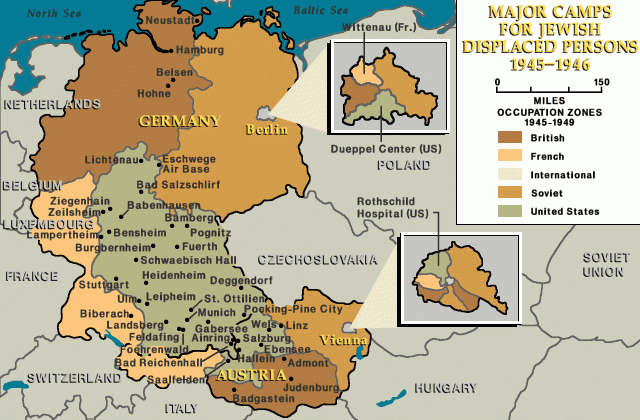
The DP camps varied in their character. The major camps and their features:
- Feldafing (Bavaria, U.S. zone). The first all-Jewish DP camp, established May 1, 1945 on the site of a former Hitler Youth training facility. Peak population about 4,000–6,000. An active cultural and religious life developed: Yiddish-language press, Hebrew classes, religious institutions.
- Föhrenwald (Bavaria, U.S. zone). Peak population some 5,600 in 1946. The last major Jewish DP camp to close, operated until February 1957 because much of the remaining DP population could not be placed in receiving countries.
- Landsberg (Bavaria, U.S. zone). Peak population roughly 6,000–7,000. Located near the prison where Hitler had been imprisoned in 1923–24 and had written Mein Kampf. A lively Yiddish-language press developed at the camp (the Landsberger Lager-Cajtung was among the most widely read DP-period publications).
- Bergen-Belsen DP Camp (British zone). Established on the site of the liberated concentration camp. Peak population about 11,000–12,000. The main center of British-zone Jewish DP life and the center of the British-zone Aliyah Bet operations, the clandestine sailings for Palestine described below.
- Zeilsheim (U.S. zone, near Frankfurt). Peak population some 3,500. Distinct from the other camps because Zeilsheim was located in a former residential housing complex rather than a former military or concentration-camp facility.
- Wetzlar, Eschwege, the Funk-Kaserne transit and emigration center in Munich, and roughly twenty smaller facilities completed the U.S.-zone DP architecture.
- about fifteen larger DP camps operated in the British zone, some ten in the French zone, roughly twenty in Austria, and about fifteen in Italy.
The DP camps built up an organized cultural and religious life across 1945–48. Some 70 Yiddish-language newspapers were published across the DP system. Elementary and secondary schools, kindergartens, and vocational classes operated across the camps, run by the Joint Distribution Committee, ORT (the Organization for Rehabilitation through Training), the Jewish Agency for Palestine, and the wider Jewish welfare organizations. And some 23,000 babies were born in DP camps between 1946 and 1948. This was the well-documented "DP baby boom," and it affirmed that the survivors meant to live and continue.
A set of major organizations kept the system running. The United Nations Relief and Rehabilitation Administration (UNRRA, 1943–47) provided much of the DP system's logistics and administration. The International Refugee Organization (IRO, 1947–52) succeeded UNRRA and organized the resettlement period. The American Jewish Joint Distribution Committee ("the Joint," founded 1914) provided the Jewish-specific support: food, medical care, religious materials, cultural programming, and emigration assistance. ORT provided vocational training. The Jewish Agency for Palestine coordinated the Aliyah Bet operations. HIAS (the Hebrew Immigrant Aid Society, founded 1881) coordinated the U.S. admissions. And the Jewish Brigade, the World War II British Army unit of roughly 5,000 Jewish Palestine volunteers, provided postwar support and organized the early operations of the Bricha, the escape network described below.
Why return was impossible
The documented record.
The question most school treatments never address is why the survivors did not simply go home. The record answers it:
- The communities no longer existed. Most of the Eastern European Jewish communities had been destroyed during the killings. Survivors returning to prewar towns found the Jewish populations gone, often the majority of the town before the war. The synagogues, schools, cemeteries, and communal organizations had been destroyed.
- The homes were occupied. Many survivors found their prewar homes occupied by non-Jewish neighbors who had moved in during the deportations. Getting property back was contested and unresolved for years, and it was the central practical barrier to return.
- The neighbors were unwelcoming or actively hostile. Many survivors met open hostility from prewar neighbors. Part of it was the property question. Part was antisemitism the Nazi defeat had not erased. Part was the politics of the moment.
- The new political authorities were not supportive. The communist regimes that took hold across Eastern Europe in 1945–48 treated the Jewish survivors as a problem to contain, not a population owed restitution. The Soviet position on Jewish-specific treatment, documented in the Soviet Jewry Chapter, shaped the Eastern European response.
- The postwar antisemitic violence kept killing. The Kielce pogrom of July 4, 1946 (treated in its own section below) was the deadliest single postwar antisemitic event, but it was not isolated. In Poland alone, estimates of Jewish survivors killed in antisemitic violence across 1944–47 range from about 500 to 1,500. The record is documented in works including Jan Tomasz Gross's Fear: Anti-Semitism in Poland after Auschwitz (Princeton, 2006). Similar postwar violence was documented in Hungary, Slovakia, Romania, and the wider region.
The Kielce pogrom · July 4, 1946
Forty-two Jewish survivors of the Holocaust killed in postwar Poland.
On July 4, 1946, a pogrom broke out in the Polish city of Kielce. It came fourteen months after the German surrender, and nearly a year and a half after the liberation of Auschwitz. Forty-two Jewish survivors were killed, and about forty more were injured. Kielce confirmed that postwar Jewish return to Poland was impossible. It accelerated the Polish Jewish emigration to the DP camps and onward.
The immediate trigger was the disappearance of an eight-year-old Polish boy, Henryk Błaszczyk, on July 1, 1946. Henryk returned home on July 3, after spending two days at the home of a family friend. His father coached him to claim that Jews had kidnapped him and held him in the building at Planty Street 7. That building housed the Kielce Jewish Committee and a large share of the surviving Kielce Jewish population. The boy's claim drew on the older medieval blood libel treated in the Blood Libel Chapter. It was reported to Polish police on July 4. A crowd gathered outside the Planty Street 7 building. Polish police and military personnel joined the violence rather than preventing it.
The pogrom lasted some five hours. Polish soldiers and police entered the Planty Street 7 building and removed Jewish residents to the courtyard. There the assembled crowd beat and killed them. Further violence occurred at the Kielce railway station, where Jewish travelers passing through the city were attacked. The forty-two killed included large numbers of Auschwitz and Bergen-Belsen survivors. They had survived the killings, only to be killed by Polish neighbors fourteen months after the German surrender.
After Kielce, Jewish emigration from Poland to the DP camps in Germany and Austria sharply accelerated. Roughly 100,000 Polish Jews emigrated through the Bricha network in the months following Kielce, more than had emigrated in the preceding fourteen months. Kielce stands as the documentary evidence of why postwar return was impossible. Later scholars documented the event and its consequences, including Jan Tomasz Gross in Fear and Joanna Tokarska-Bakir in Pod Klątwą (Under a Curse, 2018). Their work is part of the wider Polish engagement with the question of postwar antisemitic violence in Poland. The Polish Institute of National Remembrance (IPN) examined the documentary record in the post-1989 period.
The Bricha
The organized movement from East to West.
The Bricha (Hebrew: בריחה, "flight" or "escape") was the large, organized, clandestine movement of Eastern European Jewish survivors out of their prewar territories. It carried them across the Polish, Czech, Hungarian, Austrian, and German borders to the DP camps in the Allied zones of occupied Germany, Austria, and Italy, and from there onward to Palestine. The Bricha operated from about mid-1945 through 1948. It moved some 250,000 Jewish survivors across the broader European territory.
The Bricha's infrastructure came from four sources. One was the Jewish Brigade, the British Army unit of roughly 5,000 Jewish Palestine volunteers. Another was the Mossad LeAliyah Bet, the clandestine-immigration arm of the Yishuv, the Jewish community of pre-state Palestine. The Joint Distribution Committee provided the financial and logistical support. And local Jewish actors, a wide network of them, worked across the territories the Bricha crossed. Large parts of the Allied military administration cooperated: chiefly the U.S. zone, partly the British zone, with friction in the French zone. That cooperation made the operations possible.
The main routes of the Bricha:
- The Polish route. Through the Czechoslovak border at the Tatra Mountains, then south through Czechoslovakia into Austria and onward to Italy or the U.S. zone of Germany.
- The Romanian route. Through the Hungarian border, then west through Hungary and Austria.
- The Russian-zone route. Most of the Jewish survivors in the Soviet zone of Germany and the Soviet zone of Austria moved west into the Allied zones across 1945–46. The broader Cold War closure of the East-West border then made the crossings far more difficult.
The Bricha was organized, coordinated, sustained Jewish action. It gathered the surviving population in the Western DP camps, where the Joint Distribution Committee and the relief organizations could support them. From there, emigration to Israel and the receiving countries became possible. Without the Bricha, much of the Polish, Hungarian, Romanian, and broader Eastern European Jewish survivor population would have remained where return was impossible but onward emigration was difficult. The Bricha turned the postwar Jewish demographic question into one that the 1948 founding of Israel and the resettlement could answer.
Aliyah Bet and the British blockade
Clandestine immigration to Mandate Palestine, the territory Britain then governed.
Aliyah Bet (Hebrew: עלייה ב׳, "Ascent B") was the large clandestine Jewish immigration to Palestine across the 1934–48 period. It defied the British Mandate-era immigration restrictions documented in the 1933–1939 Chapter. Much of the Aliyah Bet activity came in the postwar years, 1945–48. In those years the DP population's push to reach Palestine collided with the British refusal to expand the Mandate immigration quotas.
Three parts made it work. The Mossad LeAliyah Bet, the organization of the Yishuv responsible for the clandestine immigration, directed it. The Palmach naval forces, the naval branch of the Yishuv military organization, provided large parts of the operational personnel. And U.S.-based fundraising, coordinated by the American Jewish community, supplied the money. About 142 ships were used in the Aliyah Bet operations over those years. Many were purchased through Joint Distribution Committee and American Jewish fundraising.
The British answered with force. The British navy patrolled the Eastern Mediterranean and intercepted most of the Aliyah Bet ships. Passengers were detained at Atlit, the Mandate-era detention camp in Palestine. From August 1946 they were also detained at Cyprus, where the British established detention camps to relieve the overcrowding at Atlit. Some 50,000 Aliyah Bet passengers were detained at the Cyprus camps across 1946–49. Many were held until after the 1948 founding of Israel resolved the question.
The figures across the postwar Aliyah Bet:
- roughly 70,000 Jewish DPs sailed for Palestine in Aliyah Bet operations across 1945–48. Most were intercepted before landing.
- about 50,000 were detained at Cyprus across 1946–49.
- some 1,600 died at sea or in detention across the whole 1934–1948 effort, the great majority in the wartime sinkings.
The Exodus 1947
The single most consequential Aliyah Bet ship.
The Exodus 1947 began as the SS President Warfield, a former Chesapeake Bay steamship. American Jewish fundraising purchased it, and it was refitted in Baltimore and then in southern France. On July 11, 1947, the ship departed Sète, France with roughly 4,500 Jewish DPs aboard. Most of the passengers were Polish and Hungarian survivors who had reached southern France through the Bricha network. The destination was Palestine.
The British navy intercepted the Exodus 1947 in international waters off the Palestinian coast on July 18, 1947. The passengers and crew resisted fiercely. Three were killed, including the American crew member William Bernstein, and the ship was forced into Haifa harbor. Then the British broke from their own precedent. The standard British response to Aliyah Bet ships was detention at Cyprus. This time the British government went further, and ordered the passengers moved to three British prison ships (the Empire Rival, the Runnymede Park, and the Ocean Vigour) and returned to Europe.
The point was deterrence. The British meant to show that attempting clandestine immigration to Palestine would end in physical return to Europe. What followed was the opposite of what they intended. The three prison ships traveled across the summer of 1947 under continuous, intense international press coverage. They arrived at Port-de-Bouc, France in late July 1947, and the French government refused to forcibly disembark the passengers. A three-week standoff followed. On August 22, the British government decided to return the passengers to Germany, the same country they had escaped two years earlier.
The ships arrived in Hamburg, in the British zone of occupied Germany, on September 8, 1947. The passengers were forced off the ships. They resisted physically, and the international press covered it all. They were placed in two DP camps in the British zone, Pöppendorf and Am Stau (later Sengwarden), over their resistance and under the world's eyes.
The Exodus affair shifted the international climate. On November 29, 1947, about three months after the world press watched the Exodus passengers forced back to Germany, the United Nations General Assembly voted on the Palestine partition (Resolution 181). Later research treats the affair as one of the turning points in the international position on the Palestine question. The standard study is Aviva Halamish's The Exodus Affair: Holocaust Survivors and the Struggle for Palestine (Syracuse, 1998).
The 1948 founding as DP relief
The receiving state arrives.
For many survivors, the establishment of the State of Israel did more than create a new country. It created, for the first time since liberation, a state committed to receiving Jewish refugees as citizens rather than temporary displaced persons.
The State of Israel was founded on May 14, 1948, documented in the Modern Israel Chapter. The founding resolved the question of the DP population's destination. The Israeli Law of Return, enacted July 5, 1950, established the commitment that any Jew could immigrate to Israel and become an Israeli citizen. That commitment answered the documented record of the years before. Receiving countries had refused Jewish refugees in 1933–1939. British restrictions had held back Palestine immigration in 1945–48. Large parts of the European Jewish population had been left trapped.
The DPs left for Israel in enormous numbers across 1948–51. About 136,000 Jewish DPs immigrated to Israel from the camps during this period, nearly the entire Jewish DP population that had not by then emigrated to other destinations. Counting survivors who came directly from Europe outside the DP system, the scale was larger still. By the end of 1952, Israel had absorbed some 718,000 immigrants. Of those, roughly half came from Europe, most of them survivors. The arrival of the DP population reshaped the young state's population and politics. Historians treat the DPs' integration into Israeli life as one of the central strands of early state-building.
Inside the DP camps, the effect was emptying. The peak Jewish DP population of roughly 250,000 in 1947–48 declined to about 100,000 by the end of 1949, and to some 30,000 by the end of 1950. Most of the major DP camps closed across 1949–52. Only Föhrenwald continued operating, housing the part of the DP population that could not be placed in receiving countries: chiefly the disabled, the elderly without family connections, and those for whom emigration was complicated.
U.S. admission and the Displaced Persons Act
The American share.
The DPs who did not go to Israel went to the United States, Canada, Australia, the United Kingdom, and other Western receiving countries across 1948–52. The U.S. admission process was structured by the Displaced Persons Act of 1948 (Public Law 80-774), signed by President Truman on June 25, 1948, and expanded by amendments in 1950 and 1951.
The features of the Displaced Persons Act:
- It authorized the admission of roughly 200,000 DPs over two years.
- The original 1948 act was written in ways that disadvantaged Jewish applicants. It required DPs to have entered the Allied zones before December 22, 1945, which excluded the Bricha-era arrivals of 1946–47. It reserved 30 percent of places for agricultural workers, which few Jewish DPs were. And it gave a 40 percent preference to Eastern European DPs, built to favor Polish, Ukrainian, and Baltic applicants over Jewish ones.
- President Truman, in signing the act, criticized its discriminatory provisions: "It is with very great reluctance that I have signed S. 2242, the Displaced Persons Act of 1948. … The bill that has been presented to me discriminates in callous fashion against displaced persons of the Jewish faith." Truman pressed Congress for amendments across 1949–50.
- The 1950 amendments removed the discriminatory provisions and raised the total to some 415,000 over four years.
The figures of DP admission to the U.S. across 1948–52:
- roughly 80,000 Jewish DPs admitted under the Displaced Persons Act framework.
- Additional Jewish DPs admitted through the standard immigration quotas across the period.
- Total Jewish DP admission to the U.S.: about 137,000 across 1945–52.
Most U.S. Jewish DP admissions were processed through HIAS (the Hebrew Immigrant Aid Society) and the Joint Distribution Committee. The main receiving communities, in New York, Chicago, Boston, Philadelphia, Los Angeles, and the other centers documented in the American Jewry Chapter, absorbed the DP population across the 1950s.
The closure of the camps
The end of the DP period.
The major Jewish DP camps emptied across 1949–52; the last did not close until 1957. The closing dates:
- Bergen-Belsen DP Camp: closed 1951.
- Landsberg: closed 1950.
- Feldafing: closed 1953.
- Zeilsheim: closed 1948.
- Föhrenwald: closed February 1957.
The last closure came twelve years after the end of the war. It marked the end of the European Jewish DP period. By then, most of the Jewish DP population had emigrated to Israel, the United States, Canada, Australia, the United Kingdom, or the other receiving countries. The rest had been integrated into postwar German civic life as the founding population of the postwar German Jewish community. That community was small next to the prewar German Jewish community, but larger than it would have been without the DPs who stayed.
The dispersal of the Jewish DP population across the receiving countries shaped the contemporary global Jewish demographic map. About 136,000 went to Israel from the camps. Roughly 137,000 went to the United States, about 20,000 to Canada, some 15,000 to Australia, and roughly 8,000 to the United Kingdom. Smaller numbers went to other destinations. Together these movements produced the postwar Jewish demographic configuration that the Unit 2 Chapters document.
Contested elements
The honest accounting.
Historians still argue several questions about this period:
- The Allied response question. Did the Allied military authorities, above all the U.S. Army under Patton's command in Bavaria, respond adequately to the Jewish DPs in the first postwar months? The consensus, set out in Leonard Dinnerstein's America and the Survivors of the Holocaust (Columbia, 1982), is that the early response was inadequate and the Harrison Report produced the corrections. Patton's own antisemitism is part of that record.
- The British position question. Britain kept enforcing the 1939 White Paper restrictions through the DP crisis. Why has been argued ever since. Was it Arab political concerns, imperial calculation, antisemitism within parts of the Foreign Office, or some mix? Historians still take different positions.
- The postwar Polish antisemitism question. The postwar Polish antisemitic violence, documented at Kielce and across the Polish record, has been debated at length within Poland. Jan Tomasz Gross's Fear: Anti-Semitism in Poland after Auschwitz (2006) produced intense debate in Poland. Later scholars, among them Joanna Tokarska-Bakir and Marci Shore, have documented the event and the pattern while wrestling with questions of Polish national memory.
- The Bricha and Aliyah Bet evaluation question. Did the Aliyah Bet operations help produce the November 1947 partition vote and the May 1948 founding of Israel? Or would Cold War positioning, Truman administration calculations, and the collapse of the British Mandate have produced the outcome anyway? The consensus is that the Aliyah Bet operations contributed materially to the outcome alongside those wider dynamics.
Object Spotlight
The Survivors' Talmud, Heidelberg, 1948.
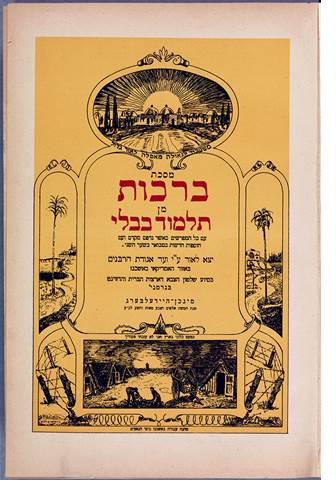
If the Chapter has one object to open it for a classroom, it is the Survivors' Talmud. It is a complete nineteen-volume edition of the Babylonian Talmud, printed in Munich and Heidelberg between 1948 and 1950. A delegation of rabbis from the Displaced Persons camps requested it. It is the only edition of the Talmud ever published by a government body: the United States Army, which acquired and ran the Heidelberg printing plant that had produced Nazi propaganda during the war.
It opens the Chapter for the same reason the period does. The Nazi state had tried to destroy not only the Jews but their books. The survivors, still in camps on German soil, asked an army to help them print the central text of Jewish learning, and printed it in the very plant that had served the regime. The title page holds the whole arc in one image: the barbed wire below, the Land of Israel above, and the line between them. It is loss and continuation on a single page.
Holding: complete sets survive at the Library of Congress, the U.S. Holocaust Memorial Museum, the National Library of Israel, and other major collections. The title and dedication pages are viewable online through USHMM's Experiencing History project.
The photographic record of liberation and the displaced-persons years is held in the archives gathered in the Museum, under Photographs, among them Yad Vashem and YIVO.
Key takeaways
- The killing stopped at liberation in 1944–45, but the survivors' ordeal did not: roughly a quarter-million Jewish Displaced Persons could not go home, and lived in DP camps until as late as 1957.
- Return was impossible for concrete, documented reasons: destroyed communities, occupied homes, and lethal postwar antisemitism. The Kielce pogrom of July 4, 1946 killed forty-two Jewish survivors in Poland.
- The Harrison Report (August 1945) and President Truman's directive (December 1945) were the first substantive responses. Conditions in the camps improved only after the U.S. recognized the survivors' distinct situation.
- The DP camps were not only waiting rooms. Survivors married, had children (the "DP baby boom"), published newspapers, staged theater, and printed the Survivors' Talmud, a deliberate rebuilding against the attempt to erase them.
- The period ends in dispersal: the Bricha and Aliyah Bet moved survivors west and toward Palestine. The 1948 founding of Israel and the U.S. Displaced Persons Act of 1948 opened the doors that finally emptied the camps.
Classroom Connections
Where this Chapter fits.
Teaching Connections
The disciplines and courses this Chapter naturally supports, for any educator, anywhere.
- World History. This Chapter examines the immediate aftermath of the Holocaust through liberation, displaced-persons camps, refugee movements, postwar migration, and the rebuilding of Jewish life. It connects the end of World War II to the humanitarian, legal, and political challenges that followed genocide.
- Classroom Applications. Students can:
- analyze refugee and displaced-person records;
- compare national immigration policies after World War II;
- evaluate humanitarian responses to genocide;
- examine the relationship between liberation and recovery;
- analyze survivor testimony alongside government documents;
- construct evidence-based historical arguments using multiple primary and secondary sources.
- International Classroom Relevance. Because this Chapter examines refugee movements, humanitarian relief, immigration policy, postwar reconstruction, and survivor experiences, it supports Holocaust education, refugee studies, human rights education, migration history, and source-based historical inquiry in classrooms worldwide.
Standards Alignment
- NYS Social Studies Framework: NY Grade 8 (United States History) 8.6 and NY Global History 10.10 (Human Rights, Genocide, and the Postwar World).
- NYS Holocaust Education Mandate, Education Law §801. This Chapter supports Holocaust instruction by examining what happened after liberation, including displaced-persons camps, survivor experiences, refugee policy, postwar antisemitism, and the search for permanent homes. It expands Holocaust education beyond the moment of military liberation to the years of recovery that followed.
- Common Core, Reading in History/Social Studies (grades 6–12). Students assess an author’s purpose and point of view (RH.6–8.6, RH.9–10.6, RH.11–12.6) and corroborate evidence across multiple sources (RH.6–8.9, RH.9–10.9, RH.11–12.9), working from military reports, refugee records, government documents, survivor testimony, photographs, diplomatic correspondence, and immigration policies.
- C3 Framework, D2.His.1 & D2.His.14 (grades 6–8 and 9–12). Students investigate chronology, historical causation, continuity and change, and evidence-based historical interpretation while examining how societies responded to the humanitarian consequences of genocide.
For further classroom use
- NYS Holocaust Education Mandate: Education Law §801. The 1944–51 period is substantively the continuation of the Holocaust education the mandate supports.
- Primary sources. The Harrison Report (free online through USHMM), Eisenhower's documentation order and his correspondence with Marshall, and the DP-period press and memoir literature give upper-grade students rich material for source-evaluation work. Yad Vashem's narrative overview, Displaced Persons Camps →, frames the period through survivor testimony and the Harrison Report itself.
- The return to life. The DP camps were not only waiting rooms. They were where survivors married, had children, published, studied, and rebuilt. Yad Vashem's exhibitions The Return to Life → and DP Camps · Culture and Press → document this through photographs, artwork, and the camp newspapers, the world-building counterpart to the loss.
- The 1948 founding as DP relief. The link between the DP camps and the establishment of Israel is concrete: on May 16, 1948 survivors at the Landsberg DP camp held a celebratory parade → marking the new state. Its founding opened the doors of emigration for the majority of the Jewish DPs.
- Film. The Long Way Home (Mark Jonathan Harris, 1997; Academy Award for Best Documentary Feature), listed on the Films & Video page, is the standard classroom documentary on this period. The Museum of Jewish Heritage in New York also holds DP-period exhibition material.
Discussion questions
These questions ask students to work from the evidence on this page and reach their own conclusions. Each is anchored in a specific fact the Chapter documents.
- The standard Holocaust unit often ends at liberation in 1944–45. But the page shows roughly a quarter-million Jewish survivors could not go home and lived in DP camps as late as 1957. Why might a survivor be unable to "go home" even after the killing stopped, and what does it change to learn that the story doesn't end at liberation?
- The Kielce pogrom of July 4, 1946 killed forty-two Jewish survivors in Poland, after the war was over. What does it tell you that returning Jews faced lethal violence in their former communities, and how does that fact reframe the meaning of "liberation"?
- The page stresses the DP camps were not only waiting rooms: survivors married, had children, published newspapers, staged theater, and printed the Survivors' Talmud. Why describe this as "rebuilding against the attempt to erase them"? What does choosing to build a life become, in that context?
- The Harrison Report and Truman's 1945 directive changed conditions only after the U.S. recognized the survivors' distinct situation. Why might it matter, for relief to work, that authorities first name a group's specific circumstances rather than treating all displaced people the same?
- This period (the aftermath, the camps, the dispersal) is usually where the telling stops. Is the aftermath of an atrocity given the same attention in school as the atrocity itself? Why might the ending be left untaught, and what is lost when it is?
Sources and citations
Primary sources
A primary source is a record from the time. It was made by people who were there. Examples: letters, diaries, photos, decrees, trial records, and newspapers.
- Klein, Gerda Weissmann. All But My Life. New York: Hill and Wang, 1957 (expanded edition 1995).
- Levi, Primo. The Reawakening (Italian original La tregua, 1963; English 1965). Boston: Little, Brown.
- The Harrison Report (August 24, 1945). U.S. State Department; preserved at the Harry S. Truman Presidential Library. Available online through USHMM's Holocaust Encyclopedia.
- The Truman directive (December 22, 1945). U.S. State Department; preserved at the Harry S. Truman Presidential Library.
- "The US Army Talmud." Experiencing History: Holocaust Sources in Context, U.S. Holocaust Memorial Museum. (Title-page inscription and dedication of the Survivors' Talmud.) perspectives.ushmm.org →
- The Joint Distribution Committee Archives. archives.jdc.org →
Secondary sources
A secondary source was written later. It is a book or article by a historian who studied those records and explains what they mean.
- Bauer, Yehuda. Flight and Rescue: Brichah. New York: Random House, 1970.
- Bauer, Yehuda. Out of the Ashes: The Impact of American Jews on Post-Holocaust European Jewry. Oxford: Pergamon Press, 1989.
- Dinnerstein, Leonard. America and the Survivors of the Holocaust. New York: Columbia University Press, 1982.
- Grossmann, Atina. Jews, Germans, and Allies: Close Encounters in Occupied Germany. Princeton: Princeton University Press, 2007.
- Patt, Avinoam J. Finding Home and Homeland: Jewish Youth and Zionism in the Aftermath of the Holocaust. Detroit: Wayne State University Press, 2009.
- Patt, Avinoam J., and Michael Berkowitz, eds. "We Are Here": New Approaches to Jewish Displaced Persons in Postwar Germany. Detroit: Wayne State University Press, 2010.
- Mankowitz, Zeev W. Life Between Memory and Hope: The Survivors of the Holocaust in Occupied Germany. Cambridge: Cambridge University Press, 2002.
- Myers Feinstein, Margarete. Holocaust Survivors in Postwar Germany, 1945–1957. Cambridge: Cambridge University Press, 2010.
- Gross, Jan Tomasz. Fear: Anti-Semitism in Poland after Auschwitz. Princeton: Princeton University Press, 2006.
- Tokarska-Bakir, Joanna. Pod Klątwą: Społeczny portret pogromu kieleckiego [Under a Curse: A Social Portrait of the Kielce Pogrom]. Warsaw: Czarna Owca, 2018.
- Halamish, Aviva. The Exodus Affair: Holocaust Survivors and the Struggle for Palestine. Syracuse: Syracuse University Press, 1998.
- Holian, Anna. Between National Socialism and Soviet Communism: Displaced Persons in Postwar Germany. Ann Arbor: University of Michigan Press, 2011.
- Wyman, Mark. DPs: Europe's Displaced Persons, 1945–1951. Philadelphia: Balch Institute Press, 1989.
- Königseder, Angelika, and Juliane Wetzel. Lebensmut im Wartesaal: Die jüdischen DPs in Nachkriegsdeutschland. Frankfurt: Fischer, 1994. (English translation: Waiting for Hope, Northwestern University Press, 2001.)
- USHMM Holocaust Encyclopedia · Displaced Persons. encyclopedia.ushmm.org/displaced-persons →
- Yad Vashem · After the Holocaust. yadvashem.org/education →
- United States Holocaust Memorial Museum, “Major camps for Jewish displaced persons, 1945–1946,” map, Holocaust Encyclopedia. encyclopedia.ushmm.org. The map in this Chapter.
Finding these documents: many primary sources are free online. Good places to start are the Fordham Internet Jewish History Sourcebook, Yale’s Avalon Project (law and diplomacy), German History in Documents, the collections of the US Holocaust Memorial Museum and Yad Vashem, the National Library of Israel, and Sefaria (for Jewish texts). Search the document’s name and date.
The legal reckoning with Nazi Germany, from the Nuremberg tribunal of 1945 to the last camp-guard trials of the 2020s.
Comments?
Write to editor@makorproject.org.
Last updated: September 2026.