The Memory Architecture
Walk into a hall in Jerusalem and look up. Six hundred faces look back at you from the ceiling, photographs of people murdered in the Holocaust, each one a recovered name. Below, in the dark, sit shelves of binders holding millions more. None of it built itself.
Why this Chapter exists
Memory is something a society chooses to build.
Holocaust education does not happen by itself. It rests on an infrastructure that had to be built, by governments, survivors, scholars, and philanthropists, across the sixty years after the war. This Chapter is about that infrastructure: the laws, museums, archives, memorials, and remembrance days that make it possible to teach the Holocaust at all.
The point is concrete. When a New York teacher opens the Holocaust Encyclopedia of the U.S. Holocaust Memorial Museum (USHMM) for class, the encyclopedia exists because the United States federal government chartered the museum in 1980 and funded the building that opened in 1993. When the same teacher uses Yad Vashem's online resources, those exist because Israel’s parliament, the Knesset, established Yad Vashem by law on August 19, 1953. Holocaust Remembrance Day exists because the United Nations adopted Resolution 60/7 on November 1, 2005. None of that infrastructure existed in 1946. It is the product of postwar decisions, built piece by piece across eighty years.
Together these institutions do more than commemorate the Holocaust. They preserve documents, testimony, photographs, artifacts, and scholarship that allow future generations to study the history from primary evidence.
The framework has drawn real scholarly debate, both supportive and critical, and the contested questions are set out honestly in the honest-accounting section.
Common misconceptions this Chapter addresses
The memory infrastructure, Yom HaShoah, Yad Vashem, USHMM, the Stolpersteine, the Berlin Memorial, the IHRA framework, the Never Again Education Act, is an institutional record the standard curriculum touches only in passing.
- "Holocaust restitution closed the chapter on Nazi-era harms." see the dedicated entry →
- "The 1952 Luxembourg Agreement was a quiet diplomatic settlement." see the dedicated entry →
- "Holocaust education has always been part of American public schools." see the dedicated entry →
1944–1950
Recording it before the war even ended.
The work of recording the Holocaust began before the war ended:
- Oneg Shabbat. The secret Warsaw Ghetto archive organized by the historian Emanuel Ringelblum and some sixty collaborators between 1940 and 1943, recording daily life in the ghetto, the deportations, and the wider Nazi project. It was buried in three caches before the ghetto was destroyed; two were recovered after the war (1946 and 1950). Some 35,000 pages survive at the Jewish Historical Institute in Warsaw. The story is told in full in the Resistance Chapter.
- The Soviet documentation. The Soviet Extraordinary Commission (established 1942) recorded the killings on Soviet soil, though it listed Jewish victims only as Soviet citizens. The Jewish Anti-Fascist Committee compiled The Black Book, edited by Vasily Grossman and Ilya Ehrenburg, suppressed by Stalin in 1948 and finally published in Jerusalem in 1980.
- The Central Jewish Historical Commission (Poland, established 1944 under Filip Friedman), which collected thousands of testimonies in 1944–47 and was later absorbed into the Jewish Historical Institute in Warsaw.
- The Wiener Holocaust Library (founded 1933 in Amsterdam by Alfred Wiener, moved to London in 1939): the first Holocaust archive, recording Nazi persecution from 1933 on.
- The YIVO Institute for Jewish Research (its center moved to New York in 1940; the Nazis looted its Vilna collections from 1941), whose archive remains the core record of Eastern European Jewish life.
- The Allied documentation. After seeing Ohrdruf on April 12, 1945, General Dwight D. Eisenhower, the Allied commander in Europe, pressed for witnesses and cameras. Army photographers produced a vast photographic and film record of the liberated camps, and the Nuremberg trials (1945–49) created the documentary record later used in scholarship and museums, covered in the Postwar Trials Chapter.
1951
Yom HaShoah, the first national day of remembrance.
Once a year, on a spring morning, a siren sounds across all of Israel for two minutes, and the country stops. Drivers pull over and step out of their cars on the highway; people stand still on the sidewalk. This is Yom HaShoah, the day Israel set aside to remember the Holocaust, set by a resolution of its parliament, the Knesset, on April 12, 1951, and anchored in law in 1959. Its full Hebrew name means "Holocaust and Heroism Remembrance Day." The date, 27 Nisan in the Hebrew calendar, was chosen to mark the Warsaw Ghetto Uprising of April 1943, nudged slightly so it would not fall during Passover; on the ordinary Western calendar it lands in April or May.
The siren sounds at 10:00 a.m. The main state ceremony is held at Yad Vashem, Israel's national Holocaust memorial in Jerusalem, with observances in schools and army units across the country.
The 1951 resolution mattered as the first state-level national day of Holocaust remembrance. The Israeli precedent shaped what followed, the spread of national commemoration days in post-Communist Eastern Europe in the 1990s, and the UN's International Holocaust Remembrance Day in 2005.
1953
Yad Vashem, Israel's national memorial.
The name says what the place is for. Yad vashem is an ancient Hebrew phrase, "a memorial and a name", from a line in the book of Isaiah that promises a name "that shall not be cut off." Israel built an entire national institution around that promise: to give back a name to people the Nazis had tried to reduce to numbers. The Knesset created it by law on August 19, 1953, with a mandate to:
- Record the Holocaust period, roughly 1933 to 1945.
- Commemorate the some six million Jewish victims.
- Commemorate the Jewish resistance, rescue, and partisan efforts.
Yad Vashem
The Righteous Among the Nations.
During the Holocaust, helping a Jew could cost a rescuer their life. A small number of people did it anyway, hid a family, forged a passport, looked the other way at a checkpoint. The Righteous Among the Nations program, mandated by the same 1953 law and set up in 1963, exists to find those people and honor them by name. Recognition is deliberately hard to earn: it takes real evidence, usually the testimony of the person who was saved, proof that the rescuer faced genuine danger, and proof that no payment changed hands.
Cases are reviewed by a commission traditionally chaired by an Israeli Supreme Court justice. Those approved receive the Medal of the Righteous, a certificate of honor, and an offer of honorary Israeli citizenship for surviving Righteous. At Yad Vashem, the Avenue and Garden of the Righteous carry trees and inscriptions with their names.
As of 2025, about 28,000 people from 51 countries have been recognized. The largest national groups are Poland (~7,200), the Netherlands (~5,900), France (~4,300), Ukraine (~2,700), Belgium (~1,800), Lithuania (~900), Hungary (~880), and Italy (~770), with roughly 100 to 200 new recognitions added each year.
Among the well-known cases: Raoul Wallenberg, the Swedish diplomat in Budapest whose protective passports saved tens of thousands of Hungarian Jews before he was arrested by Soviet forces in January 1945 and disappeared in Soviet custody; Oskar Schindler, the German industrialist who protected about 1,200 Jewish workers (recognized 1993); Chiune Sugihara, the Japanese consul in Kaunas, Lithuania, who issued about 2,000 transit visas in 1940 that allowed roughly 6,000 Jews to escape; Aristides de Sousa Mendes, the Portuguese consul in Bordeaux who defied orders to issue visas in June 1940, with about 3,900 recipients identified by name so far; the French village of Le Chambon-sur-Lignon under Pastor André Trocmé; and the Danish rescue of October 1943, which evacuated about 7,000 Danish Jews to Sweden.
The recovery of names
The Hall of Names.
The Hall of Names at Yad Vashem is the effort to recover and preserve the name of every individual Jewish victim of the Holocaust. The project, begun under the 1953 law, has recorded about 4.9 million names, some 2.8 million of them through Pages of Testimony, one-page forms filled out by surviving relatives, friends, and community members with the basic facts of each victim's life.
The Hall of Names itself, designed by Moshe Safdie for the 2005 museum expansion, is a cone holding photographs of about 600 victims at its ceiling, reflected in a pit of water below, with the Pages of Testimony stored in shelves around the space.
The work continues, roughly 100,000 Pages added in the 2020s, toward the goal of recovering all six million names. The remaining gap of about 1.1 million is mostly victims whose entire families were killed, leaving no relatives to file a Page, and victims from the Eastern European regions where the records themselves were destroyed.
The 1970s–1980s
The post-Eichmann broadening.
For much of the 1950s, survivors carried their memories mostly in private. That changed in 1961, when Adolf Eichmann, a chief organizer of the deportations, was put on trial in Jerusalem (the trial at the center of the Hannah Arendt and Postwar Trials Chapters). About 100 survivors testified, and for the first time it was on television. People who had looked away now watched. Much of the memorial framework built through the 1960s and 1970s grew out of that shift:
- American Holocaust scholarship. Raul Hilberg's The Destruction of the European Jews (1961), Hannah Arendt's Eichmann in Jerusalem (1963), and Lucy Dawidowicz's The War Against the Jews (1975) built the scholarly foundation, and Holocaust studies spread across American universities.
- The Six-Day War of June 1967, in which Israel defeated the surrounding Arab states, heightened American Jewish engagement with Jewish history and with the Holocaust as a frame for Jewish identity.
- The 1978 NBC miniseries Holocaust, watched by about 120 million Americans over four nights that April, brought the subject to a mass audience and helped prompt the President's Commission on the Holocaust, announced by Jimmy Carter on May 1, 1978 and created by executive order that November.
- Holocaust Museum LA (founded 1961), the first Holocaust museum in the United States.
1980–1993
The United States Holocaust Memorial Museum.
USHMM was the federal response to the American engagement of the late 1970s, built over roughly fifteen years:
- May 1, 1978. President Carter announced the President's Commission on the Holocaust, created by executive order that November with the Auschwitz survivor and author Elie Wiesel as chairman, to recommend a national memorial.
- September 27, 1979. The Commission recommended a national museum and education center in Washington, D.C., plus a national Days of Remembrance program.
- October 7, 1980. Congress passed Public Law 96-388, creating the U.S. Holocaust Memorial Council to design, fund, and build the museum, with Wiesel as chairman through 1986.
- October 5, 1988. The cornerstone-laying at 100 Raoul Wallenberg Place SW, beside the National Mall.
- April 22, 1993. The dedication, with President Bill Clinton, Israeli President Chaim Herzog, and about 10,000 attendees, including the lighting of the eternal flame in the Hall of Remembrance.
The building, designed by James Ingo Freed of Pei Cobb Freed & Partners, draws on the industrial vocabulary of the camps, exposed brick, steel beams, narrow corridors, while placing the Holocaust within the American civic landscape beside the National Mall and the Washington Monument.
Its reach has been large: about 47 million visitors since 1993 (around 1.7 million a year in the 2020s, among the most-visited Holocaust museums in the world), with the online Holocaust Encyclopedia drawing roughly 16 million visits a year. Its research arm, the Mandel Center for Advanced Holocaust Studies, has produced extensive scholarship, and its outreach includes teacher fellowships and the Bringing the Lessons Home community program.
Recording the witnesses
The architecture of testimony.
The recording of survivor testimony is the documentary foundation much of the memorial framework rests on. The major projects:
- The Fortunoff Video Archive at Yale, founded in 1981 by Geoffrey Hartman and Dori Laub, the first systematic video testimony archive, with about 4,400 testimonies.
- The USC Shoah Foundation Visual History Archive, founded by Steven Spielberg in 1994 after Schindler's List, more than 55,000 video testimonies in 43 languages from 65 countries, gathered in 1994–99 with some 2,300 interviewers, housed at the University of Southern California with access through about 250 institutions worldwide.
- Yad Vashem's testimony collection, about 130,000 testimonies in video, audio, and writing, much of it in partnership with the Shoah Foundation.
- USHMM's Oral History Archive, about 19,000 testimonies.
- Centropa, a multimedia archive of twentieth-century Central, Eastern, and Soviet European Jewish life, about 1,200 biographical narratives built from family photographs and recorded audio. Covered in the Films & Video and Field Trips pages.
The archives solved recording. The harder problem is the handoff, and the survivors' own families have organized to carry it. Living Links, founded in 2023 as the first national organization of the survivors' grandchildren, the generation called 3G, trains descendants to bring their families' stories into classrooms, in partnership with the USC Shoah Foundation.
1946–today
The confession that became a memorial.
Not every memorial is built of stone. Among the most quoted texts of Holocaust memory is a confession by the German pastor Martin Niemöller (1892–1984), and it began as a spoken admission of failure. Niemöller was no early opponent of the regime. A decorated U-boat officer of the First World War and a fervent nationalist, he voted for the Nazi Party in March 1933 and sympathized with many of its ideas. The regime’s interference in the churches turned him. He helped found the Pastors’ Emergency League in 1933, was arrested by the Gestapo on July 1, 1937, and after a 1938 conviction was kept in custody beyond his sentence: Sachsenhausen from 1938 to 1941, then Dachau. In the war’s final days the SS moved him south with other political prisoners, and American troops liberated him in South Tyrol, in northern Italy.
On a lecture tour of occupied western Germany in 1946, Niemöller began confessing in public what he had failed to do, in a formula that named the regime’s victims group by group: first they came for one group, and I did not speak out, because I was not one of them. Then the next group, and the next. The formula ends where his silence had left him, with no one remaining to speak for him. Because he spoke it aloud and varied the list of victims from lecture to lecture, no single canonical text exists, a fact the United States Holocaust Memorial Museum documents alongside the versions. The words spread into classrooms, anthologies, and memorial services far beyond Germany, and are often taught as a poem. Their history is itself a lesson in how memory is built: the most repeated words about silence came from a man describing his own.
1992–today
The Stolpersteine, the largest decentralized memorial in the world.
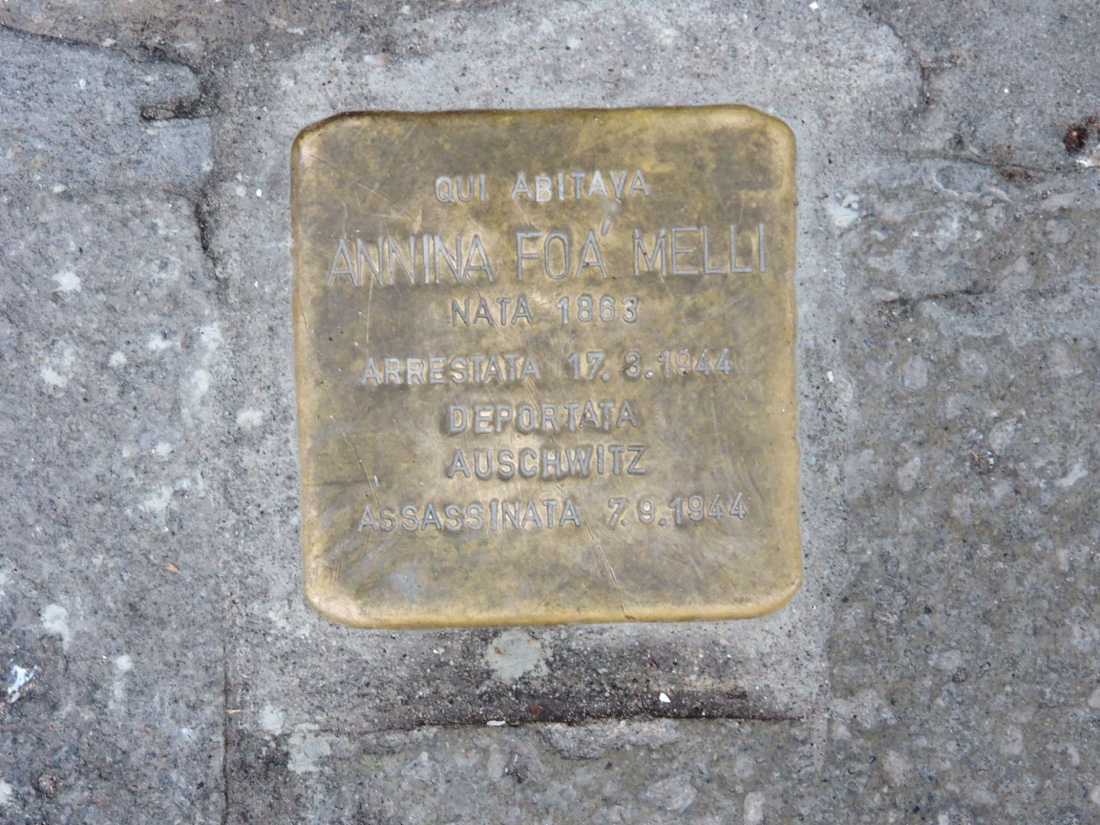
The Stolpersteine ("stumbling stones") project was begun by the German artist Gunter Demnig (born 1947) in Cologne in 1992. Each is a brass cobblestone, about 10 by 10 centimeters, set into the sidewalk in front of the prewar home of a victim of Nazi persecution, carrying the person's name, date of birth, fate, and, where known, date and place of death.
As of 2025, more than 100,000 Stolpersteine have been laid across some 30 European countries, most of them in Germany, with large numbers in the Netherlands and beyond. It is the largest of its kind.
The aim is to return the individual victim to the everyday space they were taken from. Each stone requires research, usually by local volunteers, school groups, and the victims' families, to verify the name, the home, and the fate, and the cost of each (about €120 in the 2020s) is borne by sponsors such as families, school classes, and community groups.
The project has raised questions. The Munich city council voted against permitting Stolpersteine in 2004 and again in 2015, on an argument advanced by the Jewish Community of Munich and Upper Bavaria that placing the names where pedestrians walk over them disrespects the victims. Most European Jewish communities have endorsed the project; the Munich position remains the main counter-view.
2005
The Memorial to the Murdered Jews of Europe.
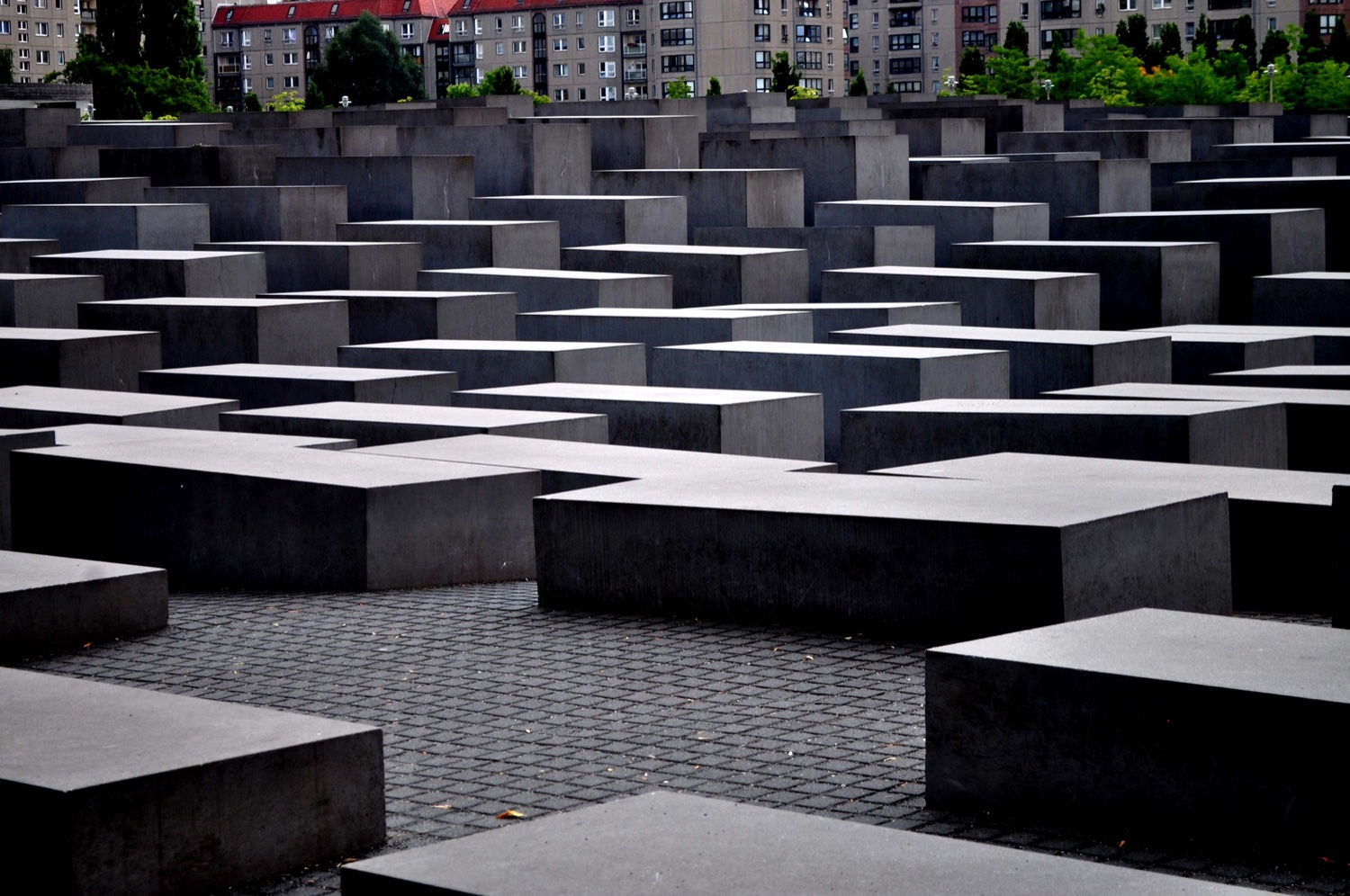
The Memorial to the Murdered Jews of Europe was dedicated on May 10, 2005, in central Berlin, about a block south of the Brandenburg Gate. It covers some 19,000 square meters (about 4.7 acres) and consists of 2,711 concrete stelae of varying heights, from about 0.2 to 4.7 meters, arranged on a gently sloping field. The architect was Peter Eisenman.
It took a long time to build. Journalist Lea Rosh first proposed a Berlin Holocaust memorial in 1988, and the process ran some seventeen years, two architectural competitions, extended debate in the Bundestag, Germany’s parliament (a 1999 vote of 314–209 approved the Eisenman design), and long negotiation. The total cost was about €27 million.
It is Germany's official national memorial to the Jewish victims, placed at the symbolic heart of the country, near the Reichstag, the Brandenburg Gate, and the former site of Hitler's Chancellery and bunker. The underground Information Center, designed by Dagmar von Wilcken, tells individual victims' stories, complementing the abstract field of stelae above with specific records below.
2005
International Holocaust Remembrance Day.
There is one day the whole world is asked to remember the Holocaust together: January 27, the date in 1945 that Soviet troops reached the gates of the Auschwitz-Birkenau camp complex, the largest Nazi killing center, and found what was left. The United Nations made it official in 2005, when its General Assembly adopted Resolution 60/7 by consensus, no country voted against, pushed by Israel, the United States, and the states of the European Union. The resolution:
- Designated January 27 as International Holocaust Remembrance Day.
- Urged member states to develop educational programs to preserve the memory of the Holocaust and help prevent genocide.
- Rejected any denial of the Holocaust as a historical event.
- Commended states that have preserved Holocaust sites for education.
The UN observance includes an annual ceremony at headquarters in New York and an academic conference, alongside national observances worldwide. The Israeli Yom HaShoah (on the Hebrew calendar) and the UN day (on the Gregorian calendar) work as complementary observances, the first focused on the Jewish-specific dimension, the second on the broader humanitarian one.
1998–today
The IHRA framework.
When governments want to teach the Holocaust the same careful way across borders, they coordinate through one body: the International Holocaust Remembrance Alliance, or IHRA. Founded in 1998, it now links about 35 member states (among them the United States, the United Kingdom, Germany, Israel, France, and Italy) and sets the shared definitions and standards they teach from.
The IHRA Working Definition of Antisemitism, adopted on May 26, 2016, is the reference point covered in the Contemporary Antisemitism Chapter. It has been adopted by about 45 national governments, the European Parliament, the U.S. State Department, and roughly 1,200 universities, municipalities, and organizations worldwide.
The teaching laws
U.S. education mandates.
Some twenty-five U.S. states require Holocaust and genocide education in their public schools, varying widely in scope.
- New York, Education Law §801. Enacted 1994 and expanded since. It requires the State Board of Regents to provide curriculum materials on the Holocaust and other genocides, and requires districts to provide the instruction.
- New Jersey, N.J.S.A. 18A:35-28 (1994), among the earliest and broadest state Holocaust education mandates, covering elementary and secondary levels; Illinois had enacted the first in 1990.
- California, Education Code §51220, placing the Holocaust within the required social science course of study since 1985.
- Florida and Texas, each with their own statutes requiring Holocaust instruction or remembrance.
- The broader list includes Pennsylvania, Michigan, Connecticut, Rhode Island, Indiana, Massachusetts, Ohio, Oregon, Wisconsin, Kentucky, Tennessee, Virginia, West Virginia, Washington, Arkansas, Maine, Nevada, Delaware, and Hawaii, with wide variation in scope.
At the federal level, the Never Again Education Act, signed into law on May 29, 2020 (Public Law 116-141), authorizes USHMM to develop and distribute Holocaust education resources and to provide teacher professional development nationwide, with $10 million authorized over five years.
What nearly all of these laws share is a limit. They require that the Holocaust be taught; very few say what to teach, in which grade, or to what depth. Those decisions (the lessons, the materials, the number of class days) are left to local districts and, in practice, to the individual teacher. The same mandate can be met by a single assembly or by a full unit, and a teacher handed the requirement is often left to find and judge the sources alone. Supplemental materials do exist (from the USHMM, state agencies, and outside organizations) but none is required: a district is free to use any of them, or none at all.
A law sets the floor; the materials a district chooses decide whether it is met with one day or with real depth.
Today
The global museum network.
Taken together, the result is striking: an international network of Holocaust museums, memorials, archives, and documentation centers now spans dozens of countries, most of it built since the 1980s. Beyond Yad Vashem and the U.S. Holocaust Memorial Museum, the major ones include:
- POLIN Museum of the History of Polish Jews (Warsaw), whose core exhibition opened October 28, 2014, on the site of the prewar Jewish quarter that became the Warsaw Ghetto. Its mandate is the thousand-year history of Polish Jewish life, the civilizational context, not only the Holocaust.
- Jewish Museum Berlin, opened September 9, 2001, designed by Daniel Libeskind, known for its zigzagging form and architectural voids.
- Museum of Jewish Heritage (New York), opened 1997, covered in the Field Trips page.
- Mémorial de la Shoah (Paris), founded in 1956 and reopened in its current form in 2005, whose Wall of Names lists the 76,000 Jews deported from France during the Holocaust.
- Anne Frank House (Amsterdam), opened May 3, 1960 in the building where Anne Frank and her family hid from 1942 to 1944, with about 1.2 million visitors a year before the pandemic.
- Others include the Imperial War Museum Holocaust Exhibition (London, 2000), the Sydney Jewish Museum (1992), Holocaust Centre Norway (Oslo), the Holocaust Memorial Center (Budapest, 2004), and the Galicia Jewish Museum (Kraków, 2004).
The honest accounting
The honest accounting.
The scholarship on the memory framework carries several open debates:
- "Americanization." Peter Novick's The Holocaust in American Life (1999) argued that late-twentieth-century American engagement with the Holocaust was shaped as much by American Jewish politics after 1967 as by the events themselves. Later scholarship has refined rather than simply adopted or rejected his thesis.
- "Uniqueness." Whether the Holocaust should be understood as a singular event or as the central example within a broader history of genocide has been debated extensively. Yad Vashem has stressed the Jewish-specific dimension; USHMM has stressed the broader humanitarian frame alongside it. Scholars such as Yehuda Bauer (Rethinking the Holocaust, 2001) and Steven Katz hold that both dimensions are real.
- "Memorial politics." Whether the memorial framework has served its educational purpose, or has been turned to present-day political ends, has been argued through the Berlin Memorial debates, the Polish debates over wartime conduct, and other cases. The scholarship records both the educational achievements and the political tensions.
- "Compassion fatigue." Whether the steady expansion of memorials has produced diminishing engagement has been raised. The data suggest engagement remains strong, USHMM's 1.7 million annual visitors, Yad Vashem's figures, but the question continues to be debated.
The ending is back in the room where this Chapter began. The Hall of Names holds 4.9 million names, and a shelf of empty binders for the million that may never be recovered. Every institution in this Chapter, the museums, the laws, the stones in the pavement, exists to keep filling shelves like that one. The building of memory turned out not to be a monument at all. It is a task that does not finish.
Key takeaways
The record in brief.
- Holocaust memory did not happen by itself. Laws, museums, archives, remembrance days, and names were built deliberately across sixty years.
- The work began during the war, with the buried Oneg Shabbat archive of the Warsaw Ghetto.
- Israel built the first national framework: Yom HaShoah in 1951 and Yad Vashem in 1953, whose Hall of Names has recovered about 4.9 million names.
- The Eichmann trial of 1961 moved survivor testimony to the center of public memory. The great testimony archives followed, beginning with Yale’s Fortunoff Archive in 1981.
- The United States built USHMM between 1978 and 1993. Germany set the Stolpersteine into its sidewalks and the Berlin Memorial at the center of its capital.
- January 27, the liberation of Auschwitz, became International Holocaust Remembrance Day by UN resolution in 2005.
- Some twenty-five U.S. states now mandate Holocaust education. New York’s Education Law §801 has required it since 1994.
Object Spotlight
A Page of Testimony.
The most consequential object in this Chapter is a single sheet of paper. A Page of Testimony is a one-page form on which someone who knew a victim, a surviving relative, a friend, a neighbor, records the basic facts of that person’s life: name, birthplace, parents, profession, wartime address, and the place and circumstances of death, and signs it.
Yad Vashem has collected about 2.8 million of them since the 1950s. They fill the shelves that ring the Hall of Names, with space left open for the pages still to come. Most of the murdered have no grave. Yad Vashem calls the Pages symbolic tombstones, and for millions of people that sheet of paper is the only marker there is.
Anyone can read them. The Pages are digitized in the Central Database of Shoah Victims’ Names, where the roughly 4.9 million names recovered so far can be searched one person at a time.
Discussion questions
Working from the evidence.
Each question is anchored in something this Chapter documents. Students should answer from the evidence on the page.
- Memory did not build itself: every institution in this Chapter was argued for, funded, and designed by particular people making choices. Choose one, a museum, a remembrance day, a database, and explain what choices its builders made about how the Holocaust would be remembered.
- The Hall of Names gathers Pages of Testimony for individual victims; Berlin’s memorial is 2,711 unmarked concrete slabs. These are opposite choices, names versus abstraction. What does each accomplish that the other cannot?
- The Stolpersteine set memory into the pavement outside a victim’s last home instead of inside a museum. What happens to a person who trips over a name in the street that cannot happen behind glass?
- The United Nations did not set an international remembrance day until 2005, sixty years after liberation. Using this Chapter’s timeline, why did remembrance grow in stages rather than beginning at once?
- The Chapter shows memory institutions spreading from Israel outward, to America, Europe, and the United Nations. What does that spread say about whose responsibility the memory became?
Classroom Connections
Where this Chapter fits.
Teaching Connections
The disciplines and courses this Chapter naturally supports, for any educator, anywhere.
- World History. The memorial framework, laws, museums, archives, remembrance days, and international institutions, including the U.S. Holocaust Memorial Museum and the 2020 Never Again Education Act, is postwar history the standard curriculum rarely covers at the level the record supports.
- Classroom Applications. Students can:
- evaluate museums and memorials as historical sources, not only as commemoration;
- analyze museum interpretation and memorial design;
- distinguish remembrance, documentation, and education as different functions;
- trace how an institution preserves and organizes primary evidence;
- compare national and international memory frameworks;
- construct evidence-based arguments using primary and secondary sources.
- International Classroom Relevance. Because this Chapter examines museums, archives, memorials, remembrance days, and international remembrance institutions, it supports Holocaust education, museum and memory studies, civic education, human-rights education, and source-based historical inquiry.
Standards Alignment
- NYS Social Studies Framework: NY Grade 8 (United States History) 8.6 and NY Global History 10.10 (Human Rights, Genocide, and the Postwar World).
- NYS Holocaust Education Mandate, Education Law §801. This Chapter provides the context for the mandate, the framework the required Holocaust education actually operates within.
- Common Core, Reading in History/Social Studies (grades 6–12). Students assess purpose and point of view (RH.6–8.6, RH.9–10.6, RH.11–12.6) and corroborate evidence across sources (RH.6–8.9, RH.9–10.9, RH.11–12.9), working from the 1953 Yad Vashem Law, the 1980 USHMM Council Act, UN Resolution 60/7, the IHRA Working Definition, and the Never Again Education Act.
- C3 Framework, D2.His.1 & D2.His.14 (grades 6–8 and 9–12). Students investigate chronology, continuity and change, and evidence-based interpretation while examining how a society builds the institutions that preserve and teach its history.
For further classroom use
- For teachers. The USHMM teacher fellowships, the Yad Vashem International School for Holocaust Studies, the Echoes & Reflections curriculum (ADL, USC Shoah Foundation, and Yad Vashem), and Facing History and Ourselves are the main free professional-development resources.
Sources and citations
Primary sources
A primary source is a record from the time. It was made by people who were there. Examples: letters, diaries, photos, decrees, trial records, and newspapers.
- Wiesel, Elie. From the Kingdom of Memory. New York: Summit Books, 1990.
- The Yad Vashem Martyrs' and Heroes' Remembrance Law (5713-1953). Israel Knesset, August 19, 1953.
- The United States Holocaust Memorial Council Act (Public Law 96-388, October 7, 1980).
- United Nations General Assembly Resolution 60/7 (November 1, 2005).
- The Never Again Education Act (Public Law 116-141, May 29, 2020).
- The IHRA Working Definition of Antisemitism (May 26, 2016).
Secondary sources
A secondary source was written later. It is a book or article by a historian who studied those records and explains what they mean.
- USC Shoah Foundation. “USC Shoah Foundation Partners with Living Links, First National Organization for Grandchildren of Holocaust Survivors.” May 2024. sfi.usc.edu.
- United States Holocaust Memorial Museum. “Martin Niemöller: ‘First they came for the Socialists...’” Holocaust Encyclopedia.
- Young, James E. The Texture of Memory: Holocaust Memorials and Meaning. New Haven: Yale University Press, 1993.
- Young, James E. At Memory's Edge: After-Images of the Holocaust in Contemporary Art and Architecture. New Haven: Yale University Press, 2000.
- Novick, Peter. The Holocaust in American Life. Boston: Houghton Mifflin, 1999.
- Cole, Tim. Selling the Holocaust: From Auschwitz to Schindler. New York: Routledge, 1999.
- Linenthal, Edward T. Preserving Memory: The Struggle to Create America's Holocaust Museum. New York: Viking, 1995.
- Zertal, Idith. Israel's Holocaust and the Politics of Nationhood. Cambridge: Cambridge University Press, 2005.
- Bauer, Yehuda. Rethinking the Holocaust. New Haven: Yale University Press, 2001.
- Stier, Oren Baruch. Holocaust Icons: Symbolizing the Shoah in History and Memory. New Brunswick: Rutgers University Press, 2015.
- Hansen-Glucklich, Jennifer. Holocaust Memory Reframed: Museums and the Challenges of Representation. New Brunswick: Rutgers University Press, 2014.
- Apel, Dora. Memory Effects: The Holocaust and the Art of Secondary Witnessing. New Brunswick: Rutgers University Press, 2002.
- Diner, Hasia R. We Remember with Reverence and Love: American Jews and the Myth of Silence after the Holocaust, 1945–1962. New York: New York University Press, 2009.
- Yad Vashem · yadvashem.org →
- United States Holocaust Memorial Museum · ushmm.org →
- USC Shoah Foundation Visual History Archive · sfi.usc.edu →
- The Stolpersteine project · stolpersteine.eu →
- Memorial to the Murdered Jews of Europe · stiftung-denkmal.de →
- International Holocaust Remembrance Alliance · holocaustremembrance.com →
- POLIN Museum of the History of Polish Jews · polin.pl/en →
Finding these documents: many primary sources are free online. Good places to start are the Fordham Internet Jewish History Sourcebook, Yale’s Avalon Project (law and diplomacy), German History in Documents, the collections of the US Holocaust Memorial Museum and Yad Vashem, the National Library of Israel, and Sefaria (for Jewish texts). Search the document’s name and date.
Nostra Aetate (1965): the Second Vatican Council declaration in which the Catholic Church repudiated the deicide charge and the teaching of contempt, reversing teachings it had carried for most of two thousand years.
Comments?
Write to editor@makorproject.org.
Last updated: August 2026.