
Open a printed Talmud, the vast multi-volume record of Jewish law and debate, almost anywhere in the world today and the same commentary appears beside the text. It was written in northern France more than nine hundred years ago by a scholar whom tradition remembers as a vineyard owner. For centuries it has been the first guide many Jewish learners use when they begin to study the Bible and the Talmud.
Rashi · Unit 5
Why this Chapter exists
The explainer beside the text.
Rashi (1040–1105), a rabbi in Troyes, in northern France, wrote line-by-line explanations of the Hebrew Bible and the Talmud. For more than nine hundred years Jewish readers have turned to him first. His explanation of the Five Books of Moses was the first dated Hebrew book ever printed (in Reggio di Calabria, Italy, in 1475) and has appeared in nearly every traditional study edition of the Hebrew Bible since. His explanation of the Talmud sits on the inner margin of every standard printed page, in the layout standardized in Venice, Italy, in the 1520s.
Maimonides (1138–1204), born a generation after Rashi’s death, worked in the Muslim Mediterranean and organized Jewish law into a single code. Rashi, in Christian northern France, explained existing texts word by word, so a reader could follow them.
Object Spotlight
The shape of a Talmud page.
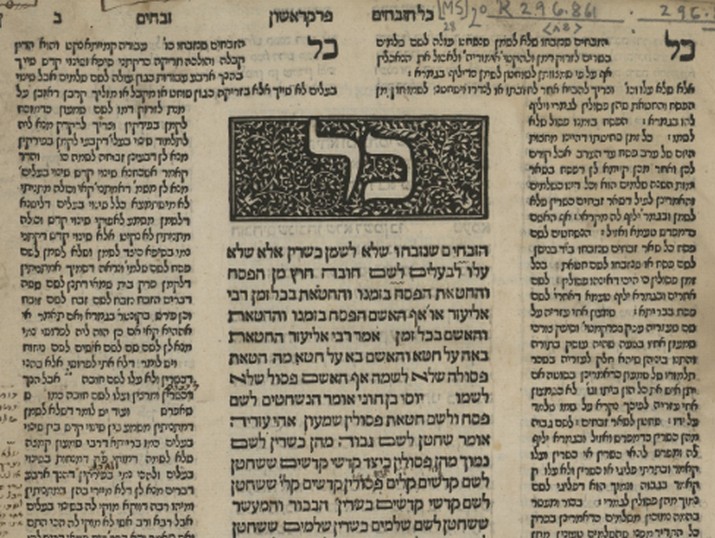
Open any printed volume of the Talmud and the page has a shape you would recognize even if you could not read a word of it. A dense block of text sits in the center. Wrapped around it, in a different and smaller typeface, are two columns of commentary, one tucked along the inner edge by the binding, one along the outer edge. The inner column is Rashi.
That arrangement has a name: the tzurat ha-daf, “the shape of the page.” It reached print in the Soncino family’s tractates beginning in 1483. Between 1520 and 1523 a Christian printer in Venice, Daniel Bomberg, working with Jewish editors, standardized it across the first complete printed Talmud, along with the page numbering still in use. Jews in Venice could not hold a printing license, which is why the press was Christian-owned. (It appears again in the Ghetto System Chapter.) Before printing, hand-copied Talmuds were laid out in many different ways. After Bomberg, the layout barely changed for five centuries: the text in the middle, Rashi on the inside, and later scholars’ commentary on the outside.
The position matches a common order of study. A reader who hits a hard phrase in the central Talmud glances inward to Rashi for the plain meaning, then turns outward to the harder questions.
Rashi never saw a printed page. He died in 1105, more than four centuries before Bomberg, and wrote to be copied by hand for the students in front of him. Nine hundred years on, a student in a yeshiva (a school of Talmud study) still opens the Talmud and finds him on the inside margin.
Troyes and the eleventh-century Rhineland
The world he worked in.
Rashi worked within the Jewish community of the Rhineland and northern France in the eleventh century. The medieval Jewish tradition called that world Ashkenaz, the Hebrew name for the German-speaking lands and their reach. Its communities included Mainz, Worms, and Speyer, the three “ShUM” cities of the Rhineland. The initials of their Hebrew names spell “ShUM,” and the three shared one religious-legal tradition. Beyond them lay Troyes, Reims, Paris, Rouen, and the wider Champagne and northern French towns.
These communities ran serious Talmudic academies. The Mainz academy was led by Rabbi Gershom ben Judah (c. 960–1028), remembered as Rabbeinu Gershom Me’or HaGolah, “Our Master Gershom, Light of the Exile.” His school was the forerunner of the ones where Rashi would study. Later Ashkenazi tradition attributed to him enactments that shaped Jewish life for centuries: a ban on polygamy, a ban on divorcing a wife against her will, and a ban on reading another person’s letters. A source written in Mainz a century after him calls some of these rules communal enactments, and scholars debate how many were his own.
Troyes was Rashi’s birthplace and the city where he spent most of his life. It was an important commercial and political center in eleventh-century Champagne, on the trade routes crossing northern Europe. In the century after Rashi, the Counts of Champagne developed the Champagne Fairs, held in Troyes and three other towns, which drew merchants from across Europe. Its Jewish community was small next to the great Rhineland or Iberian centers, but it was part of that wider network.
Life and family
The biographical record.
Rashi (the acronym for Rabbi Shlomo Yitzhaki) was born in Troyes in 1040. The record of his life is partial. Much of the tradition comes from later medieval sources and from the legal writings of his successors, not from documents of his own time. What is documented:
- Origin. Born in Troyes, Champagne, into the northern French Jewish community. Little is known of his father, Yitzhak.
- Study in the Rhineland. As a young man, probably in his late teens and twenties, Rashi studied at the Rhineland academies of Mainz and Worms, under Rabbi Yaakov ben Yakar, Rabbi Yitzhak ben Yehuda, and Rabbi Yitzhak ben Eleazar Halevi. His writings name these teachers and the specific lessons he took from them.
- Return to Troyes. Rashi was back in Troyes by about 1070 and founded his own academy there. Smaller than the Rhineland centers at first, it grew over his lifetime into a leading seat of Jewish scholarship in northern Europe.
- Family. Rashi had no sons. His line ran through his daughters, who married scholars and whose sons, Rashi’s grandsons, founded the Tosafist school described below. The three daughters, Yocheved, Miriam, and Rachel, appear in the tradition, with surviving anecdotes about their own engagement with Jewish learning. The question of women’s learning in the Rashi household is taken up in Avraham Grossman’s Pious and Rebellious: Jewish Women in Medieval Europe (Brandeis, 2004).
- Livelihood. Tradition holds that Rashi made his living growing grapes and making wine, refusing payment for teaching or rabbinic work, and his commentary does reach for vineyard and winemaking terms as analogies. Some modern scholars question the vintner story, and how he actually supported himself is not settled.
- Death. Rashi died in Troyes on July 13, 1105. The exact site of his grave is not known.
The Bible commentary
The centerpiece.
Rashi’s commentary on the Five Books of Moses has been printed and taught more widely than almost any other Jewish commentary. Its reach shows up in several ways:
- The first dated Hebrew book. The first dated Hebrew book set in movable type was Rashi’s commentary on the Five Books, printed at Reggio di Calabria, Italy, by Avraham ben Garton on February 17, 1475.
- First text for children. Ashkenazi and Sephardic communities are the Jewish worlds of northern Europe and of Spain. In traditional Jewish education in both, children have typically met Rashi’s Bible commentary as the first commentary they study once they can read Hebrew, from the Middle Ages to today.
- The script. The semi-cursive type Rashi’s commentary has been printed in since 1475 is called “Rashi script,” though Rashi never used it himself. Printers in Italy adapted it from a Sephardic semi-cursive hand in the late 1400s. It still sets his commentary, the Talmud commentary, and the medieval commentary tradition apart from the main biblical or Talmudic text on the page.
His method moves verse by verse through the text, blending a few distinct modes:
- Peshat, the plain meaning. Reading the text in its grammatical, word-level, and contextual sense. Rashi’s insistence on peshat as the foundation is one of his contributions. At Genesis 3:8 he states that he is concerned only with “the plain sense of Scripture” (peshuto shel mikra) and with rabbinic stories “that explain the words of Scripture.” Later Jewish interpreters returned to that line again and again.
- Midrash, the rabbinic storytelling tradition. Midrash is the body of rabbinic interpretation and story built around the biblical text. Where a Midrash helps explain a verse, Rashi folds it in, choosing one reading from a large body of material.
- La’azim, Old French glosses. La’az means a word in a foreign language. Where a Hebrew word needed clarifying, Rashi often gave the Old French equivalent (his own everyday language, written in Hebrew letters). By one count there are about 1,300 such glosses in the Bible commentary and about 3,500 in the Talmud commentary. They helped his own neighbors read him. Today they are a major record of eleventh-century spoken French.
Traditional study editions of the Hebrew Bible, whether Ashkenazi, Sephardic, or Mizrahi (from Jewish communities of the Middle East and North Africa), almost always run Rashi alongside the text. Beyond the Five Books, Rashi commented on almost the entire Hebrew Bible, the Prophets and the Writings, in the same plain, accessible way. His commentary on the Song of Songs, which follows earlier rabbinic tradition in reading the poem as an allegory of the love between God and Israel, became widely used.
The Talmud commentary
The companion to the Talmud.
Rashi’s commentary on the Babylonian Talmud (the Talmud compiled in the Jewish academies of Babylonia, today’s Iraq) is, in the later Jewish tradition, inseparable from the Talmud itself.
- Coverage. Rashi wrote on most of the Babylonian Talmud, about 30 of its tractates. He died before finishing the commentary on a few, including Bava Batra and Makkot. The printed editions fill those gaps with later work, including that of his grandson Rabbi Shmuel ben Meir (the Rashbam) on Bava Batra and his son-in-law Rabbi Yehudah ben Natan on Makkot.
- Method. The Talmud commentary works word by word through the text, explaining obscure Aramaic and Hebrew terms, supplying the background of each rabbinic debate, naming the technical vocabulary, and spelling out the unstated logical steps. The aim is to make the Talmud followable for a first-time reader and a quick reminder for an experienced one.
- In study today. Traditional Talmud study treats Rashi as the companion text, from the chevruta (a pair of study partners reading together) to the yeshiva curriculum.
Rashi’s method
What made it work.
Scholars have long asked what made Rashi’s work the one that stuck. The features that recur:
- Clarity and brevity. Rashi writes short, usually a sentence or two, rarely a paragraph. Because the comment is so brief, it can be read right alongside the text without slowing the reader much.
- Selective attention. He does not comment on every line. He comments where there is a real difficulty, a hard grammatical form, an unclear word, missing context, a Midrash that changes how a verse reads. So a Rashi comment is itself a signal: this is a spot that needs attention.
- Precision with language. His command of biblical and rabbinic Hebrew and of Aramaic shows in his grammar notes and his explanations of word origins.
- Plain meaning and Midrash together. By weaving the plain sense and the rabbinic tradition (now one, now the other, sometimes both) he produced a selection of the available readings, choosing what to keep and what to leave out.
- A teacher’s voice. The commentary is addressed to a student. It is patient and explanatory, focused on the reader’s understanding.
The Tosafist school
The school he left behind.
Rashi’s work passed to his daughters and their descendants, above all to his grandsons and great-grandsons, who founded the school of Talmud commentary known as the Tosafot (“additions”). The major figures:
- Rabbi Shmuel ben Meir (Rashbam, c. 1085–c. 1158). Rashi’s grandson. He carried on the work, including completing the Talmud commentary where his grandfather’s death left gaps. His own commentary on the Five Books, which pushes the plain meaning even harder than Rashi and sets Midrash aside, is printed in the standard editions.
- Rabbeinu Tam (Yaakov ben Meir, c. 1100–1171). Rashi’s grandson and Rashbam’s younger brother, the leading Tosafist of his generation. His Sefer ha-Yashar collects his Talmudic comments and legal answers. He corresponded with scholars across the medieval Jewish world, and his rulings on many questions became standard.
- Ri ha-Zaken (Rabbi Yitzhak ben Shmuel, died about 1185). A nephew of Rabbeinu Tam, the central Tosafist of the next generation, whose school shaped much of what the printed editions preserve.
- The wider school. Many more Tosafists across the twelfth and thirteenth centuries produced the body of work that fills the outer margin of the Talmud page.
The Tosafists built on Rashi in a particular way. Where he clears up the immediate difficulty, they ask the next question. They compare passages across the Talmud, point out apparent contradictions, resolve them, and draw out the underlying principles.
The First Crusade and Rashi’s response
A witness.
Pope Urban II called the First Crusade, an armed campaign to seize Jerusalem from Muslim rule, at the Council of Clermont on November 27, 1095. As forces gathered and moved east, mobs turned on the Jewish communities in their path. The result was the massacre of the Rhineland Jewish communities in May and June 1096. Crusading bands under local lords, moving ahead of the main armies, all but destroyed the Jewish communities of Worms (May 18 and 25), Mainz (May 27), and Cologne (late June). At Speyer, the bishop saved most of the community. Speyer, Worms, and Mainz were the ShUM cities, the academic heart of Ashkenazi life. Estimates of the Jewish dead across the Rhineland that spring vary widely, and even the lowest run into the thousands. Whatever the total, it took a large share of the affected communities.
Three Hebrew chronicles written soon after record the massacres: the Mainz Anonymous, the Solomon bar Simson, and the Eliezer bar Nathan chronicles. They are the main Jewish record of the events. They also shaped the Jewish religious response to massacre, the framework of Kiddush Hashem (“sanctification of the Divine Name”) for those who died rather than convert. The standard scholarly reference is Robert Chazan’s European Jewry and the First Crusade (University of California Press, 1987).
Rashi was about 55 in 1096. He was living in Troyes, which the Rhineland violence did not reach. His response is documented in several forms:
- The rulings on the forced converts. Rashi’s documented response to 1096 is in his legal rulings: Jews forced into baptism who returned to Judaism were to be received without reproach, their standing whole. (Maimonides faced the same question two generations later, when the Almohad rulers of Spain and North Africa forced Jews to convert to Islam.)
- The rebuilding. His academy at Troyes, spared the Rhineland violence, became a major center of Ashkenazi learning in the early twelfth century. The Tosafist work of his grandsons grew from it.
The Christian reception
Read by Christians too.
Christian scholars read Rashi too, from the twelfth century on. The main channels:
- The Victorine school of Paris. The twelfth-century Christian center at the Abbey of Saint-Victor in Paris, especially Andrew of Saint-Victor (c. 1110–1175), drew on the interpretation of Rashi’s school, reached largely through conversation with Jewish contemporaries, and credited simply to “the Hebrews.” The draw was his plain-sense, philological reading of the Hebrew, useful to Christian scholars then learning the language.
- Nicholas of Lyra (c. 1270–1349). The Franciscan whose Postilla Litteralis, a widely used medieval Latin Bible commentary, leaned heavily on Rashi. A later saying tied Nicholas’s Hebrew-informed reading to the Reformation: “Si Lyra non lyrasset, Lutherus non saltasset” (“If Lyra had not played, Luther would not have danced”).
- Martin Luther. Luther absorbed Rashi’s readings largely through Nicholas of Lyra, in whose pages Rashi appears constantly as “Rabbi Salomon.” Luther later wrote violently antisemitic treatises, among them On the Jews and Their Lies (1543). The Lutheran World Federation repudiated those writings in 1984, as covered in the Nostra Aetate Chapter.
- The wider reach. Christian Hebraist scholars through the Renaissance and the early-modern period, such as Sebastian Münster, continued to read Rashi.
Beryl Smalley’s The Study of the Bible in the Middle Ages and Herman Hailperin’s Rashi and the Christian Scholars trace these channels in detail.
After Rashi
The long reach.
- Commentaries on the commentary. Scholars have written whole commentaries on Rashi himself, among them Elijah Mizrahi (1455–1525, chief rabbi of Constantinople), Judah Loew ben Bezalel (the Maharal of Prague, c. 1525–1609), and many more.
- The 900th anniversary. The 900th anniversary of Rashi’s death (2005) brought wide commemoration in France, Israel, and the Jewish world.
Sites that survive
Where the record stands.
- Troyes, France, the Rashi European University Institute. The Institut Universitaire Rachi, a center for Rashi studies, opened in Troyes in 1990. The city also holds the Rashi memorial by Raymond Moretti (1990), a monumental sculpted sphere in front of the Théâtre de Champagne, and markers of his presence.
- Worms, Germany, the Rashi Synagogue and Jewish Quarter. The medieval Jewish quarter, including the synagogue tied by tradition to Rashi’s study at Worms (the surviving building is later medieval). It was destroyed on Kristallnacht, the Nazi-orchestrated night of attacks on Jewish sites in November 1938, and rebuilt in the 1950s and 1960s.
- Speyer, Worms, and Mainz, the ShUM Sites. The medieval Rhineland Jewish heritage sites of the three ShUM cities, inscribed on the UNESCO World Heritage List in 2021. schumstaedte.de →
Key takeaways
- Rashi (1040–1105) of Troyes, in northern France, wrote the commentaries that Jewish children traditionally study first, printed in traditional study editions of the Bible and on every standard printed page of the Talmud.
- His commentary on the Five Books was the first dated Hebrew book ever printed (1475). His Talmud commentary has run along the inner margin of every standard printed page since the 1520s.
- His method was brief, selective, precise, and addressed to a student, blending the plain meaning of the text with the rabbinic tradition, and including thousands of Old French glosses now used by scholars of medieval French.
- His grandsons founded the Tosafist school, whose work fills the outer margin of the Talmud page opposite Rashi’s inner margin.
- Christian scholars, including the Victorines and Nicholas of Lyra, drew extensively on Rashi’s biblical commentary, helping transmit aspects of medieval Jewish interpretation into Christian biblical scholarship.
Discussion questions
Working from the evidence.
Each question is anchored in a fact this Chapter documents. Answer from the evidence on the page.
- Rashi wrote short, and only where the text was hard. What does it tell you about a reader’s needs when an explainer chooses what not to comment on? (C3 D2.His.5)
- The standard Talmud page puts Rashi on the inner margin and his successors on the outer one. What can the physical layout of a page tell a historian about how people were meant to use it? (C3 D2.His.10)
- Christian scholars studied a Jewish commentator’s reading of the Hebrew Bible for centuries. What does that exchange suggest about the lines between religious communities in medieval Europe? (C3 D2.His.1)
- Rashi’s Old French glosses, written to help his neighbors, are now a major source for the history of the French language. How does a source come to matter for a purpose its author never intended? (C3 D2.His.11)
Classroom Connections
Where this Chapter fits.
Teaching Connections
- World History. Rashi’s life opens medieval northern European intellectual life, paired with the Mediterranean world that Maimonides represents.
- Classroom Applications. Students can:
- analyze how a commentary shapes the reading of a primary text
- trace the transmission and Christian reception of Rashi’s work (the Victorines, Nicholas of Lyra)
- compare the “text-explainer” Rashi with the “system-builder” Maimonides
- use Rashi’s Old French glosses as historical-linguistic evidence
- construct evidence-based historical arguments.
- International Classroom Relevance. Because Rashi shaped both Jewish learning and later Christian biblical scholarship, this Chapter supports world history, religious studies, and the history of the book in classrooms internationally.
Standards Alignment
- NYS Social Studies Framework: NY Global History 9.5 (Political Powers and Achievements) and 9.6 (Social and Cultural Growth and Conflict, including 9.6a, the Crusades). For grades 7–8, anchored through Common Core literacy and interdisciplinary humanities, since medieval Jewish scholarship has no dedicated middle-school social-studies standard.
- Common Core RH.6–8, RH.9–10 & RH.11–12. Students assess an author’s purpose and point of view (RH.6–8.6, RH.9–10.6, RH.11–12.6) and corroborate evidence across sources (RH.6–8.9, RH.9–10.9, RH.11–12.9), working from a commentary set beside the text it explains, the Hebrew chronicles of 1096, and modern scholarship.
- C3 Framework, D2.His.1 and D2.His.14 (grades 6–8 and 9–12). Students investigate historical context, continuity and change, and causation.
Learn more · take this further
- The First Crusade. Rashi’s response and the Hebrew chronicles of 1096 give primary-source material for teaching the First Crusade.
- French language and culture. Rashi’s Old French glosses are a major surviving source for eleventh-century spoken French, a fit for an upper-grade French course.
Sources and citations
Primary sources
A primary source is a record from the time. It was made by people who were there. Examples: letters, diaries, photos, decrees, trial records, and newspapers.
- Rashi. Commentary on the Pentateuch. Mossad ha-Rav Kook edition (Jerusalem, ongoing); Silbermann English edition (London, 1929–1934).
- Rashi. Commentary on the Babylonian Talmud. Printed on the inner margin of every Talmud page since the 1520–1523 Bomberg edition.
- Rashi. Sapirstein Edition Pentateuch with Rashi. Brooklyn: Mesorah Publications, 1995–1998.
- Rashi on Genesis 3:8. Hebrew text with English translation. Sefaria. sefaria.org →
- Eidelberg, Shlomo, ed. and trans. The Jews and the Crusaders: The Hebrew Chronicles of the First and Second Crusades. Madison: University of Wisconsin Press, 1977.
- Nicholas of Lyra. Postilla Litteralis super Totam Bibliam. 14th century.
- The ShUM Sites of Speyer, Worms, and Mainz. UNESCO World Heritage List, 2021. schumstaedte.de →
- Sefaria. sefaria.org → (digital edition of Rashi’s complete works.)
Secondary sources
A secondary source was written later. It is a book or article by a historian who studied those records and explains what they mean.
- Grossman, Avraham. Rashi. Translated by Joel Linsider. Oxford: The Littman Library of Jewish Civilization, 2012. (The standard contemporary scholarly biography.)
- Grossman, Avraham. Pious and Rebellious: Jewish Women in Medieval Europe. Waltham: Brandeis University Press, 2004.
- Shereshevsky, Esra. Rashi: The Man and His World. New York: Sepher-Hermon Press, 1982.
- Pearl, Chaim. Rashi. London: Peter Halban, 1988.
- Banitt, Menahem. Rashi: Interpreter of the Biblical Letter. Tel Aviv: Tel Aviv University Press, 1985.
- “Gershom ben Judah Me’or ha-Golah.” Encyclopaedia Judaica, 2nd ed., via Encyclopedia.com. encyclopedia.com →
- “La’az.” Encyclopaedia Judaica, 2nd ed., via Jewish Virtual Library. jewishvirtuallibrary.org → (On the number of Rashi’s Old French glosses.)
- Chazan, Robert. European Jewry and the First Crusade. Berkeley: University of California Press, 1987.
- Smalley, Beryl. The Study of the Bible in the Middle Ages. 3rd ed. Oxford: Basil Blackwell, 1983.
- Hailperin, Herman. Rashi and the Christian Scholars. Pittsburgh: University of Pittsburgh Press, 1963.
- National Library of Israel, “The Christian Who Set the Talmud’s Layout.” blog.nli.org.il/en/daf_gemara →
- Unpacked (OpenDor Media). “How Rashi Decoded Ancient Jewish Texts.” unpacked.media → (Story-style introduction for general readers.)
Finding these documents: many primary sources are free online. Good places to start are the Fordham Internet Jewish History Sourcebook, Yale’s Avalon Project (law and diplomacy), German History in Documents, the collections of the US Holocaust Memorial Museum and Yad Vashem, the National Library of Israel, and Sefaria (for Jewish texts). Search the document’s name and date.
Moses Maimonides (1138–1204): philosopher, codifier of Jewish law, and physician in Saladin’s court circle, read by Jewish, Muslim, and Christian scholars alike.
Comments?
Write to editor@teachjewishhistory.org.
Last updated: November 2026.