

On May 14, 1141, a ship left Alexandria, in Egypt, for the coast of the Land of Israel. On board was a physician and poet from Spain named Judah Halevi. Letters found centuries later in a Cairo synagogue storeroom give the date. One of his poems is still read aloud each year, on the day Jews mourn the Temple.
Why this Chapter exists
A Jewish world that spoke Spanish.
Sepharad is the Hebrew name for Spain. The Sephardim are the Jews of Spain and Portugal and their descendants. After the expulsion they carried a Spanish of their own, written in Hebrew letters, from Sarajevo to Izmir for more than four hundred years.
Jews had lived in Spain for more than a thousand years when the order of 1492 sent them away. Among them were a customs chief who negotiated with kings and a poet who sailed for the Land of Israel. There were also a mapmaker whose son was baptized in a year of massacres and a widow who moved a family fortune from Portugal to Constantinople. Some of their descendants learned only in recent decades that their families had been Jewish. The expulsion and the Inquisition are told in Unit 3 · Ch. 04 · The Expulsions, and the law Jews lived under in Muslim Spain in Unit 3 · Ch. 09 · The Dhimma.
How to read this Chapter
Three points to set straight first.
Common misconceptions this Chapter addresses
A few assumptions get in the way of seeing this community clearly.
- “Muslim Spain was a golden age of tolerance.” Hebrew poetry, philosophy, and high office were real in Córdoba and Granada. So were the massacre of Granada’s Jews in 1066 and the Almohad decrees of the 1140s. All of it happened in the same legal world. See Misconceptions →
- “Sephardic history ended in 1492.” The exiles built Salonika, Istanbul, Izmir, Safed, Amsterdam, and London, and their descendants were still printing newspapers in Ladino in the 1900s.
- “Every Sephardic Jew’s family came from Spain.” The word comes from Sepharad, and here it means the Jews of Spain and Portugal and the communities they founded. In modern use it is often widened to the Jews of the Middle East and North Africa, many of whom call themselves Sephardi because they generally follow Sephardic religious law and custom, whether or not their families came from Spain. Their own Chapters are Unit 2 · Ch. 02 to 05.
Córdoba and Granada, 900s–1100s
The physician, the vizier, and the poets.
In the 900s most of Spain was Muslim, ruled from Córdoba by a caliph, the title of a Muslim sovereign. Its Jews lived under the dhimma, the legal arrangement for Jews and Christians under Muslim rule. The first Jewish official in Spain whose career the record preserves was a physician. Hasdai ibn Shaprut (about 915 to 970) served the caliph Abd al-Rahman III as his doctor and was made director of the customs department. In 953 he handled the talks with an envoy of Otto I, king of Germany, and in 956 he negotiated a peace treaty with the king of León.
Hasdai also paid scholars. Menahem ben Saruq was his Hebrew secretary, and the poet Dunash ben Labrat, who wrote in his praise, fitted Hebrew verse to Arabic meters. A letter in Hasdai’s name survives, addressed to the king of the Khazars, a steppe people whose rulers were reported to have adopted Judaism. “All their gifts pass through my hands,” he writes of the embassies that reached Córdoba, “and I am charged with making gifts in return.” Scholars still disagree about whether the letter and its reply are genuine.
A century later the caliphate had broken into small kingdoms. In Granada, Samuel ibn Naghrela rose to vizier, the king’s chief minister, and, so his own poems record, commanded armies. His son Joseph held the same office and was killed on December 30, 1066, when a mob stormed the city’s Jewish quarter and destroyed the community in a single day. Solomon ibn Verga, a Jewish chronicler writing more than four centuries later, counted more than 1,500 heads of household among the dead. In the 1140s the Almohads, a dynasty from North Africa, took the Muslim south and offered Jews conversion, flight, or death, a policy rare in Islamic history. Among the families that fled was that of a boy born in Córdoba in 1138, Maimonides, whose life is told in Unit 5 · Ch. 03 · Maimonides. Both the offices and the violence are documented in Unit 3 · Ch. 09 · The Dhimma.
The poet Solomon ibn Gabirol, born in Málaga about 1021, died young, about 1057. His long poem Keter Malkhut, “The Royal Crown,” was taken into the Day of Atonement prayer book of some Jewish communities. His philosophy survived in Latin as Fons Vitae under a garbled name, Avicebron. Christian scholars read it for centuries, and its author was generally taken for a Muslim. In the 1800s the scholar Solomon Munk showed that Avicebron was Gabirol.
Judah Halevi, the poet of the opening lines, was born before 1075, probably in Tudela. He practiced medicine in Toledo, by then a Christian city, and traded with a Jewish merchant in Egypt, Halfon ha-Levi of Damietta. In 1140 he finished the Kuzari, a dialogue in which the Khazar king hears a philosopher, a Christian, and a Muslim, and is persuaded by a rabbi. That same year he sailed for Egypt. Letters from the Cairo Geniza, a synagogue storeroom of worn papers, follow the voyage. They record his arrival at Alexandria on September 8, 1140, his boarding ship on May 8, 1141, the weather that held the ship in port, and the sailing on May 14. Five letters he wrote to Halfon survive there too. A letter from Halfon reports his death that July. His lament Zion ha-lo tishali, “Zion, will you not ask,” is read in Ashkenazi synagogues each year on the Ninth of Av, the fast for the destruction of the Temple.
Christian Spain, 1085–1391
Toledo, Tudela, Barcelona, Majorca.
As the Christian kingdoms of the north conquered more of the peninsula, taking Toledo in 1085, more and more of Spain’s Jews came under Christian rule. Jews lived in self-governing communities, each called an aljama, under charters from the crown, much as Poland’s Jews would under their own charters.
Around 1160, or a few years later, a Jew from Tudela named Benjamin set out “from my native town to the city of Saragossa” and kept going, through Rome and Constantinople to Jerusalem and Baghdad, counting Jews as he went. His Itinerary describes Jewish communities from Spain to Iraq, though some of his figures, such as 40,000 Jews in Baghdad, seem exaggerated.
In 1263 King James I of Aragon convened a public debate in Barcelona between a convert and Rabbi Moses ben Nahman, known as Nahmanides, told in Unit 3 · Ch. 01 · Adversus Judaeos. A century later Samuel ha-Levi Abulafia (about 1320 to 1361) was treasurer to King Pedro of Castile. In 1357 he built a synagogue in Toledo with Hebrew inscriptions in his honor on its walls. In 1360 the same king suddenly ordered his arrest. He was taken to Seville and tortured to death, and his fortune and his relatives’ fortunes were confiscated. Later a church, his synagogue still stands and houses Spain’s Museo Sefardí.
On the island of Majorca, a Jewish mapmaker named Cresques Abraham made charts and compasses for the kings of Aragon. The heir to the throne titled him “master of world maps and compasses,” and the Catalan Atlas, a great world map now in Paris, is thought to be his work. He died in 1387, and his son Judah made maps for the same kings. In 1391, when riots swept the Jewish quarters of Spain, city after city, Judah converted to Christianity and became Jaime Ribes. He went on making charts, in Barcelona and, some scholars believe, in Portugal for Prince Henry the Navigator. The summer of 1391 and the century it opened are told in Unit 3 · Ch. 04 · The Expulsions.
Object Spotlight
A family gets ready for Passover, Catalonia, about 1320.
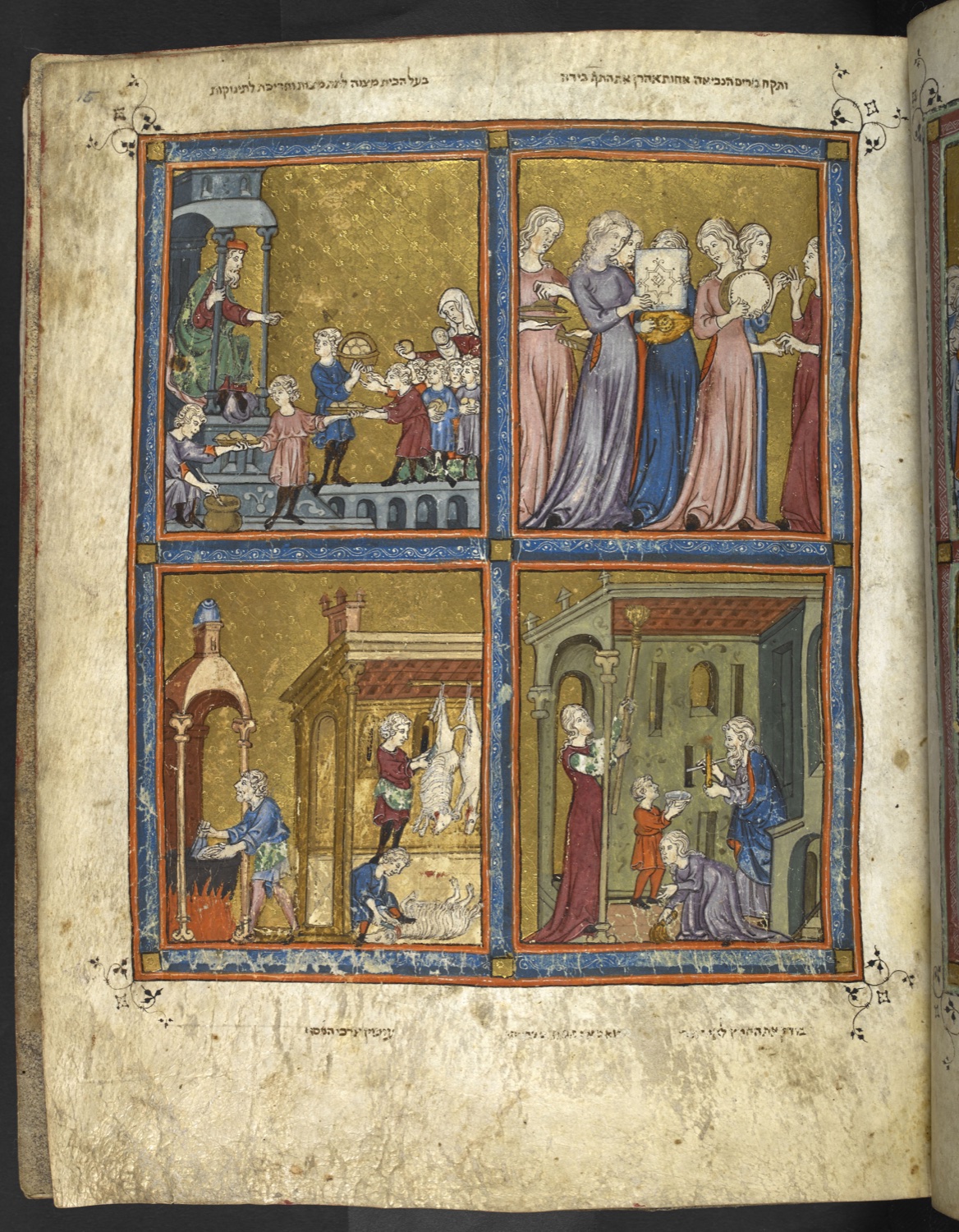
Collection of the British Library, London (Add MS 27210)
A Haggadah is the book read aloud at the Passover table. This one was painted in Catalonia, probably in Barcelona, about 1320. It opens with fourteen pages of pictures, each divided into four scenes on burnished gold, telling the story from Adam to the Exodus. The gold backgrounds give the book its name.
Look at the last page, where the Bible story ends and the household begins. A man on a high seat hands matzah, the flat unleavened bread of Passover, to a crowd of children. A woman sweeps. A man with a candle searches the room for leaven, the search Jewish law sets for the night before the festival. Lambs hang from a beam. The clothes and rooms are those of the painter’s own Catalonia, seven hundred years ago.
The book later reached Italy, where a title page and decorations on blank pages were added in the 1600s. Another Haggadah painted in Catalonia around 1350, the Sarajevo Haggadah, probably left Spain with the Jews expelled in 1492. It is told in Unit 1 · Ch. 05 · The Synagogue.
The conversos, 1391–1600s
Why people converted, and what they did next.
Between 1391 and 1497, large numbers of Jews in Spain and Portugal became Christians. In the summer of 1391, after a long preaching campaign against the Jews by Ferrant Martínez, an archdeacon in the diocese of Seville, mobs attacked the Jewish quarters of Castile and Aragon. Thousands were killed, thousands fled, and thousands were baptized by force. The friar Vicente Ferrer later preached through the towns of Castile, and many more Jews were baptized. In January 1412 Castile ordered Jews into separate quarters, made them grow their hair and beards, and closed public office, the professions, and trade to them. In 1413 Benedict XIII, one of the rival popes of the time and the one Spain recognized, opened a debate at Tortosa with Jewish delegates he had summoned from Aragon and Catalonia. It lasted some twenty months. The delegates were held away from their communities under pressure that reached threats, and in several towns local people moved to force Jews to convert. Throughout it, Jews kept arriving in Tortosa to be baptized. In March 1492 the crown ordered every Jew in Spain to leave by the end of July, taking no gold, silver, or coin. The decree names no exception, but in practice those who accepted baptism could stay. In Portugal in 1497 there was no real choice. Children were seized for baptism, the ports were closed, and the adult community was driven into mass forced conversion. The decrees are told in Unit 3 · Ch. 04 · The Expulsions.
A baptized Jew was called a converso, or a New Christian. Many conversos rose to important posts in the governments of the Spanish kingdoms, and their success drew envy. Many Christians doubted that a baptism made under duress was sincere. From 1449, cities and institutions began to bar people “of Jewish lineage” from office. In 1473 mobs attacked conversos across Castile, and from 1481 the Inquisition tried baptized Christians accused of keeping Jewish law. Baptism could not be undone, because the Church treated a baptized person who returned to Judaism as a heretic. For generations, descendants of New Christians were tried and condemned for keeping Jewish practice. The statutes and the tribunal are told in the same Chapter.
Many conversos became Christians in earnest, and their families lived on as Catholics. Others kept what they could at home, in secret: the Sabbath, the dietary laws, the fast of the Day of Atonement, fasts on Mondays and Thursdays, matzah baked at Passover, a bath in place of the ritual pool. Once the Inquisition began, any servant in the house could be an informer, and the charges brought most often against women were keeping the Sabbath and the dietary laws. Some of the tradition was lost. The Passover seder, the long table ceremony, “disappeared from most homes in Spain fairly quickly,” the Encyclopaedia Judaica notes. Isabel Rodríguez of Agudo, a New Christian, was arrested by the Inquisition and questioned in 1500 and 1501. She confessed that in 1499, after a girl prophet named Inés of Herrera promised redemption, she had begun lighting Sabbath candles and avoiding meat that Jewish law forbids.
Luis de Carvajal, from a family of Portuguese New Christians, carried that secret life to Mexico. He lived in public as a Catholic and in secret as a Jew, and he wrote it down: a memoir, a prayer book, and the Ten Commandments decorated in gold. Arrested a second time, he was burned at the stake in Mexico City in 1596 with members of his family.
Others left for places where they could live openly as Jews. Balthazar Orobio de Castro, born in Portugal in 1620, became a professor of medicine in Seville. Arrested by the Inquisition, he spent three years in its prison, was tortured, and confessed. He later fled to France, and in 1662 he reached Amsterdam, joined the Jewish community, and took the name Isaac.
Beatrice de Luna was born in Portugal about 1510 to a converso family. She married Francisco Mendes in 1528. Widowed, she left Portugal in 1537 for Antwerp, where the family firm had its branch. In 1545 she fled again, to Venice, leaving much of her property behind, and there her own sister denounced her as a secret Jew. Her nephew secured help from Ottoman diplomats, and she was released. In Ferrara, in northern Italy, she stopped living as a Christian and took the name Gracia Nasi. A Spanish translation of the Hebrew Bible printed there in 1553 was dedicated to her. That same year she moved to Constantinople.
The Ottoman world, 1492–1700s
Salonika, Istanbul, Safed.
Over the next generation the Ottoman Empire, the Muslim empire ruled from Constantinople, today’s Istanbul, became the largest home of the exiles of 1492. Many others crossed to North Africa, where the newcomers in Fez called themselves megorashim, “the exiles,” as told in Unit 2 · Ch. 04 · The Jews of North Africa. Sultan Bayezid II is said to have marveled that Spain would impoverish itself to enrich his empire. Jews there were dhimmis, a protected and subordinate minority, as told in The Dhimma, and Jewish sources report that the same sultan closed new synagogues and forced Jews to convert to Islam. In the capital the newcomers founded congregations named for the places they had left: Córdoba, Aragon, Sicily, Portugal. In 1493 two brothers from Spain set up the city’s first Hebrew printing press. Salonika (Thessaloniki), a port in what is now northern Greece, became a city with a Jewish majority.
In Constantinople, Gracia Nasi’s nephew João Micas took the name Joseph Nasi, married her only child, Reyna, and rose to influence at the sultan’s court. In 1556, after twenty-six conversos were burned in Ancona as renegades from the Christian faith, she tried to organize a boycott of that port by the empire’s Jewish merchants. Ancona belonged to the Papal States, the lands the pope ruled in central Italy. In 1558 or 1559, for a payment of 1,000 ducats a year, the sultan granted her the ruined city of Tiberias, on the Sea of Galilee, and she founded a yeshiva, a school of Talmud study, there. That lease is told in Unit 1 · Ch. 03 · The Continuous Jewish Presence.
In the Galilee hills north of Tiberias, Safed became the center of Jewish mysticism in the 1500s. Joseph Karo, who had passed through Salonika, wrote his code of Jewish law there, as told in Unit 5 · Ch. 04 · Joseph Karo. Isaac Luria taught the Kabbalah, Jewish mysticism, there too, as told in The Sacred Texts. A century later a man from Izmir, Sabbatai Zevi, declared himself the messiah. His movement reached as far as Poland, as told in the next Chapter, and in 1666, under arrest, he converted to Islam.
The Western Sephardim
Amsterdam and London.
From about 1590, Portuguese merchants from converso families settled in Amsterdam, at first without revealing that they were Jews. By 1639 their three congregations had united as one. In 1675 they dedicated the synagogue in the banner above, known as the Esnoga, to the music of an orchestra and a choir. Five years later the painter Emanuel de Witte painted a service inside it, with visitors, children, and dogs in the foreground. The community also produced Baruch Spinoza, born there in 1632, whom it banned from the community in 1656. His Opera Posthuma of 1677 is in the Museum.
England had expelled its Jews in 1290. In 1655 Menasseh ben Israel, an Amsterdam rabbi and the city’s first Jewish printer, traveled to London with a request to Oliver Cromwell. He asked him “to grant us place in your Countrey, that we may have our Synagogues, and free exercise of our Religion.” Cromwell gave no formal answer, but by 1657 Jews in England had opened a synagogue. The year before Menasseh sailed, twenty-three Jews from Dutch Brazil landed at New Amsterdam, the beginning of American Jewry.
Ladino
A Spanish written in Hebrew letters.
The exiles carried the Castilian of the 1400s east and kept it. Over the centuries it took in Hebrew, Turkish, Greek, Italian, and French words, and it is known as Ladino, Judezmo, or Judeo-Spanish. For most of its history it was written in the Hebrew alphabet, in print in a Hebrew typeface called Rashi script and by hand in a cursive called soletreo. The Ferrara Bible of 1553 was an exception, set in Latin letters for conversos who could read Spanish but not Hebrew. At home it was the language of songs and blessings. When a daughter was born, Sephardic families gathered to name her at a ceremony called in Ladino las fadas, described in Unit 1 · Ch. 09 · The Jewish Life Cycle.
In 1730 in Constantinople, a rabbi named Jacob Culi began the Me’am Lo’ez, a running commentary on the Bible in Ladino. He wrote it, in the words of the Encyclopaedia Judaica, “to provide the Ladino-speaking layman with translations of appropriate traditional texts.” He died in 1732, and other writers carried it on. It was still being printed in Izmir in 1864, as a copy on the Expulsions Chapter shows. That same year Juda Nehama printed El Lunar, the first Judeo-Spanish newspaper in Salonika, and in 1875 Saadi Halevi Ashkenazi founded La Epoca, which ran until 1912.
The Sephardic world around 1900
A port that stopped on the Sabbath.
In 1900 about 80,000 of Salonika’s 173,000 people were Jews. The Alliance Israélite Universelle, a Paris-based Jewish school network, had opened a school there in 1873. Salonika’s Jewish dockworkers were well known, and on Saturdays the town and the port came to a standstill. In 1917 a great fire destroyed much of the city and left about 50,000 to 55,000 Jews homeless.
The same world ran from Sarajevo through Istanbul and Izmir to Rhodes, an island under Italian rule from 1912. Many young people left for America. In 1902 two men from the island of Marmara, Solomon Calvo and Jacob Policar, arrived in Seattle, and in 1904 Nissim Alhadeff arrived there from Rhodes. By 1914 Seattle’s Sephardim had three synagogues. In 1910 a Ladino newspaper, La America, opened in New York, as told in American Jewry. As told in Unit 4 · Ch. 04 · The Camp System, between March and August 1943 the Germans deported more than 45,000 of Salonika’s Jews to Auschwitz-Birkenau, where most were gassed on arrival. In late July 1944 they deported about 1,800 Jews from Rhodes and Kos, and fewer than 200 of them survived.
The family secret
What the descendants of conversos found.
In 1917 Samuel Schwarz, a visitor to Belmonte, a town in the mountains of Portugal, made contact with families there who had kept Jewish practice in secret for centuries. At Passover the women, dressed in white, baked matzah and recited long prayers while the men stood guard outside. Schwarz published his account in 1925. The Jewish community of Belmonte was formally established in 1989, and in 1996 it opened a synagogue, Bet Eliahu. For some families the return to mainstream Judaism was hard. The rabbis who came to teach them brought it as a replacement for the whole body of prayers, customs, and beliefs the families had kept in secret as their Judaism.
On Majorca, the descendants of the island’s forced converts were known for centuries as Chuetas. They were barred from public office, and in 1688 many were arrested and accused of keeping Jewish practice. In 1691 many were burned at autos-da-fé, the Inquisition’s public ceremonies of sentence. Until modern times they were barred from marrying into the island’s Catholic population. In 2011 Rabbi Nissim Karelitz, head of a rabbinical court in Bnei Brak, Israel, ruled that because “most of them married among themselves,” Chuetas whose families had married only among themselves are Jews. As reported, each person would still have to come before a rabbinical court.
Nuria Guasch, a school principal from Barcelona, grew up wondering why her family put bread and salt on the table every Friday night. On his deathbed her grandfather called her over to tell her what he had never told anyone in his eighty-eight years. “I want you to reflect on your heritage,” she recalls him saying. She learned later that her grandparents were Chuetas. When JTA told her story in 2003, she was weeks away from completing her conversion to Judaism before a rabbinical court in Israel. Juan Mejía, raised Catholic in Colombia, was on his way to becoming a monk when, as a teenager, he learned that his family had Jewish roots. His grandfather had remembered men gathering in dark corners, towels on their heads, praying from a strange book. Mejía converted after years of study in Jerusalem and was ordained a rabbi at the Jewish Theological Seminary in New York in 2009.
In New Mexico, scholars disagree about whether some Hispanic families descend from conversos. In 1981 the new state historian, Stanley Hordes, began hearing from Hispanic families who lit candles on Friday night and did not eat pork. Working through Inquisition records, he found family links to people tried by the Inquisition in Mexico, Portugal, and Spain. His book To the End of the Earth (2005) argues that converso families carried Jewish practice to the northern frontier of New Spain. The folklorist Judith Neulander of Case Western Reserve University answered that many of the customs could as easily have come from a separatist Seventh-day Adventist sect in the region. “People will reconstruct the past in the way of the greatest social benefit to their communities,” she said. Seth Kunin, an anthropologist of religion who spent thirteen years among the families, traced their customs to their converso ancestors in Juggling Identities (2009).
Luis de Carvajal’s memoir, his prayer book, and his gilded Ten Commandments were kept in Mexico’s national archive until 1932, when they were stolen. In 2016 a New York collector, Leonard Milberg, found them in an auction catalog that listed them as old copies. “Who would put gold leafing on a copy?” he asked, and he paid to have them authenticated. In March 2017 the three manuscripts were returned to Mexico.
Key takeaways
- In Muslim Córdoba and Granada (900s–1000s) Jews served as physicians, officials, and viziers, and Hebrew poets took up Arabic meters. The same era brought the Granada massacre of 1066 and, in the 1140s, the Almohad decrees.
- In Christian Spain Jews governed their own communities, each called an aljama, under royal charters, and served kings as physicians, treasurers, and mapmakers.
- Jews were baptized by force in the riots of 1391, under pressure during the Tortosa debate of 1413–1414, to avoid exile in 1492, and by force in Portugal in 1497. Some conversos became Christians in earnest, some kept Jewish practice in secret, and some left to live openly as Jews.
- After 1492 the Ottoman Empire became the largest home of the exiles, and Salonika a Jewish-majority city. Ladino, their Spanish in Hebrew letters, became a print culture: the Me’am Lo’ez from 1730 and newspapers from the 1840s.
- Portuguese merchants from converso families built an open Jewish community in Amsterdam, which dedicated its synagogue in 1675. In England, Jews had opened a synagogue by 1657.
- In Belmonte, Portugal, families who had kept Jewish practice in secret formed a Jewish community in 1989. In New Mexico, scholars still disagree about where some Hispanic families’ Jewish customs came from.
Films & video
See the community on screen.
- The Last Marranos (Frédéric Brenner and Stan Neumann, 1991, 64 minutes, in Portuguese with English subtitles): the families of Belmonte, descended from Jews forced to convert in 1497, and the prayers and customs they kept in secret. National Center for Jewish Film →
- Children of the Inquisition (PBS, 2023, two parts of about an hour each): descendants of families forced to convert or flee, in Spain, Portugal, Brazil, Mexico, Texas, and New York, tracing that past today. PBS →
- Jews of the Spanish Homeland (Spain, 1929, 13 minutes, silent with English intertitles): close-ups of the leading Balkan Sephardi rabbis and footage of the schools, neighborhoods, synagogues, and cemeteries of Salonika, Constantinople, Yugoslavia, and Romania. It was produced by the writer Ernesto Giménez Caballero. National Center for Jewish Film →
- Cities of Light: The Rise and Fall of Islamic Spain (PBS, 2007, about two hours): a docudrama of Muslim Spain that shows Jewish physicians, officials, and poets at its courts. It presents Muslim Spain as a shared society “destroyed by greed, fear and intolerance.” Compare it with the Córdoba and Granada section above. PBS →
Discussion questions
Working from the evidence.
Each question is anchored in a fact this Chapter documents. Answer from the evidence on the page.
- Jacob Culi wrote the Me’am Lo’ez in Ladino so that readers without Hebrew could have the tradition in their own language, and by 1900 Salonika’s newspapers were printed in Ladino too. What does a community’s choice of language for its books and newspapers tell a historian?
- Judah Halevi wrote poems of longing for Zion, and the Geniza letters record what he did in 1140 and 1141. How does a historian use a poem and a dated letter differently?
- Cresques Abraham made maps for the king of Aragon. His son converted in 1391 and went on working under a new name. What can one family’s record show that a decree cannot?
- People converted for different reasons in 1391, 1414, 1492, and 1497, and responded in different ways afterward. Using the cases of Isabel Rodríguez, Orobio de Castro, and Gracia Nasi, how did a converso’s choices depend on where they lived and what they owned?
- Stanley Hordes, Judith Neulander, and Seth Kunin looked at the same question in New Mexico and reached different conclusions. What kinds of evidence does each rely on, and what would it take to settle the question?
Classroom Connections
Where this Chapter fits.
Teaching Connections
- World History: Medieval Spain and the Mediterranean: Jewish life under Muslim and Christian rule, and the diaspora the expulsion created.
- World History: The Ottoman Empire: a minority community’s institutions in Salonika, Istanbul, and Safed.
- World History: Early Modern Europe and the Americas: the Inquisition’s reach, Amsterdam’s trade, a converso family in Mexico, and the New Mexico debate.
- World Religions: Jewish law, poetry, and mysticism in Sepharad and Safed (Halevi, Karo, Luria), and the return of converso descendants.
- Art History: the Golden Haggadah and a Dutch painter inside a synagogue.
- Languages & Literature: Ladino, a Spanish written in Hebrew letters, and its press.
- Historical Thinking & Source Analysis: poems against dated letters, a disputed letter, trial records, a stolen memoir, and a scholarly debate with no settled answer.
Standards Alignment
- NYS Global History & Geography: 9.5 (political powers and achievements: Jewish officials, physicians, and poets in the Islamic caliphate of Córdoba) and 9.7b (the religious compositions of the Ottoman Empire reflected in its societal organization: the Sephardic communities of Salonika and Istanbul).
- Common Core ELA-Literacy: RH.11–12.6 (evaluating authors’ differing points of view: Hordes, Neulander, and Kunin on New Mexico) and RH.11–12.9 (integrating primary and secondary sources: the Geniza letters, the Haggadah, the trial records).
- C3 Framework: D2.His.2.9-12 (change and continuity across historical eras: one community under Muslim, Christian, and Ottoman rule across a thousand years) and D2.His.4.9-12 (factors that shaped people’s perspectives in different eras: the converso’s choices).
Sources and citations
Primary sources
A primary source is a record from the time. It was made by people who were there. Examples: letters, diaries, photos, decrees, trial records, and newspapers.
- Hasdai ibn Shaprut, letter to Joseph, king of the Khazars, about 960, and the reply. Translated by Jacob Marcus, The Jew in the Medieval World: A Sourcebook, 315–1791 (JPS, 1938), pp. 227–232. Scholars disagree about the authenticity of the letters. Fordham Internet Medieval Sourcebook. sourcebooks.fordham.edu →
- Judah Halevi, five letters to Halfon ha-Levi of Damietta (1127–1140) and the letters recording his voyage of 1141, from the Cairo Geniza. Published by S. D. Goitein, and by Moshe Gil and Ezra Fleischer, Yehuda ha-Levi u-venei ḥugo (Jerusalem, 2001). Poems: Hillel Halkin, Yehuda Halevi (Nextbook/Schocken, 2010); Peter Cole, The Dream of the Poem (Princeton University Press, 2007).
- Solomon ibn Gabirol, Keter Malkhut (“The Royal Crown”) and Mekor Hayyim, surviving in Latin as Fons Vitae. Translations in Peter Cole, Selected Poems of Solomon ibn Gabirol (Princeton University Press, 2001).
- Benjamin of Tudela. The Itinerary of Benjamin of Tudela: Critical Text, Translation and Commentary. Edited and translated by Marcus Nathan Adler. London, 1907. Project Gutenberg #14981. gutenberg.org →
- The Golden Haggadah, Barcelona, first quarter of the fourteenth century. British Library, Add MS 27210. Images via OPenn, University of Pennsylvania (public domain). openn.library.upenn.edu →
- The Catalan Atlas, attributed to Cresques Abraham of Majorca, fourteenth century. Bibliothèque nationale de France, Espagnol 30.
- The Sinagoga del Tránsito, Toledo, built 1357 by order of Samuel ha-Levi Abulafia, today the Museo Sefardí. cultura.gob.es →
- Confession of Isabel Rodríguez of Agudo before the Inquisition, 1500–1501 (her following of the girl prophet Inés of Herrera in 1499 and the Jewish practices she resumed). In The Posen Library of Jewish Culture and Civilization, vol. 5 (Yale University Press). posenlibrary.com →
- Luis de Carvajal, memoir, prayer book, and copy of the Ten Commandments, Mexico, 1590s. Archivo General de la Nación, Mexico City. On their theft in 1932 and return in 2017: Government of Mexico, Ministry of Foreign Affairs, press release 114, March 22, 2017, and Princeton Alumni Weekly, November 30, 2018 (listed below), which differ on whether the 2016 auction sale went through. gob.mx →
- Biblia en lengua española traduzida palabra por palabra de la verdad hebrayca (the Ferrara Bible). Ferrara, 1553. Dedicated to Gracia Nasi.
- Menasseh ben Israel. To His Highnesse the Lord Protector of the Common-wealth of England, Scotland, and Ireland: The Humble Addresses. London, 1655. In Lucien Wolf, ed., Menasseh ben Israel’s Mission to Oliver Cromwell (1901). Project Gutenberg #62562. gutenberg.org →
- Painting. Emanuel de Witte. Interior of the Portuguese Synagogue in Amsterdam. 1680. Oil on canvas, 110 × 99 cm. Rijksmuseum, Amsterdam, SK-A-3738. Public domain. rijksmuseum.nl →
- Jacob Culi and continuators. Me’am Lo’ez. Constantinople, from 1730. English: Aryeh Kaplan, trans., The Torah Anthology (Moznaim, 1977–). An Izmir printing of 1864 is shown on Unit 3 · Ch. 04 · The Expulsions.
- El Lunar (Salonika, 1864) and La Epoca (Salonika, 1875–1912), Judeo-Spanish newspapers.
Secondary sources
A secondary source was written later. It is a book or article by a historian who studied those records and explains what they mean.
- Encyclopaedia Judaica, 2nd ed., at encyclopedia.com: “Judah Halevi” (the Geniza letters and the voyage of 1141). encyclopedia.com →
- Ashtor, Eliyahu. “Ḥisdai (Ḥasdai) ibn Shaprut.” Encyclopaedia Judaica. encyclopedia.com →
- “Gabirol, Solomon ben Judah, ibn.” Encyclopaedia Judaica. encyclopedia.com →
- Roth, Cecil. “Benjamin (ben Jonah) of Tudela.” Encyclopaedia Judaica. (The dating of the journey and the reliability of the figures.) encyclopedia.com →
- “Abulafia, Samuel ben Meir ha-Levi.” Encyclopaedia Judaica. encyclopedia.com →
- “Cresques, Abraham.” Encyclopaedia Judaica. (Cresques Abraham, his son Judah, and the conversion of 1391.) encyclopedia.com →
- “Haggadah, Passover.” Encyclopaedia Judaica. (The Golden Haggadah and the Spanish illuminated Haggadot.) encyclopedia.com →
- “Anusim.” Encyclopaedia Judaica. (1391, Vicente Ferrer, the laws of 1412, Tortosa, the attacks of 1473, what the conversos kept and lost, informers, Belmonte, the Chuetas.) encyclopedia.com →
- “Spain.” Encyclopaedia Judaica. (Vicente Ferrer’s preaching in Castile and the laws of January 1412.) encyclopedia.com →
- “Granada.” Encyclopaedia Judaica. (The revolt of 1066, and Solomon ibn Verga’s later count of the dead.) encyclopedia.com →
- “Chuetas.” Encyclopaedia Judaica. (Their exclusion from office, the arrests of 1688, and the burnings of 1691.) encyclopedia.com →
- “Tortosa, Disputation of.” Encyclopaedia Judaica. encyclopedia.com →
- “Orobio de Castro, Isaac.” Encyclopaedia Judaica. encyclopedia.com →
- “Nasi, Gracia.” Encyclopaedia Judaica. encyclopedia.com →
- “Istanbul.” Encyclopaedia Judaica. (The congregations named for Spanish towns, the press of 1493, the population of the 1500s, the Mendes family.) encyclopedia.com →
- “Ottoman Empire.” Encyclopaedia Judaica. (Bayezid II, the closing of new synagogues, and the reports of forced conversions in Jewish sources.) encyclopedia.com →
- “Safed.” Encyclopaedia Judaica. encyclopedia.com →
- “Salonika.” Encyclopaedia Judaica. (The population of 1900, the Alliance school, the Jewish stevedores, the Sabbath standstill, the newspapers, the fire of 1917.) encyclopedia.com →
- United States Holocaust Memorial Museum. “Salonika.” Holocaust Encyclopedia. (The deportation of more than 45,000 Jews to Auschwitz-Birkenau, March to August 1943, where most were gassed on arrival.) encyclopedia.ushmm.org →
- “Shabbetai Ẓevi.” Encyclopaedia Judaica. encyclopedia.com →
- “Amsterdam” and “London.” Encyclopaedia Judaica. (The Portuguese settlement from about 1590, the union of 1639, the synagogue of 1675, and the resettlement of the 1650s.) encyclopedia.com →
- “Ladino” and “Culi, Jacob.” Encyclopaedia Judaica. encyclopedia.com →
- “Press.” Encyclopaedia Judaica. (The first Ladino newspapers, from Smyrna in 1846.) encyclopedia.com →
- “Belmonte.” Encyclopaedia Judaica. (Schwarz in 1917, the community of 1989, the synagogue of 1996.) encyclopedia.com →
- Jewish Museum of Thessaloniki. “The Jews of Thessaloniki” and “Judeo-Espaniol” (Haim Vidal Sephiha). (The Ferrara Bible in Latin letters; the fire of 1917.) jmth.gr →
- Nadler, Steven. “Baruch Spinoza.” Stanford Encyclopedia of Philosophy. plato.stanford.edu →
- Gerber, Jane S. The Jews of Spain: A History of the Sephardic Experience. Free Press, 1992.
- Baer, Yitzhak. A History of the Jews in Christian Spain. 2 vols. JPS, 1961–66.
- Cohen, Mark R. Under Crescent and Cross: The Jews in the Middle Ages. Princeton University Press, 1994.
- Scheindlin, Raymond P. The Song of the Distant Dove: Judah Halevi’s Pilgrimage. Oxford University Press, 2008.
- Cole, Peter. The Dream of the Poem: Hebrew Poetry from Muslim and Christian Spain, 950–1492. Princeton University Press, 2007.
- Yerushalmi, Yosef Hayim. From Spanish Court to Italian Ghetto. Columbia University Press, 1971.
- Roth, Cecil. The House of Nasi: Doña Gracia. JPS, 1948.
- Ray, Jonathan. After Expulsion: 1492 and the Making of Sephardic Jewry. NYU Press, 2013.
- Benbassa, Esther, and Aron Rodrigue. Sephardi Jewry: A History of the Judeo-Spanish Community, 14th–20th Centuries. University of California Press, 2000.
- Naar, Devin E. Jewish Salonica: Between the Ottoman Empire and Modern Greece. Stanford University Press, 2016.
- Kaplan, Yosef. “For Whom Did Emanuel de Witte Paint His Three Pictures of the Sephardic Synagogue in Amsterdam?” Studia Rosenthaliana 32 (1998).
- Borovaya, Olga. Modern Ladino Culture: Press, Belles Lettres, and Theater in the Late Ottoman Empire. Indiana University Press, 2012.
- Hordes, Stanley M. To the End of the Earth: A History of the Crypto-Jews of New Mexico. Columbia University Press, 2005. cup.columbia.edu →
- Kunin, Seth D. Juggling Identities: Identity and Authenticity Among the Crypto-Jews. Columbia University Press, 2009. cup.columbia.edu →
- Neulander, Judith. “Crypto-Jews of the Southwest: An Imagined Community.” Jewish Folklore and Ethnology Review 16, no. 1 (1994). Her argument and the quotation on this page as reported in Wyatt Orme, “‘Crypto-Jews’ in the Southwest Find Faith in a Shrouded Legacy,” NPR Code Switch, February 19, 2014. npr.org →
- Socolovsky, Jerome. “Spaniards Find Way Back to Judaism.” JTA, March 4, 2003. (Nuria Guasch’s account.) jta.org →
- Harris, Ben. “Newly Ordained Colombian Rabbi Vows to Help Conversos.” JTA, May 28, 2009. (Juan Mejía.) jta.org →
- “Island’s ‘Hidden Jews’ Accepted.” Israel National News, July 11, 2011; and “Rabbi Rules Chuetas of Mallorca Are Jews,” Ynetnews, July 17, 2011. (Rabbi Nissim Karelitz’s opinion, reported from Shavei Israel’s announcement.) israelnationalnews.com →
- Princeton Alumni Weekly. “Leonard Milberg ’53 Helps Return 16th-Century Texts to Rightful Home.” November 30, 2018. paw.princeton.edu →
- Micklin, Lee. “Seattle Sephardim: Beginnings.” HistoryLink.org Essay 864, 1998; and Harris, Taryn, “Sephardic Jews in Washington,” HistoryLink.org Essay 10778, 2014. historylink.org →
- University of Washington, Stroum Center for Jewish Studies. Sephardic Studies Digital Collection. jewishstudies.washington.edu →
Finding these documents: many primary sources are free online. Good places to start are the Fordham Internet Jewish History Sourcebook, Yale’s Avalon Project (law and diplomacy), German History in Documents, the collections of the US Holocaust Memorial Museum and Yad Vashem, the National Library of Israel, and Sefaria (for Jewish texts). Search the document’s name and date.
Once the largest Jewish community on earth: royal charters and Jewish self-government, yeshivas and Hasidism, and a modern world of Yiddish writers, schools, theaters, and parties.
Comments?
Write to editor@teachjewishhistory.org.
Last updated: November 2026.