In 1948 roughly 850,000 Jews lived in the Arab countries of the Middle East and North Africa (MENA), in communities many centuries old, some of them, as in Iraq, more than 2,500 years old. Within a single generation almost all of them were gone.
Common misconceptions this Chapter addresses
- “The Jews of the Arab world left because the State of Israel was founded in 1948.” see the dedicated entry →
- “The campaign against these communities was ancient, local hatred rather than a modern, state-driven one.” see the dedicated entry →
- “The ordinary populations of these countries turned on their Jewish neighbors.” see the dedicated entry →
Why this Chapter exists
Communities centuries old, gone in three decades.
The Jewish communities of the Middle East and North Africa had lived in the lands they left for periods ranging from a few centuries to more than two and a half millennia. The Babylonian Jewish community of Iraq was founded by the exiles deported from the Kingdom of Judah in 597 and 586 BCE, a continuous presence of more than 2,500 years. The Iranian Jewish community was documented from the Achaemenid period of the sixth century BCE. The Yemenite Jewish community claimed pre-Islamic roots and is documented continuously from late antiquity. The Egyptian Jewish community was documented from the fifth century BCE (the Elephantine papyri) through the Middle Ages to the mid-twentieth century. Moroccan, Tunisian, Libyan, Algerian, and Syrian Jewish communities were documented continuously from the Roman period forward.
Between roughly 1945 and 1972, nearly all of those communities were uprooted. The synagogues, schools, cemeteries, businesses, and communal records of communities centuries old were left behind, and the daily life that went with them ended. About 850,000 people left or were forced out of the countries where they were born, and about 600,000 of them settled in Israel.
Distinguishing the framework
What caused the departure, and what did not.
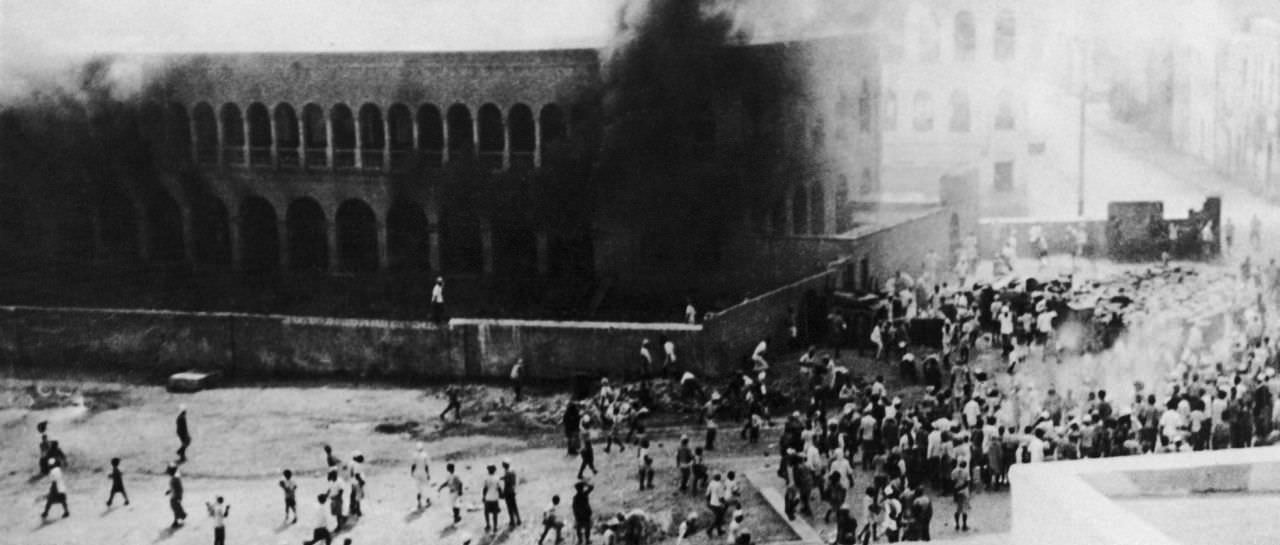
What the governments did. Across the region, governments stripped Jews of citizenship, seized their property and their communities’ buildings, made mass arrests, ordered expulsions, and closed Jewish schools. In Iraq, Jews were hanged in public after trials on espionage and treason charges. Separately, mobs attacked Jewish neighborhoods in Cairo and Tripoli in November 1945, in Aden and Aleppo in December 1947, and in Tripoli and the Moroccan towns of Oujda and Jerada in June 1948. In Cairo that year, bombs struck the Jewish neighborhoods.
The order of events. The State of Israel was founded on May 14, 1948. The Farhud, the Baghdad pogrom, came seven years earlier, in June 1941, while the Holocaust was under way in Europe. The pogroms in Tripoli and Cairo came in 1945. Those in Aden and Aleppo followed the United Nations vote of November 1947 to partition Palestine. The laws that stripped citizenship and seized property came after May 1948, and the governments that passed them pointed to the war with Israel. The founding of Israel also changed where people could go: for the first time, the Jews uprooted from these countries had a state that would take them in. The wartime experience documented in The Holocaust in MENA is part of the longer background. How Jews left varied by country: loss of citizenship and frozen property in Iraq, expulsions from Egypt, flight after pogroms in Libya and Aden, an airlift from Yemen, and slower, more mixed departures in Morocco and Tunisia. Historians differ on how to describe these departures as a group: as a refugee flight, or as emigration shaped by Zionist organizing and by conditions that differed from country to country.
Who acted. Governments, mobs, and identifiable groups carried out the acts described above. Ordinary people in these countries did not act as one. In many documented cases they sheltered, protected, or helped their Jewish neighbors. In Basra in May 1941, for example, when looting broke out after British forces occupied the city, some Arab notables posted night watchmen to guard Jewish property and gave Jews refuge in their homes.
The European import
What was new in the twentieth century.
Historians including Bernard Lewis, Mark Cohen, Norman Stillman, Gilbert Achcar, and Esther Webman describe what these governments did to their Jewish citizens between 1945 and 1972 as new in its scale and in the ideas behind it. In their account it was not simply the older Islamic system of the dhimma returning.
The older system. The dhimma was set out in the tradition of the Pact of Umar, a list of conditions for non-Muslim subjects credited to Umar, an early Muslim ruler. Muslim rulers applied it for centuries. Under it, Jews and Christians alike held a lower legal rank as “People of the Book.” It was discriminatory, and at times it was enforced with violence. Examples include the 1066 massacre in Granada and the persecutions of the 1100s under the Almohads, a strict dynasty that ruled Spain and North Africa. They also include the 1679 expulsion of Yemen’s Jews to Mawza, near the Red Sea coast, and the attacks Morocco’s Sultan Moulay Yazid ordered on Jewish quarters in 1790–1792. Some of that violence fell on Jews alone. The tradition also held its own hostile views of Jews, as the Dhimma Chapter shows. But the system was not built around Jews as Jews. It did not teach that Jews were uniquely evil, and a person could leave the lower rank by converting. Most of these communities had lived under it for more than a thousand years.
What arrived in the twentieth century. The Protocols of the Elders of Zion, a forged text claiming a Jewish plot to rule the world, was circulating in Arabic across the region by the mid-1920s. The Mufti of Jerusalem, the leading Muslim cleric of British-ruled Palestine, worked with the Nazi regime during the war, as the Holocaust in MENA Chapter documents. Radio Zeesen broadcast Nazi propaganda in Arabic from 1939 to 1945. Vichy France, the French government that worked with Nazi Germany from 1940 to 1944, extended its antisemitic laws across French North Africa. Some Arab nationalist and Islamist movements (Islamists seek government by Islamic law) took up this European material, and the region’s press and politics spread it further. In the historians’ account, these new ideas were added on top of the older system. Together with the war with Israel, which the governments themselves cited, they shaped what those governments did after 1948.
The scale of the departure
The numbers, by community.
Here are the Jewish populations of the major MENA communities around 1948 and in recent years. All figures are approximate, and documentation gaps in several communities make precise totals impossible.
- Iraq. Some 135,000 in 1948. Fewer than 100 by the late 1990s.
- Iran. Roughly 100,000–120,000 in 1948. About 8,000–10,000 in 2026. Most left after the 1979 revolution, not in 1945–1972.
- Yemen and Aden. Some 63,000 in 1948. Fewer than ten in 2026.
- Egypt. Roughly 75,000–80,000 in 1948. Fewer than 20 by the 2020s.
- Libya. About 38,000 in 1948. Effectively none by 1970.
- Syria. About 15,000 in 1947 by the Encyclopaedia Judaica’s count, though other tallies run as high as 40,000. Effectively none by the 2020s.
- Lebanon. About 5,200 in 1948, rising to about 9,000 in the 1950s. Effectively none in 2026.
- Morocco. About 250,000–265,000 in 1948, the largest MENA Jewish community at the moment of Israeli independence. Some 2,000 in 2026.
- Tunisia. Roughly 105,000 in 1948. About 1,000–1,500 in 2026.
- Algeria. Some 140,000 in 1948, most of them French citizens under the Crémieux Decree, the 1870 grant of French citizenship to Algerian Jews. Effectively none after independence in 1962.
Add the Arab-land communities together, leaving Iran aside, and you reach roughly 850,000 people who left their countries or were expelled from them between 1945 and 1972, the figure used by JIMENA (Jews Indigenous to the Middle East and North Africa) and the World Jewish Congress. The departure from Iran after 1979 added some 60,000 to 70,000 more across the following decades.
Riots and pogroms · 1945–1948
The pattern was in motion before 1948.
Pressure on the MENA Jewish communities rose in the years before the founding of the State of Israel in 1948. The 1941 Farhud in Baghdad is told in The Jews of Iraq. Between 1945 and 1948, mobs struck Jewish communities across the region.
- The 1945 Tripoli pogrom. November 4–7, 1945. By different counts, between 121 and 187 Libyan Jews killed and many more wounded. Rioters looted Jewish homes and businesses across Tripoli and nearby towns and burned five synagogues in Tripoli, nine in all by one count. It was the deadliest anti-Jewish event in modern Libyan history.
- The 1945 Cairo and Alexandria pogroms. November 2–3, 1945. On the anniversary of the Balfour Declaration, Britain’s 1917 statement supporting a Jewish national home in Palestine, mobs attacked the Jewish quarter of Cairo. They burned synagogues, a Jewish hospital, and an old-age home and looted Jewish shops. In many cases, the Jewish Telegraphic Agency reported, police stood by. Greek Orthodox, Catholic, and Coptic property was also attacked. The rioting spread to Alexandria, where rioters killed six people.
- The 1947 Aden pogrom. December 2–4, 1947. Aden was then a British Crown Colony. On November 29, 1947, the United Nations voted to partition British-ruled Palestine into a Jewish state and an Arab state. In the days that followed, anti-Jewish rioting in Aden killed at least 82 Jews. By the British government’s count it also killed 38 Arabs, most shot by the British-commanded levies who eventually intervened. Rioters burned the community’s two Jewish schools and looted most Jewish shops. The World Jewish Congress reported in 1948 that a third of all Jewish homes had been destroyed and four synagogues burned.
- The 1947 Aleppo pogrom. December 1, 1947. Two days after the UN Partition vote, anti-Jewish rioting in Aleppo, Syria, damaged or destroyed about 150 Jewish buildings, some 50 shops and offices, at least ten synagogues, and five Jewish schools. Rioters burned 160 old Torah scrolls from the Bahsita synagogue. The Aleppo Codex, a tenth-century Hebrew Bible kept in the city’s Great Synagogue, survived the burning of the building, though many of its leaves were lost (see the Object Spotlight below).
- The 1948 Tripoli pogrom. June 12–14, 1948. A second major anti-Jewish pogrom in Tripoli, weeks after Israeli independence, killed at least 12 Jews and destroyed 280 Jewish homes. This time a Jewish self-defense group kept the rioters out of the Jewish quarter.
- The 1948 Cairo bombings. June through November 1948. After Israeli independence in May 1948, neighboring Arab states, Egypt among them, went to war against the new state. The Egyptian government arrested and interned hundreds of Egyptian Jews. Bombs planted in Jewish neighborhoods and businesses in Cairo from June 1948 killed or wounded about 250 Jews.
Iraq · 1941–1969
From the Farhud to Operation Ezra and Nehemiah.
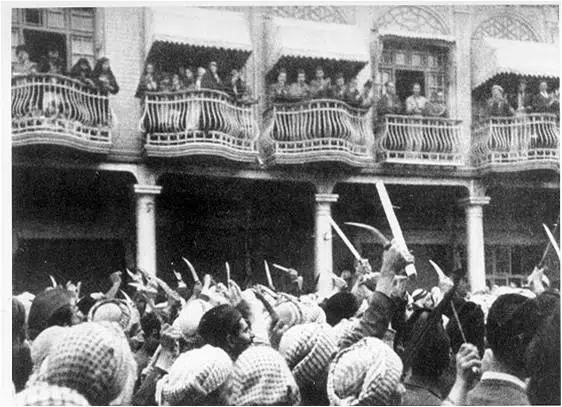
The Iraqi Jewish community of about 135,000 in 1948 had lived continuously in Mesopotamia for more than 2,500 years. The community’s life ran deep and wide: the Great Synagogue of Baghdad, the Frank Iny and Shamash schools, the office of the Hakham Bashi, the community’s chief rabbi, the commercial networks across the Tigris cities.
The Farhud of June 1–2, 1941 had already shifted the political ground for the community. In the postwar period, successive Iraqi governments, under the Hashemite monarchy and after, instituted increasingly restrictive policies. In 1948, following Iraq’s entry into the Arab-Israeli War, the Iraqi government:
- Declared Zionism, the movement to build and support a Jewish state, a criminal offense punishable by imprisonment.
- Arrested hundreds of Iraqi Jews on charges of Zionist sympathy.
- Conducted the public hanging on September 23, 1948 of Shafiq Ades, one of the wealthiest Jewish citizens of Basra, after a military court convicted him of treason, on a charge of selling scrap metal to Israel. The Ades hanging, broadcast and publicized, was widely understood within the community as the signal that Iraqi Jews could no longer rely on their citizenship for protection.
- Imposed sweeping economic restrictions on Jewish businesses, including the dismissal of Jewish employees from government positions and the freezing of Jewish bank accounts.
In March 1950, the Iraqi parliament passed Law No. 1 of 1950, the Denaturalization Law. It permitted Iraqi Jews to renounce their citizenship and emigrate within a one-year window. The law was widely understood as the invitation for the community to leave, and the overwhelming majority of Iraq’s Jews registered to go. Operation Ezra and Nehemiah, the Israeli-organized airlift conducted between 1950 and 1952, carried the great majority of the roughly 120,000 to 130,000 Iraqi Jews who left in 1950–1952 to Israel.
During the registration year, a series of bombings struck Jewish targets in Baghdad. The deadliest, in January 1951, killed at least three people at the Masuda Shemtob synagogue, where Jews gathered before leaving. An Iraqi court convicted two members of the Zionist underground of some of the attacks, and they were hanged in 1952. Who carried out the bombings is still disputed among historians. (Bashkin, New Babylonians; Meir-Glitzenstein, Zionism in an Arab Country.)
In March 1951, immediately after the departure window formally closed, the parliament passed Law No. 5 of 1951. It froze the assets of every Iraqi Jew who had renounced citizenship under the 1950 law, when nearly 65,000 of them were still waiting to leave. Together, the two laws amounted to the legal seizure of Iraqi Jewish property at scale. Families were permitted to leave with only 50 Iraqi dinars per adult in cash, roughly 140 US dollars at the time. The economic dispossession is documented in the records of the Joint Distribution Committee and in the later claims literature.
About 6,000 Jews stayed, most of them from wealthy families who believed the danger would pass. In 1952 all but two of the Jewish schools closed, and in 1954 the state nationalized the Meir Elias Hospital. Conditions eased under Abd al-Karim Qasim, who ruled from 1958 to 1963. The rulers who overthrew him restored the old restrictions and added more, and after the Six-Day War of 1967 the government forbade all dealings with Jews. On January 27, 1969, the Iraqi Ba’athist government publicly hanged nine Iraqi Jews, among fourteen people executed that day on charges of spying for Israel. The government broadcast and celebrated the hangings, and the departure of the rest of the community accelerated. By the late 1970s, the Iraqi Jewish community of 2,500 years had been reduced to a few hundred.
Yemen and Aden · 1947–1950
Operation Magic Carpet, 1949–1950.
The Yemenite Jewish community traced its presence in Yemen to pre-Islamic antiquity. Large communities lived at Sana’a and Aden, with dozens of smaller towns and villages across the country. In absolute numbers the community was small, roughly 63,000 at the start of the postwar period. But it was distinctive: in its religious tradition, in its Hebrew calligraphy and manuscripts, and in customs that set it apart from both the Ashkenazi (European-descended) and Sephardic (Spanish-descended) Jewish worlds.
Several pressures came together in the immediate postwar period. The December 1947 Aden pogrom, documented above, drove the Aden Jewish community into refugee camps under British administration. Inside Yemen itself, formal restrictions on Jewish life had a long history. In the 1940s they were enforced by the Imam Yahya and then, after his 1948 assassination, by his successor Imam Ahmad. The restrictions had gone as far as expulsion before. In 1679 an earlier ruler, the Imam al-Mahdi Ahmad, expelled the country’s Jews, and only the Jews, to Mawza, a barren strip near the Red Sea coast. By some scholarly estimates as many as two-thirds died of hunger and disease before the survivors were permitted back a year later. Yemenite religious law also included the Orphans’ Decree, which assigned Jewish orphans under bar mitzvah age to the guardianship of Muslim authorities for forced conversion.
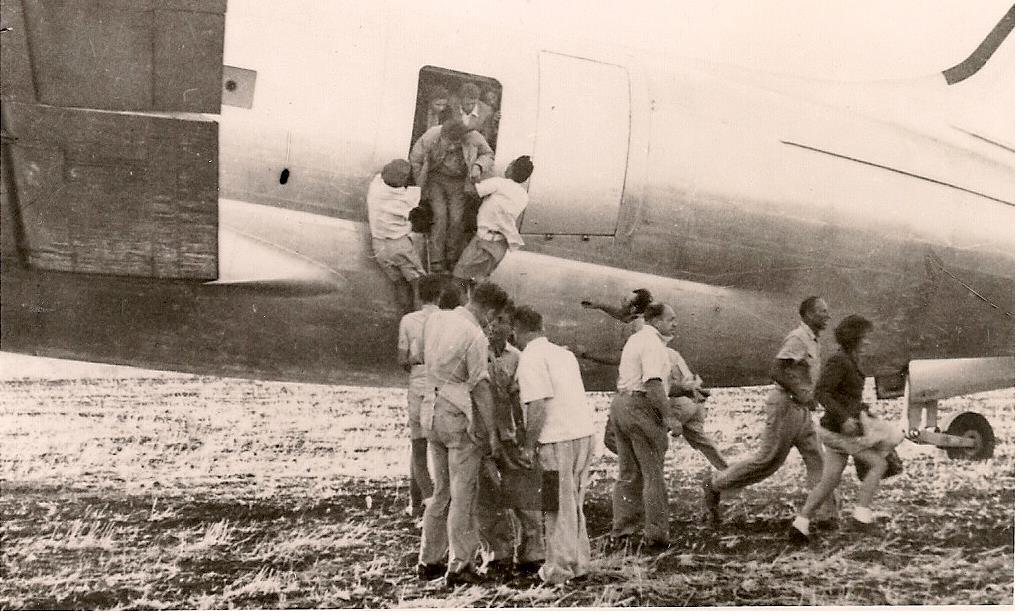
Then came the airlift. Operation Magic Carpet (Hebrew: Al Kanfei Nesharim, “On Eagles’ Wings”) ran from June 1949 to September 1950. The community was gathered in Aden, in a refugee camp known as Hashed, and American and British charter aircraft flew about 49,000 Yemenite Jews from there to Israel. Another 14,000 reached Israel by other routes, before or after the operation. By the mid-1950s the departure was all but complete, and the small community that stayed shrank further across the following decades. Fewer than ten Yemenite Jews were known to remain in Yemen as of 2026.
Egypt · 1948–1967
1948 internment, 1956 expulsion, and the 1967 final dismantling.
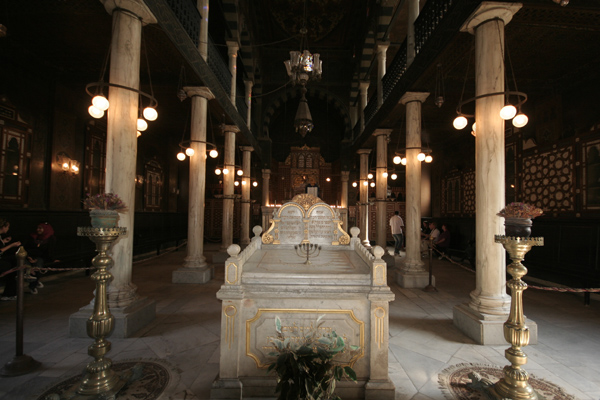
The Egyptian Jewish community numbered some 75,000–80,000 in 1948. It was concentrated principally in Cairo and Alexandria, with smaller communities in the Delta cities. It was exceptionally diverse. It included Sephardic families, Mizrahi families with roots in the Middle East and North Africa, and Karaites, members of a Jewish movement that accepts only the written Hebrew Bible and rejects the Talmud. It also included Levantine families and Ashkenazi families from late-nineteenth-century European migrations. Many carried foreign-citizenship statuses inherited from the Ottoman and British periods. Large parts of the community held French, Italian, Greek, Spanish, or British citizenship rather than Egyptian.
The systematic dismantling of the Egyptian Jewish community took place in three identifiable phases.
The 1948 phase. Egypt entered the Arab-Israeli War in May 1948. The government then interned hundreds of Egyptian Jews under emergency-law provisions and froze the bank accounts of roughly one-third of the community. The bombings of Jewish neighborhoods in Cairo noted above added to the pressure. About 25,000 Egyptian Jews left between 1948 and 1950, some 14,000 of them for Israel and the rest mainly to France, Italy, Brazil, and the United States.
The 1956 phase. After the Suez Crisis, in which Britain, France, and Israel attacked Egypt over the Suez Canal in October–November 1956, the Egyptian government under Gamal Abdel Nasser declared all “Zionist” residents enemies of the state. It did so in a November 1956 proclamation, with Law No. 391 of 1956 amending the nationality law to permit stripping their citizenship. It issued a formal expulsion order for British and French nationals, which hit the large share of the community holding those citizenships. The pressure fell just as hard on the roughly one-third of Egypt’s Jews who were stateless, holding no citizenship at all. The government also conducted mass arrests and internments. The expulsions and forced departures of 1956 removed some 25,000 to 30,000 additional Egyptian Jews from the country. Property was confiscated through emergency legislation. Those who left were permitted roughly 20 Egyptian pounds in personal goods.
The 1967 phase. After the Six-Day War of June 1967, in which Israel defeated Egypt, Syria, and Jordan, the Egyptian government arrested about 425 of the remaining Egyptian Jewish men and interned them, in some cases for extended periods reaching into 1970. The internments, and the broader pressure around them, drove out essentially all of the remaining community. By 1977 about 400 Jews remained of a community some 2,500 years old, most of them elderly.
(Beinin, The Dispersion of Egyptian Jewry; Krämer, The Jews in Modern Egypt, 1914–1952.)
Libya · 1945–1970
The 1945 pogrom, the 1948 pogrom, and the 1967 finale.
The Libyan Jewish community numbered some 38,000 in the immediate postwar period. It had been documented in Libya’s Cyrenaica from the third century BCE. The 1945 Tripoli pogrom documented above opened a sustained period of violence and pressure. The 1948 Tripoli pogrom that followed Israeli independence sped the departure further.
Between 1948 and 1951, roughly 30,000 Libyan Jews departed for Israel under the Israeli-organized emigration program. That was the great majority of the community. About 8,000 remained. They lived under increasingly restrictive conditions through the 1950s and 1960s under the United Kingdom of Libya (1951–1969). When the Six-Day War broke out in June 1967, mobs in Tripoli killed at least 17 Libyan Jews. Within weeks, in an evacuation the Italian government organized, essentially the entire remaining community fled, mainly to Italy and Israel.
The 1969 Libyan revolution under Muammar Gaddafi formally completed the dismantling. In 1970 the new regime issued decrees confiscating all remaining Jewish-owned property in Libya. By the early 1970s, the Libyan Jewish community of more than two thousand years had effectively ended. (Roumani, The Jews of Libya.)
Object Spotlight
The Aleppo Codex
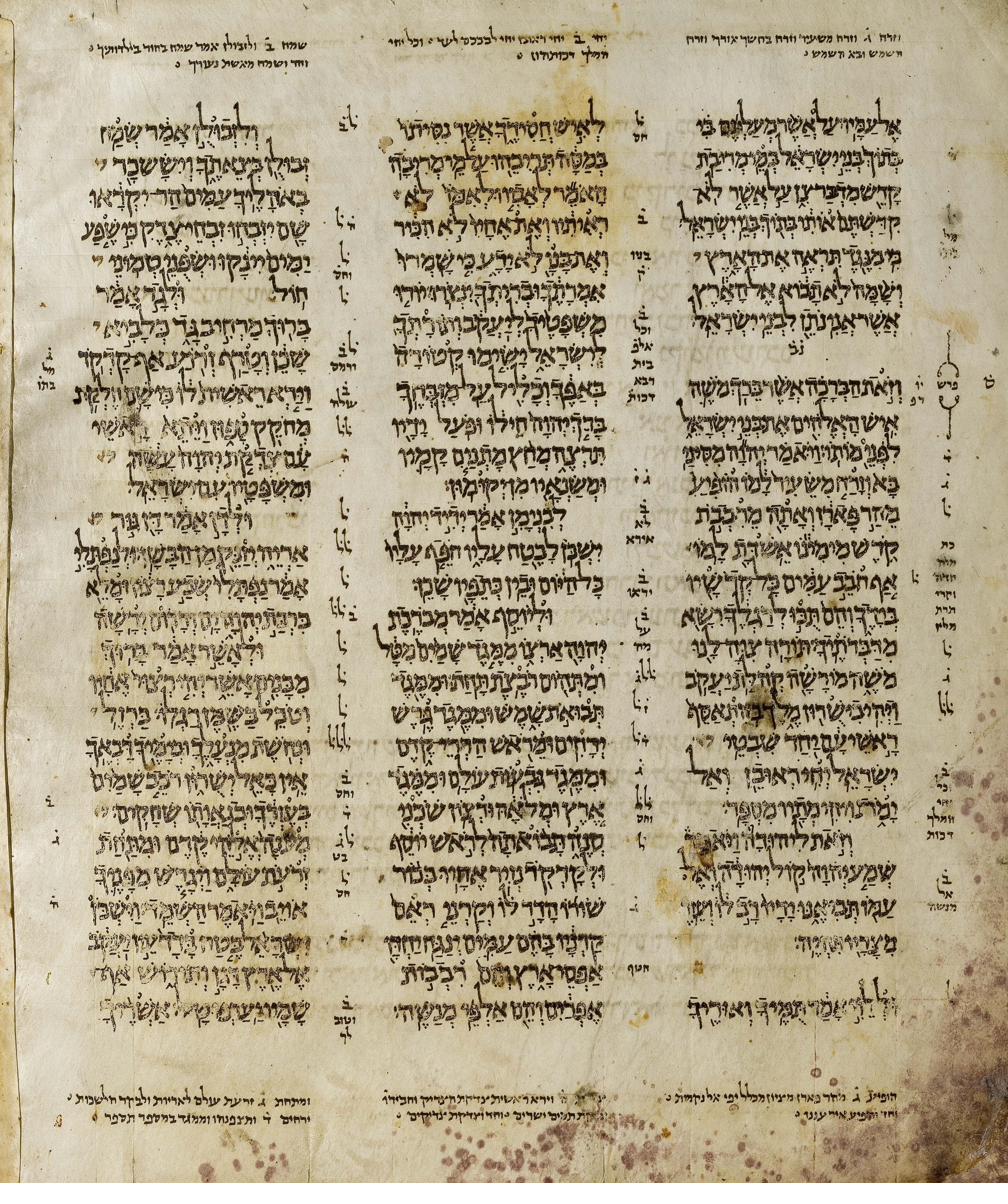
Three columns of small, careful Hebrew writing fill a sheet of worn parchment, with even smaller notes around the edges. The large letters are the text of the Hebrew Bible. The tiny marginal notes are instructions: how each word is spelled, how it is pronounced, where the reader pauses. The page comes from the Aleppo Codex, a complete Hebrew Bible written by hand around 930 CE in Tiberias, in the Land of Israel, and one of the most exact copies of the Hebrew Bible ever produced. A codex is a bound book, the form that replaced the scroll for study. Its vowels and notes are attributed to Aaron Ben-Asher, of the family of scholars who perfected the system that fixed how the biblical text is read.
Within two centuries the book had passed through Jerusalem to Egypt, where the philosopher and legal authority Maimonides saw it and attested to its accuracy. By the late fourteenth century it had come to the Jewish community of Aleppo, in northern Syria. There it was kept in the Great Synagogue (also called the Central Synagogue) for nearly six hundred years, guarded so closely that it became known as the Crown of Aleppo.
On the night of December 1, 1947, days after the United Nations voted to partition British Mandatory Palestine, mobs attacked the Jewish quarter of Aleppo and set the Great Synagogue on fire. The codex was thought destroyed. It had in fact survived, hidden by members of the community, but pages were lost in the violence and its aftermath. Of the roughly 487 original leaves, 294 survive, and most of the Torah, the first five books, is gone. Scholars still debate exactly how and when the missing leaves disappeared, during or after the fire.
In 1958 the surviving portion was smuggled out of Syria by way of Turkey and given to Israel’s president, Yitzhak Ben-Zvi, who placed it with the Ben-Zvi Institute in Jerusalem. It became the base text for modern scholarly editions of the Hebrew Bible, and it is now displayed at the Israel Museum in Jerusalem.
Syria and Lebanon · 1947–1995
The December 1947 pogrom, the long restriction, the 1992–1995 exit.
Syria’s Jews lived chiefly in Aleppo, Damascus, and the smaller community of Qamishli in northeastern Syria. Counts differ. The Encyclopaedia Judaica gives about 15,000 in 1947, and other tallies run as high as 40,000. Aleppo’s Jews had been documented continuously since the Roman period.
The December 1947 Aleppo pogrom destroyed much of the community’s infrastructure and burned the Great Synagogue. The departure began in the immediate aftermath. From 1948 onward, however, the Syrian government put formal legal restrictions in place that made leaving progressively harder. Syrian Jews needed government permission to travel. They could not sell property without state approval. They had to carry identity documents marking them as Jews, and they lived under surveillance and periodic arrest under emergency-law provisions. Between 1948 and 1961 about 5,000 Syrian Jews reached Israel, and others crossed into Lebanon. By 1968 about 4,000 remained. They lived under these restrictions for more than two decades. Some escaped in secret. In 1974 four young Jewish women from Damascus who tried to flee were raped and murdered.
Between 1989 and 1992, sustained American diplomatic pressure on the Syrian government under Hafez al-Assad loosened the departure restrictions. About 2,600 Syrian Jews left in 1992 alone, and by 1994, 3,565 had immigrated to the United States. Others went to Israel, among them the chief rabbi of Damascus. The arrangements were advanced by US Representative Stephen Solarz, the Canadian advocate Judy Feld Carr, the Conference of Presidents of Major American Jewish Organizations, and other diplomatic channels. The 1992–1995 departure all but completed the community’s exit. Syria’s Jewish community as of 2026 numbers a handful of elderly individuals.
Lebanon’s Jewish community numbered about 5,200 in 1948 and rose to about 9,000 in the 1950s, partly as Jews from Syria and Iraq arrived. It declined steadily during the Lebanese Civil War (1975–1990). The community is effectively zero in 2026.
Morocco · 1948–1972
A monarchy that mostly protected its Jews, and a long departure.
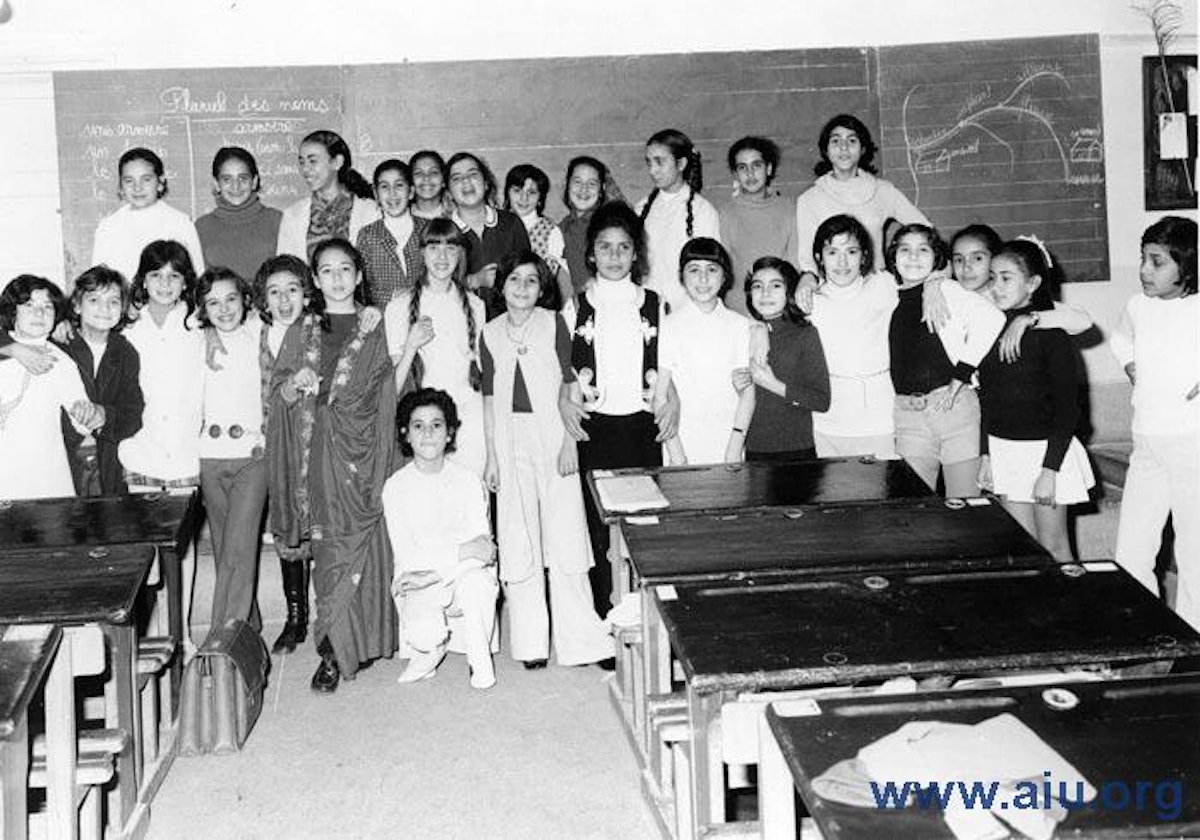
The Moroccan Jewish community numbered roughly 250,000–265,000 in 1948, the largest single MENA Jewish community at the moment of Israeli independence. Jews had been documented in Morocco continuously since the Roman period. After 1492, Sephardic refugees from the Iberian expulsions greatly enlarged the community.
The Moroccan case is an exception to the violent state-driven pattern documented in the other countries. After independence in 1956 the monarchy, under Mohammed V and then Hassan II, mostly protected its Jewish community. Mohammed V’s wartime record, a mixed one, is told in The Holocaust in MENA. Under Mohammed V, a Jewish physician, Leon Benzaquen, served as minister of posts in Morocco’s first government. Earlier rulers had not always protected the community. Moroccan Jewish chronicles remembered the reign of Sultan Moulay Yazid as the worst since the Almohad persecutions more than six centuries earlier. On taking the throne in 1790, he ordered two years of attacks on the Jewish quarters of Tetouan, Meknes, Fez, and Marrakesh. He ordered them as revenge, because years earlier the Jews of Tetouan had refused to lend him money to raise an army against his father.
Most Moroccan Jews left anyway. No single cause drove them. The broader regional pressures played a part, and so did the example of other MENA communities. Decolonization changed the country (Morocco gained independence from France in 1956). Economic hardship pressed large segments of the community. Zionist organizers worked within Morocco across the late 1940s and 1950s.
Morocco also saw deadly mob violence. On June 7 and 8, 1948, weeks after Israel’s declaration of independence, mobs killed more than forty Jews in the eastern towns of Oujda and Jerada, most of them in Jerada, a small mining town. Scores of the attackers were tried, and two were sentenced to death. The departure accelerated from that point. Specific events shaped the timing. In 1956 the government barred emigration to Israel, which produced clandestine departure operations. In January 1961 a smuggling boat, the Egoz, sank and more than forty Jewish emigrants drowned, and later that year the restrictions were lifted. Operation Yachin, conducted between 1961 and 1964 under arrangements negotiated between Israel and the Moroccan monarchy with strong American Jewish support, transported about 97,000 Moroccan Jews to Israel.
The Moroccan departure stretched across a longer time frame than the other regional cases, most of it between 1948 and 1972, and it ended less completely. Some 2,000 Jews remained in Morocco as of 2026, primarily in Casablanca and Rabat, with active synagogues and a functioning communal infrastructure.
Tunisia · 1948–1967
The community that survived German occupation, then was pressed to leave.
The Tunisian Jewish community numbered roughly 105,000 in 1948. It had lived through the forced labor, heavy property losses, and trauma of the German occupation of November 1942 – May 1943, documented in The Holocaust in MENA, and most of its people survived. The postwar departure came in two principal waves.
The first wave came between 1948 and 1956. It was driven by the broader regional pressures and by the unsettled politics of the late French colonial period in Tunisia. About 50,000 Tunisian Jews departed during this period, primarily to Israel and to France.
The second wave followed Tunisian independence in 1956, when the structures that had supported Jewish communal life under the French protectorate were dismantled. The Bourguiba government’s nationalist policies were not as overtly hostile as the patterns in Iraq, Egypt, or Libya, yet they kept steady pressure on the community to leave through the late 1950s and 1960s. Two crises set off specific waves of departure. The first was the 1961 Bizerte crisis, fighting between Tunisia and France over the French naval base, followed by weeks of hostility toward Jews suspected of siding with France. The second was the anti-Jewish riots in Tunis in 1967, following the Six-Day War. By the mid-1970s, the community had been reduced to some 7,000, principally in Tunis and on the island of Djerba. There the historic synagogue at El Ghriba, believed to incorporate elements dating to late antiquity, remains in operation.
Roughly 1,000 to 1,500 Jews remained in Tunisia as of 2026, principally on Djerba. The El Ghriba synagogue continues to operate and remains a pilgrimage site. It has also been a target of antisemitic violence in the contemporary period, including the 2002 al-Qaeda bombing that killed 21 people, and a 2023 shooting during the pilgrimage that killed two Jewish pilgrims and three security officers.
Algeria · 1954–1962
The community that left with the French.
The Algerian Jewish case is distinct from the other regional cases because of the legal status the community held under the Crémieux Decree of 1870, which had granted French citizenship to Algerian Jews. The Vichy abrogation of the decree in 1940 (documented in The Holocaust in MENA) and its restoration in October 1943 returned the community to French citizenship. Citizenship did not always protect. In August 1934, in the eastern Algerian city of Constantine, a rumor of an insult to a mosque became days of rioting in which twenty-five Jews were killed, whole families among them, while the French authorities failed to intervene.
The war for independence (1954–1962) caught the community between two violent sides. In December 1960 the Great Synagogue of Algiers was desecrated. On June 22, 1961, Raymond Leyris, known as Cheikh Raymond, was shot dead in the market of his hometown, Constantine. A Jew who sang in Arabic, he was a master of Arab-Andalusian music. His killing marked the start of the exile of Constantine’s Jews.
The Algerian Jewish community of about 140,000 at the close of the colonial period departed Algeria almost entirely in the months surrounding Algerian independence in July 1962. The community’s departure ran alongside the broader exodus of the pieds-noirs European settler population. Some 130,000 of the 140,000 Algerian Jews departed in 1962, the great majority going to metropolitan France. Smaller numbers went to Israel.
The Algerian government did not expel the community. Its members, French citizens since 1870, left with the end of French rule. Those who stayed met pressure from the new state. After Houari Boumédienne took power in 1965, Jews faced heavy taxes and an economic boycott, and Algeria’s Supreme Court declared that Jews were no longer under the protection of the law. The result matched the regional outcome: almost no Jews remained in Algeria.
Iran · from 1979
The 1979 break.
Iran is the major regional exception in timing. The community, roughly 100,000–120,000 at the postwar peak, came through the 1945–1972 period with its institutions intact, though some 25,000 to 30,000, mostly from the poorer provincial towns, emigrated to Israel between 1948 and 1953. The Pahlavi monarchy kept a largely protective posture toward the Jewish community from the 1940s to the 1970s. Iranian Jews were citizens. They took part in public life, ran communal institutions, and lived in conditions quite different from the patterns documented in the Arab countries.
The major break came with the 1979 Iranian Revolution and the establishment of the Islamic Republic. The new regime executed Jewish citizens, among them the prominent Jewish businessman Habib Elghanian, in May 1979. By the count of the Federation of Iranian Jews, it has executed at least 17 Jews since the revolution. The regime also placed formal restrictions on the life of the community, and the pressure to leave became sustained. In the decade after 1979, about 60,000 Iranian Jews departed, primarily to the United States and to Israel. Los Angeles became home to one of the largest Iranian Jewish communities outside Iran.
Some 8,000 to 10,000 Jews remained in Iran as of 2026, principally in Tehran, Isfahan, and Shiraz. The community still operates synagogues, schools, and communal institutions under formal regulation by the Iranian state. It is one of the largest Jewish communities remaining in the region outside Israel. It is also the only major regional case in which the principal departure came in the post-1972 period.
Where they went
The receiving societies.
The destinations of the roughly 850,000 Jews uprooted from the MENA region:
- Israel. About 600,000 of them eventually settled in Israel, far more than in any other destination. Their reception by a young state under heavy strain, and the long debate over how much they faced discrimination, are told in the Modern Israel Chapter.
- France. Some 200,000–230,000 settled in France, principally from the North African communities. The Algerian, Moroccan, and Tunisian Jewish populations of France reshaped French Jewish demography in the postwar period. By the 1970s, the majority of French Jewry was of North African origin.
- The United States. Roughly 25,000–30,000 settled in the United States, many joining the Syrian Jewish community of Brooklyn, which earlier migrants had founded in the early twentieth century.
- Canada, the United Kingdom, Italy, Brazil, Argentina, Mexico, and elsewhere. Smaller communities received the remainder.
Two refugee populations
What the United Nations built after 1948.
The same mid-century years produced two refugee populations. Historians’ estimates of the Palestinian Arabs who fled or were expelled in and just after the 1948 war run from under 600,000 to more than 750,000 (the Modern Israel Chapter gives each estimate and its source). Between 1945 and 1972, roughly 850,000 Jews left the Arab world or were driven from it. What happened next is recorded in the founding documents of two international institutions.
For the Palestinian refugees, the United Nations created a dedicated agency in December 1949, the UN Relief and Works Agency (UNRWA), which registers refugees’ descendants through the male line as refugees too. (UNRWA, “Palestine refugees”; the agency’s definition, its counts, and its first report are in the Modern Israel Chapter.)
Every other refugee population in the world falls under a different body, the UN High Commissioner for Refugees, working from the 1951 Refugee Convention. Its stated solutions are voluntary return, integration into the country of arrival, or resettlement in a third country. The 1951 Convention contains no rule passing refugee status to descendants, and status ends when a refugee gains a new nationality and that country’s protection. UNHCR does extend refugee status to a refugee’s dependants, at minimum the spouse and minor children, under what its Handbook calls “the principle of family unity.” Supporters and critics of UNRWA disagree over how far UNRWA’s rule for descendants differs from that practice. (UNHCR, the 1951 Convention; the Convention’s text, Article 1C(3), at the UN Human Rights Office; UNHCR Handbook on Procedures and Criteria for Determining Refugee Status, paragraphs 184–185, as quoted by the UK Upper Tribunal.)
The Jewish refugees of these same years received no dedicated agency and no permanent registry. Israel absorbed the majority, France and other countries most of the rest, and within a generation their refugee status had ended in citizenship, the outcome UNHCR calls a durable solution. Their descendants today are citizens of the countries that received them.
Property and the question of restitution
Property left behind.
The departing communities lost most of what they owned. In most of the region, those who left were made to go with few belongings and almost no cash. Real estate, businesses, and financial assets stayed behind, along with the communal property: synagogues, schools, cemeteries, communal buildings. The full scale of the losses is still being documented, and estimates vary widely.
Restitution for Jewish property from the MENA region is still an open question. It has run through diplomacy, law, and politics for more than seventy years. On April 1, 2008, the US House of Representatives passed Resolution 185. It said that a lasting Middle East peace agreement must resolve the issues of all refugees displaced from countries in the region, “including Jews, Christians, and other populations.” It also urged the President to instruct American representatives at the United Nations and elsewhere. Any resolution on Middle East refugees that refers to “the Palestinian refugee issue” must also include “a similarly explicit reference to the resolution of the issue of Jewish refugees from Arab countries.” The resolution was nonbinding, and the question remains unresolved.
Recognition and the archives
The documentation.
An early recognition came from the United Nations itself. In 1957 the UN High Commissioner for Refugees, Auguste Lindt, spoke to his agency’s executive committee about refugees from Egypt, many of them Jews expelled after the 1956 Suez war. He said they fell “under the mandate of the High Commissioner.” (UNHCR, speech of Auguste R. Lindt, 1957.)
In 2014 Israel’s parliament set November 30 as a national day of commemoration for the Jewish refugees from Arab countries and Iran.
The laws, the registers, the photographs, and the testimony are now held in archives and oral-history collections, among them the Iraqi Jewish Archive, the Babylonian Jewry Heritage Center, and JIMENA’s recorded interviews. Many can be read and heard online.
Key takeaways
- Jewish communities lived across the Middle East and North Africa continuously for centuries (in Iraq, for more than 2,500 years) long before the modern states they left.
- Between roughly 1945 and 1972, about 850,000 of these Jews left or were forced out. In most countries the communities were dismantled: their institutions closed, their property seized, their legal standing revoked.
- Governments across the region stripped citizenship, seized property, and ordered expulsions, and the pogroms began years before the State of Israel was founded in 1948.
- How the communities ended differed by country: loss of citizenship and frozen property in Iraq, expulsions from Egypt, flight after pogroms in Libya and Aden, an airlift from Yemen, and slower departures from Morocco and Tunisia.
- The departing communities rebuilt their lives chiefly in Israel, France, and the Americas, where their traditions continue.
Discussion questions
Working from the evidence.
Each question is anchored in a fact this Chapter documents. Answer from the evidence on the page.
- Roughly 850,000 Jews left the Middle East and North Africa within a generation. The Chapter documents the laws that stripped citizenship, froze property, and conditioned exit. How do those laws change what the word “left” describes?
- The Chapter contrasts two refugee populations from the same era. From the evidence on the page, what differed in how each population was defined, counted, and resettled, and what followed from that difference?
- The same era ended differently in different countries: some communities left almost at once, some over decades, and one, Iran’s, did not end. Using two countries from the Chapter, explain what made their endings different.
- About 600,000 of those who left settled in Israel, and by the 1970s most of French Jewry was of North African origin. Using this Chapter and the Modern Israel Chapter, how did these arrivals change the communities that took them in?
Classroom Connections
Where this Chapter fits.
Teaching Connections
- World History, Decolonization & the Modern Middle East: the uprooting of 1945–1972, in which nearly all the Jews of the Arab world left or were driven out within a single generation.
- World History, Human Rights: how roughly 850,000 Jews were driven out of Arab lands or fled them.
- World History, WWII & the Postwar Era: the pre-1948 events: the Farhud, the 1945 Tripoli and Cairo pogroms, and the 1947 Aden and Aleppo pogroms.
- United States History: the American reception and resettlement of MENA Jewish refugees after 1945.
- Historical Thinking: causation and framing: what caused the departure, and what did not.
- Source Analysis & Archives Education: oral histories, archives, and documentary film.
Standards Alignment
- NYS Global History & Geography: 10.10 (human rights, the 850,000 Jews who left or were driven out of Arab lands).
- Common Core ELA-Literacy: RH.11–12.7 (integrating multiple sources).
- C3 Framework: Dimension 2 (causation and multiple perspectives: what caused the departure, and how the parallel events of the period relate).
Further Teaching Resources
- The departure on film, the Films & Video collection, organized by region (Remember Baghdad, The Last Jews of Baghdad, Forget Baghdad, and more).
- JIMENA, Jews Indigenous to the Middle East and North Africa: educational resources and a recorded oral-history program of community members describing departure and resettlement. JIMENA oral histories →
- Unpacked, “The Farhud: The Nazi-Fueled Pogrom in Iraq”: an educational feature with photographs and video on the 1941 Farhud and its place in the Iraqi-Jewish departure. unpacked.media →
- World Jewish Congress, Legacy of Jews in MENA: country-by-country profiles of the Jewish communities of the Middle East and North Africa, with history, photographs, and the story of each departure. worldjewishcongress.org →
Sources and citations
Primary sources
A primary source is a record from the time. It was made by people who were there. Examples: letters, diaries, photos, decrees, trial records, and newspapers.
- U.S. Congress. House Resolution 185, 110th Cong., 2nd sess., April 1, 2008. (On Jewish refugees from Arab and Muslim-majority countries.) govinfo.gov →
- Babylonian Jewry Heritage Center, Or Yehuda, Israel. Collection on Iraqi Jewry and Operation Ezra and Nehemiah.
- Or Shalom Center for Libyan Jewish Heritage. Collection on Libyan Jewry.
- Iraq. Law No. 1 of 1950 (the Denaturalization Law, permitting Jews to leave upon renouncing citizenship) and Law No. 5 of 1951 (freezing the property of departing Jews).
- Libya. The law of July 21, 1970, confiscating the property of the Jews who had left Libya.
- United Kingdom, House of Commons. Written answer, “Tripolitania (Disturbance),” November 27, 1945. (The pogrom began in Tripoli on the night of November 4–5 and ended by November 8.) api.parliament.uk.
- United Kingdom, House of Commons. Written answer, “Aden Disturbances,” February 11, 1948. (Killed in the December 1947 Aden pogrom: 82 Jews, 38 Arabs, and three others.) api.parliament.uk.
- Jewish Telegraphic Agency. “Anti-Jewish Riots in Egypt; Synagogues Burned in Cairo; Six Killed in Alexandria.” November 4, 1945. (The Cairo riots on the anniversary of the Balfour Declaration.) jta.org.
- Jewish Telegraphic Agency. “British Administration Halts All Assistance to Jewish Victims of Arab Pogrom in Aden.” September 15, 1948. (The World Jewish Congress’s account of the losses in the December 1947 riots.) jta.org.
- Jewish Telegraphic Agency. “Arab Mobs Kill 42 in Anti-Jewish Pogroms in Two Towns in Morocco; Loot Jewish Stores.” June 9, 1948. (Thirty-seven killed at Jerada, five at Oujda.) jta.org.
- Jewish Telegraphic Agency. “Casablanca Court Condemns Two Moroccans for Participating in Pogroms; 11 Others Jailed.” February 15, 1949. (The Oujda trial: two death sentences, eleven prison terms, twenty-one acquittals; a second trial for Jerada.) jta.org.
- U.S. Department of State. 2023 Report on International Religious Freedom: Tunisia. Washington, 2024. (On the May 9, 2023 shooting at the El Ghriba synagogue.) state.gov.
- American Jewish Year Book, vol. 64 (1963). “North Africa: Tunisia.” (On the aftermath of the 1961 Bizerte crisis: hostility toward Jews suspected of siding with France, and the departure of 15,000 to 25,000 Tunisian Jews in 1961–62.) bjpa.org.
- Iraqi Jewish Archive. “After Millenia.” U.S. National Archives online exhibit. (On the January 1969 hangings and the 1951 asset law.) exhibit.ijarchive.org.
- UNHCR. Handbook on Procedures and Criteria for Determining Refugee Status, paragraphs 184–185, on the principle of family unity, as quoted in UK Upper Tribunal decision OA/18438/2013. tribunalsdecisions.service.gov.uk.
- Lindt, Auguste R., UN High Commissioner for Refugees. Speech at the opening of the fourth session of the UNREF Executive Committee, January 1957. unhcr.org.
- United Nations Relief and Works Agency for Palestine Refugees in the Near East. Interim Report of the Director (A/1451/Rev.1), October 6, 1950. (On the 1950 ration lists.) unispal.un.org.
Secondary sources
A secondary source was written later. It is a book or article by a historian who studied those records and explains what they mean.
- Jewish Virtual Library. “Jews in Islamic Countries: Iran.” (On the execution of Habib Elghanian and the Federation of Iranian Jews’ count of executions since 1979.) jewishvirtuallibrary.org.
- Stillman, Norman A. The Jews of Arab Lands in Modern Times. Philadelphia: Jewish Publication Society, 1991.
- Cohen, Hayyim J. The Jews of the Middle East, 1860–1972. Jerusalem: Israel Universities Press, 1973.
- Lewis, Bernard. The Jews of Islam. Princeton: Princeton University Press, 1984.
- Roumani, Maurice M. The Jews of Libya: Coexistence, Persecution, Resettlement. Brighton: Sussex Academic Press, 2008.
- Beinin, Joel. The Dispersion of Egyptian Jewry: Culture, Politics, and the Formation of a Modern Diaspora. Berkeley: University of California Press, 1998.
- Krämer, Gudrun. The Jews in Modern Egypt, 1914–1952. Seattle: University of Washington Press, 1989.
- Bashkin, Orit. New Babylonians: A History of Jews in Modern Iraq. Stanford: Stanford University Press, 2012.
- Meir-Glitzenstein, Esther. Zionism in an Arab Country: Jews in Iraq in the 1940s. London: Routledge, 2004.
- Shenhav, Yehouda. The Arab Jews: A Postcolonial Reading of Nationalism, Religion, and Ethnicity. Stanford: Stanford University Press, 2006.
- Stein, Sarah Abrevaya. Family Papers: A Sephardic Journey Through the Twentieth Century. New York: Farrar, Straus and Giroux, 2019.
- Laskier, Michael M. North African Jewry in the Twentieth Century: The Jews of Morocco, Tunisia, and Algeria. New York: NYU Press, 1994.
- Boum, Aomar. Memories of Absence: How Muslims Remember Jews in Morocco. Stanford: Stanford University Press, 2013.
- Levy, Lital. Poetic Trespass: Writing Between Hebrew and Arabic in Israel/Palestine. Princeton: Princeton University Press, 2014.
- Behar, Moshe, and Zvi Ben-Dor Benite, eds. Modern Middle Eastern Jewish Thought: Writings on Identity, Politics, and Culture, 1893–1958. Waltham: Brandeis University Press, 2013.
- Schroeter, Daniel J. The Sultan’s Jew: Morocco and the Sephardi World. Stanford: Stanford University Press, 2002.
- Tobi, Yosef. The Jews of Yemen: Studies in Their History and Culture. Leiden: Brill, 1999.
- Parfitt, Tudor. The Road to Redemption: The Jews of the Yemen, 1900–1950. Leiden: Brill, 1996.
- Zenner, Walter P. A Global Community: The Jews from Aleppo, Syria. Detroit: Wayne State University Press, 2000.
- Sutton, David E. Aleppo Chronicles: The Story of the Unique Sephardeem of the Ancient Near East. Brooklyn: Magen David Publications, 1988.
- JIMENA · Jews Indigenous to the Middle East and North Africa. jimena.org.
- American Sephardi Federation. Center for Jewish History, New York. americansephardi.org.
- ANU · Museum of the Jewish People, Tel Aviv. anumuseum.org.il.
- Jewish Virtual Library. “Iran Virtual Jewish History Tour.” American-Israeli Cooperative Enterprise. jewishvirtuallibrary.org.
- Jewish Virtual Library. “Syria Virtual Jewish History Tour.” American-Israeli Cooperative Enterprise. (The Encyclopaedia Judaica text: about 15,000 Jews in Syria in 1947, most of whom left during the 1940s; about 5,000 who reached Israel between 1948 and 1961; about 4,000 remaining in 1968; about 2,600 who left in 1992; 3,565 who had immigrated to the United States by 1994, the rest going to Israel.) jewishvirtuallibrary.org.
- Jewish Virtual Library. “Jews in Islamic Countries: Syria.” American-Israeli Cooperative Enterprise. (A higher tally: 40,000 Jews in Syria in 1948.) jewishvirtuallibrary.org.
- Jewish Virtual Library. “Jews in Islamic Countries: Libya.” American-Israeli Cooperative Enterprise. (On the 12 Jews killed and 280 Jewish homes destroyed in Tripoli on June 12, 1948.) jewishvirtuallibrary.org.
- Jewish Virtual Library. “Iraq Virtual Jewish History Tour.” American-Israeli Cooperative Enterprise. (The Encyclopaedia Judaica text: the asset freeze of March 10, 1951 with nearly 65,000 still waiting, the 6,000 who remained, the easing under Qasim, and the measures after 1963 and 1967.) jewishvirtuallibrary.org.
- Jewish Virtual Library. “Lebanon Virtual Jewish History Tour.” American-Israeli Cooperative Enterprise. (About 5,200 Jews in 1948, rising to about 9,000 by 1951, among them about 2,000 Jewish immigrants from Syria and Iraq.) jewishvirtuallibrary.org.
- Cohen, Mark R. Under Crescent and Cross: The Jews in the Middle Ages. Princeton: Princeton University Press, 2nd ed., 2008.
- Achcar, Gilbert. The Arabs and the Holocaust: The Arab-Israeli War of Narratives. New York: Metropolitan Books, 2010.
- Litvak, Meir, and Esther Webman. From Empathy to Denial: Arab Responses to the Holocaust. New York: Columbia University Press, 2009.
- Encyclopaedia Judaica. “Tetuan.” (On Sultan Moulay Yazid’s attacks of 1790 and his motive.) encyclopedia.com.
- Encyclopaedia Judaica. “Aden” and “Aleppo.” (On the two Jewish schools burned and the shops pillaged in Aden in December 1947, and the buildings, synagogues, and schools damaged and the Torah scrolls burned in Aleppo.) Aden, Aleppo.
- Encyclopaedia Judaica. “Algeria,” “Baghdad,” “Libya,” “Morocco,” and “Egypt,” as reproduced in the Jewish Virtual Library. (On the December 1960 desecration of the Great Synagogue of Algiers, the measures against Algeria’s remaining Jews after 1965, the 1969 hangings, the 1945 and 1948 Tripoli riots, the June 7, 1948 killings at Oujda and Jerada and the trials that followed, the 1956 Moroccan emigration ban and the Egoz, Leon Benzaquen, and the June to August 1948 bombings in Cairo.) Algeria, Baghdad, Libya, Morocco, Egypt.
- Institut Européen des Musiques Juives. “Cheikh Raymond – Une histoire algérienne,” notice of Bertrand Dicale, Cheikh Raymond: Une histoire algérienne (Paris: First Editions, 2011). (On Raymond Leyris and his killing in Constantine on June 22, 1961.) iemj.org.
- United States Holocaust Memorial Museum. “The Farhud.” Holocaust Encyclopedia. (On the death toll and on Arab notables who protected Jews.) encyclopedia.ushmm.org.
- Yad Ben-Zvi Institute. “The Aleppo Codex.” ybz.org.il.
- Morris, Benny. The Birth of the Palestinian Refugee Problem Revisited. Cambridge: Cambridge University Press, 2004.
- Karsh, Efraim. “How Many Palestinian Arab Refugees Were There?” Israel Affairs 17, no. 2 (2011): 224–246. doi.org.
- Khalidi, Rashid. The Iron Cage: The Story of the Palestinian Struggle for Statehood. Boston: Beacon Press, 2006.
Finding these documents: many primary sources are free online. Good places to start are the Fordham Internet Jewish History Sourcebook, Yale’s Avalon Project (law and diplomacy), German History in Documents, the collections of the US Holocaust Memorial Museum and Yad Vashem, the National Library of Israel, and Sefaria (for Jewish texts). Search the document’s name and date.
The Chapters so far have stayed in the Middle East and North Africa. The Unit now turns to Europe, beginning in Spain, then Poland and Lithuania and the Soviet Union.
Poets, physicians, and royal officials in Córdoba and Toledo, the conversos after 1391, and the Sephardic world the exiles built in Istanbul, Salonika, Amsterdam, and London.
Comments?
Write to editor@teachjewishhistory.org.
Last updated: November 2026.