

In September 1654 a French ship called the Sainte Catherine sailed into the harbor of New Amsterdam, the small Dutch port that would become New York, and put ashore twenty-three Jews who still owed the captain for their passage. The governor wanted to turn them away. They stayed, and the community they founded is older than the United States itself.
The 1654 arrival at New Amsterdam, the founding moment of organized Jewish life in what became the United States. American Jewish Historical Society.
Why this Chapter exists
American Jewish history is an immigration story.
Jewish immigration to America raises the questions every immigration history asks: who came, when, why they left home, where they landed, what work they found, and which laws opened or shut the door behind them. American Jewish history is one community arriving in distinct waves, each from a different corner of the Jewish world and each leaving for different reasons. Each wave reshaped the community that came before it. Some of the people of these waves, and their descendants, have Chapters of their own in Unit 5: Levi Strauss, Emma Lazarus, Samuel Gompers, Albert Einstein, and Jonas Salk.
Three features make it its own thread. The same community arrives five separate times under five separate sets of conditions, so causes and effects stand out clearly. It connects directly to familiar chapters of American history: colonial settlement, the great migration of 1880 to 1924, the quota laws that ended it, the refugee crises of the 1930s and 1940s, and the human-rights movements of the Cold War. It also shows a single principle being tested over and over: whether a country built on religious liberty would extend it to a small and visible minority.
A note on a recurring word. A Sephardic Jew traces ancestry to the Jewish communities of Spain and Portugal, expelled or forcibly converted in 1492 and 1497 (The Jews of Spain and the Sephardic World). In America the word is also used more widely, for many Jews whose families came from the Middle East, North Africa, and Central Asia. Some of them also use the newer Israeli term Mizrahi, from the Hebrew for “eastern.” An Ashkenazi Jew traces ancestry to the Jewish communities of Central and Eastern Europe. The two groups spoke different languages and followed slightly different customs.
Common misconceptions this Chapter addresses
- “Jews have always been Eastern European and Ashkenazi.” See the entry →
- “Jewish history is primarily a story of persecution and suffering.” See the entry →
- “‘Judeo-Christian’ is a long-established historical category.” See the entry →
The Sephardic beginning · 1654
Twenty-three refugees and a governor who wanted them gone.
The first organized Jewish community in what became the United States arrived in 1654. Twenty-three Jews, refugees from Dutch Brazil, reached New Amsterdam, the Dutch trading port on the southern tip of Manhattan that the English would later rename New York. They descended from the Jews of Spain and Portugal, expelled or forced to convert in the 1490s. Many of their families had lived as baptized New Christians before returning to Judaism in Amsterdam or under Dutch rule in Brazil (The Jews of Spain and the Sephardic World). They had fled Recife when the Portuguese recaptured it in 1654. Jews who had lived openly under the Dutch again faced the reach of the Portuguese Inquisition, the Church tribunal that tried baptized Christians suspected of secretly practicing Judaism, and the terms of surrender gave them three months to leave. New Amsterdam was where their ship ended up.
The colony’s Director-General, Peter Stuyvesant, asked the Dutch West India Company for permission to expel them. The Company refused, partly because Jewish investors held shares in it, partly because the colony needed settlers. The newcomers were allowed to stay, on the condition that they care for their own poor and not become a burden. From that grudging permission grew Congregation Shearith Israel, the oldest Jewish congregation in North America, which traces its founding to 1654 and is still active in New York today.
Permission to stay was not yet equal standing. The Jews of New Amsterdam were barred from the burgher guard, the citizens’ watch every able man was expected to keep, and were taxed instead for an exemption they had not asked for. Asser Levy, an Ashkenazi trader from Amsterdam, refused the arrangement. In November 1655 he and Jacob Barsimson, who had landed alone two weeks before the Sainte Catherine arrived, petitioned to stand watch like everyone else. The court said no, and added that they were free to leave. Levy stayed, and by 1657 he was keeping watch with the others. That April he claimed the burgher right, the citizenship of the town itself, and was refused again. He appealed to the governor and council, citing his guard service and his old standing as a burgher of Amsterdam, and on April 21, 1657 the council ordered that Jews be admitted as burghers. He went on to a sworn butcher’s license, excused from slaughtering hogs, to property, and to a merchant’s reputation that had Christians and Jews alike doing business with him by the time he died. Within three years of the landing, the first Jewish civil-rights fights in America had been argued and won.
This first wave was small, and it stayed small for a long time. By the time of the American Revolution, perhaps two thousand Jews lived in the thirteen colonies, in a handful of port towns: New York, Newport, Philadelphia, Charleston, Savannah. The congregations kept the Sephardic rite, though by the early eighteenth century most of their members were Ashkenazim from Central Europe. Haym Salomon, a Polish-born broker in Philadelphia, turned the Revolution’s foreign loans into usable cash for the Office of Finance, run by Robert Morris. He died insolvent in 1785. The first wave also produced one of the most quoted documents in American religious history. In 1790, Moses Seixas, warden of Newport’s Hebrew Congregation, welcomed President George Washington by praising "a Government, which to bigotry gives no sanction, to persecution no assistance." Washington’s reply took up Seixas’s own phrase and made it the government’s promise.
Object Spotlight
Myer Myers's Torah finials, New York, 18th century.
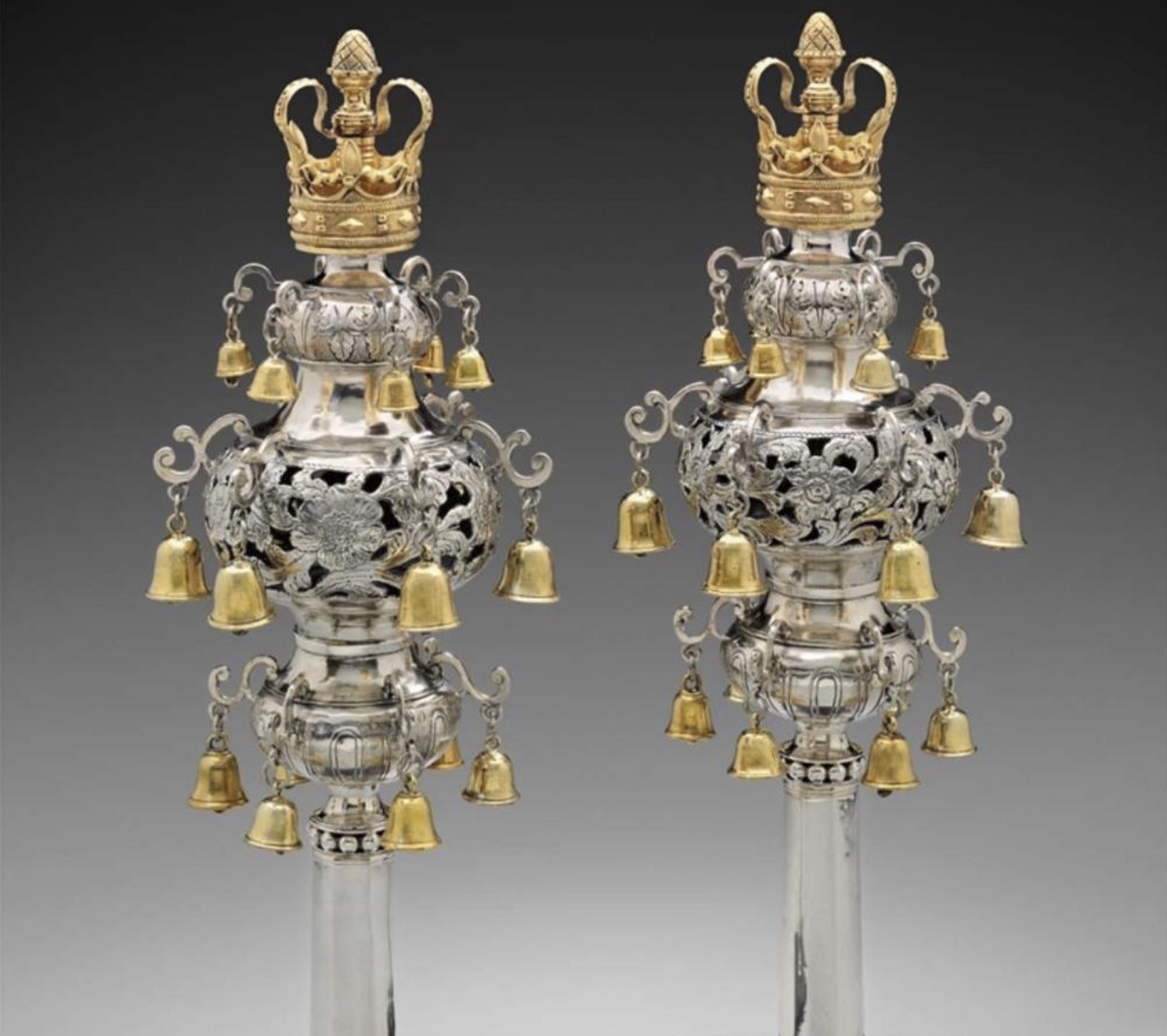
A Torah scroll, the handwritten parchment scroll of the first five books of the Hebrew tradition, is wound on two wooden rollers. When the scroll is dressed and not in use, a pair of ornaments is slipped over the tops of those rollers. In Hebrew they are called rimonim, "pomegranates," because the older ones were shaped like the fruit. Many, like these, are hung with tiny silver bells that ring when the scroll is carried. They are among the few objects in a synagogue made purely to honor the scroll, and a community that could afford fine ones commissioned them from the best silversmith it could find.
In eighteenth-century New York, that silversmith was Myer Myers. He was born in New York in 1723, the son of Dutch Jewish immigrants. He became one of the most accomplished silversmiths in the colonies, skilled enough that his Christian neighbors hired him too. In his own community he served as a leader of New York's Congregation Shearith Israel. Most colonial Judaica was made by Christian craftsmen. In much of Western Europe, Jews were barred from the silversmiths' guilds, so few Jewish artisans could train in the craft. Myers broke that pattern. Historians regard him as the first formally trained Jewish silversmith in Britain’s North American colonies.
This pair was made for the Newport synagogue, completed in 1763 and still standing as the oldest synagogue in the United States. The finials belong to Congregation Shearith Israel, the New York congregation that traces back to that first 1654 arrival. The Museum of Fine Arts in Boston, where the finials have been displayed, notes that they were most likely in the Newport synagogue on the day in 1790 when George Washington visited. That visit produced his letter promising "to bigotry no sanction." Today the New York congregation still uses them on the High Holidays, the most sacred days of the Jewish year.
Object record and image: Museum of Fine Arts, Boston. The standard study of Myers is David L. Barquist, Myer Myers: Jewish Silversmith in Colonial New York (Yale University Press, 2001).
The German wave · 1820–1880
Peddlers, merchants, and a new kind of synagogue.
In the middle decades of the nineteenth century a larger wave arrived: Central European Jews, most of them German-speaking. They left the German states and the Austrian Empire, where laws still capped where Jews could live, whom they could marry, and what work they could do. Economic change was also closing the trades their families had lived by. Many started as peddlers, walking the back roads of a fast-growing country with packs of goods, then opening stores in the towns that grew up around them. They spread far beyond the East Coast, into the South, the Midwest, and the mining towns of the West, settling where earlier immigrant Jews had never reached.
This wave brought an idea as much as a population. Reform Judaism, a movement begun in the German states to adapt traditional Jewish practice to modern life, took root in America and grew into a major branch of American Jewish religious life. Conservative Judaism took shape in America in the late nineteenth century, and Reconstructionist Judaism in the twentieth. The Synagogue Chapter explains how these movements and Orthodox Judaism differ. Some families from this wave became prominent in American commerce, banking, and civic life. By the time the next and largest wave arrived, the German Jewish community was established, prosperous, and in some ways anxious about the very different newcomers who were about to land.
The Eastern European wave · 1880–1924
More than two million people, and the Lower East Side.
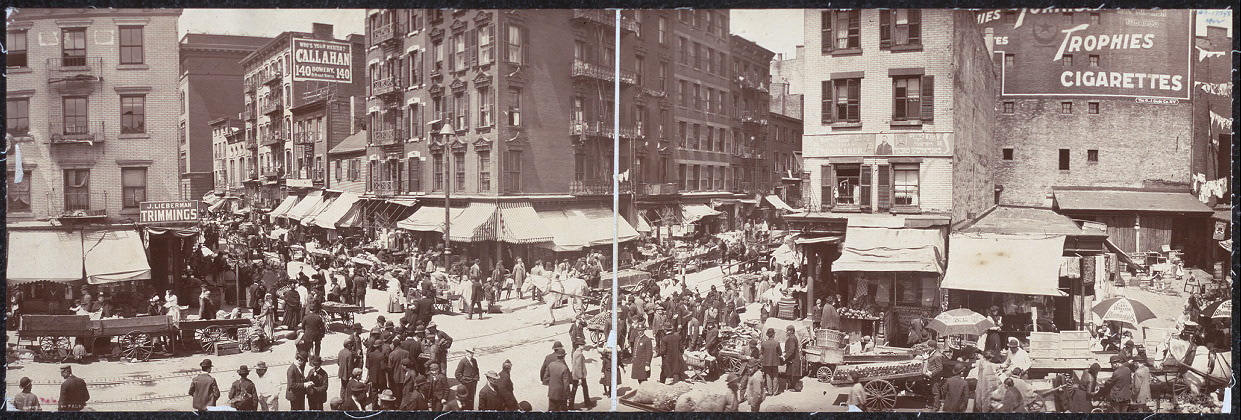
The largest wave came between roughly 1880 and 1924, when more than two million Jews left the Russian Empire and Eastern Europe for the United States. They were fleeing grinding poverty and organized anti-Jewish violence: the pogroms, mob attacks on Jewish towns and neighborhoods, often with the authorities standing aside or joining in. This was Ashkenazi immigration, Yiddish-speaking, and on a scale the earlier waves could not have imagined. It is the wave of the crowded tenements of New York's Lower East Side, the pushcart markets, and the garment shops. Emma Lazarus, a New York poet from an old Sephardic family, taught English to refugees of the pogroms. In 1883 she wrote “The New Colossus” to help pay for the Statue of Liberty’s pedestal, the sonnet that says “Give me your tired, your poor.”
They concentrated in the cities, above all New York, and entered the needle trades (the garment industry) in enormous numbers. Out of those shops came a vigorous Yiddish-language press and theater and a major Jewish presence in the American labor movement. The garment unions, above all the International Ladies’ Garment Workers’ Union (the ILGWU, founded in New York in 1900), led great strikes in 1909 and 1910. On March 25, 1911, fire swept the Triangle Shirtwaist Factory in Manhattan and killed 146 workers, most of them recent Jewish and Italian immigrants, many of them young women. The Forverts (the Forward), a Yiddish daily founded in New York in 1897, helped form a relief committee for the victims’ families, and the unions’ push for safety laws followed.
You can still walk through this history. In New York, the Lower East Side Tenement Museum has rebuilt the apartments of real immigrant families from this wave, Jewish families from the Russian Empire among them, using census records, ship manifests, and oral histories. One family it follows is the Rogarshevskys: Fannie and Abraham raised six children at 97 Orchard Street in the 1910s. The Lower East Side was a first stop, not a permanent address. As families found their footing they moved uptown and outward. By the 1910s Harlem held one of the largest Jewish communities in the country. Then came Brooklyn and the Bronx, a neighborhood-to-neighborhood climb that could empty and refill a whole district within a generation. Not all of this wave landed in New York. Golda Meir, later Israel’s Prime Minister, was raised and educated in Milwaukee from 1906 and was a schoolteacher there before she left for Palestine in 1921. Her story is told in the Modern State of Israel Chapter.
Not every Jewish immigrant of these years spoke Yiddish. Sephardic Jews from the Ottoman Empire came too, from Istanbul, Salonika, and Rhodes, in today’s Turkey and Greece. They spoke Ladino (Judeo-Spanish), descended from the Spanish their ancestors carried out of Spain in 1492 (The Jews of Spain and the Sephardic World). In 1910 Moise Gadol, an immigrant from Bulgaria, launched La America in New York, the first Ladino newspaper in the United States. Other families went as far as Seattle, home to a Sephardic community ever since. Arabic-speaking Jews from Syria came in the same years and laid the foundations of the Syrian Jewish community of Brooklyn. The 1924 quotas sharply cut these arrivals too.
The doors close · 1924
The law that ended the wave, and what it cost later.
The great migration did not taper off on its own. It was stopped by law. A series of federal immigration acts in the early nineteen-twenties, culminating in the Immigration Act of 1924, set strict national-origin quotas designed to sharply cut immigration from Southern and Eastern Europe. For Eastern European Jews, the door that had been open for forty years was, in effect, shut. The national-origin quotas stayed in place until the Immigration and Nationality Act of 1965 ended them.
The quotas were written in 1924. They were still in force in the 1930s and early 1940s, when Jews trying to escape Nazi Germany and Nazi-occupied Europe sought entry to the United States. They found the door nearly shut. The barrier was less the quota numbers themselves, which went unfilled for most of the 1930s, than the paperwork built around them: “public charge” rulings, affidavit requirements, and consular practice. That refugee story is taken up in Unit 4, The Holocaust Era.
The 1920s in America saw a revived Ku Klux Klan and a hardening suspicion of immigrants. In the autumn of 1928, the small town of Massena in upstate New York saw the one recorded case of blood libel in American history: the medieval accusation that Jews murder Christian children for ritual blood. When a four-year-old girl went missing, rumor blamed the town's Jews, and the mayor and a state trooper summoned the local rabbi for questioning before the child was found unharmed in the woods the next day. Historian Edward Berenson, who grew up in Massena, points to the town's aluminum plant. It drew immigrant workers from parts of Europe and Canada where antisemitism had raged and the blood libel was commonly accepted. The Old-World accusation most likely crossed the ocean with them. The full history of the blood libel is told in Unit 3, The Blood Libel.
Shut out, and building anyway · 1862–1955
The doors that would not open, and the ones they built.
Kept out, and attacked · 1862–1941
In 1862, in the middle of the Civil War, the Union general Ulysses S. Grant issued General Orders No. 11. Dated December 17, it expelled “Jews, as a class” from the Department of the Tennessee, the military district he commanded across parts of Tennessee, Mississippi, and Kentucky. They were given twenty-four hours to leave. In Paducah, Kentucky, at least thirty Jewish families were forced from their homes. Cesar Kaskel, a Jewish immigrant from Prussia living in Paducah, carried the protest to Washington and met President Abraham Lincoln on January 3, 1863. The next day Lincoln had the Union army’s general-in-chief, Henry Halleck, order Grant to revoke the order. In 1868 Grant wrote, “I do not pretend to sustain the order.” As president he appointed a record number of Jews to government posts.
In 1877, the New York banker Joseph Seligman arrived at the Grand Union Hotel in Saratoga Springs, where he had spent the past ten summers. The manager turned him away on orders from the man who ran the hotel. “Mr. Hilton has given instructions,” the manager told him, “that no Israelites shall be permitted in future to stop at this hotel.” Israelites was an older word for Jews. The story ran in the New York Times.
In 1913, Leo Frank, the Jewish manager of an Atlanta pencil factory, was convicted of murdering Mary Phagan, a thirteen-year-old employee, and sentenced to hang. Thomas E. Watson, a former Populist politician who published a paper called the Jeffersonian, campaigned against Frank. His attacks on Jews, and on Frank in particular, raised the paper’s sales.
The case also inspired the founding of the Anti-Defamation League. B’nai B’rith, a Jewish fraternal order, created the League in Chicago in 1913, the year of Frank’s conviction. Its purpose was “to stop the defamation of the Jewish people and to secure justice and fair treatment to all.”
Georgia’s governor, John Slaton, read more than 10,000 pages of evidence, visited the factory, and concluded Frank was innocent. In June 1915 he commuted the sentence to life in prison. Riots broke out, and Slaton declared martial law.
Two months later, about twenty-five prominent men from Marietta, Mary Phagan’s hometown, took Frank from a prison farm. In the early hours of August 17, 1915, they hanged him from an oak tree. Months later, according to the historian Leonard Dinnerstein, many of the same men took part in the ceremony at Stone Mountain that founded the modern Ku Klux Klan. In 1986 Georgia pardoned Frank, “without attempting to address the question of guilt or innocence,” for the state’s failure to protect him and to bring his killers to justice. The pardon came in part after the 1982 testimony of Alonzo Mann, who had been an office boy at the factory. He said he had seen Jim Conley, the factory janitor who was the state’s main witness against Frank, carrying Mary Phagan’s body to the basement. Conley had threatened to kill him if he told.
In 1920 the carmaker Henry Ford began publishing a series of antisemitic articles, “The International Jew,” in his newspaper, The Dearborn Independent. The series drew on the Protocols of the Elders of Zion, a forged text. The series was reissued as four books. In 1927, facing a libel suit, Ford issued a public retraction in his name. In it he asked Jews’ “forgiveness for the harm that I have unintentionally committed.”
In the 1930s, Father Charles Coughlin, a Catholic priest in Michigan, reached “tens of millions” of radio listeners. Ten days after Kristallnacht, the Nazi pogrom of November 1938, he justified the Nazi violence on the air as a reaction to what he called Jewish communism. In 1939 he urged his followers to join the Christian Front, a militia-like group that held “Buy Christian” rallies. Some of its members harassed Jews in the street. By 1940, many radio stations had canceled his broadcasts. In 1942 his archbishop ordered him to confine himself to his work as a parish priest or risk being removed from the priesthood.
Several ideas here have longer histories. The accusation behind the Massena blood libel began in medieval England (The Blood Libel), and the forgery Ford’s newspaper spread came from the Russian Empire (The Protocols of the Elders of Zion). The 1924 quotas drew in part on the race theories of the eugenics movement (The Racial Turn). In October 2018, an antisemitic gunman killed eleven worshippers at the Tree of Life synagogue in Pittsburgh, the deadliest antisemitic attack in American history. That attack is set in its present-day context in Contemporary Antisemitism.
Quotas and closed doors · 1922–1957
At Harvard, Jewish students made up about 22 percent of the college by 1922. President A. Lawrence Lowell proposed a limit of 15 percent. In 1923 a special committee refused, insisting on Harvard’s “traditional policy of freedom from discrimination on grounds of race or religion.” Harvard then limited Jewish admissions by other means. It capped the size of the freshman class, and in 1926 it added personal interviews and photographs to its applications.
In a private letter in 1925 to a member of Harvard’s governing board, Lowell explained the method. “To prevent a dangerous increase in the proportion of Jews,” he wrote, the “straightforward and effective” way was “a selection by a personal estimate of character.” By one count, the Jewish share had fallen to about 10 percent by 1933.
Columbia ran a branch in Brooklyn, Seth Low Junior College, from 1928 to 1936. Its own archives describe the students as “primarily Jewish and Italian students not desired on the campus in Morningside Heights,” the neighborhood of Columbia’s main campus in Manhattan.
Medical schools set limits too. In 1929, Frank Gavin, a professor at the General Theological Seminary, reported that almost all of the 600 Americans applying to the University of Edinburgh’s medical school were Jews. He said they were going abroad because they found it so hard to get into accredited schools at home. A count by B’nai B’rith covered 67 American medical schools. The Jewish share of their students fell from 15.9 percent in 1935 to 12.7 percent in 1946, while total enrollment rose.
Many jobs were closed as well. Employment agencies advertised for “Christians” or “Gentiles.” In an American Jewish Congress survey reported by Time in 1939, 35 of 90 major employment agencies asked employers for their “religious preference.” The big law firms were largely closed to Jewish lawyers.
Resort brochures said “Gentiles Only,” or in code, “Restricted Clientele.” Gentleman’s Agreement, a 1947 film about a magazine writer who poses as a Jew to investigate antisemitism, won the Academy Award for Best Picture. The Library of Congress calls it “one of the first films to directly explore the still-timely topic of religious-based discrimination.” As late as 1957, a national survey by the Anti-Defamation League found 22.9 percent of American resort hotels barring Jews.
Building their own · 1914–1955
In the Catskill Mountains of New York, Jews opened hotels of their own, some of them giant resorts. Jennie Grossinger, an immigrant from the Austro-Hungarian Empire, helped her family take in paying guests on a Catskills farm her father bought in 1914. Under her direction the guest house grew into Grossinger’s, a resort that drew both Jews and gentiles.
Shut out of older industries, Jewish immigrants and their children built the film studios, the story told in The Founders of Hollywood. Jewish residents of Los Angeles who were kept out of the Wilshire and Los Angeles country clubs founded the Hillcrest Country Club in 1920.
Jewish students turned to public colleges. The City College of New York was free and admitted students on merit. In its own words, Jewish students went there “because they had no other option.” People called it “the poor man’s Harvard,” and ten of its graduates went on to win the Nobel Prize. When Brooklyn College opened in 1930, free of tuition, students drained away from Columbia’s Brooklyn branch.
In the Depression, Jewish women shut out of office jobs turned to teaching, where a licensing exam decided who was hired. In 1940, Jewish women were 56 percent of New York City’s new teachers.
Jewish lawyers founded firms of their own. In 1950, the legal scholar Eli Wald writes, there was not one large Jewish law firm in New York. By the mid-1960s, six of the twenty largest were Jewish firms, grown “in spite of explicit discrimination.”
Brandeis University opened in 1948, planned from the start as “a university without quotas.” It was founded by the American Jewish community “at a time when Jews and other ethnic and racial minorities, and women, faced discrimination in higher education.” In Minneapolis, where Jewish doctors were excluded from medical faculties and private hospital staffs, the community opened Mount Sinai Hospital in 1951. In 1955 Yeshiva University opened the Albert Einstein College of Medicine, the first American medical school in a Jewish university. It was planned to run without the quotas other medical schools kept. The physicist Albert Einstein lent it his name because, he wrote, it “will welcome students of all creeds and races.”
Into the law · 1945–1954
On March 12, 1945, months before the Second World War ended, New York became the first state to outlaw job discrimination because of “race, color, creed, or national origin.” Creed was the word that covered Jews. In 1948 New York passed the first state law against discrimination in college admissions, a law Jewish advocates pressed for as a way to end the quotas.
In the Supreme Court, the American Jewish Congress and the American Jewish Committee both filed briefs supporting the Black families in Shelley v. Kraemer (1948). The ruling barred courts from enforcing racial covenants, clauses in property deeds that kept people of certain races from living in a home. The American Jewish Committee filed in Sweatt v. Painter (1950), which opened the University of Texas law school to a Black student. The American Jewish Congress filed in Brown v. Board of Education (1954), which ruled segregated public schools unconstitutional. In each case they were one voice among many. Lawyers for the NAACP (the National Association for the Advancement of Colored People) argued the cases, Thurgood Marshall among them. Marshall later served on the Supreme Court.
Women build the institutions · 1838–1972
The whole wide world, without limit.
Jewish women had been founding institutions since the early republic. In 1838 Rebecca Gratz of Philadelphia opened the Hebrew Sunday School, the first Jewish Sunday school in America, for girls and boys together, and ran it into her eighties. In 1893 Chicago’s world’s fair, the World’s Columbian Exposition, included a World’s Parliament of Religions. Hannah Greenebaum Solomon, a Chicago clubwoman, chaired the Jewish women’s committee and held their congress under the Parliament rather than in the fair’s Woman’s Building. On its last day the delegates founded the National Council of Jewish Women, with Solomon as president. Its workers met immigrant girls traveling alone at the ports, Ellis Island above all, more than twenty thousand of them over the years. In 1920 Solomon looked back. “Woman’s sphere is in the home, they told us. The last thirty years have been devoted to proof of our boast that woman’s sphere is the whole wide world, without limit.”
In 1893, the year the Council was founded, Lillian Wald, a nurse from Rochester, began nursing immigrant families in the tenements of the Lower East Side. Her rounds grew into the Henry Street Settlement, still at work in the neighborhood, and into a profession she named: public health nursing.
Henrietta Szold of Baltimore met the same wave in a classroom. In the late 1880s she helped Baltimore’s immigrants start a night school for English and civics. When she enrolled at the Jewish Theological Seminary in New York, she had to sign a promise that she did not aspire to the rabbinate. In 1909 she visited Palestine and saw how little health care it had. On February 24, 1912, thirty-eight women met at New York’s Temple Emanu-El, elected Szold president, and chose nursing as their work. Among the founders was Rosalie Solomons Phillips of Shearith Israel, the congregation that grew from the 1654 landing. The group became Hadassah, the Women’s Zionist Organization of America. In 1913, with 122 members and $542 in dues, it sent two nurses, Rose Kaplan and Rachel Landy, to Jerusalem. Hadassah grew into American Jews’ largest mass-membership organization, and Szold died in 1945 in the hospital it had built in Jerusalem.
The rabbinate took longest. Regina Jonas of Berlin was ordained in 1935, the first woman known to have been ordained a rabbi, and was murdered at Auschwitz in 1944 (Unit 4 · Ch. 01 · The Years Before the Killing). Sally Priesand of Cleveland entered Hebrew Union College in Cincinnati in 1968. Congregations refused to interview her for student pulpits. On June 3, 1972, the college’s president, Alfred Gottschalk, ordained her. At twenty-five she was the first woman a rabbinical seminary had ever ordained.
The civil-rights generation · 1960s
Praying with their legs.
By the 1960s the children and grandchildren of the immigrant waves were established Americans. Many of them joined the civil-rights movement as marchers, organizers, lawyers, and Freedom Riders. On June 21, 1964, two Jewish volunteers, Andrew Goodman and Michael Schwerner, were murdered in Mississippi with James Chaney, a Black civil-rights worker from Meridian.
Rabbi Abraham Joshua Heschel, a philosopher, became a friend and ally of the Reverend Dr. Martin Luther King, Jr. Heschel had escaped Nazi Europe weeks before the invasion of Poland and lost much of his family in the Holocaust. He marched in the front row beside King on the Selma-to-Montgomery voting-rights march in March 1965. Afterward he wrote that "I felt my legs were praying." In March 1968 King spoke at the Rabbinical Assembly’s convention, where Heschel introduced him. Ten days later, King was assassinated.
In later decades, the Black–Jewish alliance of these years frayed over political disagreements.
Refuge, survival, newcomers, and Soviet Jewry · 1933–1990s
The last arrivals.
The Nazi era brought a wave of refugees, those who managed to get through the barriers described above. They included a concentration of scientists, scholars, writers, and artists who reshaped American intellectual and cultural life. While they arrived, about 550,000 Jewish men and women served in the U.S. armed forces. After 1945, Holocaust survivors followed the refugees. Together, the refugees and the survivors form the fourth wave.
In the decades after the war, Jews from the Middle East and Central Asia came as well, in larger numbers once the 1965 Immigration and Nationality Act ended the national-origin quotas. Brooklyn’s Syrian community took in Jews who fled or were expelled from Egypt in the 1950s and 1960s, then Jews from Lebanon and, in the 1990s, from Syria. Many Persian Jews settled in Los Angeles after Iran’s 1979 revolution. Bukharan Jews from Soviet Central Asia reached Queens, most in the late 1980s and early 1990s. A 2025 national study, commissioned by JIMENA (Jews Indigenous to the Middle East and North Africa) and conducted at New York University, estimated that 7 to 11 percent of American Jewish adults are Sephardic, Mizrahi, or both.
The fifth wave was different in kind. It was a migration American Jews campaigned for and then received. In the second half of the twentieth century, American Jews built a sustained human-rights campaign on behalf of Soviet Jews, who were forbidden by the Soviet government to practice their religion freely or to emigrate. The movement pressed for the simple right to leave. From the 1970s through the 1990s, hundreds of thousands of Soviet Jews settled in the United States. That story has its own Chapter in this Unit: Soviet Jewry. A community that began in 1654 as twenty-three refugees a governor tried to turn away was, by the end of the twentieth century, receiving newcomers of its own.
Key takeaways
- Organized Jewish life in America began in 1654, when twenty-three Sephardic refugees landed at New Amsterdam. By 1657 Asser Levy had petitioned his way to guard duty and the burgher right there.
- The community arrived in five distinct waves: Sephardic (1654), German (19th century), Eastern European (1880–1924), Nazi-era and postwar refugees, and the Soviet Jewry emigration.
- Sephardic Jews arrived within the later waves too: Ladino speakers from the Ottoman Empire before 1924, and Jews from the Middle East and Central Asia in the second half of the twentieth century.
- The Immigration Act of 1924 ended the largest wave by law, and that same law narrowed the door for refugees fleeing Nazi Europe a decade later.
- In 1862 General Ulysses S. Grant expelled Jews “as a class” from his military district. A protest from Paducah reached President Lincoln, who had the order revoked within weeks.
- From the 1870s to the 1950s, many American hotels, colleges, medical schools, law firms, and employers kept Jews out, by written rule or quiet practice.
- Kept out, Jews built their own hotels, law firms, hospitals, and universities. Jewish groups pressed for New York’s 1948 admissions law and filed briefs in landmark civil-rights cases.
Discussion questions
Working from the evidence.
Each question is anchored in a fact this Chapter documents. Answer from the evidence on the page.
- In 1654 the Dutch West India Company overruled Governor Stuyvesant and let twenty-three Jewish refugees stay, because the colony needed settlers and Jewish investors held shares in the Company. How should we judge a right of residence granted for practical reasons rather than on principle?
- Asser Levy answered each exclusion with a petition to the same courts that excluded him, and won guard duty, the butcher’s trade, and the burgher right within three years. What does his method tell us about how rights were actually secured in a colonial town?
- The Myer Myers finials show a community commissioning fine ceremonial art about a century after the 1654 landing. What can an object tell a historian that a written record cannot, and what can it not tell us?
- In 1986 Georgia pardoned Leo Frank “without attempting to address the question of guilt or innocence.” What did the pardon correct, and what did it leave open?
- In 1923 a Harvard committee refused an open quota on Jewish students. The college then cut their share through interviews, photographs, and judgments of “character.” Why might an unwritten limit be harder to challenge than a written one?
- The Immigration Act of 1924 was written in one decade and was still law in the next, when refugees fled Nazi Europe. How does tracing a single law across two crises change the way we read each one?
- Historian Edward Berenson traces America’s only recorded blood-libel case (Massena, 1928) to residents who came from regions where the accusation was common. What does it mean that a prejudice can travel with the people who held it?
- Jewish organizations filed briefs in Shelley, Sweatt, and Brown, cases brought for Black plaintiffs and argued by NAACP lawyers, and many Jews later marched for civil rights. Why might one group join a fight over another group’s rights, and what might strain such an alliance?
Classroom Connections
Where this Chapter fits.
Teaching Connections
- United States History, Immigration: the five waves mapped onto the standard US immigration narrative: the Eastern European wave, the 1924 quotas, the garment trades, and the labor movement.
- United States History, Colonial Foundations & Religious Liberty: the 1654 arrivals, Asser Levy’s petitions, and Washington’s 1790 Newport letter.
- United States History, 1862–1955: Grant’s General Orders No. 11 and its revocation, exclusion from hotels, colleges, medical schools, and jobs, the Leo Frank case, New York’s 1945 and 1948 anti-discrimination laws, and Jewish amicus briefs in Shelley, Sweatt, and Brown.
- United States History: the Civil-Rights Era: Jewish participation in the civil-rights movement (Heschel and King).
- Comparative Migration: read beside Soviet Jewry and The Departure from MENA: one community arriving and departing across very different political systems.
- Historical Thinking & Source Analysis: the 1877 Saratoga report, Ford’s 1927 retraction, the 1986 Frank pardon, Lowell’s 1925 letter, and the opinions in Shelley, Sweatt, and Brown, with census records, manifests, and oral histories.
- Art History & Museum Education: the Myer Myers Torah finials.
Standards Alignment
- NYS US History: 11.5 (immigration and industrial America, the Eastern European wave), 11.7 (the quota acts of the 1920s) and 11.9 (the Cold War, the Soviet Jewry movement).
- Common Core ELA-Literacy: RH.6–8.2 and RH.11–12.2 (determining central ideas across census records, manifests, congregational records, and oral histories).
Further Teaching Resources
- Institute for Curriculum Services, “Jewish Americans: Identity, History, Experience”, a standards-aligned overview fact sheet for classroom use.
- U.S. Holocaust Memorial Museum, Americans and the Holocaust teaching collection and the lesson American Responses to the Holocaust: how the 1924 quotas shaped what the United States did, and did not do, when refugees sought entry in the 1930s and 1940s. The Museum’s Nazis in America online exhibit traces the German American Bund, the pro-Nazi movement that drew American crowds in the 1930s. It is also the subject of the PBS American Experience documentary Nazi Town, USA.
- The National WWII Museum, Jewish Americans in World War II: the wartime generation, the roughly 550,000 American Jews who served, even as many awaited word of relatives trapped under Nazi rule in Europe. A companion documentary, Camp Confidential: America’s Secret Nazis (2021), tells the story of the Jewish refugee soldiers who interrogated high-value Nazi prisoners at a secret U.S. Army facility in Virginia. Subscription required.
- Brandeis University, The Jewish Experience: Heschel, King, and progressive politics, drawing on historian Julian Zelizer’s biography of Heschel. For primary sources, the Jewish Theological Seminary’s Heschel archive documents King’s March 1968 appearance at the Rabbinical Assembly, where Heschel introduced him. PBS Religion & Ethics NewsWeekly has a short profile of Heschel for classroom viewing.
Sources and citations
Primary sources
A primary source is a record from the time. It was made by people who were there. Examples: letters, diaries, photos, decrees, trial records, and newspapers.
- Bain News Service. "[Protest against child labor in a labor parade]," May 1, 1909. George Grantham Bain Collection, Library of Congress Prints & Photographs Division, LC-DIG-ppmsca-06591. loc.gov
- The Jewish Theological Seminary. "King and Heschel at the Rabbinical Assembly Conference," Heschel archive. heschel.jtsa.edu
- American Jewish Historical Society. Records of the 1654 New Amsterdam arrival and Congregation Shearith Israel. ajhs.org
- “A Sensation at Saratoga.” New York Times, June 19, 1877. Reproduced by the Jewish Women’s Archive. jwa.org.
- Georgia State Board of Pardons and Paroles. Pardon of Leo M. Frank, 1986. Text quoted in Leonard Dinnerstein, “Leo Frank Case,” New Georgia Encyclopedia. georgiaencyclopedia.org.
- Ford, Henry. Statement to Louis Marshall retracting the charges in The Dearborn Independent and The International Jew, June 30, 1927, with Marshall’s explanatory statement. American Jewish Year Book, 1927–28. Berman Jewish Policy Archive. bjpa.org.
- “Cites Figures Showing Extent of Discrimination Against Jewish Applicants to Medical Schools.” Jewish Telegraphic Agency, November 27, 1929. jta.org.
- “Proportion of Jewish Students Enrolled in Professional Schools Shows Sharp Drop.” Jewish Telegraphic Agency, September 30, 1947. Reports the B’nai B’rith census. jta.org.
- New York State. Law Against Discrimination (the Ives-Quinn Act), Laws of 1945, ch. 292. Agency history, New York State Archives. archives.nysed.gov.
- Shelley v. Kraemer, 334 U.S. 1 (1948). U.S. Reports, Library of Congress. loc.gov.
- Sweatt v. Painter, 339 U.S. 629 (1950). U.S. Reports, Library of Congress. loc.gov.
- Brown v. Board of Education, 347 U.S. 483 (1954). U.S. Reports, Library of Congress. loc.gov.
- Immigration Act of 1924 (the Johnson–Reed Act), Pub. L. 68–139, 43 Stat. 153. (The national-origin quota legislation.)
- Washington, George. Letter to the Hebrew Congregation in Newport, Rhode Island, August 1790. The Papers of George Washington, University of Virginia.
- Petition of the Jewish merchants of Amsterdam to the Dutch West India Company on behalf of the Jews of New Amsterdam, January 1655. The document that won the right to remain.
- Records of New Amsterdam, 1653–1674. Edited by Berthold Fernow, 1897. The court minutes holding the Levy and Barsimson guard petition of 1655 and Levy’s burgher admission of April 1657. archives.nyc
- The Papers of Robert Morris, 1781–1784. University of Pittsburgh Press. Haym Salomon appears throughout as broker to the Office of Finance.
- Grant, Ulysses S. General Orders No. 11, Department of the Tennessee, December 17, 1862. A handwritten copy survives in the bound volume of Grant’s general orders, Ulysses S. Grant and Julia Dent Grant Papers, Ulysses S. Grant Presidential Library, Mississippi State University Libraries. msstate-archives.libraryhost.com.
- Protests to President Lincoln against General Orders No. 11, January 1863, with Lincoln’s endorsement and General-in-Chief Henry Halleck’s telegram to Grant. Abraham Lincoln Papers, Manuscript Division, Library of Congress. Presented in Abraham J. Karp, From the Ends of the Earth: Judaic Treasures of the Library of Congress (Library of Congress, 1991). Text at the Jewish Virtual Library. jewishvirtuallibrary.org.
- Grant, Ulysses S. Letter to Isaac N. Morris, September 14, 1868. Quoted in National Park Service, “Ulysses S. Grant and General Orders No. 11.” nps.gov.
- U.S. Department of Justice, Office of Public Affairs. “Jury Recommends Sentence of Death for Pennsylvania Man Convicted for Tree of Life Synagogue Shooting.” Press release, August 2, 2023. justice.gov.
- U.S. Department of Justice, Civil Rights Division. “Michael Schwerner, James Chaney, Andrew Goodman.” Case summary. justice.gov.
- Jewish Women’s Congress, Chicago, September 1893. Resolution founding the National Council of Jewish Women (“do therefore band ourselves together in a union of workers”). Papers of the Jewish Women’s Congress, 1894. Text quoted at the Jewish Women’s Archive. jwa.org.
- Solomon, Hannah G. On the first thirty years of the National Council of Jewish Women (“woman’s sphere is the whole wide world, without limit”). American Hebrew, 1920. Quoted in Beth Wenger, “Hannah Greenebaum Solomon,” Jewish Women’s Archive. jwa.org.
- Hadassah. Founders’ call of February 14, 1912 (“the time is ripe for a large organization of women Zionists”) and the founding meeting of February 24, 1912, Temple Emanu-El, New York. Quoted in Mira Katzburg-Yungman, “Hadassah in the United States,” Jewish Women’s Archive. jwa.org.
Secondary sources
A secondary source was written later. It is a book or article by a historian who studied those records and explains what they mean.
- Dinnerstein, Leonard. “Leo Frank Case.” New Georgia Encyclopedia, Georgia Humanities and University of Georgia Press, updated 2020. georgiaencyclopedia.org.
- Library of Congress. “Trial and Lynching of Leo Frank: Topics in Chronicling America.” Research guide. guides.loc.gov.
- Anti-Defamation League. “Mission and History.” adl.org.
- United States Holocaust Memorial Museum. “The Radio Priest: Charles E. Coughlin and American Antisemitism.” Holocaust Encyclopedia. encyclopedia.ushmm.org.
- United States Holocaust Memorial Museum. “Antisemitism and Henry Ford’s The International Jew.” Holocaust Encyclopedia. encyclopedia.ushmm.org.
- The Henry Ford. “Henry Ford and Anti-Semitism.” Popular research topics. On the Sapiro libel suit and the 1927 apology. thehenryford.org.
- Harvard University, Radcliffe Institute. “Abbott Lawrence Lowell and Discrimination in Admissions and Housing.” Harvard & the Legacy of Slavery. Draws on the Lowell papers and on Marcia Synnott, The Half-Opened Door (1979), and Jerome Karabel, The Chosen (2005). Dates Lowell’s letter to the overseer Henry James to November 1925 and the faculty’s approval of interviews and photographs to January 1926. harvard.edu.
- “‘The White Man’s College’: How Antisemitism Shaped Harvard’s Legacy Admissions.” Harvard Crimson, November 9, 2023. Quotes Lowell’s letter to Henry James III on limiting Jewish enrollment, and gives the 21.5 percent Jewish share for 1921–22. thecrimson.com.
- Hyman, Charles B., and Monika K. Piascik. “Retrospection: President Lowell’s Quotas.” Harvard Crimson, March 26, 2015. On the proposed 15 percent limit and the 1923 committee report. thecrimson.com.
- Baena, Victoria A. “Making Out a President’s Character: A Profile of President Abbot Lawrence Lowell.” Harvard Crimson, October 21, 2011. Gives the 22 percent (1922) and 10 percent (1933) figures. thecrimson.com.
- Columbia University Archives. “Seth Low Junior College.” Research guide. library.columbia.edu.
- The City College of New York. “Our History.” ccny.cuny.edu.
- Zarroli, Jim. Festival in the Catskills celebrates the resort area once known as the Borscht Belt. NPR, August 2023. npr.org.
- Brandeis University. “Our Story.” brandeis.edu.
- Albert Einstein College of Medicine. “Our Story.” einsteinmed.edu.
- Kita, Miyuki. “Cracking the Quotas: The 1948 New York Fair Educational Practices Act and the Jewish Quest for Color-Blindness.” FIU Law Review 19, no. 3 (2025). fiu.edu.
- Library of Congress. National Film Registry announcement naming Gentleman’s Agreement (1947), December 13, 2017. loc.gov.
- “National Affairs: Christian Per Inch.” Time, January 9, 1939. Reports the American Jewish Congress survey of employment advertising. time.com.
- Wald, Eli. “The Rise and Fall of the WASP and Jewish Law Firms.” Stanford Law Review 60 (2008): 1803. stanfordlawreview.org.
- Weber, Laura. “Mount Sinai Hospital and Foundation, Minneapolis.” MNopedia, Minnesota Historical Society. mnhs.org.
- Vermont Historical Society. “Creating an Image: Exclusivity.” vermonthistory.org.
- “Anti-Jewish Discrimination in American Hotels Declines Sharply.” Jewish Telegraphic Agency, January 31, 1964. Reports the Anti-Defamation League’s national hotel surveys. jta.org.
- Kobrin, Rebecca. “Teaching Profession in the United States.” Shalvi/Hyman Encyclopedia of Jewish Women, Jewish Women’s Archive. jwa.org.
- Medea, Andra. “Jennie Grossinger.” Shalvi/Hyman Encyclopedia of Jewish Women, Jewish Women’s Archive. jwa.org.
- Spitzzeri, Paul R. “Games People Play: A Press Photo of Hillcrest Country Club Golf Pro Lewis Scott, October 1925.” Homestead Museum, 2020. homesteadmuseum.blog.
- Brandeis University, Robert D. Farber University Archives. “Early Documents of the Formation of Brandeis University.” 2015. brandeis.edu.
- “Jews & Medicine.” YU News, Yeshiva University, July 30, 2012. yu.edu.
- U.S. House of Representatives, History, Art & Archives. “The Immigration and Nationality Act of 1965.” Historical Highlights. history.house.gov.
- Supreme Court of the United States. “Justices 1789 to Present.” supremecourt.gov.
- Svonkin, Stuart. Jews Against Prejudice: American Jews and the Fight for Civil Liberties. New York: Columbia University Press, 1997. cup.columbia.edu.
- Sarna, Jonathan D. American Judaism: A History. New Haven: Yale University Press, 2004. (The standard one-volume scholarly history of the American Jewish community.)
- Encyclopaedia Judaica. “Recife.” (On the Portuguese New Christians of Recife, Jewish life under Dutch rule, and the capitulation of January 26, 1654, which gave the Jews three months to leave.) encyclopedia.com →
- JIMENA and New York University. Sephardic and Mizrahi Jews in the United States: Identities, Experiences, and Communities. National demographic study directed by Mijal Bitton, 2025. sephardicstudy.org. (The first national demographic study of these communities. Its National Demographic Profile gives the 7 to 11 percent range for American Jewish adults, from a Brandeis University analysis of the Pew Research Center’s 2020 survey and local community studies.)
- Ben-Ur, Aviva, trans. and annot. “‘We Speak and Write This Language Against Our Will’: Jews, Hispanics, and the Dilemma of Ladino-Speaking Sephardim in Early-Twentieth-Century New York.” American Jewish Archives Journal 50, nos. 1–2 (1998). (On the Ladino-speaking migration from the Ottoman Empire and the newspaper La America.) americanjewisharchives.org.
- Library of Congress. “The Power of the Tongue.” Words Like Sapphires: 100 Years of Hebraica at the Library of Congress, online exhibition. (On Moise Gadol and La America, the Ladino weekly he launched in New York in 1910.) loc.gov.
- University of Washington, Stroum Center for Jewish Studies, Sephardic Studies Program. “Seattle Sephardic Legacies” and “A Guidebook for Sephardic Immigrants.” (On Ottoman Sephardic families in Seattle and on Moise Gadol.) jewishstudies.washington.edu. The program’s century in Seattle: About the Sephardic Studies Program.
- Diner, Hasia R. The Jews of the United States, 1654–2000. Berkeley: University of California Press, 2004.
- Diner, Hasia R. A Time for Gathering: The Second Migration, 1820–1880. Baltimore: Johns Hopkins University Press, 1992. (On the German Jewish wave.)
- Barquist, David L. Myer Myers: Jewish Silversmith in Colonial New York. New Haven: Yale University Press, 2001. The finials’ object record: Museum of Fine Arts, Boston. collections.mfa.org
- Gurock, Jeffrey S. When Harlem Was Jewish, 1870–1930. New York: Columbia University Press, 1979. (On the second settlement and its dispersal.)
- Howe, Irving. World of Our Fathers: The Journey of the East European Jews to America and the Life They Found and Made. New York: Harcourt Brace Jovanovich, 1976.
- Berenson, Edward. The Accusation: Blood Libel in an American Town. New York: W. W. Norton, 2019. (On the 1928 Massena case.) See also NYU News, "The Story of America's First, and Only, Blood Libel," September 2019. nyu.edu
- United States Holocaust Memorial Museum. Americans and the Holocaust teaching materials and the lesson "American Responses to the Holocaust." ushmm.org
- United States Holocaust Memorial Museum. "Nazis in America" (German American Bund), Americans and the Holocaust online exhibition. exhibitions.ushmm.org
- Nazi Town, USA. PBS American Experience, 2024. pbs.org
- Zelizer, Julian E. Abraham Joshua Heschel: A Life of Radical Amazement. New Haven: Yale University Press, 2021. Discussed in Brandeis University, "The Jewish Experience." brandeis.edu
- "Abraham Joshua Heschel." PBS Religion & Ethics NewsWeekly (WNET), January 18, 2008. pbs.org
- Institute for Curriculum Services. "Jewish Americans: Identity, History, Experience" fact sheet. icsresources.org
- The National WWII Museum. "Jewish Americans in World War II." nationalww2museum.org
- Camp Confidential: America's Secret Nazis. Documentary, 2021 (subscription streaming). On the Jewish refugee soldiers of Fort Hunt, Virginia ("P.O. Box 1142").
- Lower East Side Tenement Museum. Documented immigrant family histories (Gumpertz, Levine, Rogarshevsky). tenement.org
- Kranson, Rachel. “International Ladies Garment Workers Union.” Encyclopaedia Judaica, 2nd ed. On the union’s founding in New York on June 3, 1900, and the 1909 shirtwaist strike. encyclopedia.com.
- Jewish Virtual Library. “Abraham Cahan (1860–1951).” On the founding of the Yiddish daily Forverts in New York in April 1897. jewishvirtuallibrary.org.
- Cornell University, Kheel Center. The Triangle Factory Fire: “Fire!” and “Relief Work.” The victims, the relief work planned by Local 25 of the ILGWU, and the Joint Relief Committee formed by the Jewish Daily Forward, the United Hebrew Trades, and other groups. trianglefire.ilr.cornell.edu/story/fire.html and trianglefire.ilr.cornell.edu/story/reliefWork.html.
- National Park Service, Ulysses S. Grant National Historic Site. “Ulysses S. Grant and General Orders No. 11.” Updated January 14, 2021. nps.gov.
- Sarna, Jonathan D. When General Grant Expelled the Jews. New York: Schocken, 2012. penguinrandomhouse.com.
- Waxman, Maron L. Review of Jonathan D. Sarna, When General Grant Expelled the Jews. Jewish Book Council, March 8, 2012. jewishbookcouncil.org.
- United States Holocaust Memorial Museum. “Immigration to the United States 1933–41.” Holocaust Encyclopedia. On the eugenic and racial basis of the 1924 national-origin quotas. encyclopedia.ushmm.org.
- “James Chaney.” Unresolved, PBS Frontline. pbs.org.
- “Speakers Called for Justice in the 1964 Killing.” Jewish Telegraphic Agency, June 22, 2004. jta.org.
- Jewish Women’s Archive. “Introduction: Jews and the American Civil Rights Movement.” (Michael Schwerner and Andrew Goodman, “both Jews from New York,” and James Chaney.) jwa.org.
- Wenger, Beth. “Hannah Greenebaum Solomon.” Shalvi/Hyman Encyclopedia of Jewish Women, Jewish Women’s Archive. jwa.org.
- Rogow, Faith. “National Council of Jewish Women.” Shalvi/Hyman Encyclopedia of Jewish Women, Jewish Women’s Archive. (The 1893 founding, the immigrant-aid work at the ports, and the more than twenty thousand girls served.) jwa.org.
- Brown, Michael. “Henrietta Szold.” Shalvi/Hyman Encyclopedia of Jewish Women, Jewish Women’s Archive. (The Baltimore night school, the Seminary pledge, the 1913 nurses, and her death in Hadassah’s Jerusalem hospital in 1945.) jwa.org.
- Katzburg-Yungman, Mira. “Hadassah in the United States.” Shalvi/Hyman Encyclopedia of Jewish Women, Jewish Women’s Archive. (The February 24, 1912 meeting, the 122 members and $542 of January 1913, Rose Kaplan and Rachel Landy.) jwa.org.
- Hadassah, The Women’s Zionist Organization of America. “Our History.” hadassah.org.
- Nadell, Pamela S. “Sally Jane Priesand.” Shalvi/Hyman Encyclopedia of Jewish Women, Jewish Women’s Archive, updated 2021. jwa.org.
- Jewish Women’s Archive. “Sally Priesand Ordained as First American Woman Rabbi.” This Week in History, June 3, 1972. jwa.org.
- Klapheck, Elisa. “Regina Jonas.” Shalvi/Hyman Encyclopedia of Jewish Women, Jewish Women’s Archive. jwa.org.
- Feld, Marjorie N. “Lillian D. Wald.” Shalvi/Hyman Encyclopedia of Jewish Women, Jewish Women’s Archive. jwa.org.
- Ashton, Dianne. “Rebecca Gratz.” Shalvi/Hyman Encyclopedia of Jewish Women, Jewish Women’s Archive. jwa.org.
Finding these documents: many primary sources are free online. Good places to start are the Fordham Internet Jewish History Sourcebook, Yale’s Avalon Project (law and diplomacy), German History in Documents, the collections of the US Holocaust Memorial Museum and Yad Vashem, the National Library of Israel, and Sefaria (for Jewish texts). Search the document’s name and date.
The Beta Israel, the Jews of Ethiopia, their tradition, their recognition under Jewish law, and the Israeli airlifts of 1984–1991, including Operation Solomon, which flew 14,325 people to Israel in about 36 hours.
Comments?
Write to editor@teachjewishhistory.org.
Last updated: November 2026.