For most of two thousand years, many of the largest and oldest Jewish communities on earth were outside Europe, in Baghdad and Cairo, in Persia and Morocco. The map ran further still, to the highlands of Ethiopia and a city on the Yellow River in China. Scattered across Asia, Africa, and Europe, and later the Americas, they stayed one people, in steady contact for centuries.
Why this Chapter exists
The Jewish world was a network, not an outpost.
For long stretches of history the largest and most influential Jewish communities were in the Middle East and North Africa, not in Europe. The legal and intellectual center of gravity sat for centuries in what is now Iraq.
Common misconceptions this Chapter addresses
A few common assumptions about the diaspora do not match the historical record.
- “Jewish history runs from ancient Israel straight to modern Europe.” For long stretches of the last two thousand years many of the largest, oldest, and most influential Jewish communities were in the Middle East and North Africa, not Europe. see the dedicated entry →
- “The diaspora communities were isolated from one another.” They were a network, sharing texts, law, a calendar, trade, and scholars who moved between them. A ruling from the academies of Iraq could shape practice in Spain. see the dedicated entry →
A world built in waves
These communities formed in waves, and the waves overlap.
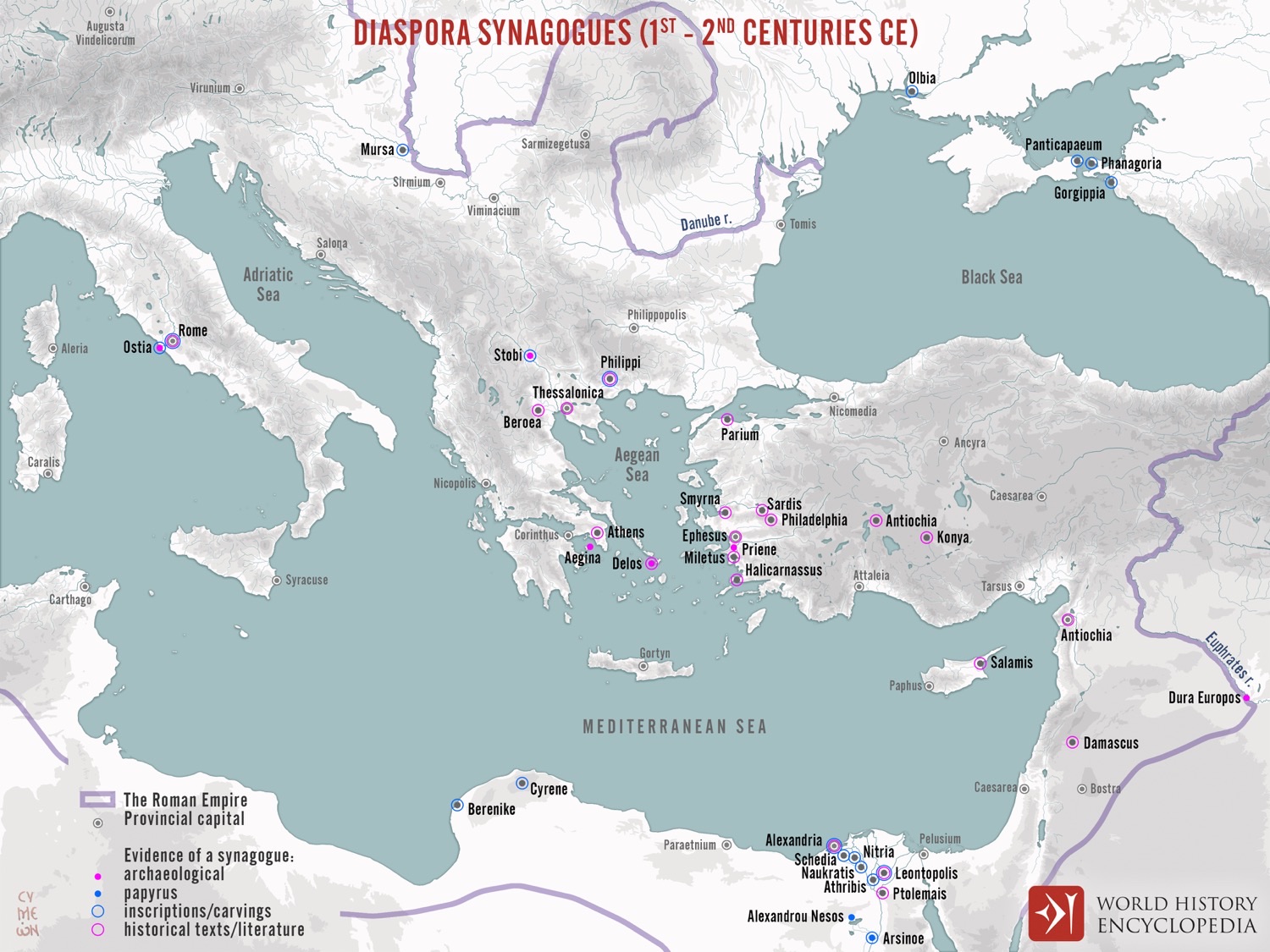
Jewish communities did not all begin at once, and they did not begin at random. They formed in distinct waves of movement, each set off by a particular event. Knowing the waves shows which communities on the map below are old and which are newer. Why the diaspora held together as one people across all of them is told in the Unit 1 Chapter The Diaspora.
The first wave came with the Babylonian deportations of 597 and 586 BCE. The Babylonian Empire, centered in present-day Iraq, conquered the Kingdom of Judah, the Jewish kingdom in the Land of Israel. It destroyed the First Temple, the sanctuary at the heart of Jewish worship in Jerusalem, and deported Judah’s elites (the royal house, the priests, the officials, and the artisans) eastward. When Persia conquered Babylon in 539 BCE and permitted a return, many chose to stay. That decision created the Babylonian community, which became the long spine of the diaspora and persisted through every wave that followed.
The second wave spread Jews across the Greek- and Roman-ruled Mediterranean in the centuries around the start of the Common Era, drawn by trade and the reach of empire. It reached Asia Minor, Greece, and Rome itself, and greatly enlarged a community in Egypt that was already centuries old.
The third wave came with the Roman conquest of Judah and the destruction of the Second Temple (rebuilt after the return from Babylon) in 70 CE. There was no expulsion in 70 CE. Captives were carried off and migration continued for centuries, while Jews remained the majority in the land for generations more. The communities of the East were already old by the time the Temple fell.
The fourth wave is medieval and modern. It began with the rise of Jewish life in the Rhineland and Eastern Europe (Ashkenaz). The expulsion of Jews from Spain in 1492 scattered Sephardi Jews, the Jews of Spanish descent, to North Africa, the Netherlands, the New World, and the Ottoman Empire, the Muslim empire ruled from today’s Turkey. The twentieth century brought the mass migration to the United States and the uprooting of nearly all the Jews of Arab lands between the 1940s and the early 1970s (and later from Iran). It also brought the airlifts that carried Ethiopian Jews to Israel. A continuous Jewish presence in the Land of Israel ran through all four waves.
The spread
Where the communities were.
The Jews of the Middle East and North Africa are often called Mizrahi, from the Hebrew for “eastern,” a name that came into use in Israel in the later twentieth century. Many call themselves Sephardi instead, since they generally follow Sephardic religious law and custom.
The Middle East and North Africa
Iraq (Babylonia). The community of Mesopotamia is among the oldest in the entire diaspora, founded with the Babylonian exiles of 597 and 586 BCE and continuous for some 2,500 years. Its academies compiled the Babylonian Talmud, the central text of rabbinic Judaism, and Baghdad remained a major center of Jewish life into the twentieth century. By the early twentieth century Jews were about one in five of Baghdad by the British count of 1919 (more by other estimates), and the new state’s first finance minister, Sassoon Eskell (Heskayl), was Jewish. The community is followed in depth in its own Chapter.
Iran (Persia). One of the oldest continuous Jewish communities on earth, present since at least the sixth century BCE, when Cyrus the Great brought Babylonia and its Jewish exiles into the Persian Empire. Persian Jews preserved their own language, Judeo-Persian, and lived across cities from Isfahan to Shiraz. Their long history is followed in its own Chapter.
Syria. The Jews of Aleppo and Damascus formed one of the Levant’s oldest communities. Aleppo guarded the Aleppo Codex, a tenth-century manuscript widely regarded as the most authoritative copy of the Hebrew Bible, for centuries. The 1840 Damascus Affair, a blood-libel case (the false accusation that Jews murder children for ritual use), drew international attention and is followed in Unit 3. After a pogrom, a violent mob attack on Jews, in Aleppo in December 1947, the community escaped in stages over the following decades, some of it in secret, under Syrian laws that made leaving harder and harder.
Yemen. At the southern tip of the Arabian Peninsula, the Jews of Yemen kept distinctive customs, pronunciations, and manuscripts across many centuries of relative isolation. Most of the community was airlifted to Israel in 1949–1950, and nearly all had left by the mid-1950s.
Egypt. Jewish life along the Nile runs from antiquity through the great medieval community of Fustat (Old Cairo), whose synagogue storeroom, the Cairo Geniza, preserved nearly a thousand years of letters, contracts, and books. Maimonides, the great medieval Jewish scholar and philosopher, led this community in the twelfth century. Most Egyptian Jews left in the years after 1948. After the Suez war of 1956, the government expelled or forced out some 25,000 to 30,000 Jews. Many were given days to go and had to abandon their property.
North Africa (the Maghreb). Jewish communities spread across Morocco, Algeria, Tunisia, and Libya, some predating the Arab conquest of the 600s and 700s CE, which brought Islam to the region, and some founded by Sephardi exiles after 1492. They produced major centers of learning and, in the modern period, lived under French and Italian colonial rule. One of their scholars, Isaac Alfasi (1013–1103), took his name from Fez and wrote his digest of Talmudic law in North Africa. Their story is followed in its own Chapter.
Europe
Spain and Portugal (Sepharad). The Jews of medieval Iberia built one of the most productive communities in Jewish history before the Spanish crown expelled them in 1492. In Portugal, King Manuel I ordered the Jews out in December 1496, then forced them to convert to Christianity in 1497. Sephardi exiles carried their language (Ladino), their legal traditions, and their family names into the Ottoman Empire, the Netherlands, North Africa, and eventually the Americas. Their story has its own Chapter, Unit 2 · Ch. 06 · The Jews of Spain and the Sephardic World.
France. In the eleventh century Rashi, the leading medieval commentator on the Bible and Talmud, taught in Troyes. In 1791 France made all its Jews full citizens, the first European state to do so. In 1894 a Jewish army officer, Alfred Dreyfus, was wrongly convicted of treason. From the 1950s, Jews from North Africa came in large numbers, and France’s Jewish community is now the largest in Europe. Its story continues in The Expulsions, The Racial Turn, and The Departure from MENA.
The Netherlands and England. By about 1600, Jews of Portuguese descent, many from families forced to convert, had found refuge in Amsterdam. There, within a generation, they were living openly as Jews and had become leading traders. England had expelled its Jews in 1290. In 1655 Menasseh ben Israel, a rabbi of Amsterdam, asked Oliver Cromwell, then England’s ruler, to let them return. Cromwell gave no formal answer, but by 1657 Jews in England had opened a synagogue. Both stories begin in The Expulsions and continue in The Jews of Spain and the Sephardic World.
Italy (Italkim). Jewish life in Rome dates to the second wave and has continued in Italy without interruption for roughly two thousand years. The Jewish catacombs of Rome, with their hundreds of inscriptions and carved menorahs, are the largest body of archaeological evidence for any early Jewish community in Europe.
The German lands and Central Europe (Ashkenaz). Jewish communities in the German lands in the Middle Ages, with centers such as Mainz and Worms on the Rhine, developed the traditions, the scholarship, and the Yiddish language that later spread east. Prague’s Old-New Synagogue, built in the late 1200s, is still in use. At fourteen, Moses Mendelssohn followed his teacher to Berlin and became one of Europe’s best-known philosophers. In 1930 Hungary counted about 445,000 Jews, and between the wars more than half of them lived in and around Budapest. Their story continues in The Ghetto System, The Racial Turn, Theodor Herzl, and The Years Before the Killing.
Turkey and Greece (the Ottoman lands). When Spain expelled its Jews in 1492, the Ottoman Empire welcomed them. Istanbul and Izmir became major Sephardi centers, and Ladino-speaking communities flourished across the empire for more than four hundred years. In Greece the newcomers joined the ancient Romaniote Jews, present since the Greco-Roman wave. Salonika (Thessaloniki) became, for a time, a city with a Jewish majority and a center of Ladino print culture, before its community was almost entirely destroyed in the Holocaust. The exiles’ Ottoman world is told in The Jews of Spain and the Sephardic World.
Poland and Lithuania. In the Middle Ages Jews moved east from the German lands into Poland, where rulers granted them charters of rights. For nearly two centuries, until 1764, their own councils ran Jewish affairs. By then about 750,000 Jews lived in Poland and Lithuania, the largest Jewish community in the world. In 1931 Warsaw had about 352,000 Jews, more than any other city in Europe. Their story has its own Chapter, Unit 2 · Ch. 07 · The Jews of Poland and Lithuania, and runs on into Unit 3 and Unit 4.
The Russian Empire. When Russia, Prussia, and Austria divided Poland between 1772 and 1795, Russia took in the largest Jewish population in the world. From the 1790s until 1917, most Jews could live only in a western zone called the Pale of Settlement. The census of 1897 counted about 5.2 million Jews. Among them was the Yiddish writer and humorist Sholem Aleichem, born in Pereyaslav in today’s Ukraine. About three million left between the 1870s and 1917, most of them for America. Their story continues in The Russian Pogroms and Soviet Jewry.
Romania. Records from the 1500s place Jewish merchants from Poland and Sephardi Jews from the Ottoman Empire in Moldavia and Wallachia, the two lands that later united as Romania. In 1876 Iași, Moldavia’s largest Jewish community, saw the first performance of Abraham Goldfaden’s Yiddish theater. Despite pressure from European powers, only 529 Jews were made citizens between 1880 and 1913. Full civil rights waited for the peace treaties of 1919 and the constitution of 1923. In 1930 Romania counted about 757,000 Jews. The war years are told in The Einsatzgruppen.
Asia
The Caucasus and Central Asia. Several old communities lived along the Silk Road and in the mountains between the Black and Caspian Seas. The Mountain Jews of the eastern Caucasus spoke Judeo-Tat. The Georgian Jews have been present, by their own tradition, since antiquity. The Bukharan Jews of Central Asia spoke Bukhori, a Jewish form of Tajik. Most moved to Israel and the United States in the twentieth century.
India. The Indian subcontinent held three long-separate Jewish communities. The Cochin Jews lived on the Malabar coast in the southwest and the Bene Israel on the Konkan coast near Bombay (Mumbai). The Baghdadi Jews arrived in the port cities under British rule. The Bene Israel lived for centuries in Marathi-speaking villages, so cut off from other Jews that Cochin teachers traveled to them in the 1800s to teach mainstream practice. The Cochin community’s Paradesi synagogue, built in 1568, still stands in the quarter of Kochi called “Jew Town.” Local Hindu rulers granted the Cochin Jews privileges, recorded on copper plates around 1000 CE. Violence came in wartime. In 1524, Muslim forces fighting the Portuguese attacked the Jews near Cranganore, killed many, and destroyed their synagogues. In 1662 the Portuguese killed many of the Cochin Jews, and Portugal’s Goa Inquisition pursued crypto-Jews, people of Jewish descent who kept Judaism in secret. After 1948 most members of the three communities left India, many of them for Israel. Their story is followed by the BBC and My Jewish Learning.
Kaifeng, China. A Jewish community settled in Kaifeng, on the Yellow River in Henan province, during the Song dynasty, most likely in the eleventh century. Its members probably came from Persia, by the Silk Road or by sea. The community’s own carved stone records of 1489 and 1512 tell the story. They built a synagogue in 1163 (in full Chinese architectural style, the building modeled in the banner above). The community flourished into the eighteenth century, then declined. By 1850 only about two hundred Jews remained, without a rabbi. One of their Torah scrolls is now in the British Library, and their story is told further by My Jewish Learning.
Africa and the Americas
Ethiopia (Beta Israel). In the highlands of northern Ethiopia, the Beta Israel, “House of Israel,” kept their own form of Jewish life for centuries, cut off from other Jewish communities. Many worked as blacksmiths and potters, and priests called kessoch led the community. Between 1984 and 1991 Israel flew most of them out, more than 14,000 people in 36 hours in May 1991 alone. Their story is followed in its own Chapter.
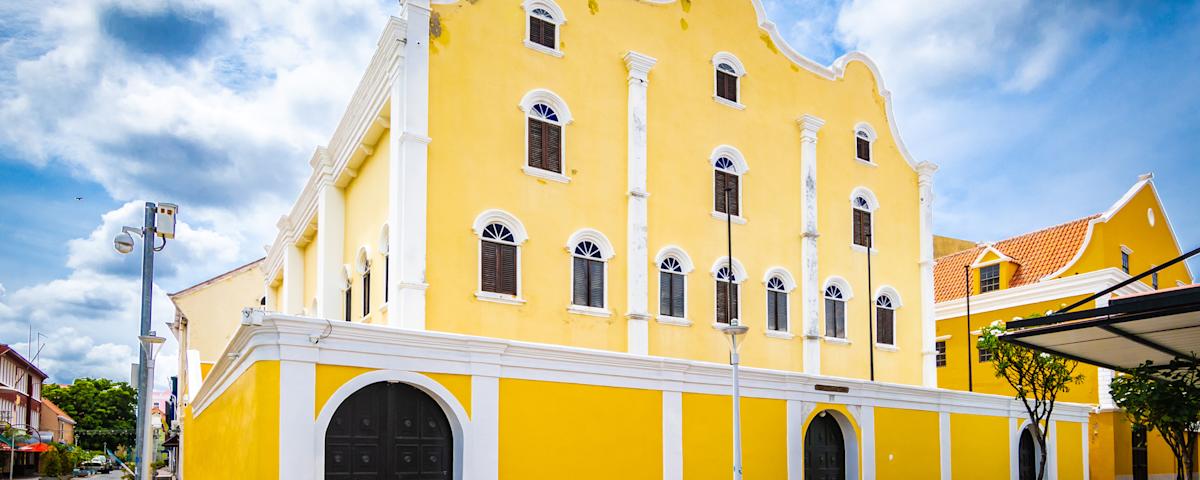
Latin America and the Caribbean. The Sephardi dispersion after 1492 reached the New World early. A Jewish community took root at Recife in Dutch-held Brazil, and when the Portuguese retook the city, refugees from it reached New Amsterdam (today’s New York) in 1654, the beginning of organized Jewish life in what became the United States. Other communities settled across the Caribbean. The Mikvé Israel-Emanuel synagogue in Willemstad, Curaçao, consecrated in 1732, is the oldest synagogue in continuous use anywhere in the Americas. Its sanctuary keeps a sand floor, a Sephardi custom often said to recall the years when Jews in Iberia had to worship in secret.
Argentina. On August 14, 1889, the steamship Weser brought more than 800 Jews from the Russian Empire to Argentina. Families from that ship bought land in Santa Fe province and founded Moisés Ville. In 1891 Baron Maurice de Hirsch, a financier and philanthropist, founded the Jewish Colonization Association, and its colonies spread across Santa Fe, Entre Ríos, and Buenos Aires provinces. The colonists took up the life of the gauchos, the cowboys of the Argentine plains. One of their sons, Alberto Gerchunoff, made them the subject of his first and most famous book, Los gauchos judíos (1910). The colonies peaked in 1925 at about 20,000 people. On July 18, 1994, a bomb destroyed the AMIA Jewish community center in Buenos Aires and killed 85 people, an attack told, with the court ruling thirty years later, in The Terror Record. More than eight in ten Argentine Jews live in Buenos Aires and its suburbs, and the community, about 170,000 people, is the largest in Central and South America.
The United States. Congregation Shearith Israel, still active in New York, traces its founding to the refugees of 1654. As Jews arrived from the German lands, the country’s Jewish population grew from about 15,000 in 1840 to 150,000 in 1860. Between 1881 and 1924 more than two million Jews came from Eastern Europe. Today the United States has the world’s second-largest Jewish community, after Israel. Its story is followed in its own Chapter.
One pattern, many tongues
Read in Hebrew letters, spoken in a hundred places.
The languages these communities spoke show the same mix of difference and connection. Hebrew remained the language of prayer, scripture, and scholarship, but for much of Jewish history it was not the everyday language of most Jews. Around the start of the Common Era, Jews in the Land of Israel spoke Aramaic and Greek alongside Hebrew, and over the next centuries Hebrew faded as an everyday spoken language. From then on, wherever a community settled, it tended to take up the local language and make it its own.
Most Jews of the Arab world spoke Judeo-Arabic. In the mountains of Kurdistan, today divided among Iraq, Iran, Turkey, and Syria, Jews spoke Jewish Neo-Aramaic, a modern form of Aramaic, the language of much of the Talmud. In Iran and Afghanistan, as early as the eighth century, Jews spoke Judeo-Persian. Jews in Italy spoke Judeo-Italian, in the Caucasus Judeo-Tat, and in Central Asia Bukhori, a form of Tajik. The two best known are Yiddish, the language of Ashkenaz, medieval German woven through with Hebrew and, later, Slavic, and Ladino (Judeo-Spanish), carried out of Spain in 1492 and kept alive in the Ottoman Empire for four more centuries. In all, Jews have spoken several dozen distinct language varieties, from southern India to Morocco to the Caucasus.
Almost all of these languages, however different they sounded, were written in the same Hebrew alphabet. A Jew in Baghdad writing Judeo-Arabic and a Jew in Salonika writing Ladino used letters the other could read, even when neither could understand the other’s speech. Most of these languages are now endangered or gone, thinned by migration, the Holocaust, Soviet suppression, and the pull of new national languages.
Ten worked examples
The Chapters that follow.
Each of the ten Chapters in this Unit takes one community and follows it closely, its beginning, its depth, and in many cases its end there.
- The Jews of Iraq, the first-wave community and the long center of Jewish law.
- The Jews of Iran, one of the oldest continuous communities, on Persian soil.
- The Jews of North Africa, Morocco, Algeria, Tunisia, and Libya across centuries.
- The Departure from MENA, how the Middle Eastern and North African communities ended.
- The Jews of Spain and the Sephardic World, the Jews of medieval Iberia and the world the exiles built after 1492.
- The Jews of Poland and Lithuania, once the largest Jewish community on earth.
- Soviet Jewry, Jewish life and the struggle to leave the Soviet Union.
- American Jewry, from 1654 to the largest diaspora community today.
- Ethiopian Jewry, Beta Israel, the community of the Ethiopian highlands.
- The Modern State of Israel, where many of these communities reconverged.
Key takeaways
- Jewish history did not run through one region. For long stretches of the last two thousand years its center of gravity was outside Europe: in Iraq, North Africa, Iran, and across the Mediterranean.
- The communities formed in distinct waves of movement, each set off by a particular event, beginning with the Babylonian exiles of 597 and 586 BCE.
- They were different worlds: different languages, rulers, food, music, and at the same time a connected network, sharing texts, a calendar, law, and scholars who moved between them.
- Almost all of the Jewish languages, from Judeo-Arabic to Yiddish and Ladino, were written in the same Hebrew alphabet.
- Many of these communities ended within a single lifetime, and a large part of their people reconverged in the Modern State of Israel.
Object Spotlight
A trader’s notes, from India to Cairo.
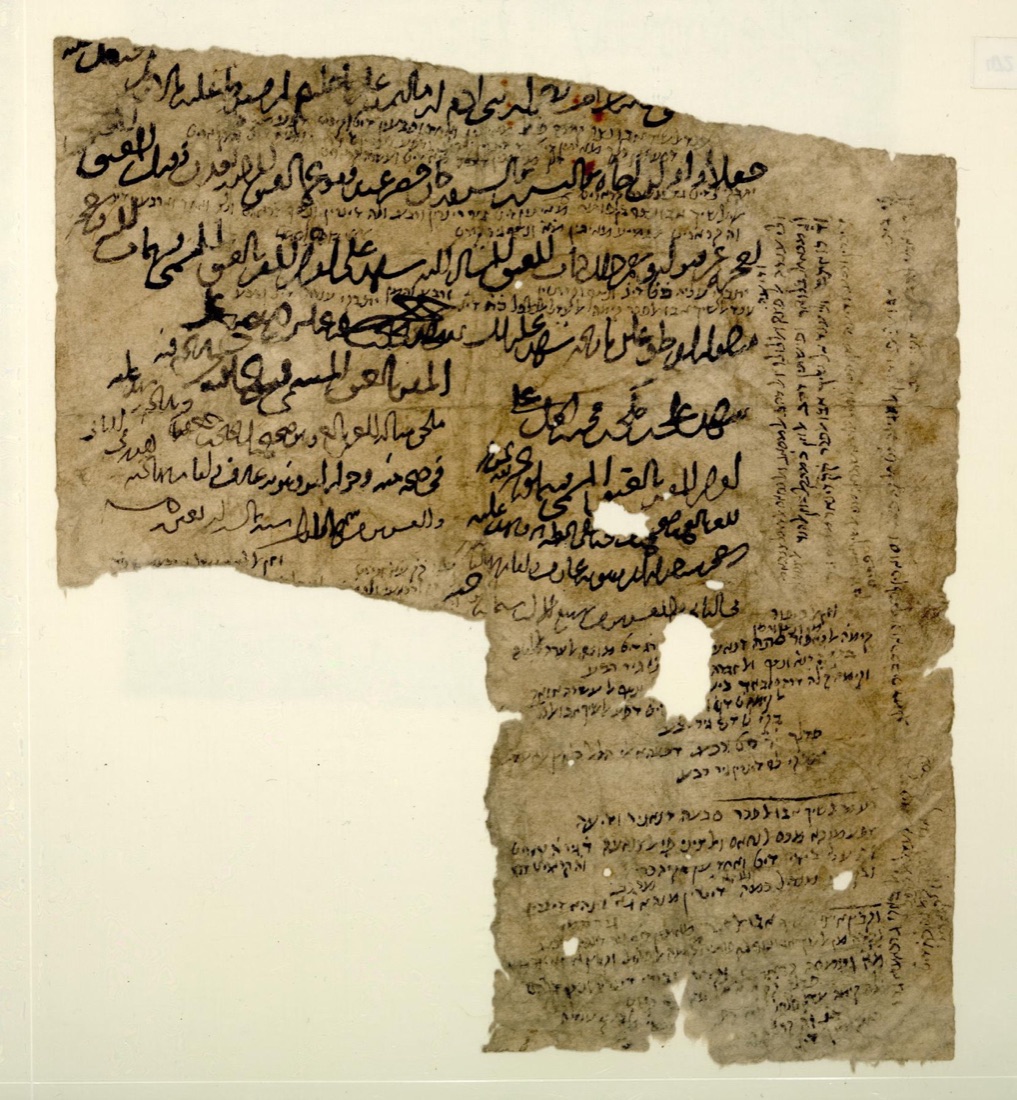
Collection of the Center for Advanced Judaic Studies Library, University of Pennsylvania (Halper 472)
University of Pennsylvania Libraries. Public domain.
This torn sheet belonged to Abraham Ben Yiju, a Jewish merchant in the India trade. He was born in al-Mahdiyya, in today’s Tunisia, and spent some years in Aden, in Yemen. Before 1132 he moved to India. He lived on and off in Mangalore, on India’s southwest coast, until 1149, then went back to Yemen and on to Egypt.
Back in Egypt, he reused a legal statement made out in his name. It was written in Arabic script, dated June 17, 1153, and recorded that he had freed a slave in Aden. In the spaces around its lines, and on the back, Ben Yiju kept his accounts in Judeo-Arabic, Arabic written in Hebrew letters, which Jews from Spain to Iraq could read.
The notes list the money, jewelry, and goods he had left with men in Fustat, and his daily spending on bread, oil, and household needs. They name goods he had brought from India, among them bronze, china, and camphor. One entry records the sale of a load of pepper for 197¾ dinars.
The largest share of the Geniza is held today by Cambridge University Library, in its Taylor-Schechter Genizah Collection. This sheet is in Philadelphia, at the University of Pennsylvania.
Discussion questions
Working from the evidence.
Each question is anchored in a fact this Chapter documents. Answer from the evidence on the page.
- The Chapter opens by calling the Jewish world “a network, not an outpost.” Pick two pieces of evidence on this page that show communities in contact with each other. What kind of contact does each one prove?
- Communities wrote Arabic, Spanish, German, and Persian in Hebrew letters. What does a shared alphabet across dozens of spoken languages tell you about what held the network together?
- These communities formed in waves: exile, trade, expulsion. Choose one community from the map and explain how knowing when and why it formed changes how you read its later story.
- The Object Spotlight shows one merchant’s accounts, not a royal chronicle. What can an ordinary business record prove about the connected Jewish world that an official history cannot?
Classroom Connections
Where this Chapter fits.
Teaching Connections
- World History, the First Civilizations: the diaspora’s origin in Mesopotamia (present-day Iraq) with the deportations of 597 and 586 BCE, tied to the river-valley civilizations and the Babylonian Empire.
- World History & Belief Systems: how a single belief system held a people together across vast distances, through shared texts, a shared calendar, and a shared script.
- World History, the Classical World: the spread across the Greek- and Roman-ruled Mediterranean and the Roman destruction of the Second Temple in 70 CE.
- Trade Networks & an Interconnected World: the responsa system and the Cairo Geniza document a connected medieval economy stretching from Spain to India.
- Geography: the shape of the whole Jewish world, region by region.
- Languages & Linguistics: the diaspora’s languages (Judeo-Arabic, Ladino, Yiddish, Judeo-Persian) written in the Hebrew alphabet, one pattern repeated across the map.
Standards Alignment
- NYS Global History & Geography: 9.1 (the first civilizations), 9.2 (Belief Systems, incl. 9.2b “belief systems were often used to unify groups of people”), and 9.3 (the classical world).
Sources and citations
Primary sources
A primary source is a record from the time. It was made by people who were there. Examples: letters, diaries, photos, decrees, trial records, and newspapers.
- The Cairo Geniza. Hundreds of thousands of manuscript fragments, letters, contracts, and everyday documents from the Ben Ezra Synagogue in Fustat (Old Cairo), spanning roughly the 9th to the 19th centuries. The largest holding is the Taylor-Schechter Genizah Collection at Cambridge University Library, with digitized images free online via the Cambridge Digital Library. Two Geniza manuscripts are featured in the Museum.
- Abraham Ben Yiju. Accounts and notes, Fustat (Old Cairo), c. 1152–1153, Judeo-Arabic, written around an Arabic legal statement dated June 17, 1153. Cairo Geniza. Center for Advanced Judaic Studies Library, University of Pennsylvania (Halper 472). openn.library.upenn.edu →
- Benjamin of Tudela. The Itinerary of Benjamin of Tudela, c. 1165–1173. The great medieval travel account of Jewish communities from Spain to Baghdad and beyond, with population counts and named leaders for each. Translated by Marcus Nathan Adler, 1907.
- The Kaifeng synagogue stelae, 1489 and 1512. Stone inscriptions in which the Jews of Kaifeng, China recorded their own history, beliefs, and the rebuilding of their synagogue. Kaifeng Municipal Museum.
- Abraham ibn Daud. Sefer ha-Qabbalah (The Book of Tradition), Toledo, 1161. The medieval chronicle of how learning passed from Babylonia to the communities of Spain and North Africa.
- The Cochin copper plates, c. 1000 CE. The privileges granted by the Chera ruler to Joseph Rabban and the Jews of the Malabar coast, engraved in copper and kept at the Paradesi Synagogue, Kochi, India.
- National Constituent Assembly of France. “Admission of Jews to Rights of Citizenship,” decree of 27 September 1791. English translation in Liberty, Equality, Fraternity: Exploring the French Revolution, Roy Rosenzweig Center for History and New Media, George Mason University, and the American Social History Project, City University of New York. revolution.chnm.org →
- Argentina, Presidencia de la Nación. Decreto 339/1999, 13 April 1999. The decree declaring the town center of Moisés Ville, Santa Fe province, a national historic settlement as the first settlement of Jewish immigration in Argentina, October 1889. Spanish text at servicios.infoleg.gob.ar →
Secondary sources
A secondary source was written later. It is a book or article by a historian who studied those records and explains what they mean.
- Goitein, S. D. A Mediterranean Society: The Jewish Communities of the Arab World as Portrayed in the Documents of the Cairo Geniza. 6 vols. University of California Press, 1967–1993. (The foundational study of the connected medieval diaspora, built from the Cairo Geniza documents.)
- Goitein, S. D., and Mordechai Akiva Friedman. India Traders of the Middle Ages: Documents from the Cairo Geniza (India Book, part one). Leiden: Brill, 2008. (The letters and accounts of Abraham Ben Yiju and other India traders.)
- Princeton Geniza Project. “Avraham Ben Yijū.” Princeton University. (His birth in al-Mahdiyya, his years in Aden and India, his return to Egypt, and the descriptions of Halper 472.) geniza.princeton.edu →
- Stillman, Norman A. The Jews of Arab Lands: A History and Source Book. Philadelphia: Jewish Publication Society, 1979.
- Ben-Sasson, H. H., ed. A History of the Jewish People. Cambridge, MA: Harvard University Press, 1976.
- Gerber, Jane S. The Jews of Spain: A History of the Sephardic Experience. New York: Free Press, 1992.
- Rutgers, Leonard V. The Jews in Late Ancient Rome. Leiden: Brill, 1995. (On the Roman Jewish community and the catacomb evidence.)
- Sabar, Yona, and Alan Niku. “Jewish Neo-Aramaic.” Jewish Language Website, edited by Sarah Bunin Benor. Los Angeles: Jewish Language Project. (On the Aramaic spoken by the Jews of Kurdistan, from Zakho in Iraq to Bijar in Iran.) jewishlanguages.org →
- Tahan, Ilana. “The Kaifeng Torah Scroll: A British Library Treasure.” British Library, 2020. (On the Jews of Kaifeng, the scholarly case for their Persian roots, and their synagogue, first built in 1163.) British Library.
- DellaPergola, Sergio. “World Jewish Population, 2024.” In American Jewish Year Book 2024, edited by Arnold Dashefsky and Ira M. Sheskin. Cham: Springer, 2025. (Country-by-country estimates, including the fall of Iran’s Jewish population from about 72,000 in 1970 to about 9,000, and Argentina’s 170,000 as the largest Jewish community in Central and South America.) Free online from the Israel Central Bureau of Statistics.
- Encyclopaedia Judaica. “Argentina.” (On the Weser immigrants of August 14, 1889, the founding of Moisés Ville, the Jewish Colonization Association’s colonies in Santa Fe, Entre Ríos, and Buenos Aires provinces, the 1925 peak of 20,382 settlers, the share of Argentine Jews living in greater Buenos Aires, and the 1994 AMIA bombing.) encyclopedia.com →
- Jewish Virtual Library. “Jewish Colonization Association (ICA).” American-Israeli Cooperative Enterprise. (Founded by Baron Maurice de Hirsch in 1891; its settlement work in Argentina.) jewishvirtuallibrary.org →
- Encyclopaedia Judaica. “Hirsch, Baron Maurice de.” (On Hirsch, 1831–1896, financier and philanthropist, and the founding of the ICA in 1891.) encyclopedia.com →
- Encyclopaedia Judaica. “Gerchunoff, Alberto.” (On his childhood in Moisés Ville and Los gauchos judíos, 1910.) encyclopedia.com →
- Jewish Virtual Library. “Argentina Virtual Jewish History Tour.” American-Israeli Cooperative Enterprise. (On the Weser colonists who became gauchos.) jewishvirtuallibrary.org →
- The Jewish Encyclopedia. “India.” Funk & Wagnalls, 1901–1906. (On the 1524 attack on the Jews of Cranganore and the Portuguese killings at Cochin in 1662.) jewishencyclopedia.com →
- “Portugal.” Encyclopedia.com. (On King Manuel I forcing the Jews of Portugal to convert in 1496–1497.) encyclopedia.com →
- Yad Ben-Zvi Institute. “The Aleppo Codex.” (On the codex, its damage in the December 1947 riots in Aleppo, and its transfer to Jerusalem in 1958.) ybz.org.il →
- Bitton, Mijal, director. Sephardic and Mizrahi Jews in the United States: Identities, Experiences, and Communities. New York University; commissioned by JIMENA, 2025. Summary of Findings. (On the origin of the term Mizrahi in Israel and on how Sephardic and Mizrahi Jews describe themselves.) sephardicstudy.org →
- Deshen, Shlomo. “Adot ha-Mizrah.” Encyclopedia of the Modern Middle East and North Africa. (On the Israeli terms edot ha-mizrah and mizrahim for the Jews of the Middle East and North Africa.) encyclopedia.com →
- Encyclopaedia Judaica. “Egypt,” as reproduced in the Jewish Virtual Library. (On the orders of November 1956 expelling thousands of Egyptian Jews.) jewishvirtuallibrary.org →
- Jewish Virtual Library. “France Virtual Jewish History Tour.” American-Israeli Cooperative Enterprise. (On Rashi, the Dreyfus case, the arrival of North African Jews in the 1950s and 1960s, and France as home to Europe’s largest Jewish community.) jewishvirtuallibrary.org →
- Barnavi, Eli, ed. A Historical Atlas of the Jewish People. Schocken Books. Excerpt “Jewish Emancipation in Western Europe,” My Jewish Learning. (On the French law of 27 September 1791 as “the first act of full emancipation by a Christian state.”) myjewishlearning.com →
- Encyclopaedia Judaica. “Rashi,” as reproduced in the Jewish Virtual Library. (On Rashi, 1040–1105, of Troyes, the leading commentator on the Bible and Talmud, and his studies at Mainz and Worms.) jewishvirtuallibrary.org →
- Jewish Virtual Library. “The Netherlands Virtual Jewish History Tour.” American-Israeli Cooperative Enterprise. (On the refuge in Amsterdam by about 1600, Jewish traders there, and Menasseh ben Israel’s petition of 1655.) jewishvirtuallibrary.org →
- Jewish Virtual Library. “United Kingdom Virtual Jewish History Tour.” American-Israeli Cooperative Enterprise. (On the expulsion of 1290, Menasseh ben Israel’s mission of 1655, and the London synagogue of 1657.) jewishvirtuallibrary.org →
- Jewish Virtual Library. “Germany Virtual Jewish History Tour.” American-Israeli Cooperative Enterprise. (On the medieval academies of Mainz and Worms.) jewishvirtuallibrary.org →
- Jewish Community of Prague. “Old-New Synagogue.” (Built in the last third of the thirteenth century, and the community’s main synagogue for more than seven hundred years.) synagogue.cz →
- Jewish Virtual Library. “Moses Mendelssohn.” American-Israeli Cooperative Enterprise. (On the fourteen-year-old Mendelssohn following his teacher, David Fraenkel, to Berlin.) jewishvirtuallibrary.org →
- Haraszti, György. “Hungary: Hungary from 1918 to 1945.” The YIVO Encyclopedia of Jews in Eastern Europe. (The 444,567 Jews of post-Trianon Hungary in 1930, and the interwar shift of more than half of Hungarian Jewry to greater Budapest.) encyclopedia.yivo.org →
- Rosman, Moshe. “Poland: Poland before 1795.” The YIVO Encyclopedia of Jews in Eastern Europe. (The Ashkenazic roots of Polish Jewry, the privilege of 1264, and the community as the largest of its period.) encyclopedia.yivo.org →
- Encyclopaedia Judaica. “Councils of the Lands,” as reproduced in the Jewish Virtual Library. (On Jewish self-government in Poland and Lithuania until 1764 and the Council of Four Lands at the fairs of Lublin and Jarosław.) jewishvirtuallibrary.org →
- Polonsky, Antony. “Warsaw.” The YIVO Encyclopedia of Jews in Eastern Europe. (Warsaw’s Jewish population of 352,000 in 1931, the largest in Europe.) encyclopedia.yivo.org →
- Stanislawski, Michael. “Russia: Russian Empire.” The YIVO Encyclopedia of Jews in Eastern Europe. (The partitions of Poland, the 1897 census figure of 5,198,401 Jews, and the emigration of about three million.) encyclopedia.yivo.org →
- Klier, John. “Pale of Settlement.” The YIVO Encyclopedia of Jews in Eastern Europe. (The origins of the Pale in 1790 and its abolition in 1917.) encyclopedia.yivo.org →
- Miron, Dan. “Sholem Aleichem.” The YIVO Encyclopedia of Jews in Eastern Europe. (Sholem Aleichem as a founder of modern Yiddish literature and “a supreme Jewish humorist.”) encyclopedia.yivo.org →
- Stillman, Norman A., updated by Harvey E. Goldberg. “Jews in the Middle East.” Encyclopedia of the Modern Middle East and North Africa. (On Sassoon Heskayl, Iraq’s first finance minister.) encyclopedia.com →
- The Jewish Encyclopedia. “Alfasi, Isaac ben Jacob.” Funk & Wagnalls, 1901–1906. (On Alfasi’s birth near Fez and his digest of Talmudic law, the Halakhot.) jewishencyclopedia.com →
- Volovici, Leon. “Romania.” The YIVO Encyclopedia of Jews in Eastern Europe. (The first communities, the 529 Jews naturalized from 1880 to 1913, the rights of 1919 and 1923, and the 1930 total of 756,930.) encyclopedia.yivo.org →
- Herşcovici, Lucian-Zeev. “Iași.” The YIVO Encyclopedia of Jews in Eastern Europe. (Iași as the largest Jewish community of Moldavia, and the first performance of Goldfaden’s Yiddish theater there in 1876.) encyclopedia.yivo.org →
- Kaplan, Steven, et al. “Beta Israel.” Encyclopaedia Judaica, 2nd ed. (On the communities of northern Ethiopia, their crafts and priests, and Operations Moses and Solomon.) encyclopedia.com →
- Library of Congress. From Haven to Home: 350 Years of Jewish Life in America, “A Century of Immigration, 1820–1924.” (On the growth from 15,000 to 150,000 Jews between 1840 and 1860, and the East European migration of 1881–1924.) loc.gov →
- Congregation Shearith Israel. “Our History.” (Founded in 1654, the first Jewish congregation in North America.) shearithisrael.org →
- Congregation Mikvé Israel-Emanuel, Curaçao. (Consecrated in 1732, the oldest synagogue in continuous use in the Americas, with its sand floor.) snoa.com →
- Jewish Virtual Library. “Jewish Population of the World.” American-Israeli Cooperative Enterprise. (The 2024 country ranking: Israel first, the United States second, France third and first in Europe.) jewishvirtuallibrary.org →
Finding these documents: many primary sources are free online. Good places to start are the Fordham Internet Jewish History Sourcebook, Yale’s Avalon Project (law and diplomacy), German History in Documents, the collections of the US Holocaust Memorial Museum and Yad Vashem, the National Library of Israel, and Sefaria (for Jewish texts). Search the document’s name and date.
This Unit opens with the whole diaspora in view. The Chapters that follow visit individual communities (in Iraq, Iran, North Africa, and beyond) one at a time.
For more than 2,500 years, Iraq held one of the oldest and most influential Jewish communities on earth, the home of the great academies, a modern urban world, and a presence that ended in a single generation.
Comments?
Write to editor@teachjewishhistory.org.
Last updated: November 2026.