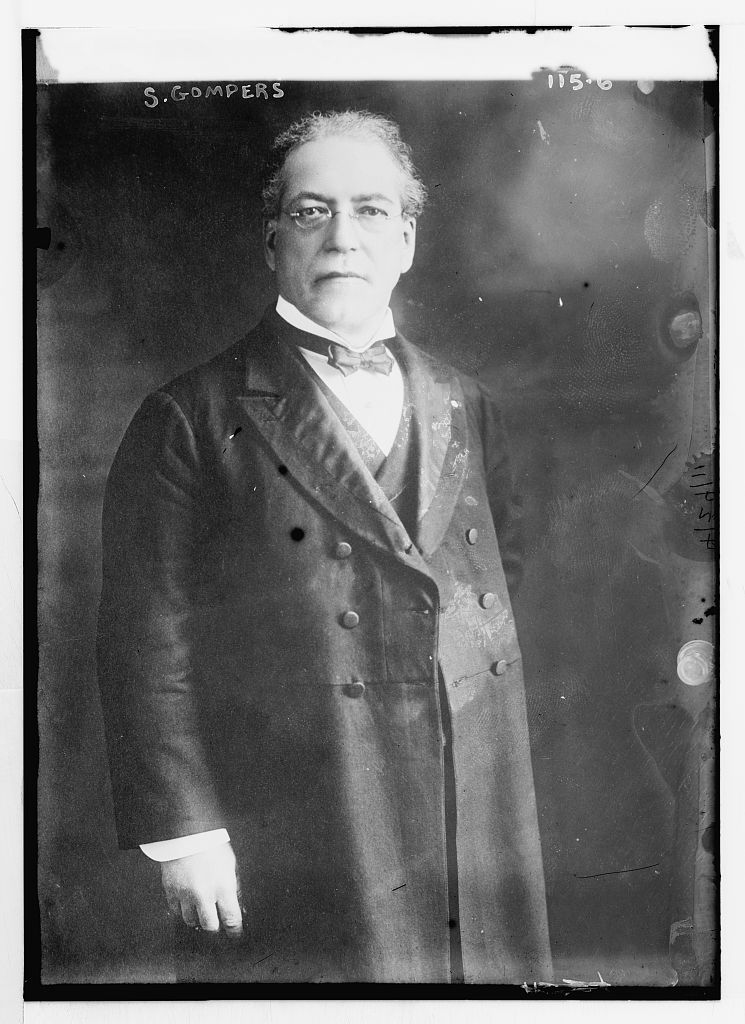
Samuel Gompers
If your school day ends, if a workday has a closing time at all, part of that clock was wound by a cigar maker from a London tenement. He never got rich, and he never owned a factory. He organized the workers inside the factories, and led the organization he built for nearly forty years.
Samuel Gompers, 1850–1924, the immigrant who became the voice of American labor
Why this Chapter exists
The other side of the ledger.
Most Chapters in this Unit are about what individual Jews made: a commentary, a law code, a poem, a vaccine. This one is about what organized workers won, and about the Jewish immigrant who did more than almost anyone to organize them. The eight-hour day, the paid holiday, the union contract: these are contributions too, used daily by people who have never heard the name of the man in this Chapter.
1850–1877
The reading room that made cigars.
Samuel Gompers was born on January 27, 1850, in a tenement in the East End of London (a tenement is a crowded, cheap apartment building). His parents were Dutch Jews whose families had moved from Amsterdam, and his father rolled cigars for a living. From age six Samuel attended the Jews’ Free School, a charity school for the children of poor Jewish families. At ten, the family needed his wages, and he left school to learn his father’s trade. In 1863, when he was thirteen, the family sailed for New York and settled on the Lower East Side.
The cigar shop became his university. Rolling cigars is quiet handwork, so the men in the shop pooled their pay to hire one of their own to read aloud while the rest worked: newspapers, novels, economics. Gompers listened, and often read. At fourteen he joined the cigar makers’ union (a union is an organization of workers who join together to bargain over pay and conditions). An older Swedish cigar maker named Ferdinand Laurrell became his teacher, and his advice shaped everything that followed: trust the union, not the grand theories. Gompers rose to lead his New York local while still in his twenties.
1881–1893
A federation of the skilled.
American unions in those years were small, scattered, and easily broken. Gompers’s answer was a federation. Each craft union (a craft union organizes one skilled trade, like carpenters or cigar makers) would govern itself, pay real dues, and build a strike fund (money saved in advance so workers can hold out when they stop work). And each would stand behind the others. The craft unions had first federated loosely in 1881. On December 8, 1886, in Columbus, Ohio, they reorganized as the American Federation of Labor and elected Gompers, a thirty-six-year-old cigar maker, its first president. He held the job, with one single-year interruption, until the day he died.
He kept the Federation away from revolutions, away from a labor party of its own, and away from grand plans to remake society, though not away from politics: the Federation lobbied Congress and endorsed candidates. His unionism made demands a worker could measure: shorter hours, higher wages, safer shops, a contract in writing. He called it “pure and simple” unionism. Asked what labor actually wanted, he answered in a speech in Chicago in 1893: “We want more schoolhouses and less jails; more books and less arsenals; more learning and less vice; more leisure and less greed; more justice and less revenge.”
1886–1918
Eight for work, eight for rest.
The movement’s great demand fit on a banner: eight hours for work, eight hours for rest, eight hours for what we will. In 1890 the Federation put its strength behind the carpenters, who struck and won the eight-hour day in dozens of cities, trade by trade, year by year. The victories were never national and never final, but the clock was moving. In 1894, Congress made Labor Day, a holiday the unions had invented for themselves twelve years earlier, a federal holiday.
After the Triangle Shirtwaist fire killed 146 garment workers in New York in 1911, Gompers was named to the state commission that investigated the disaster, and its findings drove a wave of workplace-safety laws. By the end of the First World War, the Federation’s unions counted some three million members, and its president, once a boy reading aloud in a cigar shop, sat on the national councils that ran the war effort.
1882–1924
The lines he drew.
The record also has a harder side. The Federation organized the skilled crafts, and many of its member unions shut Black workers out; Gompers let each union set its own rules, and the exclusion stood. He supported the laws that barred Chinese immigrants from the country, and late in life he backed limits on immigration itself, though he had arrived as a poor immigrant boy. The man who widened the door for some workers helped hold it shut for others.
He died in San Antonio, Texas, on December 13, 1924, days after collapsing on a trip to Mexico, still president of the Federation he had led for thirty-seven of its first thirty-eight years. The organization he built, today the AFL-CIO, is still the largest federation of unions in the United States.
Object Spotlight
A parade that is still on the calendar.
The banner image at the top of this page is an engraving from Frank Leslie’s Illustrated Newspaper: the first Labor Day parade, marching around Union Square in New York on September 5, 1882. Gompers was then a local cigar-union leader in that city. Read the signs the marchers carry. One says “Labor creates all wealth.” Another says “Eight hours constitute a day’s work.”
The marchers gave themselves the day off; the holiday came later. Twelve years afterward, Congress made the first Monday of September a national holiday, and it has been on the American calendar ever since. Most holidays honor a person or an event. This one honors the people the parade was made of.
The analytical question
Where is his monument?
Gompers built no company, wrote no law code, and left no fortune. His record is kept in other forms: the minutes of a thousand negotiations, the hours a workday lasts, a September Monday when the country rests. Every claim here traces to a record: a school register in London, a union card in New York, the Federation’s founding minutes in Columbus, an engraving of a parade. The monument is harder to see, because so many people live inside it.
Key takeaways
- Samuel Gompers (1850–1924) was born to a Dutch-Jewish family in a London tenement, left the Jews’ Free School at ten to roll cigars, and came to New York’s Lower East Side at thirteen.
- He helped found the American Federation of Labor in Columbus, Ohio on December 8, 1886, and served as its president for thirty-seven of its first thirty-eight years, until his death.
- His “pure and simple” unionism made demands a worker could measure: the eight-hour day, safer shops, a contract in writing; by the end of the First World War the Federation counted some three million members.
- The record has a harder side: many AFL craft unions excluded Black workers, and Gompers backed Chinese exclusion and later immigration limits. The federation he built, today the AFL-CIO, still exists.
Discussion questions
Working from the evidence.
Grounded in the sourced record above.
- Gompers left school at ten, yet the cigar shop where readers were hired to read aloud gave him an education. What does his story say about where learning happens, and who pays for it?
- The Federation organized skilled crafts because they were hardest to replace during a strike. What did that strategy win, and which workers did it leave outside?
- Read the 1893 quotation closely. Of the five “more and less” pairs, which asks for money? What does the list say labor believed it was really bargaining for?
- Gompers arrived as a poor immigrant, then supported Chinese exclusion and later limits on immigration. What does the contradiction teach about how movements define who counts as “us”?
- Look at the 1882 engraving in the banner and the Object Spotlight. What do the marchers’ signs ask for, and how many of those demands are now simply how work is done?
Classroom Connections
Where this Chapter fits.
Teaching Connections
The disciplines and courses this Chapter naturally supports, for any educator, anywhere.
- US History: industrialization, the labor movement, and the Progressive era through one organizer’s arc.
- Economics & Civics: unions, strikes, collective bargaining, and how workplace rules are actually made.
- Primary-Source Analysis: the 1893 “What Does Labor Want?” address and the 1882 parade engraving, read line by line and sign by sign.
- Ethics: the lines the movement drew, and who was left outside them.
- Jewish History: the Lower East Side immigrant arc, alongside the American Jewry Chapter and the commerce and labor field of Across the Fields.
Standards Alignment
- NYS US History & Government: 11.5 (industrialization and urbanization, 1870–1920).
- Common Core ELA-Literacy: RH.9–10.2 (central ideas from primary and secondary sources) and RH.6–8.7 (integrating visual information, here the parade engraving).
Further Teaching Resources
- The Samuel Gompers Papers, University of Maryland, the scholarly edition of his letters and speeches.
- Seventy Years of Life and Labor, his autobiography, free to read.
- Cornell University, the Triangle Factory Fire, the documentary record of the 1911 disaster and the reforms that followed.
Sources and citations
Primary sources
A primary source is a record from the time. It was made by people who were there. Examples: letters, diaries, photos, decrees, trial records, and newspapers.
- Gompers, Samuel. Seventy Years of Life and Labor: An Autobiography. New York: E. P. Dutton, 1925. archive.org.
- Gompers, Samuel. “What Does Labor Want?” Address to the International Labor Congress, Chicago, August 28, 1893. In The Samuel Gompers Papers. gompers.umd.edu.
- “New York City – Grand Demonstration of Workingmen, September 5th.” Engraving. Frank Leslie’s Illustrated Newspaper, September 16, 1882.
- S. Gompers. Photograph, Bain News Service, 1911. Library of Congress.
Secondary sources
A secondary source was written later. It is a book or article by a historian who studied those records and explains what they mean.
- Livesay, Harold C. Samuel Gompers and Organized Labor in America. Boston: Little, Brown, 1978.
- Kaufman, Stuart B., et al., eds. The Samuel Gompers Papers. 13 vols. Urbana: University of Illinois Press, 1986–2013.
Theodor Herzl (1860–1904): the Viennese journalist who watched a Paris mob degrade a Jewish officer and concluded that the Jews needed a country of their own.
Comments?
Write to editor@makorproject.org.
Last updated: September 2026.