

The Founders of Hollywood
A clothing-company bookkeeper from a small town in southern Germany. A Hungarian orphan who became a New York furrier. A Hungarian-born garment worker raised in New York. A scrap-metal dealer’s son from the Russian Empire, raised in Canada. A cobbler’s four sons from Poland. A tailor’s son from New York’s East Side. Between roughly 1903 and 1920, these men, all Jewish, immigrants and children of immigrants, went into a business that respectable society looked down on: the moving picture. The companies they built became the major Hollywood studios.
The Founders of Hollywood · Unit 5
Why this Chapter exists
An American industry with an immigrant origin story.
Universal, Paramount, Fox, MGM, Warner Bros., Columbia: each of these studios, the firms that built the Hollywood studio system, was founded or led by a Jewish immigrant or the child of one, within roughly a dozen years of each other. Since 2024 the founders’ story has been the subject of the first permanent exhibition at the film industry’s own museum.
A misconception this Chapter addresses
- “Jews control the media.” See the entry →
1867–1892
Six arrivals.
Carl Laemmle was born in the Jewish quarter of Laupheim, in the German kingdom of Württemberg, in 1867, and sailed from Bremerhaven for New York in 1884, at seventeen, on a ticket his father gave him as a birthday present. Adolph Zukor, orphaned young, left Hungary at sixteen and learned the fur trade in a New York shop. William Fox, born Vilmos Fried in Tolcsva, Hungary, arrived as an infant and left school at eleven to support his family in the garment trade. Louis B. Mayer, born Lazar Meir in the Russian Empire around 1884, grew up in Saint John, New Brunswick, in Canada, where his father ran a scrap-metal business. He later gave the Fourth of July as his birthday, and in 1907 he bought a run-down theater in Haverhill, Massachusetts, and reopened it as a movie house. The Warner brothers were the sons of a cobbler from Krasnosielc, Poland, and three of the four were born there. Harry Cohn was born on New York’s Upper East Side in 1891 to a tailor from Germany and a mother from the Pale of Settlement, the region of the Russian Empire where Jews were required to live.
None of these men had a university degree, and none inherited money. The established banks, corporations, and leading firms of the era shut most Jews out, and poor newcomers without schooling had even less chance. The broader pattern of exclusion is documented in the American Jewry Chapter. Film was a new business. Many in the established classes dismissed it as cheap amusement for immigrants and workers, shown in nickelodeons, storefront theaters where a nickel bought a seat. The historian Neal Gabler, in his group biography An Empire of Their Own (1988), describes the founders as outsiders who built an industry of their own and, through its films, their own vision of the American dream.
1905–1930
From nickelodeons to an industry.
Most of them started as exhibitors, running nickelodeons, and worked backward into distributing films and then making them. Zukor’s Famous Players (1912) grew into Paramount. Laemmle merged his film company into Universal in 1912 and opened Universal City, a purpose-built studio city, in 1915. Fox Film incorporated the same year. Warner Bros. incorporated in 1923 and bet the company on synchronized sound. The Jazz Singer (1927), the film that began the end of the silent era, tells the story of a cantor’s son (a cantor leads the sung prayers of a synagogue) torn between his father’s synagogue and the stage. Its star also performs in blackface, the minstrel-show practice of white performers darkening their faces to caricature Black people. Marcus Loew, a New York theater-chain owner and himself the son of Jewish immigrants, assembled MGM in 1924 and put Mayer in charge of the studio. Cohn’s company became Columbia the same year.
These companies built what became known as the studio system: production, distribution, and exhibition under one roof, with stars under contract and theater chains owned by the largest studios. By 1930 an industry that had not existed when its founders were boys was a major American business, and American films were shown around the world.
Jewish performers worked in front of the camera too. The star of The Jazz Singer was Al Jolson, born Asa Yoelson, himself the son of a cantor. Many performers changed their names. Emanuel Goldenberg became Edward G. Robinson, Issur Danielovitch became Kirk Douglas, and Betty Joan Perske became Lauren Bacall. Some of the founders had changed theirs as well. Vilmos Fried became William Fox and Lazar Meir became Louis B. Mayer, while Laemmle, Zukor, and Cohn kept their names.
Jewish entrepreneurs took part in early cinema outside the United States as well. They were leading promoters of early cinema in Baghdad, and Togo Mizrahi was a founding figure of Egyptian cinema in Alexandria. The regional story, with its sources, is told on the Films & Video page.
1936–1939
Laemmle’s list.
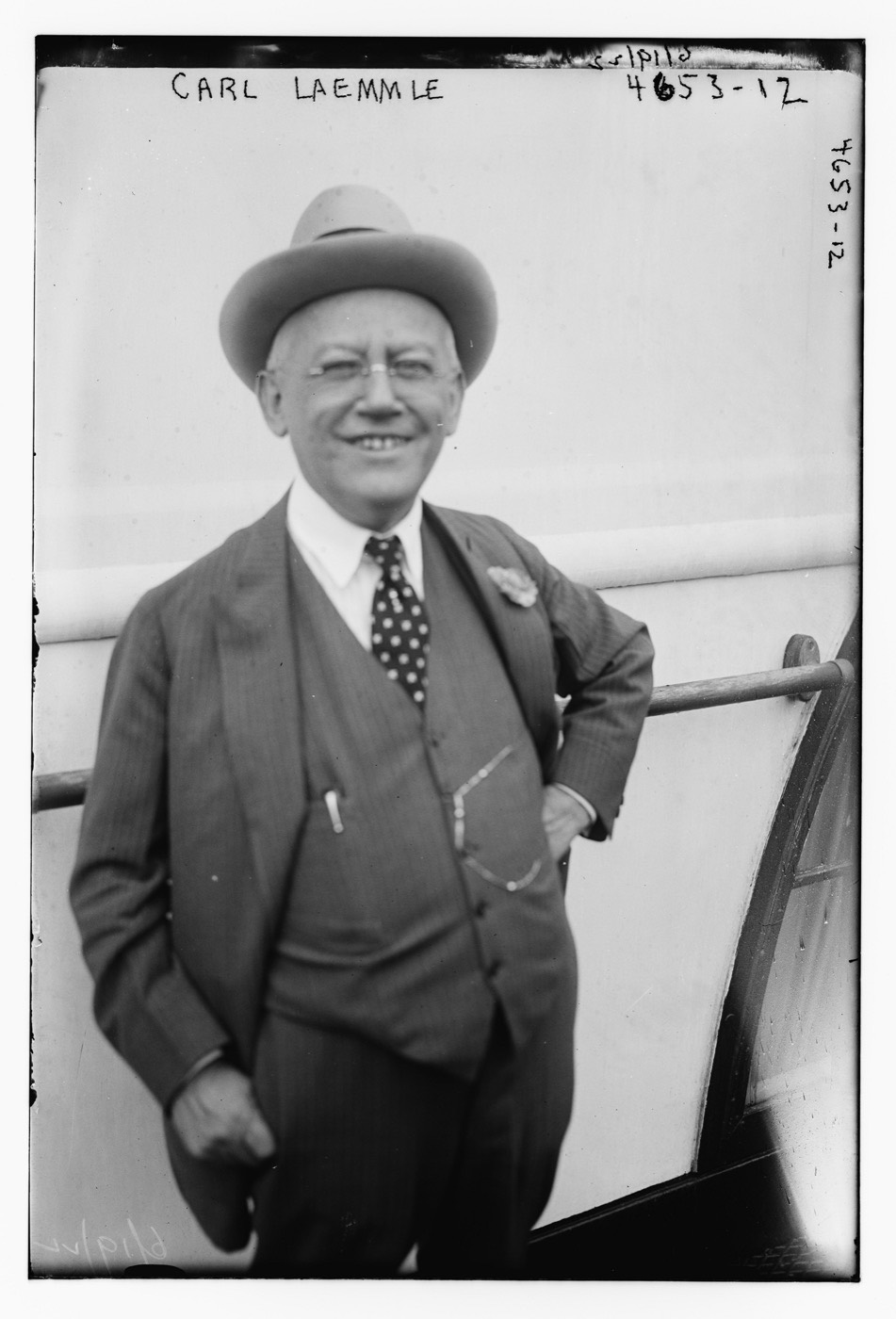
Laemmle lost control of Universal in 1936, when he was forced to sell it. He spent much of his retirement, as the Nazi government stripped Germany’s Jews of their rights and livelihoods, helping Jews leave Germany. Under American immigration law, a refugee needed a sworn affidavit of financial support from a sponsor in the United States. Laemmle signed affidavits for more than 300 German Jews, from his hometown of Laupheim and beyond it, and wrote to the State Department directly. His April 12, 1938, letter to Secretary of State Cordell Hull, asking that the American consulate in Stuttgart speed its work, survives in the National Archives. In it he wrote that he felt it “the solemn duty of every Jew in America who can afford it” to help. By 1938, according to the German Historical Institute’s account, the U.S. government would accept his affidavits only for his closest relatives. He died on September 24, 1939, three weeks after the Second World War began. The historian Udo Bayer’s study of the campaign, titled “Laemmle’s List,” credits the affidavits with saving hundreds of people. (U.S. National Archives, from State Department records; German Historical Institute, Immigrant Entrepreneurship; Udo Bayer, “Laemmle’s List,” Film History.)
2021–2024
How the industry remembered, and corrected itself.
The memory of the founders has its own documented history, and it is recent. When the Academy Museum of Motion Pictures, the film industry’s official museum, opened in Los Angeles in 2021, its galleries did not tell the history of the industry’s Jewish founders, an omission that drew public criticism. On May 19, 2024, it opened Hollywoodland: Jewish Founders and the Making of a Movie Capital, its first permanent exhibition, dedicated to that story. Weeks later, more than 300 film-industry professionals signed an open letter objecting to the exhibition’s wall text. They wrote that it described the founders with words such as “tyrant” and “predator” and blamed Jews alone for the industry’s past faults, which they called, “whether intentional or not, antisemitic.” The museum announced immediate changes to the text and an advisory group of experts. (Academy Museum, the exhibition; JTA, June 10, 2024, on the open letter and the museum’s revisions.)
Object Spotlight
A gate on former farmland.
The gate in the banner photograph is the entrance of Universal City, photographed in 1915, the year Carl Laemmle opened it. He built the studio on a former chicken farm of about 230 acres in the San Fernando Valley, north of Los Angeles. Thirty-one years separate the gate from his 1884 crossing from Bremerhaven.
The analytical question
Why these men, why this industry.
Historians, Neal Gabler among them, explain the founders’ concentration in film by circumstance. They were largely shut out of older industries, and the movies were new, disreputable, and risky enough that established money had not claimed them. Explanations based on a supposed inborn group talent for entertainment are not supported by the record, and they mirror the group stereotypes that antisemitic claims about the industry have long relied on. The young industry did have one barrier. The Motion Picture Patents Company, a trust built on Thomas Edison’s film patents, licensed only its members and sued unlicensed producers. Laemmle’s company was among the independents that defied it, and he faced hundreds of lawsuits. The U.S. government brought an antitrust suit against the trust in 1912, and in 1915 a federal court ruled against it. How much did exclusion decide where these men went, and how much did their own work decide what they built?
Key takeaways
- Universal, Paramount, Fox, MGM, Warner Bros., and Columbia were all founded or led by Jewish immigrants or children of immigrants from Central and Eastern Europe, within roughly a dozen years.
- Largely shut out of established industries, the founders entered the new and looked-down-on nickelodeon business and built the Hollywood studio system.
- Carl Laemmle, Universal’s founder, signed affidavits for more than 300 German Jews in his final years. Scholars credit the campaign with saving hundreds, and his 1938 letter to the Secretary of State survives in the U.S. National Archives.
- The Academy Museum opened in 2021 without the founders’ story, opened its first permanent exhibition, Hollywoodland, on them in 2024, and revised its text after public criticism.
- Historians explain the founders’ path by their exclusion from older industries and the openness of a new one. The record does not support explanations based on a group trait.
Discussion questions
Working from the evidence.
Each question is anchored in a fact this Chapter documents. Answer from the evidence on the page.
- None of the founders went to college, and the era’s established industries had little room for them. What does their concentration in a brand-new industry tell you about how discrimination shapes where talent goes?
- Warner Bros. bet the company on synchronized sound, and The Jazz Singer tells of a cantor’s son torn between his father’s synagogue and the stage. Its star, Al Jolson, was himself a cantor’s son. What does the film’s story share with the lives of the men who made it?
- Laemmle’s affidavit campaign is preserved in State Department files. What does it change historically when private generosity leaves a government paper trail?
- The Academy Museum first omitted the founders, then built a permanent exhibition about them, then revised that exhibition’s language under criticism. What does this sequence show about who tells an institution’s history and how corrections happen?
- The Chapter sets aside explanations based on a supposed group talent. Why is a flattering group explanation still a stereotype, and what explanation does the record support instead?
Classroom Connections
Where this Chapter fits.
Teaching Connections
- US History: immigration, exclusion from the professions, and the invention of a signature American industry.
- Media & Film Studies: the studio system’s origins, the nickelodeon era, and the coming of sound.
- Holocaust Studies: the Laemmle affidavit campaign as a documented American rescue effort within restrictive immigration law.
- Historical Thinking: the Academy Museum sequence as a live case study in public memory and its correction.
- Economics & Entrepreneurship: market entry where incumbency and credentials mattered least.
Standards Alignment
- NYS Social Studies Framework: NY US History 11.5 (Industrialization and Urbanization, 1870–1920, including 11.5b, immigration from southern and eastern Europe) and 11.7 (Prosperity and Depression, 1920–1939, including 11.7a, the cultural trends of the 1920s). Also NY Grade 8 United States History 8.2 (A Changing Society) and 8.4 (World War I and the Roaring Twenties).
- Common Core ELA-Literacy: RH.9–10.2 (central ideas from primary and secondary sources) and RH.11–12.6 (comparing points of view on the same history).
Further Teaching Resources
- Academy Museum, Hollywoodland, the industry’s own permanent exhibition on its founders.
- U.S. National Archives on Carl Laemmle, the rescue campaign from the government’s own files.
- Films & Video: the studio-era materials gathered in the full Films & Video collection.
Sources and citations
Primary sources
A primary source is a record from the time. It was made by people who were there. Examples: letters, diaries, photos, decrees, trial records, and newspapers.
- Laemmle, Carl. Letter to Secretary of State Cordell Hull, April 12, 1938, and related affidavit correspondence. U.S. National Archives, State Department records. archives.gov.
- Universal City entrance, 1915. Photograph, public domain.
- Academy Museum of Motion Pictures. Hollywoodland: Jewish Founders and the Making of a Movie Capital. Permanent exhibition, opened May 2024. academymuseum.org.
Secondary sources
A secondary source was written later. It is a book or article by a historian who studied those records and explains what they mean.
- Gabler, Neal. An Empire of Their Own: How the Jews Invented Hollywood. New York: Crown, 1988.
- Bayer, Udo. “Laemmle’s List: Carl Laemmle’s Affidavits for Jewish Refugees.” Film History.
- Jewish Telegraphic Agency. “LA’s Academy Museum to revise exhibit on Jewish founders after criticism from Jewish Hollywood figures.” June 10, 2024. jta.org.
- EBSCO Research Starters. “Louis B. Mayer.” ebsco.com.
- German Historical Institute. Immigrant Entrepreneurship entries on Carl Laemmle and Harry Cohn. immigrantentrepreneurship.org.
A finding note. Louis B. Mayer’s town of birth in the Russian Empire is uncertain in the records. The German Historical Institute’s entry counts affidavits for more than 300 German Jews, the National Archives’ own account says “hundreds,” and Bayer’s study credits the affidavits with saving hundreds.
Finding these documents: many primary sources are free online. Good places to start are the Fordham Internet Jewish History Sourcebook, Yale’s Avalon Project (law and diplomacy), German History in Documents, the collections of the US Holocaust Memorial Museum and Yad Vashem, the National Library of Israel, and Sefaria (for Jewish texts). Search the document’s name and date.
Jonas Salk (1914–1995): the child of a Russian-Jewish immigrant family who led the work on the first effective polio vaccine, refused to patent it, and asked a television interviewer, “Could you patent the sun?”
Comments?
Write to editor@teachjewishhistory.org.
Last updated: November 2026.